
Read the first chapter
The whole of chapter one, free. About 6 min. Turn the pages with the arrows, your keyboard, or a swipe.
Chapter 1
Life’s Speed: Stay in Motion
Overview
“Momentum is the quiet miracle-until it stops.” You’ve felt it, even if you couldn’t name it yet. One day you’re moving-mind moving, body moving, choices landing like footsteps-and the next day something catches. Not always dramatically. Sometimes it’s small. A delayed decision. A skipped workout. A scroll that turns into an hour. Then-click. The bike stops. And the wave stops with it.
That silence isn’t just “being tired.” It’s the world going still around your next move. Your thoughts get louder, your plans get blurrier, and life feels like it’s asking, Are we still riding, or are we done? This chapter reframes life as momentum-not frantic motion, not rushing for the sake of it, but consistent forward movement of mind, body, and choices.
This Chapter Is For You If... - You’ve noticed how quickly your energy collapses when you miss a day (or a week) and you want a way back. - You keep “starting over” instead of staying in motion. - You want practical momentum, not hype-something you can do with real minutes and real schedules. - You’re ready to treat your life like a wave-and-bike system: linked, moving, responsive.
The Core Truth
When the bike stops, the wave stops-and silence becomes the loudest signal in your life.
Momentum isn’t just speed. It’s connection. The wave rises while the bike keeps racing along the sea. But when the bike halts-when your mind stops deciding, your body stops showing up, your choices stop carrying you forward-the wave doesn’t magically keep going by itself. It settles. Foam fades. The screen goes dark for a second.
Here’s the concrete truth: momentum is easiest to keep when it’s small and consistent. The “stop” doesn’t always show up as a dramatic failure. It shows up as a pattern you don’t challenge-like letting your morning drift until noon, or skipping the one tiny reset that usually gets you back on track. Then one day you look up and realize you’ve been standing still inside a life that keeps moving.
Leila, 34, an ER nurse, knows this in her bones. During a busy shift, there’s no room for “thinking about thinking.” She checks in, moves to the next patient, updates her chart, grabs water, resets her gloves. Not because she’s fearless-because stopping costs time that someone else needs. On her toughest days, she doesn’t need a motivational speech. She needs motion. A simple thing: walk the hallway once between admissions. Straighten her badge. Refill her water. Two minutes of forward movement that tells her brain, We’re still riding.
That’s what this principle changes. The silence isn’t a mystery. It’s feedback. And you can respond.
In Practice, This Means... - You treat “stuck” as a signal, not a verdict-then you do one motion that breaks the silence. - You choose consistency over intensity (a 10-minute win beats a 2-hour burst that disappears). - You protect your momentum with small resets at predictable times, especially after interruptions. - You catch the early stop (the first missed step), not the late collapse.
Putting It Into Practice
Momentum doesn’t require a new personality. It requires a routine that can survive real days-days with calls, delays, and that one moment when you feel like you’ve hit the brakes.
Use your Momentum Checkpoint Model like a simple dashboard. Not complicated. Just honest.
1. Pick your “bike” (one daily motion you can’t skip). Choose one action that counts as you staying in motion-even if everything else is messy. Examples: 10-minute walk, 5-minute tidy of your workspace, writing 3 lines in your journal, stretching at your desk. Timing: morning or right after you come home-when you’re most likely to drift.
2. Set 3 checkpoints that match your day’s rhythm. - Morning checkpoint (5-10 minutes): Decide one next step. Not ten. One. - Midday checkpoint (2 minutes): Physical reset (water, stand up, quick stretch, quick breath cycle). - Evening checkpoint (5 minutes): Close the loop: what did you finish, and what’s the first action for tomorrow?
3. When you feel the stop, run the “Silence Scan” (30 seconds). Ask: Did my body stop moving, did my mind stop deciding, or did my choices stop connecting? Then choose the smallest correction for that category. If your body’s stuck, move your body. If your mind’s stuck, make one decision. If your choices are stuck, do one practical task.
4. Use a “momentum minimum,” not a mood-based goal. Pick a minimum you can do on your worst day. Example: “Even if I’m exhausted, I still do the bike motion for 10 minutes.” Timing rule: you do the minimum before you earn the motivation. Motivation shows up more often when you’ve already moved.
5. Track the checkpoint, not your whole life. You don’t need to log every win. You just need to notice whether the bike kept rolling. One quick mark in your notes app is enough: “Morning checkpoint done,” “Midday reset done,” “Evening loop closed.”
No dramatic reinvention. Just a system that prevents the wave from dying in silence.
Real-Life Example
Leila’s wave almost went silent on a Tuesday.
Before: Her ER shift was relentless-beds changing, admissions piling up, her brain buzzing like a fluorescent light. Between patients, she told herself she’d “catch up later.” Later became later and later became bedtime. She sat down, her phone lit up, and she didn’t stand back up. No walk. No stretch. No chart review. Just a slow drift until her mind felt like it was stuck in glue. The next morning, getting out of bed felt heavier than it should.
Action: On the way to work, she did something tiny and specific-she committed to her momentum minimum. Ten minutes after her first break, she walked the hallway once and refilled her water. Then she wrote one line on her phone: Next patient step: check allergies and update plan. That was it. One decision. One motion.
Result: By the afternoon, the silence didn’t have time to take over. She still had a hard shift-ER days don’t magically turn soft-but her mind stayed connected. When her thoughts tried to spiral, her body was already moving. When her plan felt messy, she had one next step written down. The wave didn’t have to “fix” itself; the bike kept it alive.
That’s the point. You don’t wait for a perfect day to start moving. You start moving so the day has something to hold onto.
Time to Reflect
When you slow down enough to look at your own momentum, you stop guessing. You start seeing patterns.
1. Where does your bike usually stop? Think about the last time things went quiet inside your life. Was it mornings, after work, when you were tired, or after a disappointment? Naming the moment makes it fixable.
2. What kind of silence shows up for you-body, mind, or choices? If you’re not sure, notice what’s missing: movement, decision-making, or follow-through. Honest reflection often reveals it’s one missing piece, not “everything.”
3. What is your earliest warning sign that the wave is settling? Maybe it’s “I’ll do it later,” or “I’ll start tomorrow,” or the moment you stop answering your own plans. Early signs are gifts. They arrive before the full stop.
4. What’s the smallest motion that would restart you within 10 minutes? Keep it real. If it takes longer than you can manage on a bad day, it’s not a momentum minimum-it’s a fantasy.
5. If you could protect your momentum with one checkpoint today, which would you choose? Morning, midday, or evening-pick one. You’re not building a perfect life. You’re keeping the bike rolling.
Answer these like you’d talk to a trusted coworker: plain, specific, and kind enough to be true.
Next Step
Complete your Momentum Checkpoint Model today by doing one bike motion for 10 minutes, then writing one “next step” line for tomorrow in your phone notes.
Time needed: 15-20 minutes total. You will know it worked when... you feel the silence loosen-your mind has one clear next action, and your body has done at least one forward-moving step that proves you’re still riding.
Do that, and you won’t just survive the day-you’ll build the kind of momentum that makes the next chapter feel possible.
End of chapter one. 4 more chapters in the full book.
Swipe or use the arrows to turn the page
What's inside: 5 chapters
- 1. Life’s Speed: Stay in Motion
- 2. Unstoppable Waves: Accept What You Can’t Control
- 3. Dream Speed: Turn Vision Into Daily Fuel
- 4. When Silence Hits: Reignite Your Spark
- 5. Run Again: Build a Life That Keeps Moving
About this book
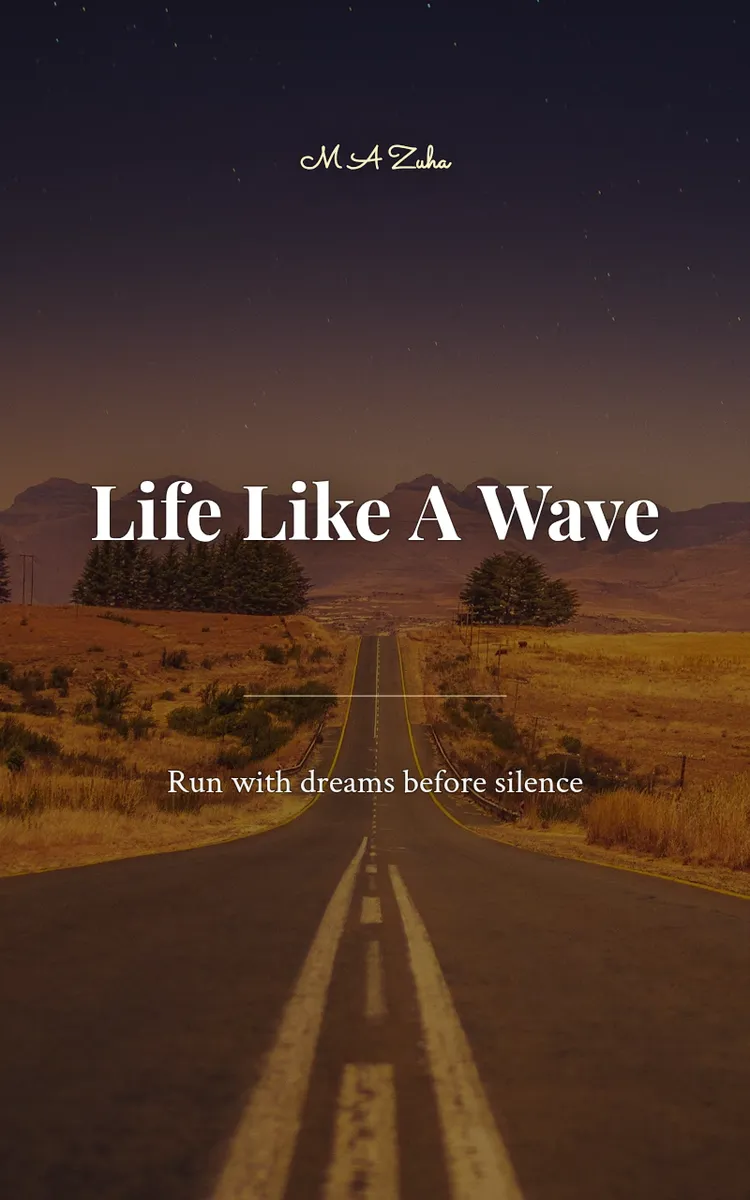
"Life Like A Wave" is a inspirational book by M A Zuha with 5 chapters and approximately 7,208 words. Motivational reflection using a wave-and-bike metaphor.
This book was created using Inkfluence AI, an AI-powered book generation platform that helps authors write, design, and publish complete books. It was made with the AI Inspirational Book Writer.
Frequently Asked Questions
What is "Life Like A Wave" about?
Motivational reflection using a wave-and-bike metaphor
How many chapters are in "Life Like A Wave"?
The book contains 5 chapters and approximately 7,208 words. Topics covered include Life’s Speed: Stay in Motion, Unstoppable Waves: Accept What You Can’t Control, Dream Speed: Turn Vision Into Daily Fuel, When Silence Hits: Reignite Your Spark, and more.
Who wrote "Life Like A Wave"?
This book was written by M A Zuha and created using Inkfluence AI, an AI book generation platform that helps authors write, design, and publish books.
How can I create a similar inspirational book?
You can create your own inspirational book using Inkfluence AI. Describe your idea, choose your style, and the AI writes the full book for you. It's free to start.
Write your own inspirational book with AI
Describe your idea and Inkfluence writes the whole thing. Free to start.
Start writingCreated with Inkfluence AI


