
Read the first chapter
The whole of chapter one, free. About 3 min. Turn the pages with the arrows, your keyboard, or a swipe.
Chapter 1
Choosing Your Entrepreneur Identity
The Question Behind Your Workday
What happens when your calendar says “employee,” but your goals require you to think like an owner?
You finish another shift, close the laptop, and tell yourself you’ll work on the business later. Then “later” becomes dinner, messages, fatigue, and another morning commute. The problem may not be discipline. Your daily cues still reinforce the 9-5 identity: wait for permission, complete assigned tasks, avoid visible mistakes, and measure success by approval.
An entrepreneur identity operates differently. It notices problems, makes decisions, tests ideas, and creates value before certainty arrives.
Which identity is your routine rehearsing every day?
From Employee Identity to Entrepreneur Identity
Old Belief: I’ll become an entrepreneur after I leave my job. New Reality: I become an entrepreneur by repeatedly practicing entrepreneurial behavior before I leave.
Identity follows evidence. Each time you make a market decision, publish an offer, speak with a potential customer, or review results, you give your brain proof that this is something you do - not merely something you hope to do.
Consider a simple shift. Instead of saying, “I’m researching a business idea,” use, “I’m validating a customer problem.” The first phrase can support endless browsing. The second points toward a behavior: identify a customer, ask a focused question, and record the response.
This matters because self-talk directs attention. If your internal script says, “I need permission,” you’ll wait. If it says, “My job is to test the next assumption,” action becomes more natural.
The Identity Switchboard in Daily Use
The Identity Switchboard has three controls:
| Control | 9-5 cue | Entrepreneur cue | |---|---|---| | Language | “I’m waiting for approval.” | “I’m making the next responsible decision.” | | Environment | Work ends when the shift ends. | A defined business block begins after work. | | Evidence | Hours completed. | Customer conversations, tests, and shipped work. |
Your goal isn’t to pretend your job doesn’t exist. It’s to install small, repeatable signals that activate the identity you’re building.
Signs the old pattern is running your life:
1. You collect information but avoid customer contact. 2. You wait for a perfect plan before publishing anything. 3. You describe your business as “something I might do.” 4. You judge progress by effort instead of evidence.
Identity changes when your language, environment, and repeated actions point in the same direction.
Questions That Expose the Current Script
1. What phrase do you use when explaining your business to someone else? Replace “I’m thinking about starting” with a factual statement about current behavior, such as “I’m testing an offer for local service businesses.”
2. Which part of your day still trains you to wait for permission? Identify one decision you can own this week, such as choosing a price, contacting a prospect, or publishing a landing page.
3. What evidence would prove you’re acting like an entrepreneur? Choose observable evidence: three customer conversations, one paid test, or a public offer.
4. Which cue can trigger business action without relying on motivation? Attach a task to an existing event, such as opening your laptop after dinner and immediately reviewing your customer notes.
Seven-Day Identity Switchboard Challenge
Install one entrepreneur cue for seven days
• Choose one daily 30-minute business block. - Write this self-talk prompt at the top of your notes: What assumption am I testing today? - Complete one evidence-producing action. - Record the action, result, and next decision. - End each session by stating: “I’m building this through repeated decisions.”
Difficulty: Medium
You’ll know it’s working when...
• You start the block with less negotiation. - Your notes contain evidence, not just ideas. - You describe yourself through current actions. - The next business decision feels more obvious.
The Identity You Rehearse Becomes the Business You Build
You don’t wait to feel like an entrepreneur; you create that identity through daily evidence.
• Self-talk directs attention toward waiting or testing. - Daily cues make entrepreneurial behavior easier to repeat. - The Identity Switchboard aligns language, environment, and evidence. - Progress becomes visible through decisions, conversations, and shipped work.
The next chapter turns this identity into a practical transition plan, so your new way of thinking can guide how you use time, money, and energy while still employed.
End of chapter one. 4 more chapters in the full book.
Swipe or use the arrows to turn the page
What's inside: 5 chapters
- 1. Choosing Your Entrepreneur Identity
- 2. Defeating Scarcity Beliefs About Money
- 3. Building Boundaries Without Guilt
- 4. Communicating Your Value to Get Customers
- 5. Quitting With Resilience and Purpose
About this book
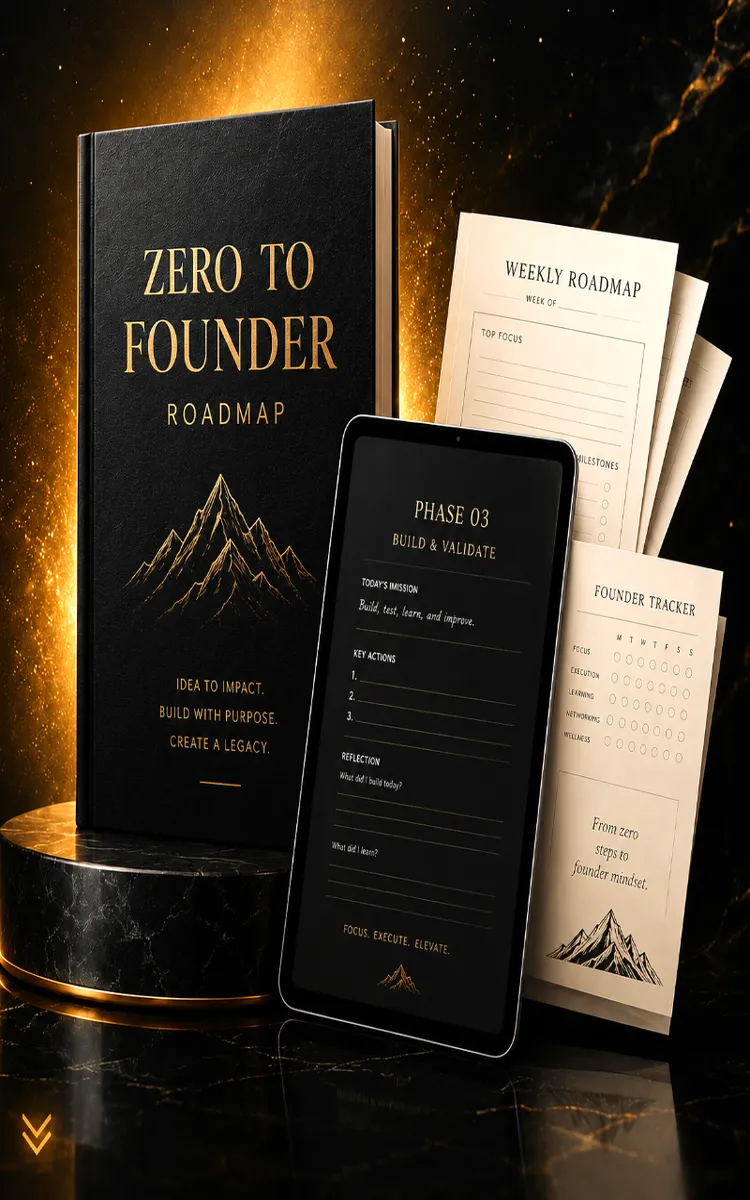
"Zero to Founder" is a self-help book by Zero to Founder with 5 chapters and approximately 3,586 words. Leaving a 9-5 job and starting entrepreneurship.
This book was created using Inkfluence AI, an AI-powered book generation platform that helps authors write, design, and publish complete books. It was made with the AI Self-Help Book Writer.
Frequently Asked Questions
What is "Zero to Founder" about?
Leaving a 9-5 job and starting entrepreneurship
How many chapters are in "Zero to Founder"?
The book contains 5 chapters and approximately 3,586 words. Topics covered include Choosing Your Entrepreneur Identity, Defeating Scarcity Beliefs About Money, Building Boundaries Without Guilt, Communicating Your Value to Get Customers, and more.
Who wrote "Zero to Founder"?
This book was written by Zero to Founder and created using Inkfluence AI, an AI book generation platform that helps authors write, design, and publish books.
How can I create a similar self-help book?
You can create your own self-help book using Inkfluence AI. Describe your idea, choose your style, and the AI writes the full book for you. It's free to start.
Write your own self-help book with AI
Describe your idea and Inkfluence writes the whole thing. Free to start.
Start writingCreated with Inkfluence AI


