

Read the first chapter
The whole of chapter one, free. About 8 min. Turn the pages with the arrows, your keyboard, or a swipe.
Chapter 1
Rabbit Body Language Basics
You can’t “talk” with a rabbit the way you talk with a dog, and that’s exactly why body language matters. The fastest way to stop guessing is to read four core signal groups - ear positions, body posture, breathing, and grooming - then match what you see to what your rabbit likely feels.
Talia, 22, first-time rabbit owner, learned this the hard way: she walked into the room, saw her rabbit sit very still, and assumed, “He’s bored.” Two minutes later, he started chewing fast, thumping once, and backing away from her feet. After she slowed down and checked his ears, posture, and breathing, the picture changed fast. What looked like “bored” turned into “I’m not settled and I want space.”
Once you can read these basics, you gain something practical: you can spot stress early, reduce accidental scares, and respond in the right direction - more quiet, more comfort, or a quick check for pain. You’ll also learn a simple way to confirm your interpretation using grooming and breathing, not just one moment of behavior.
Rabbit Signal Decoder: Ear Positions, Posture, Breathing, and Grooming
Rabbits send most of their “messages” with their bodies. They don’t use facial expressions the way humans do. Instead, their ears move like a live signal board, their posture tells you how safe they feel, and breathing shows whether their body is calm or braced. Grooming matters too because rabbits groom when they feel secure - but they also groom when they’re uncomfortable or trying to cope.
Here’s the problem this chapter solves: beginners often look for one “warning sign” (like teeth grinding or thumping) and miss the earlier signals that come first. A rabbit can look calm enough to ignore, then shift posture, then change breathing, and only later escalate. If you learn the basics now, you’ll catch the shift sooner and respond before it turns into a full stress moment.
You’ll also be able to do something useful during real care tasks. When you offer hay, clean the litter, or pick your rabbit up for a quick check, you’ll watch for the same four signal groups and decide: “Proceed gently” or “pause and reset.”
How It Works: The Rabbit Signal Decoder (what each core signal tells you)
Use this rule: you interpret signals together. One ear position alone can mean different things, but patterns become clearer when you check all four groups.
• Read ear positions first (direction + height).
Rabbits can point ears forward, hold them upright, rotate them outward, or flatten them back. Ear movement often happens faster than posture, so start here.
• Ears upright and facing forward often mean alert attention - your rabbit is listening and checking.
• Ears angled outward or to the side often mean relaxed awareness.
• Ears laid back can mean fear or discomfort, especially if posture also tightens and breathing gets faster.
• Check body posture (loose vs tight, stretched vs tucked).
Posture tells you how much “muscle readiness” your rabbit has.
• A relaxed, loaf-like sit (body resting, not braced) usually means your rabbit feels safe enough to settle.
• A low, stretched body with front legs extended can mean comfort, but if the rabbit also freezes stiffly, it can mean “I’m waiting for something scary.”
• A backed-up, hunched, or tucked posture often means your rabbit wants distance.
• Watch breathing (calm rhythm vs active bracing).
Breathing is one of the clearest “right now” signals. Calm breathing feels steady and unhurried. Stress breathing often looks faster or more “held.”
• If you see fast breathing plus stillness, treat it as alert stress and slow your actions immediately.
• If you see slow, steady breathing while the rabbit relaxes, treat it as settled.
• Use grooming as a confirmation signal (what kind of grooming, and how the body looks).
Grooming can confirm comfort, but it can also show coping.
• Regular grooming with a relaxed posture (like grooming fur while resting) usually means your rabbit feels secure.
• Repeated grooming that looks frantic, or grooming that happens while the rabbit also looks tense (ears back, body tight), can signal discomfort or stress.
Ask yourself a quick comprehension check: “If I only watched ears, would I miss anything?” Then answer honestly - because you will. That’s why the Rabbit Signal Decoder uses all four groups in one glance.
Putting It Into Practice: How to read signals during normal care
You don’t need special tools for this. You need a routine eye habit. When you watch, keep your movement slow enough that your rabbit doesn’t change signals just because you showed up.
Try this during a calm moment before you touch anything:
• Stand/sit at the room’s edge for 10 seconds.
Keep your hands down. Let your rabbit “show” you how he already feels.
Expected outcome: You’ll see a baseline ear position and a breathing rhythm.
• Look at ears for 2 seconds, then posture for 2 seconds, then breathing for 2 seconds.
Don’t mix them up - make yourself check in order.
Expected outcome: You’ll notice whether your rabbit looks alert-but-calm or alert-and-braced.
• Check grooming only after the first three signals.
Wait to see if grooming starts naturally during the calm window.
Expected outcome: Relaxed grooming confirms your “safe” read. Tense grooming while the body tightens warns you to slow down.
• Match your action to the signal pattern.
• If ears are upright but breathing stays slow and posture stays loose, you can continue gentle care.
• If ears go back and breathing speeds up, pause and reduce stimulation (lower your voice, step away, give space).
Expected outcome: Your rabbit settles faster because you stop adding pressure.
Quick checklist (use this before you touch, clean, or pick up)
• Ears: upright/forward, relaxed angled, or laid back?
• Posture: loaf/loose vs tight/hunched vs backing away?
• Breathing: slow and steady vs fast/held?
• Grooming: relaxed and normal vs frantic while tense?
• Action: proceed gently or pause and reset space?
Practical takeaway: When you read all four groups, you stop relying on one “scary” sign and you start responding early.
Rabbit Signal Decoder Scenario: What to do when your rabbit looks “off”
Here’s a realistic moment: you open the pen to refresh water and hay. Your rabbit greets you with a still body and ears that don’t look relaxed. You want to act correctly, not guess.
Use this exact sequence with Talia’s kind of situation in mind - where “bored” turned into “not safe.”
• Pause at the doorway and count 5 breaths.
Watch your rabbit’s breathing during those five breaths.
Expected outcome: You’ll tell whether the moment is calm alert or active stress.
• Check ear position right after you pause.
Look for direction and height.
• If ears stay upright but posture stays loose, your rabbit may just be interested.
• If ears rotate back while the body tightens, treat it as fear/discomfort.
• Check posture: does the body look loose or braced?
Look at how the rabbit holds the body - does it loaf comfortably, or does it freeze tight?
Expected outcome: Braced posture usually means you should reduce your approach.
• Decide: proceed or reset (one choice, no halfway).
• If ears look relaxed/angled and breathing stays steady: calmly refresh hay and water without sudden movements.
• If ears go back and breathing speeds up: step back, close the pen door halfway (if possible), and give 1-3 minutes of space.
• Confirm with grooming after you reset.
After space helps, watch whether grooming resumes in a relaxed way.
Expected outcome: If grooming returns and posture softens, your earlier read was likely correct.
• Try one small care step, then stop.
Don’t do the whole cleanup in one go if your rabbit seems unsure.
Expected outcome: Your rabbit learns that you don’t overwhelm him, and you get clearer signals during smaller interactions.
Quick checklist for this scenario:
• Pause and count 5 breaths
• Read ear position
• Read posture (loose vs braced)
• Choose proceed or reset space
• Confirm with relaxed grooming
• Do one small step, then stop
Practical takeaway: The “right” response to body language is not just interpreting - it’s changing your behavior to match what you read.
Common Mistakes and Edge Cases When Reading Signals
Even with the basics, beginners run into predictable problems. Fixing these will make your readings more accurate fast.
Mistake 1: Treating “upright ears” as always calm
Upright ears often mean alert attention, not automatic comfort. A rabbit can hold ears up while still feeling uneasy - especially if posture tightens or breathing speeds up.
Do this: Check posture and breathing immediately after you see upright ears. If breathing stays steady and the body looks loose, proceed gently. If breathing speeds up or the rabbit freezes tight, slow down or give space.
Not this: Assume “ears up = friendly” and keep reaching in during tense moments.
Mistake 2: Missing slow stress because the rabbit stays still
Many rabbits don’t thrash when they feel bad. They freeze. Stillness can look “good” even when the rabbit is braced.
Do this: Watch breathing and look for tension in the body. If you see faster breathing or a stiff, un-rolling posture, treat it as stress even if the rabbit doesn’t thump.
Not this: Wait for obvious signs like thumping before you change your approach.
Mistake 3: Over-interpreting grooming without checking tension
Grooming can mean comfort, but it can also look like coping when the rabbit feels uneasy. Grooming alone can trick you.
Do this: Pair grooming with ears and posture. Relaxed grooming usually happens with a soft body. Tense or repetitive grooming with ears back or a braced posture often means discomfort or stress.
Not this: Decide “he’s fine” just because you see grooming happening.
Practical takeaway: You improve your accuracy by pairing signals, not by hunting for one “perfect” sign.
As you build this habit, your rabbit’s body starts to feel like a clear language instead of a mystery. In the next parts of your rabbit care journey, you’ll use these same signals to choose safer handling and to notice when something in your rabbit’s body might need attention - before it becomes a bigger problem.
End of chapter one. 7 more chapters and about 15,959 words in the full book.
Swipe or use the arrows to turn the page


What's inside: 8 chapters
- 1. Rabbit Body Language Basics
- 2. Stress vs. Fear: What to Spot
- 3. Healthy Diet: Hay, Pellets, Water
- 4. Litter Training and Clean Habits
- 5. Safe Housing: Size, Flooring, Setup
- 6. Handling and Bonding Without Fear
- 7. Enrichment That Prevents Boredom
- 8. Health Monitoring and Emergency Red Flags
About this book
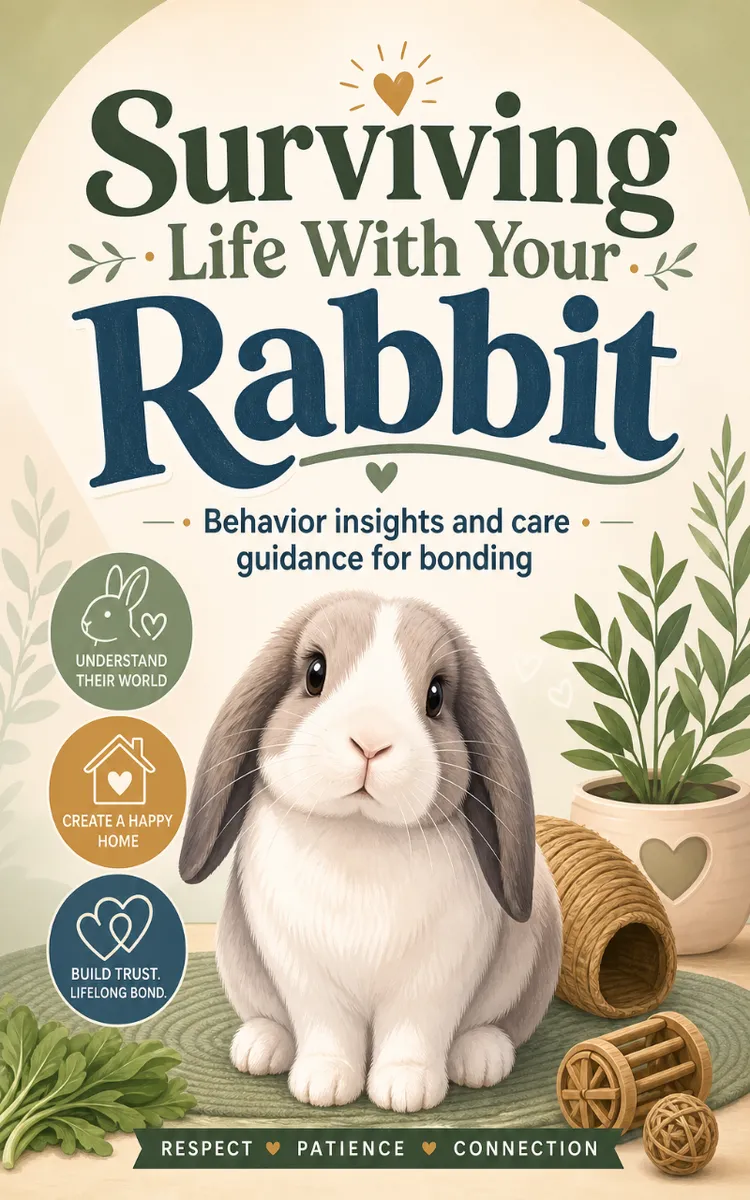
"Surviving Life With Your Rabbit" is a how-to guide book by Violet Powers with 8 chapters and approximately 15,959 words. Rabbit behavior reading, care best practices, and bonding.
This book was created using Inkfluence AI, an AI-powered book generation platform that helps authors write, design, and publish complete books. It was made with the AI Ebook Generator.
Frequently Asked Questions
What is "Surviving Life With Your Rabbit" about?
Rabbit behavior reading, care best practices, and bonding
How many chapters are in "Surviving Life With Your Rabbit"?
The book contains 8 chapters and approximately 15,959 words. Topics covered include Rabbit Body Language Basics, Stress vs. Fear: What to Spot, Healthy Diet: Hay, Pellets, Water, Litter Training and Clean Habits, and more.
Who wrote "Surviving Life With Your Rabbit"?
This book was written by Violet Powers and created using Inkfluence AI, an AI book generation platform that helps authors write, design, and publish books.
How can I create a similar how-to guide book?
You can create your own how-to guide book using Inkfluence AI. Describe your idea, choose your style, and the AI writes the full book for you. It's free to start.
Write your own how-to guide book with AI
Describe your idea and Inkfluence writes the whole thing. Free to start.
Start writingCreated with Inkfluence AI


