

Read the first chapter
The whole of chapter one, free. About 9 min. Turn the pages with the arrows, your keyboard, or a swipe.
Chapter 1
Guinea Pig Body Language Basics
A guinea pig can look “fine” right up until you notice the little things that tell you how they feel. The first time you see a pig sit very still with half-lidded eyes and fast, shallow breathing, it’s easy to think they’re just resting. Then you check again an hour later and realize you missed the early warning. Guinea pig body language gives you those early clues - ears, posture, teeth, and breathing - so you can spot comfort, stress, and illness before things slide downhill.
Talia, 31, a first-time guinea pig owner, told herself she would “watch for eating.” She did, but she focused on food so long that she didn’t notice the pattern in her pig’s breathing during cuddle time. Once she learned what those breathing changes meant, she started catching problems earlier and taking quicker action - like adjusting handling and calling her vet sooner when needed. That’s what this chapter helps you do: read your guinea pig’s signals the way you’d read a smoke alarm - fast, specific, and practical.
After this chapter, you’ll know exactly what to look for, how to check it without stressing your pig, and what each signal usually means. You’ll also get a simple way to compare “today” to “normal for your guinea pig,” so you stop guessing and start acting.
The BAP Signal Map: Ears, Posture, Teeth, and Breathing (What They Mean)
Your guinea pig’s body language often shows up in four main places: B ody position (posture), A ngle and movement of P arts (especially ears), T eeth, and B reathing. This is the backbone of the BAP Signal Map: a quick mental checklist you can run every time you check on your pig.
Use this map to answer four questions, each time you look:
• Are they comfortable or tense right now?
• Do they look normal for them, or do they look “off” today?
• Do any signals point to pain, stress, or breathing trouble?
• Do I need to change something now (handling, environment, partner access) or call for help?
Here’s the key idea: you don’t interpret one signal alone. Your guinea pig can freeze when you approach, and that can look like “something’s wrong” even when it isn’t. When you read the whole map - ears, posture, teeth, breathing together - you get a clearer picture.
Below are the four parts of the BAP Signal Map and what you’re looking for. After each item, you’ll see a concrete example of how it changes your next move.
• Ears: check position and responsiveness
• Look at whether the ears stand upright, lay back, flatten, or twitch with alertness. Ears that stay pinned back can signal stress or fear, while ears that stay relaxed and responsive usually fit comfort.
• Example: If your guinea pig keeps ears upright but lets you approach and sniff them, that often means “I’m alert, not worried.” If ears flatten and the body tightens when you reach in, treat it as stress and slow down.
• Posture: watch how they hold their body
• Notice whether they stretch out comfortably, crouch low, hunch, freeze in place, or press close to the ground. Relaxed postures usually look loose and easy; pain or illness often shows up as a tighter, guarded stance.
• Example: A relaxed pig may sprawl with a loose belly. A pig that crouches tightly with a curved back and stays that way needs closer attention, not just “some quiet time.”
• Teeth: listen with your eyes
• Watch for grinding or chattering, and check whether you see open-mouth chewing or repeated jaw movement that doesn’t match normal eating. Teeth signals can also overlap with stress.
• Example: Light chewing during eating is normal. Teeth clicking or chattering without food, paired with tense posture, is a strong “check more carefully” cue.
• Breathing: treat changes as time-sensitive
• Watch the side of the body and the chest/abdomen. You’re looking for normal rhythm versus fast breathing, heavy effort, or repeated pauses. Breathing trouble often shows up before you see obvious behavior changes.
• Example: If your pig usually breathes calmly and then you see faster breathing while they stay still and tense, that’s a “slow down and reassess right away” moment.
Take a second and ask yourself a quick comprehension check: When you look at your guinea pig, do you currently check breathing first, or do you only check after you notice eating has changed? Your goal is to shift toward the BAP Signal Map so you spot problems earlier.
Practical takeaway
Use the BAP Signal Map as a consistent routine: ears + posture + teeth + breathing, all together, every time you do a quick check. That combination beats guessing from one sign.
Putting the BAP Signal Map Into Practice (Fast Checks Without Causing Stress)
You’ll get the best reading when you check in a way that doesn’t trigger fear. Your guinea pig “body language” can change because you entered the room, lifted a hand, or startled them. So you need a simple routine that gives you useful information without turning every check into a stressful event.
Use this approach during normal daily care - when your guinea pig expects you - so “today” comparisons mean something.
• Start with a calm baseline from 1 meter (about 3 feet)
• Stand where your guinea pig can see you. Don’t reach in immediately. Give them a minute to settle so you can see their natural posture and ear position.
• Expected outcome: You’ll get a clearer “normal” picture before handling or interruption.
• Do one “BAP scan” in under 30 seconds
• Scan in this order: ears → posture → teeth → breathing. Don’t wait for a perfect moment; look for consistent patterns.
• Expected outcome: You catch stable comfort or stable stress quickly.
• Check breathing by watching the body movement, not by putting your face close
• Look at the side of the chest/abdomen. If you can see a clear rise-and-fall pattern that matches calm activity, note it as normal for your pig.
• Expected outcome: You reduce the chance of irritating your pig while still catching breathing changes.
• Only then do the “hands-on” part, if you need it
• If you’re doing a gentle touch check (like feeling for obvious discomfort), keep it brief. Stop if the posture tightens or ears flatten.
• Expected outcome: You gather extra info without turning the check into a panic event.
A small but important rule: if you see a breathing change, you don’t “wait and see for a couple days.” You reassess quickly and act. Many guinea pig owners miss this because they assume their pig will “tell them” more clearly later. Breathing often tells you first.
Quick checklist
• Stand still for about 60 seconds and watch ears and posture.
• Scan ears → posture → teeth → breathing in one short pass.
• Watch breathing by looking at body movement (not your ear or your face).
• If breathing looks off, reassess right away and don’t delay action.
• Stop any handling that causes ears to flatten or the body to tense.
Practical takeaway
Do short, repeatable checks at the same time of day. You’ll learn your guinea pig’s “normal” faster and you’ll catch changes sooner.
A Real-World Scenario: Reading Signals During Cuddle Time (Talia’s Setup)
Talia’s cage sits in a busy room where people walk past. She noticed that her guinea pig seemed “fine” when she sat down, but she wasn’t sure what “fine” looked like. She started using the BAP Signal Map during her usual cuddle time so she could compare calm moments to stressful ones.
Follow her method with your own guinea pig during a familiar routine like floor time or lap time.
Step-by-step: run a BAP scan during cuddle time
• Pick a consistent moment
• Choose a time your guinea pig already expects you, like right after you refresh hay or after you do the morning check.
• Expected outcome: Your pig settles faster, so you read their signals instead of your interruption.
• Let your guinea pig start calm
• Sit quietly and keep your hands low. Watch for ears position and posture for about one minute.
• Expected outcome: You see relaxed ears and a loose body if they feel safe.
• Scan the four signals
• Ears: Are they upright and responsive, or flattened/pinned?
• Posture: Do they sprawl or do they crouch/hunch?
• Teeth: Do you see normal chewing only with food, or do you see teeth movement without eating?
• Breathing: Does the body rise-and-fall look calm and steady?
• Expected outcome: You can label the moment as “comfortable baseline” or “stress/pain suspected.”
• Apply one adjustment based on what you see
• If ears flatten and posture tightens when you move closer, slow your approach and reduce handling time.
• If teeth chatter appears along with tense posture, stop touching and let them settle before you try again.
• If breathing looks fast or “effortful,” don’t debate it. Recheck immediately, monitor for more signs (hunched posture, reduced movement), and contact your vet for guidance.
• Expected outcome: Your guinea pig either relaxes after you change the handling, or you catch a potentially medical issue early.
• Record the outcome in plain words
• Write down what you saw: “ears upright, posture loose, normal chewing, calm breathing” or “ears pinned, hunched, teeth chattering, fast breathing.”
• Expected outcome: You build a personal “normal” reference for your pig.
Quick checklist for this scenario
• Quiet minute first: check ears + posture before you touch.
• Run the BAP scan (ears, posture, teeth, breathing).
• Make one change that matches the signal you saw.
• If breathing looks wrong, reassess right away and contact your vet.
• Write a one-line note so you learn your pig’s patterns.
Practical takeaway
Turn cuddle time into a short reading session. You’ll learn what “relaxed” and “not okay” look like for your specific guinea pig, not just what you read online.
Common Mistakes and Edge Cases When Reading Body Language
Even experienced owners get tripped up here. Body language can shift quickly, and some signals overlap. The fixes below help you avoid common misreads.
Mistake: You trust one signal and ignore the rest
Example: You see a pig sitting still and assume “they’re resting,” even though their ears flatten and breathing looks faster than normal.
Fix: Always run the full BAP Signal Map. If breathing changes, treat it as urgent even if they still look “quiet.”
Tight handling turns “stress signals” into “illness signals”
Do this: Stop touching and reassess after you give them space. If their ears lift back up and posture loosens within a short settling period, you likely caused stress rather than uncovering illness.
Not this: Keep handling longer just to “see if it passes.” Extra handling can keep their stress response switched on and make breathing look worse.
Mistake: You wait for obvious eating changes before you act
Do this: Check breathing early during your routine scans. Pair breathing with posture and teeth - fast breathing plus hunching or teeth movement without eating deserves faster attention.
Not this: “They ate yesterday, so they must be okay today.” Guinea pigs can change before appetite drops, and breathing trouble can start quietly.
Practical takeaway
Use the BAP Signal Map to reduce guesswork, but also respect context: handling and environment can change signals fast. Your job is to read patterns, not single moments.
Closing: What “Good Reading” Looks Like in Your Daily Routine
Once you start using the BAP Signal Map, your checks get simpler. You stop waiting for the “big symptom” and you start noticing the smaller shifts - ears that flatten, posture that tightens, teeth that move in an odd way, breathing that changes rhythm. That’s how you protect your guinea pig in the real world, where problems don’t always announce themselves loudly.
Keep your routine short and repeatable, and let “normal for your pig” guide you. Next, you’ll build on these signals to understand what comfort and stress look like across everyday situations - so you can prevent problems, not just react to them.
End of chapter one. 7 more chapters and about 15,401 words in the full book.
Swipe or use the arrows to turn the page


What's inside: 8 chapters
- 1. Guinea Pig Body Language Basics
- 2. Choosing a Safe Habitat Setup
- 3. Hay, Pellets, and Water Ratios
- 4. Fresh Veg Scheduling Without Mistakes
- 5. Spot-Cleaning and Weekly Deep-Clean
- 6. Recognizing Pain and Emergency Signs
- 7. Bonding and Handling for Trust
- 8. Enrichment and Social Pairing Plans
About this book
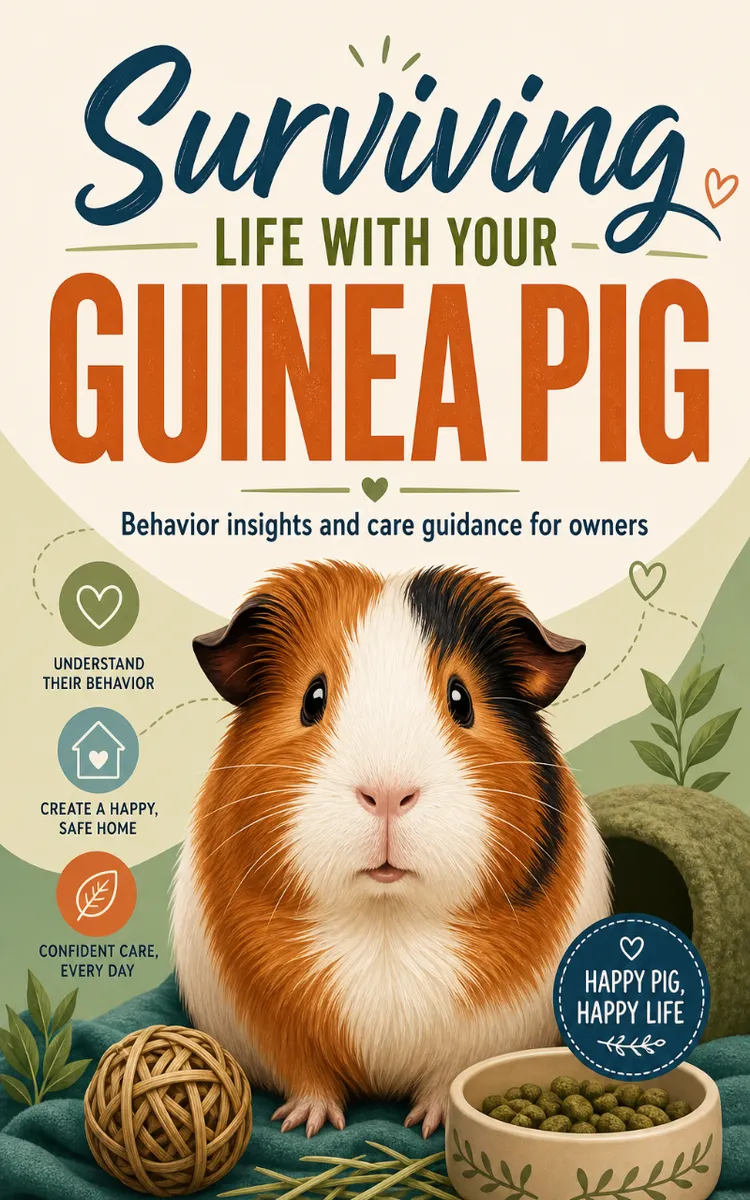
"Surviving Life With Your Guinea Pig" is a how-to guide book by Violet Powers with 8 chapters and approximately 15,401 words. Guinea pig behavior reading and best care practices.
This book was created using Inkfluence AI, an AI-powered book generation platform that helps authors write, design, and publish complete books. It was made with the AI Ebook Generator.
Frequently Asked Questions
What is "Surviving Life With Your Guinea Pig" about?
Guinea pig behavior reading and best care practices
How many chapters are in "Surviving Life With Your Guinea Pig"?
The book contains 8 chapters and approximately 15,401 words. Topics covered include Guinea Pig Body Language Basics, Choosing a Safe Habitat Setup, Hay, Pellets, and Water Ratios, Fresh Veg Scheduling Without Mistakes, and more.
Who wrote "Surviving Life With Your Guinea Pig"?
This book was written by Violet Powers and created using Inkfluence AI, an AI book generation platform that helps authors write, design, and publish books.
How can I create a similar how-to guide book?
You can create your own how-to guide book using Inkfluence AI. Describe your idea, choose your style, and the AI writes the full book for you. It's free to start.
Write your own how-to guide book with AI
Describe your idea and Inkfluence writes the whole thing. Free to start.
Start writingCreated with Inkfluence AI


