
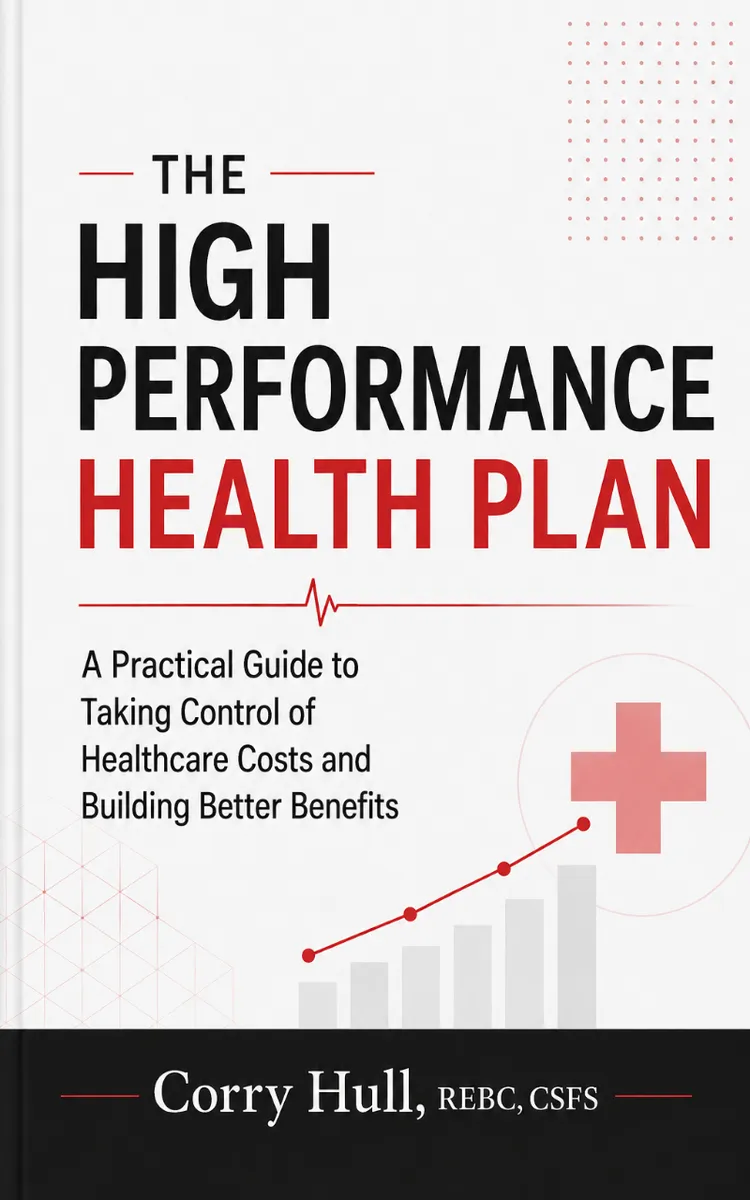
Read the first chapter
The whole of chapter one, free. About 8 min. Turn the pages with the arrows, your keyboard, or a swipe.
Chapter 1
Chapter 1 - Benefits Are Compensation
The easiest way to misunderstand employee benefits is to treat them as separate from compensation.
They are not.
Every dollar an employer spends on health insurance, retirement contributions, paid leave, disability coverage, life insurance, or any other benefit is part of what it costs to employ someone. Employees may not see all of those dollars on a paycheck, but the business still has to earn the money before it can spend it.
That sounds obvious, yet it is one of the most important ideas in this book because healthcare has gradually become disconnected from the compensation conversation.
When a health plan renewal comes in at 18 percent, people talk about it as if a weather system moved through the building. The insurance market is up. Medical trend is up. Pharmacy trend is up. There were a few large claims. The carrier needs more premium.
Then HR and finance start figuring out how to absorb it.
What rarely gets said out loud is that the increase is competing with every other dollar the company wants to spend on its people.
If a company has 300 employees and its annual healthcare cost goes up $750,000, that money has to come from somewhere. Maybe the company absorbs it and accepts lower margins. Maybe it reduces the merit increase pool. Maybe employees pay more each paycheck. Maybe the deductible goes from $2,000 to $3,500. Maybe the company delays adding a 401(k) match. Maybe it hires three fewer people.
The health plan doesn't exist outside the company's economics. It is part of them.
The Same Bucket of Dollars
The Bureau of Labor Statistics breaks employer compensation into wages and benefits. For private-industry workers in December 2025, wages and salaries accounted for about 70 percent of employer compensation costs, while benefits accounted for about 30 percent. Health insurance alone represented a meaningful part of that total.
I bring that up because employers often talk about benefits as though the company pays for them and employees receive them for free. Economically, that is too simple.
The employer may write the check, but compensation is a package. If one component grows faster than the value the business can sustainably produce, it puts pressure on the other components.
That is why I tell employers that healthcare inflation eventually becomes wage suppression, benefit erosion, or both.
You do not have to believe that every dollar saved on healthcare automatically becomes a dollar of wages. Real businesses have many competing uses for capital. But over time, a company that controls healthcare better has more choices than a company that does not.
It can improve wages.
It can reduce payroll deductions.
It can lower deductibles.
It can fund a richer retirement contribution.
It can add paid leave.
It can invest in recruiting and training.
It can protect margins and jobs during a difficult year.
Those are all forms of value.
Benefits Exist to Help the Employer Compete
Before health insurance became the monster line item it is today, employee benefits served a straightforward business purpose: they helped employers compete for labor.
That is still the purpose.
An employer offers benefits because the employer wants good people to join the organization, stay there, and feel protected enough to focus on their work. Benefits can reinforce culture. They can differentiate one employer from another. They can protect an employee from a financial event that would otherwise be devastating.
The best benefits programs do all of those things.
But once the cost of the benefit grows faster than the value employees perceive, something breaks.
I see this all the time. A company may be spending $18,000 or $20,000 per employee on medical coverage, but the employee experiences the plan as a $4,000 deductible, a high payroll deduction, a confusing provider directory, and a pharmacy counter that tells them their medication is not covered.
The employer is spending a fortune. The employee feels underinsured.
That is a terrible trade for both sides.
One goal of a high-performance health plan is to close that gap. If the company is going to spend that much money, employees should feel the value.
The Hidden Compensation Statement
Most employees know their salary. Many know their bonus potential. Fewer know what the employer spends on their health plan, payroll taxes, retirement contributions, disability coverage, life insurance, and other benefits.
That creates a communication problem.
Imagine two employers competing for the same employee. Employer A pays $82,000 and offers a health plan that costs the employee $180 per month with a $1,500 deductible. Employer B pays $85,000 but charges $520 per month for family coverage and has a $5,000 deductible.
The higher salary may look better at first glance. The total compensation package may tell a different story.
This is why I like total-compensation statements when they are done well. Not because employers need to brag about every dollar they spend, but because employees deserve to understand the full value of the employment relationship.
The same thinking should influence health plan strategy. If you can reduce waste without reducing care, you create room to improve the compensation package in ways employees can actually notice.
That is fundamentally different from cost shifting.
Cost Control and Cost Shifting Are Not the Same Thing
One of the most common mistakes in benefits strategy is calling a higher deductible "cost containment."
It is not.
A higher deductible may reduce the employer's premium or claims liability. It may change employee behavior. It may be appropriate in some situations. But if the underlying healthcare still costs the same and you simply move more of the bill to the employee, you have not contained the cost. You changed who paid it.
That distinction is central to this book.
True cost containment changes the price, the utilization, the site of care, the drug, the contract, the administrative waste, or the clinical outcome.
Moving an MRI from a hospital outpatient department charging $3,200 to an independent imaging center charging $650 is cost containment.
Replacing an expensive biologic with an appropriate lower-cost biosimilar can be cost containment.
Negotiating a PBM contract that eliminates spread pricing and passes through manufacturer rebates can be cost containment.
Helping an employee use primary care before a condition turns into an emergency department visit can be cost containment.
Raising the deductible by $2,000 is cost shifting.
Employers should understand the difference before someone sells one to them as the other.
The P&L Does Not Care What You Call It
I have worked with CFOs who initially viewed employee benefits as an HR expense. Once we separated the numbers, the conversation changed quickly.
Take a hypothetical employer with 500 employees. Assume its total medical and pharmacy spend is $6.5 million. If healthcare trend adds 8 percent, the next year costs roughly $520,000 more before any change in headcount.
If the company earns a 10 percent operating margin, it needs more than $5 million in additional revenue to produce the $520,000 of operating income consumed by the healthcare increase.
That is why healthcare belongs in the company's financial strategy.
It does not mean the CFO should design the formulary. It means finance should understand the risk, the cash flow, the largest claim drivers, vendor economics, and the decisions the company can influence.
HR brings an equally important perspective. A change that looks brilliant on a spreadsheet can be a disaster if employees cannot access care, do not understand the plan, or lose trusted physicians without a realistic alternative.
The best plans are built when finance and HR solve the same problem together.
Finance asks: Is the expense sustainable?
HR asks: Does the benefit work for our people?
The answer has to be yes to both.
Benefits as a Recruiting and Retention Strategy
Employers sometimes underestimate how much healthcare affects an employee's decision to stay.
People may not talk about health insurance in an interview as enthusiastically as they talk about salary or flexibility, but the benefit becomes very real when a child needs surgery, a spouse receives a cancer diagnosis, or a medication suddenly costs hundreds of dollars.
A well-designed plan creates trust at those moments.
A poorly designed plan destroys it.
That is why I do not believe the highest-performing health plan is simply the cheapest plan. The goal is to remove waste and redirect savings toward value.
A company that reduces unnecessary hospital spending and then uses part of the savings to provide $0 primary care, waive employee cost sharing at a center of excellence, or reduce payroll contributions is doing something very different from a company that saves the same amount by increasing the deductible.
Both may reduce employer spending. Only one improves the employee value proposition.
That is the idea behind what Health Rosetta calls the Health Rosetta Dividend: take dollars that were being wasted in the healthcare supply chain and put them to better use for employees, the employer, and the community.
I think that is one of the most important concepts in modern benefits strategy.
The Question I Want Leadership to Ask
Before we talk about carriers, networks, self-funding, captives, PBMs, or any of the other tools in this book, I want the leadership team to answer one question:
What are we trying to accomplish with our benefits program?
The answer cannot simply be "keep the renewal low."
A better answer might be:
• We want to offer benefits that help us recruit skilled employees in a difficult labor market.
• We want employees to be able to afford to use the plan we provide.
• We want predictable healthcare spending without blindly paying whatever the market asks.
• We want to protect employees from catastrophic financial exposure.
• We want better access to primary care and high-quality specialists.
• We want to understand what is driving our claims and have the ability to act on that understanding.
• We want savings to create room for better compensation instead of disappearing into healthcare inflation.
Once leadership defines the purpose, the plan can be designed around it.
Without that definition, the renewal becomes the strategy by default.
Put the Health Plan Back Inside Compensation
The first shift in thinking is simple: stop treating the health plan as a separate insurance transaction.
It is part of how you pay people.
It is part of how you compete for talent.
It is part of the company's financial model.
And because it is part of compensation, the employer has every reason to demand the same level of transparency, accountability, and purchasing discipline it would for any other major expense.
The rest of this book is about how to do that.
End of chapter one. 29 more chapters in the full book.
Swipe or use the arrows to turn the page
What's inside: 30 chapters
- 1. Chapter 1 - Benefits Are Compensation
- 2. Chapter 2 - How Employer Health Benefits Became the Default
- 3. Chapter 3 - Healthcare as Interlocking Incentives
- 4. Chapter 4 - Why Discounts Aren't Prices
- 5. Chapter 5 - Hospital Systems, Networks, and the Price of Care
- 6. Chapter 6 - The Prescription Drug Money Flow
- 7. Chapter 7 - Follow the Money Across Intermediaries
- 8. Chapter 8 - Health Insurance Is Not Healthcare
- 9. Chapter 9 - The ACA, the Individual Market, and Fifteen Years of Change
- 10. Chapter 10 - Financing vs. Managing Healthcare
- 11. Chapter 11 - Self-Funding Mechanics in Plain English
- 12. Chapter 12 - Level-Funded Plans — The Middle Ground
- 13. Chapter 13 - How a Health Claim Actually Gets Paid
- 14. Chapter 14 - Funding the Claims Checkbook: Reserves, IBNR, and Cash Flow
- 15. Chapter 15 - Stop-Loss Contracts That Matter
- 16. Chapter 16 - Captives for Risk Sharing and Control
- 17. Chapter 17 - Data and Transparency: See Before You Solve
- 18. Chapter 18 - The TPA Is the Operating System
- 19. Chapter 19 - Contracts Define Control
- 20. Chapter 20 - Pharmacy Strategy Beyond the PBM Contract
- 21. Chapter 21 - Provider, Network, and Site-of-Care Strategy
- 22. Chapter 22 - The Self-Funded Cost-Containment Toolbox
- 23. Chapter 23 - Navigation, Advocacy, Incentives, and Payment Integrity
- 24. Chapter 24 - Are You Ready to Self-Fund?
- 25. Chapter 25 - Design the Plan Around What Matters Most
- 26. Chapter 26 - Crawl, Walk, Run, Sprint
- 27. Chapter 27 - Implementation: What a Real Transition Takes
- 28. Chapter 28 - What a High-Performance Health Plan Feels Like
- 29. Chapter 29 - Measure, Reinvest, and Keep Improving
- 30. Appendix
About this book
"The High Performance Health Plan" is a general book by Corry Hull with 30 chapters and approximately 83,404 words. It covers key insights and practical takeaways on the topic.
This book was created using Inkfluence AI, an AI-powered book generation platform that helps authors write, design, and publish complete books.
Frequently Asked Questions
What is "The High Performance Health Plan" about?
"The High Performance Health Plan" is a general book by Corry Hull covering key insights and practical takeaways on the topic.
How many chapters are in "The High Performance Health Plan"?
The book contains 30 chapters and approximately 83,404 words. Topics covered include Chapter 1 - Benefits Are Compensation, Chapter 2 - How Employer Health Benefits Became the Default, Chapter 3 - Healthcare as Interlocking Incentives, Chapter 4 - Why Discounts Aren't Prices, and more.
Who wrote "The High Performance Health Plan"?
This book was written by Corry Hull and created using Inkfluence AI, an AI book generation platform that helps authors write, design, and publish books.
Write your own book with AI
Describe your idea and Inkfluence writes the whole thing. Free to start.
Start writingCreated with Inkfluence AI


