
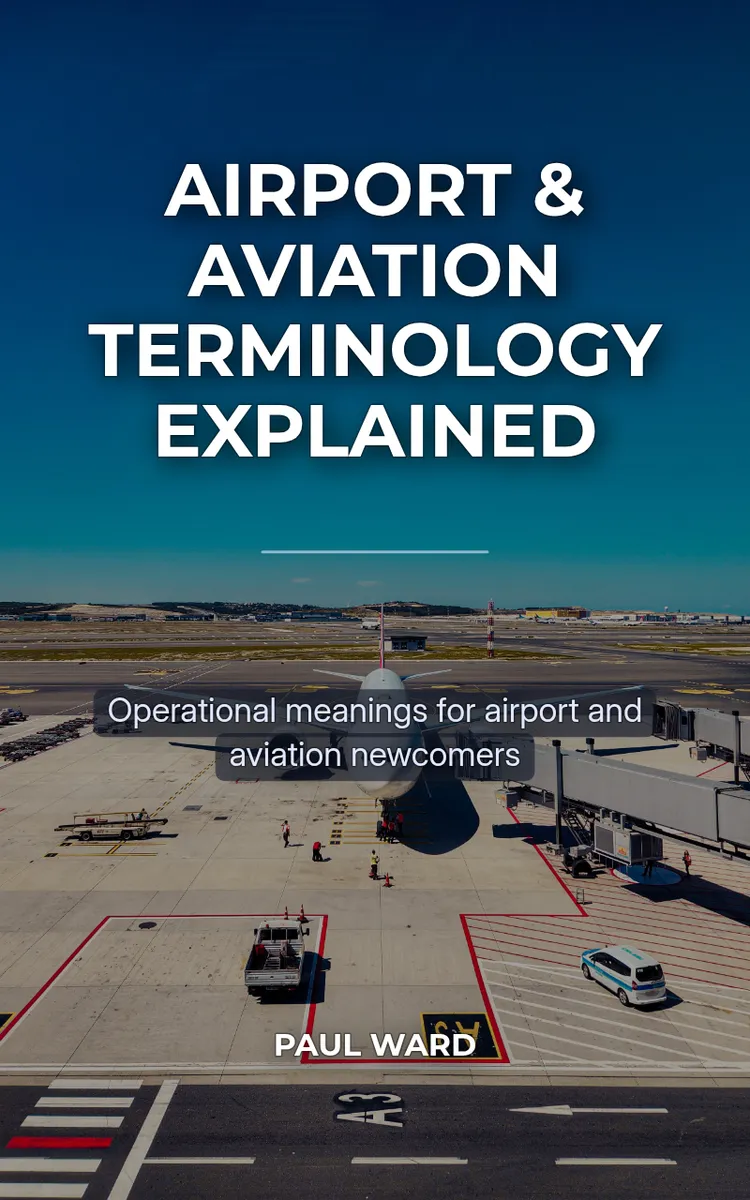
Airport & Aviation Terminology Explained
Created with Inkfluence AI
Airport and aviation terms, abbreviations, and operational language
Table of Contents
- 1. Airport Codes and Location Basics
- 2. Runways, Taxiways, and Markings
- 3. ATC Clearances and Phraseology
- 4. Gates, Stands, and Passenger Flow
- 5. Cargo Terms: ULDs, AWBs, and Handling
- 6. Flight Planning Words and Dispatch Terms
- 7. Weather, NOTAMs, and Operational Alerts
- 8. Delays, Cancellations, and Recovery Language
Preview: Airport Codes and Location Basics
A short excerpt from “Airport Codes and Location Basics”. The full book contains 8 chapters and 15,231 words.
Why airport codes and location terms decide whether you land the right place
Have you ever looked at a flight plan, a schedule, or a cargo document and thought, “Why does this place have letters and numbers instead of a normal name?” That question matters because airport codes and runway identifiers aren’t decoration - they prevent mix-ups. When you read them correctly, you confirm the right airport, the right direction of travel, and the right runway for operations.
Airport schedules, charts, and operational messages use short codes because they travel fast across systems. If you guess, you can book the wrong airport, route cargo to the wrong field, or brief a crew on the wrong runway. If you learn the code patterns, you can read the message the way the industry reads it: quickly, consistently, and with fewer surprises.
After this chapter, you will be able to (1) tell apart IATA and ICAO codes, (2) read runway identifiers like “09” or “27L” and understand what direction they mean, and (3) translate common location terms like “on the field,” “at the ramp,” or “near the threshold” into practical meaning you can use right away. You will also know what to double-check when codes look similar.
The Code-to-Context Map: learn the patterns, then attach real meaning
The core skill is turning a code into context. You do that with a simple habit: map each identifier to the “place” it points to, then confirm the direction and the operational area (runway, taxiway, ramp, terminal, or apron). Use this map every time you read a schedule, a chart note, or a location callout.
Build your Code-to-Context Map
1. Identify the code type: IATA versus ICAO.
IATA (International Air Transport Association) codes are the common 3-letter codes you see on tickets and many public schedules (for example, “JFK”). ICAO (International Civil Aviation Organization) codes are 4-letter codes used for flight operations, routing, and aviation documents (for example, “KJFK”).
Why it matters: IATA tells you the airport for passenger-facing use; ICAO helps you avoid confusion in operations because it uses a more structured format.
2. Attach the code to a real location on your chart or app.
When you see an IATA code, immediately look for that airport name and location on the map you’re using. When you see an ICAO code, do the same - but treat it as the “operational” airport identifier and match it to the airport’s chart data.
Why it matters: Two airports can share similar letters in informal references. The IATA-to-ICAO difference forces you to confirm you’re reading the same airport across systems.
3. Read runway identifiers as magnetic direction rounded to tens.
Runway numbers like “09” or “27” come from the runway’s magnetic heading rounded to the nearest 10 degrees, then divided by 10. So runway “09” points roughly toward 090° (east), and runway “27” points roughly toward 270° (west).
Why it matters: You can sanity-check the runway direction even if you don’t remember the airport layout.
4. Use the letter suffix to pick the parallel runway.
If you see “27L” or “27R,” the “L” means Left and “R” means Right relative to the approach direction toward that runway number. Some airports use “C” for Center when there are three parallels.
Why it matters: “27” alone can describe multiple physical runways. The suffix tells you which one.
5. Translate common location terms into operational areas.
Learn the “area vocabulary” used in airport work:
- Threshold area: where landing begins; it sits at the start edge of the usable runway for landing.
- Touchdown zone: the area where wheels typically meet the runway.
- Ramp / apron: where aircraft park, load, and unload (passengers or cargo).
- On the movement area: taxiways and runways where aircraft move under control.
Why it matters: The same airport can have different rules and procedures depending on whether you’re on the movement area or parked on the apron.
A concrete example using Talia’s confusion (and how she fixes it)
Talia, 19, first-time traveler, sees “ATL” on her booking and later notices a document that lists “KATL.” She wonders if those are two different places. She applies the map:
- She labels ATL as IATA (3 letters) and KATL as ICAO (4 letters).
- She confirms both codes point to the same airport by matching them to the same airport name on her map/app.
- Then she checks her arrival runway info. If her itinerary says “Runway 27L,” she reads it as runway heading roughly 270° (west) and the “L” as the left parallel runway from the approach direction.
That’s the payoff: she stops treating the codes as random letters and starts treating them as coordinates and directions.
...
About this book
"Airport & Aviation Terminology Explained" is a how-to guide book by Paul Ward with 8 chapters and approximately 15,231 words. Airport and aviation terms, abbreviations, and operational language.
This book was created using Inkfluence AI, an AI-powered book generation platform that helps authors write, design, and publish complete books. It was made with the AI Ebook Generator.
Frequently Asked Questions
What is "Airport & Aviation Terminology Explained" about?
Airport and aviation terms, abbreviations, and operational language
How many chapters are in "Airport & Aviation Terminology Explained"?
The book contains 8 chapters and approximately 15,231 words. Topics covered include Airport Codes and Location Basics, Runways, Taxiways, and Markings, ATC Clearances and Phraseology, Gates, Stands, and Passenger Flow, and more.
Who wrote "Airport & Aviation Terminology Explained"?
This book was written by Paul Ward and created using Inkfluence AI, an AI book generation platform that helps authors write, design, and publish books.
How can I create a similar how-to guide book?
You can create your own how-to guide book using Inkfluence AI. Describe your idea, choose your style, and the AI writes the full book for you. It's free to start.
Write your own how-to guide book with AI
Describe your idea and Inkfluence writes the whole thing. Free to start.
Start writingCreated with Inkfluence AI


