
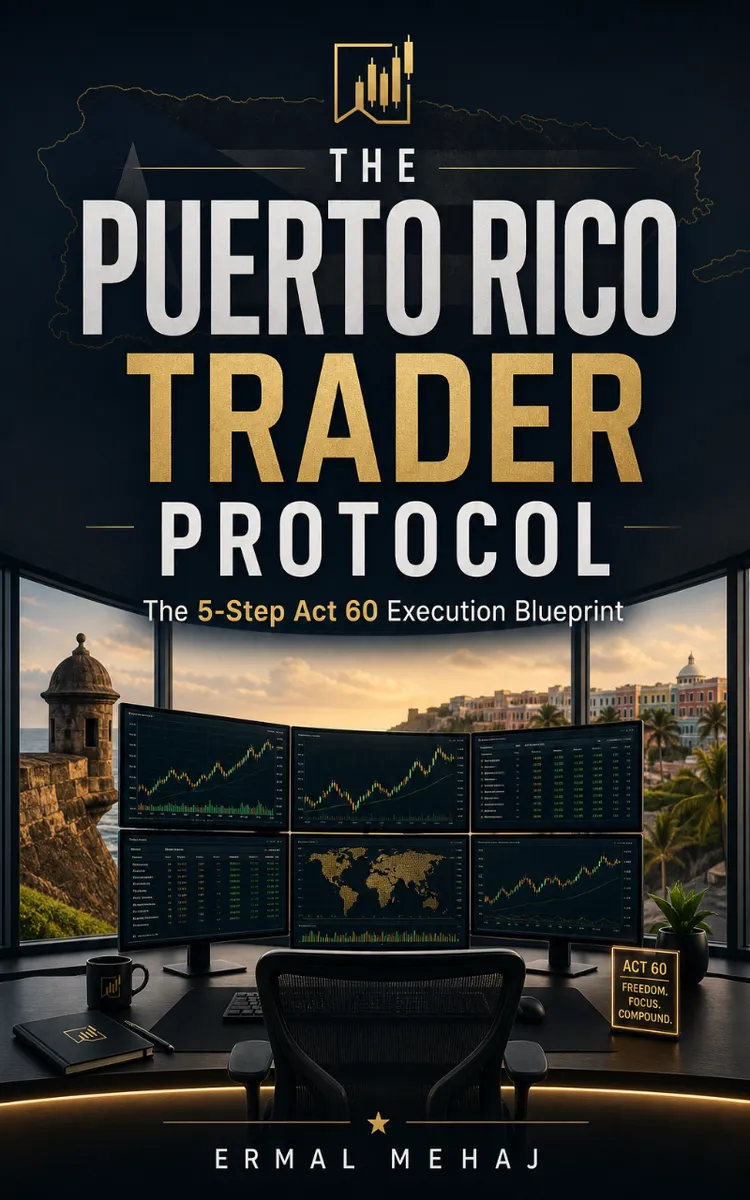
The Puerto Rico Trader Protocol
Created with Inkfluence AI
Relocating traders to Puerto Rico for Act 60 tax benefits
Table of Contents
- 1. Pre-Move Financial Architecture & Domicile Severance
- 2. Satisfying the IRS "Bona Fide Residency" Triple-Test (IRC § 937)
- 3. Act 60 Decree Filing, Housing Compliance, & Estate Protection
- 4. Advanced Trading Operations, Asset Classes, & Hybrid Income
- 5. Trading Desk Uptime, IRS Audits, & Exit Protocols
Preview: Pre-Move Financial Architecture & Domicile Severance
A short excerpt from “Pre-Move Financial Architecture & Domicile Severance”. The full book contains 5 chapters and 2,803 words.
Your pre-move setup decides whether your Puerto Rico story stays clean when the IRS asks for receipts. Build your financial architecture before you relocate: lock in asset baselines, separate what you owned before from what you trade after, and document domicile severance so your old state can’t claim you still lived there.
Treat this like trading operations, not paperwork. You want timestamped evidence you can point to quickly, and you want your entity and brokerage structure to match where you actually trade from - Puerto Rico - not where you just came from.
Establishing Pre-Move Asset Baselines and Timestamped Mark-to-Market Snapshots
Start with mark-to-market snapshots on the day you trigger the move process, then repeat at your next key milestone. Capture holdings, cost basis, unrealized gains/losses, and account ownership exactly as shown by your broker and custodian systems. Your goal: a baseline you can defend, not a narrative you hope nobody questions. Ask yourself: if someone froze your accounts and asked “What did you own on move day?”, could you produce it in minutes?
Use a consistent timestamping method you can reference later in your records. For crypto, export exchange statements and wallet balances; for securities, pull broker statements and positions. Keep the exports as immutable files (date-stamped exports from the platform, plus a local archive).
Practical takeaway: create one “Move Day Snapshot” folder and one “Next Milestone Snapshot” folder, and never edit the source exports after you save them.
Bifurcating Pre-Move Assets From Post-Move Trading Accounts
You must prevent commingling. Split your pre-move assets from post-move trading accounts so you can clearly show which positions existed before relocation and which came into play after you started trading from Puerto Rico. This matters because the IRS looks for operational consistency, not intent statements.
Implement this separation with two clean lanes: pre-move holdings stay in a pre-move tracking account set, and post-move trading happens in a Puerto Rico-aligned account set. When you fund post-move trading, trace the origin back to your pre-move baseline exports so your transfers don’t look like “new money” with unclear timing.
Practical takeaway: label accounts and exports by “pre” and “post” and keep every transfer trail mapped to the snapshot timestamps.
Severing High-Tax State Domiciles Under Statutory Residence Rules
You need to sever CA, NY, NJ domicile ties using statutory residence logic, not vibes. The IRS and state tax authorities both care about where your life actually anchored while you were still “in transition.” You’re not just changing address; you’re cutting the continued connection that those states use to claim you stayed resident.
Operationally, you should remove ongoing “resident signals” that keep you tethered to those states - especially things that look like you kept a functioning home base there while you claimed Puerto Rico status. Document your change with dates: when you stopped using the mainland location as your primary base, when you updated key records, and when you started operating from the island.
Practical takeaway: build a domicile timeline that lines up with your move milestones and your account bifurcation dates - don’t let them drift.
Restructuring Mainland LLCs/S-Corps and Transitioning to PR-Compliant Brokers
If you trade through a mainland LLC or S-Corp, you don’t just “keep it running.” Restructure so your entity operations and your brokerage relationship match your Puerto Rico trading reality. The goal is alignment: entity control, account ownership/management, and brokerage execution all point to the same place.
On the brokerage side, transition to PR-compliant platforms that fit your operational needs. Many traders use Interactive Brokers and TradeStation because you can maintain clean custody/statement trails while you relocate.
Practical takeaway: before you execute any post-move trades, verify your entity docs and brokerage accounts reflect the new operational center - then lock those records with the same timestamp discipline you used for your asset snapshots.
About this book
"The Puerto Rico Trader Protocol" is a how-to guide book by Anonymous with 5 chapters and approximately 2,803 words. Relocating traders to Puerto Rico for Act 60 tax benefits.
This book was created using Inkfluence AI, an AI-powered book generation platform that helps authors write, design, and publish complete books. It was made with the AI Ebook Generator.
Frequently Asked Questions
What is "The Puerto Rico Trader Protocol" about?
Relocating traders to Puerto Rico for Act 60 tax benefits
How many chapters are in "The Puerto Rico Trader Protocol"?
The book contains 5 chapters and approximately 2,803 words. Topics covered include Pre-Move Financial Architecture & Domicile Severance, Satisfying the IRS "Bona Fide Residency" Triple-Test (IRC § 937), Act 60 Decree Filing, Housing Compliance, & Estate Protection, Advanced Trading Operations, Asset Classes, & Hybrid Income, and more.
Who wrote "The Puerto Rico Trader Protocol"?
This book was written by Anonymous and created using Inkfluence AI, an AI book generation platform that helps authors write, design, and publish books.
How can I create a similar how-to guide book?
You can create your own how-to guide book using Inkfluence AI. Describe your idea, choose your style, and the AI writes the full book for you. It's free to start.
Write your own how-to guide book with AI
Describe your idea and Inkfluence writes the whole thing. Free to start.
Start writingCreated with Inkfluence AI


