
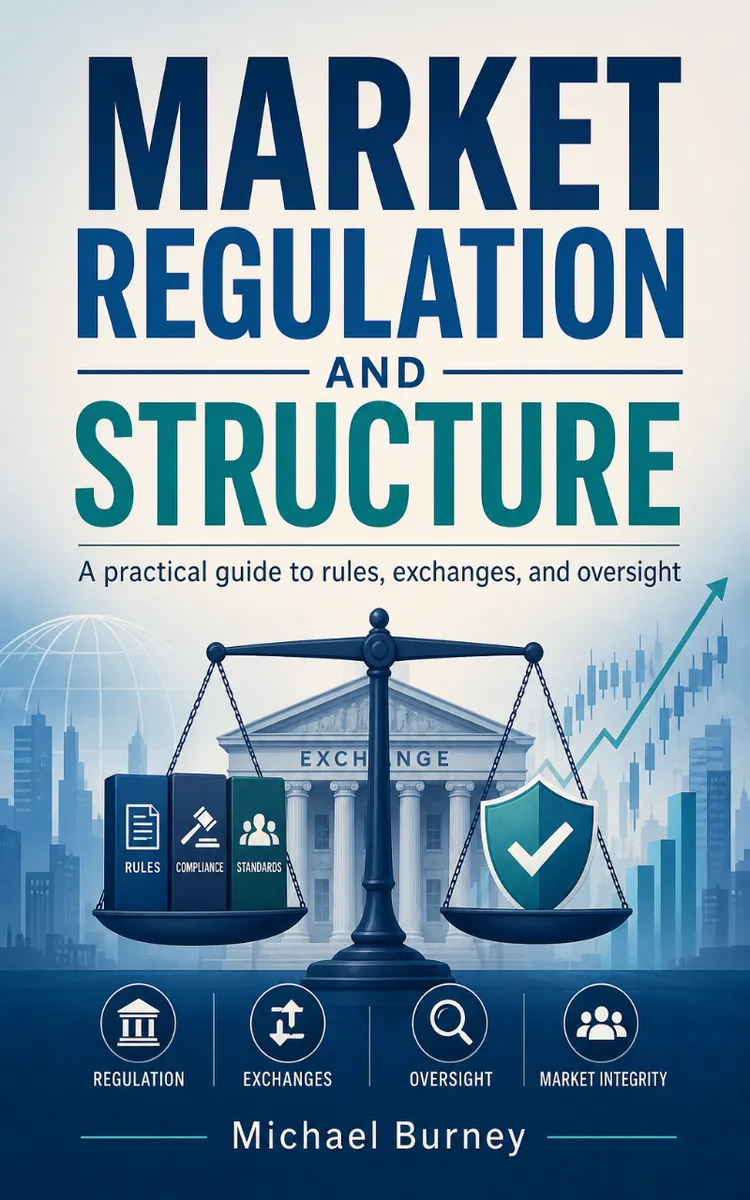

Read the first chapter
The whole of chapter one, free. About 9 min. Turn the pages with the arrows, your keyboard, or a swipe.
Chapter 1
Market Rules: Core Concepts
Your trading desk does not fail because you can’t read a chart. It fails because you can’t read the rulebook at the moment you place the order. One rejected order, one wrong routing instruction, one late disclosure, and your “execution plan” turns into an audit trail you didn’t mean to generate.
Market regulation exists to control how orders move, how venues accept them, and how the system proves it all happened. The problem this chapter solves is simple: you need a working mental model for the building blocks of market regulation - from order types to enforcement objectives and compliance terminology - so you can translate rules into day-to-day decisions. After you finish, you will be able to map a concrete trading workflow onto the Market Rules Map, spot where compliance risk enters, and document the key facts regulators expect to see.
Market Rules Map: Order Types, Enforcement Objectives, and Compliance Terms
The Market Rules Map gives you a structured way to connect three things that often stay in separate folders: (1) the order types you send, (2) the enforcement objectives regulators pursue, and (3) the compliance terminology everyone uses when something goes wrong. You don’t need a theory lesson; you need a checklist mindset that turns rules into actions.
Start with order types, because they determine what you actually ask the market to do. A limit order instructs the venue: “Fill only at this price or better.” A market order instructs: “Execute immediately at the best available prices.” A stop order instructs: “Activate when the market trades through a threshold.” Each order type creates different execution behavior and different evidence trails. Regulators care because different order instructions can produce different market effects and different opportunities for misuse.
Next, tie those order instructions to enforcement objectives. Enforcement objectives are the practical targets regulators enforce, such as fair access, prevention of manipulative conduct, orderly trading, and protection against conflicts of interest. You don’t enforce a concept like “fairness” directly; you enforce behaviors that break the fairness mechanism, such as misleading order handling, unauthorized trading practices, or failures to follow required routing and disclosure rules. When you align your workflow to enforcement objectives, you can explain why your controls matter, not just that you have controls.
Finally, use compliance terminology correctly. In broker-dealer operations, the terms you hear in investigations usually come from the same small set: order handling, routing, execution quality, audit trail, exception handling, supervision, and disclosure. “Audit trail” means the time-stamped record of what happened: your order’s lifecycle, venue responses, and any internal approvals or modifications. “Supervision” means the documented oversight process that catches errors before they scale. If you label your files and logs with the right terms, you speed up both your internal reviews and regulator-facing responses.
To make this concrete, consider Talia, 34, a compliance analyst at a broker-dealer. She gets a ticket from the trading team: “Why did our client’s limit order get canceled right after we modified it?” She doesn’t start with blame. She checks the order type behavior (limit modification and cancel/replace rules), then she checks the enforcement objective (order handling integrity and prevention of misleading activity), then she checks whether the supervision process and audit trail captured the modification reason and approval.
Use the Market Rules Map like this:
1. Identify the order type and its behavioral promise. Write down what the order must do in plain language: “Only fill at X or better,” “trigger at Y,” or “execute immediately.” This step prevents you from treating a limit order like a market order during review.
2. Map the order to the relevant enforcement objective. Pick the closest objective that explains why the rule exists. For example, if the workflow touches order handling integrity, focus on fair and orderly trading and the prevention of manipulative or misleading order behavior.
3. Name the compliance artifacts you must generate. List the audit trail elements you expect: order timestamps, modification/cancel events, routing destination, and any internal approval or exception code. Use the same terms the compliance team and regulators use.
4. Define exception handling and supervision checkpoints. Decide what you do when the system behaves unexpectedly: you flag the order, you pull the audit trail, you check supervision logs, and you document the resolution. This step turns a “we’ll look into it” email into an enforceable control.
Putting It Into Practice: Build a Rule-Connected Workflow for Real Orders
Theory breaks down the moment you touch production. The practical move is to convert rules into a workflow you can run every time you place, route, modify, or cancel an order.
Use Talia’s operational lens as your template. She receives a batch of client orders routed through a specific execution path. She notices a spike in “cancel/replace sequences” within a short window. The trading team says it was routine price improvement. Talia’s job is to verify that the system followed the order type’s rules and that the audit trail supports the stated intent.
Here’s a concrete way to apply the Market Rules Map to a single workflow: a client submits a limit order, the desk modifies it, and the system cancels and replaces it across venues.
1. Capture the exact client instruction and the order type. Record the limit price, time-in-force, and any trigger condition. Example: “Buy 5,000 shares, limit 42.10, good for day.” Expected outcome: You can explain what price constraint governed execution.
2. Confirm routing and venue acceptance steps. Pull the routing destination from the order lifecycle log. Confirm whether the venue accepted the original order and how it handled the modification. Expected outcome: The audit trail shows where the order lived before and after the modification.
3. Document the modification reason at the time of change. Require a reason code when you change price or quantity. Example reasons: “client adjustment,” “market data update,” or “system error correction.” Expected outcome: Your supervision record ties the cancel/replace sequence to a legitimate operational cause.
4. Run the audit trail reconciliation against the enforcement objective. Check whether the cancel/replace pattern aligns with the limit order behavior (e.g., you didn’t accidentally send an order that acted like a market order). Then check whether the behavior could be read as misleading or manipulative. Expected outcome: Your reconciliation report can state: what changed, why it changed, and what rule expectation it satisfies.
5. Close the loop with supervision: approve, escalate, or clear. If the audit trail shows missing reason codes, unusual timing, or unexpected routing, you escalate. If everything matches the workflow, you clear the exception and record the resolution. Expected outcome: You prevent silent failures from becoming repeat failures.
Quick checklist
• Order type: Did the order instruction match the behavior you expected (limit vs market vs stop)? - Audit trail: Do you have time-stamped records for entry, modification, cancel, and replace? - Routing: Did the order route to the venue shown in the lifecycle logs? - Reason codes: Did the system capture a documented reason for each modification? - Supervision outcome: Did the workflow approve, escalate, or clear the exception with a documented basis?
If you do this consistently, you stop treating compliance as a post-trade cleanup task. You build a rule-connected workflow that produces evidence at the moment it matters.
Scenario Walkthrough: Talia Investigates a Cancel/Replace Spike
Talia’s desk flags a week of client orders where the system produced unusually fast cancel/replace sequences after modifications. The trading lead insists the activity supported best execution. Talia’s compliance process treats that claim as a hypothesis until the audit trail proves the workflow behaved as designed.
She applies the Market Rules Map to one representative order path first, then she uses the result as the standard for the rest of the batch.
1. Select one order with a clear timeline. Pick an order that shows: original entry, modification event, cancel event, and replace event. Record the exact limit price before and after modification. Expected outcome: You can identify whether the limit constraint changed and when.
2. Verify order type behavior. Confirm the order remained a limit order throughout the lifecycle and did not convert into a different instruction due to a system mapping issue. Expected outcome: The behavior matches the behavioral promise of a limit order: no fills worse than the limit.
3. Trace routing and venue acceptance. Pull the routing destination and venue responses for the original order and the replacement order. Expected outcome: The audit trail shows consistent routing logic or a documented, approved change.
4. Check modification documentation. Pull the reason code attached to the modification. If the system requires an approval for certain price changes, verify the approval record exists. Expected outcome: Every cancel/replace has a documented operational reason tied to the supervision process.
5. Map the observed behavior to the enforcement objective. Talia links the pattern to order handling integrity and prevention of misleading activity. She asks: “Could an independent reviewer interpret this as attempts to create false signals, or does the evidence show legitimate operational adjustments?” Expected outcome: Her conclusion rests on evidence, not on “intent” alone.
6. Decide and document the supervision action. If reason codes or approvals are missing, she escalates to investigate control gaps. If the evidence supports legitimate modifications, she clears the exception and notes the pattern as an operational characteristic. Expected outcome: The firm produces a regulator-ready record: what happened, why it happened, and what controls prevented harm.
Quick checklist
• Choose a representative order with a full lifecycle timeline. - Confirm the order type stayed consistent with the instruction. - Reconcile routing and venue responses to the order lifecycle. - Verify reason codes and supervision approvals exist for each modification. - Tie findings to the enforcement objective in plain language.
The operational takeaway: you don’t “argue” about whether the activity looks acceptable. You reconcile the audit trail to the rule-connected workflow and let the evidence answer the question.
Common Mistakes and Edge Cases in Rule-Connected Compliance
Even strong teams make predictable mistakes when they rely on intuition instead of the Market Rules Map. Here are the ones that show up in real investigations and how to correct them.
Mistake: Mixing up order type expectations When someone reviews a limit order using market order assumptions, they misread the evidence. For example, a reviewer might expect immediate fills and interpret a lack of fills as “failure,” then chase the wrong control. Do this: Treat each order type as a different instruction with a different behavioral promise. Confirm the instruction at entry and confirm the instruction remained consistent through modification. Not this: Assume “we modified it, so it behaved like execution.” You must verify the order instruction and the venue’s acceptance behavior.
Mistake: Skipping the enforcement objective link Teams sometimes produce long audit trail writeups that never state the enforcement objective they addressed. That gap slows reviews and increases back-and-forth. Do this: For every exception, write one sentence that ties the observed behavior to a specific enforcement objective: fair access, orderly trading, prevention of manipulative or misleading order behavior, or protection from conflicts. Keep it evidence-driven. Not this: Write “This was likely fine” without stating what rule expectation the workflow satisfied.
Mistake: Treating missing documentation as a “minor clerical issue” Missing reason codes, missing approval records, or incomplete audit trail elements can turn a harmless operational glitch into a control failure. Regulators care because the system loses its ability to explain why actions occurred. Do this: Treat missing compliance artifacts as a supervision exception. Pull the lifecycle again, confirm what the system recorded, and run your exception handling workflow immediately. Not this: Close the ticket because “the trade looks correct.” If the audit trail lacks required evidence, you cannot prove the rule-connected workflow executed as intended.
Market regulation becomes manageable when you stop treating it as a pile of unrelated rules. You map each order type to an enforcement objective and you generate the compliance artifacts that prove the workflow ran correctly. That discipline turns compliance from a reactive burden into a measurable, repeatable operating control - and it sets you up for deeper coverage of exchange structure and oversight mechanisms in the next sections of the book.
End of chapter one. 7 more chapters in the full book.
Swipe or use the arrows to turn the page


What's inside: 8 chapters
- 1. Market Rules: Core Concepts
- 2. Exchange Design and Trading Venues
- 3. Order Handling and Market Microstructure
- 4. Surveillance: Detecting Manipulation
- 5. Best Execution and Routing Duties
- 6. Regulatory Reporting and Recordkeeping
- 7. Compliance Controls for Trader Behavior
- 8. Enforcement, Exams, and Ongoing Oversight
About this book
"Market Regulation And Structure" is a finance book by Michael Burney with 8 chapters and approximately 16,452 words. Trading market regulation, exchange structure, and oversight mechanisms.
This book was created using Inkfluence AI, an AI-powered book generation platform that helps authors write, design, and publish complete books. It was made with the AI Ebook Generator.
Frequently Asked Questions
What is "Market Regulation And Structure" about?
Trading market regulation, exchange structure, and oversight mechanisms
How many chapters are in "Market Regulation And Structure"?
The book contains 8 chapters and approximately 16,452 words. Topics covered include Market Rules: Core Concepts, Exchange Design and Trading Venues, Order Handling and Market Microstructure, Surveillance: Detecting Manipulation, and more.
Who wrote "Market Regulation And Structure"?
This book was written by Michael Burney and created using Inkfluence AI, an AI book generation platform that helps authors write, design, and publish books.
How can I create a similar finance book?
You can create your own finance book using Inkfluence AI. Describe your idea, choose your style, and the AI writes the full book for you. It's free to start.
Write your own finance book with AI
Describe your idea and Inkfluence writes the whole thing. Free to start.
Start writingCreated with Inkfluence AI


