
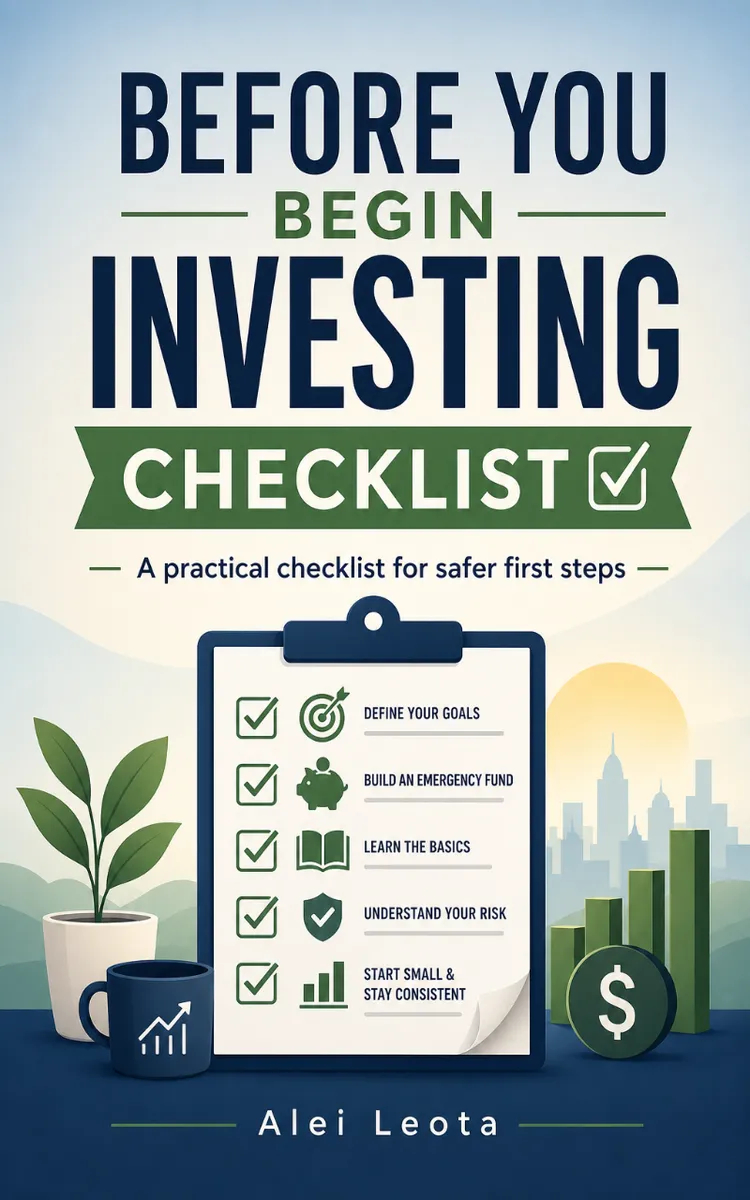
Before You Begin Investing Checklist
Created with Inkfluence AI
Pre-investment checklist for evaluating readiness and risks
Table of Contents
- 1. Emergency Fund and Cash Buffer Checklist
- 2. Risk Tolerance and Time Horizon Checklist
- 3. Brokerage Setup and Account Funding Checklist
- 4. Portfolio Plan and Diversification Checklist
- 5. Investment Rules, Costs, and Automation Checklist
Preview: Emergency Fund and Cash Buffer Checklist
A short excerpt from “Emergency Fund and Cash Buffer Checklist”. The full book contains 5 chapters and 8,537 words.
What This Helps You Do
A market drop is easier to handle when your rent, groceries, and urgent bills are already covered in cash. Tanya, 34, a retail manager, can keep her investment account untouched during a downturn because her safety money is separated and ready.
Use this checklist before buying investments, and revisit it after a job change, major purchase, new debt, or income shift. It helps you build the Cash Runway Ladder: essential cash first, planned cash next, and investment money only after both are secure.
Before You Start
Set aside one focused hour and gather the records that show what actually leaves your account. Use the last three months of bank and credit card statements rather than guessing from memory.
Prepare these materials:
- Bank statements from the past three months
- Credit card statements from the past three months
- Recent pay stubs or income records
- A list of monthly debt payments
- A list of upcoming large expenses
- Your current account balances
- A calculator or spreadsheet
Separate spending into three groups:
- Essential: housing, utilities, food, insurance, transport, healthcare, and minimum debt payments
- Important but adjustable: subscriptions, dining out, clothing, hobbies, and extra debt payments
- Occasional: repairs, annual insurance, gifts, travel, taxes, and professional fees
Use your average monthly essential spending as the starting number. If Tanya spends $2,400 each month on housing, food, transport, insurance, utilities, and debt minimums, $2,400 is her monthly runway cost.
Do not count expected investment returns, credit card limits, or money you may borrow from family. A safety net should work without a rising market, new debt, or someone else’s approval.
List income that could stop or shrink. Include overtime, commissions, tips, bonuses, seasonal work, and side jobs. Base the runway on reliable income and essential expenses, not on the best month of the year.
Create separate labels for the money you are protecting. A high-yield savings account can hold emergency cash if withdrawals are easy and the balance is not exposed to market losses. Check the account’s current interest rate, withdrawal rules, and deposit insurance before using it.
Checklist Items
Find Your Essential Monthly Cost
☐ Review three months of bank and card statements.
☐ Total housing, utilities, food, transport, insurance, and healthcare.
☐ Add minimum payments for every debt.
☐ Include required costs for children, pets, or dependents.
☐ Remove optional spending from the essential total.
☐ Add irregular bills divided by twelve.
☐ Record your essential monthly cost in dollars.
☐ Round the number slightly upward for price increases.
Your result is the base of the Cash Runway Ladder. If Tanya’s essential spending is $2,400 monthly and irregular bills add $200 monthly, her working base is $2,600. This number is more useful than a general rule because it reflects her actual bills.
Build the Cash Runway Ladder
☐ Fund one month of essential expenses first.
☐ Increase cash to three months of essential expenses.
☐ Consider six months for unstable or single income.
☐ Keep emergency cash separate from daily spending money.
☐ Label each cash level in your savings tracker.
☐ Recalculate the ladder after major income changes.
Use these levels as practical targets:
| Ladder level | Target | Purpose |
|---|---|---|
| Level 1: Immediate buffer | One month | Covers a short disruption or urgent bill |
| Level 2: Working runway | Three months | Protects against a normal job or income gap |
| Level 3: Strong runway | Six months | Supports unstable income or larger responsibilities |
For Tanya, one month equals $2,600, three months equals $7,800, and six months equals $15,600. She does not need to reach six months before taking any other financial step if her income is stable, but she should not treat money needed for the first three months as investment capital.
Protect Against Common Emergencies
☐ Price a basic health insurance deductible.
☐ Save the deductible amount in accessible cash.
☐ Check your car’s repair and replacement risks.
☐ Set aside money for essential equipment repairs.
☐ Review home, renter’s, auto, and disability coverage.
☐ Confirm insurance premiums fit your monthly budget.
☐ List medical, family, or work-related risks.
☐ Add known risks to your cash target.
An emergency fund should match the problems you could realistically face. A $1,000 car repair matters more to someone who must drive to work than to someone with reliable public transport. A high deductible also changes the amount of cash needed.
Do not use investments as a substitute for insurance. A stock fund may be worth less precisely when a job loss or medical bill occurs. Cash and suitable insurance handle different risks.
Separate Cash From Investment Money
☐ Open or identify a separate emergency savings account....
About this book
"Before You Begin Investing Checklist" is a checklist pack book by Anonymous with 5 chapters and approximately 8,537 words. Pre-investment checklist for evaluating readiness and risks.
This book was created using Inkfluence AI, an AI-powered book generation platform that helps authors write, design, and publish complete books.
Frequently Asked Questions
What is "Before You Begin Investing Checklist" about?
Pre-investment checklist for evaluating readiness and risks
How many chapters are in "Before You Begin Investing Checklist"?
The book contains 5 chapters and approximately 8,537 words. Topics covered include Emergency Fund and Cash Buffer Checklist, Risk Tolerance and Time Horizon Checklist, Brokerage Setup and Account Funding Checklist, Portfolio Plan and Diversification Checklist, and more.
Who wrote "Before You Begin Investing Checklist"?
This book was written by Anonymous and created using Inkfluence AI, an AI book generation platform that helps authors write, design, and publish books.
Write your own checklist pack book with AI
Describe your idea and Inkfluence writes the whole thing. Free to start.
Start writingCreated with Inkfluence AI


