

Read the first chapter
The whole of chapter one, free. About 7 min. Turn the pages with the arrows, your keyboard, or a swipe.
Chapter 1
How Subsidized Housing Works
A renter can receive a letter saying, “You may qualify,” and still have no apartment, no approved rent, and no move-in date. That gap confuses many applicants. Subsidized housing does not work through one national apartment list. Several programs, agencies, owners, and approval steps connect before assistance reaches a lease.
Your job at the beginning is not to memorize every program name. Your job is to identify which system controls the application, which rule controls eligibility, and which decision creates the final lease. The Subsidy-to-Lease Map gives you that structure. It follows the path from program funding to household screening, unit approval, lease signing, and ongoing rent assistance.
Learn the Core Systems
American subsidized housing uses public money to reduce housing costs or create homes with rents limited by program rules. The U.S. Department of Housing and Urban Development (HUD) funds or oversees many programs, but HUD usually does not hand an apartment key directly to an applicant. A Public Housing Agency (PHA), property owner, nonprofit, state agency, tribal housing authority, or another local administrator usually handles the practical work.
The first major difference concerns who receives the assistance. A tenant-based subsidy follows an eligible household, subject to program rules and approvals. A project-based subsidy stays connected to a particular apartment or building. Other properties receive financing that requires them to rent to households under certain income limits, but those properties may not calculate rent the same way as income-based programs. These distinctions matter because the application route, waiting list, rent calculation, and move options can differ.
Use the Subsidy-to-Lease Map to sort every lead into four points:
• Funding source: Which federal, state, local, or private program supports the unit? - Decision-maker: Which agency or property owner decides eligibility? - Unit connection: Does assistance follow you, or does it stay with the apartment? - Lease result: Who signs the lease, and who receives the rent subsidy?
For example, a PHA may decide that a household qualifies for a voucher, but a landlord still must approve the household and the PHA must approve the specific unit. In another building, the property manager may decide whether the applicant meets the building’s income rules, while the subsidy remains attached to that building. Do not treat the words “affordable,” “subsidized,” and “Section 8” as interchangeable. Ask which system stands behind the listing.
The second major difference concerns the rent. Some programs base the tenant’s rent partly on household income. Other programs set an income ceiling for admission but charge a rent tied to the unit rather than to the exact income of each household. A household with the same income can receive different results in two properties because the programs use different rules.
Before you spend time on an application, write down the program name, the administrator, the type of assistance, and the expected rent method. If the listing does not provide those details, call the official office or property manager and ask for them. Your practical takeaway is simple: identify the system before you judge whether a housing lead fits.
Eligibility Basics
Eligibility starts with household facts, not with a general statement that you need affordable rent. Programs commonly review household income, household members, citizenship or eligible immigration status where required, age or disability requirements for designated housing, and other local rules. Each program applies its own requirements. A person who qualifies for one program may not qualify for another.
Income usually includes more than wages from a job. The reviewing agency or owner may examine pay, benefits, pensions, unemployment payments, child support, self-employment income, assets, and other sources required by that program. The agency may also verify information through documents and authorized databases. Never guess at a number or leave out income because it seems small. An incorrect application can cause delays, a denial, or removal from a waiting list.
Eligibility also depends on the household, not only on the person completing the form. List everyone who will live in the home and explain each person’s relationship to the household. Report changes honestly. Do not add someone merely to qualify for a larger unit, and do not leave someone out to fit a preference. If a household member has a disability, needs an accessible feature, or requires a live-in aide, report the need through the proper accommodation process rather than changing the household description.
Local rules can affect waiting-list access and preferences. A PHA or property may give priority to certain applicants under an approved policy, but you must meet the stated definition and provide accurate proof. A preference does not always guarantee immediate housing. It may change the order in which an application receives review, and some programs may have no preference at all.
Ask yourself three questions before applying: What income does this program count? Who must appear on the application? Which eligibility rule can this office verify? Then check the program’s current written instructions. Rules, income limits, waiting-list openings, and contact information can change. Treat online posts, old letters, and advice from other renters as leads - not as final authority.
Prepare a basic eligibility folder with identification, income records, benefit statements, household information, and current contact details. The exact documents vary, so do not send private records to an unverified person who promises placement. Use the official agency or property contact listed through a reliable government or owner source. The key lesson is that accurate facts move an application forward; broad claims about hardship do not replace required verification.
How HUD-funded Housing Actually Moves from Program Rules to Your Lease
The Subsidy-to-Lease Map begins with a funding rule. Congress, HUD, the United States Department of Agriculture, a state housing agency, or a local government may provide money or authority for a housing program. That source establishes broad requirements. The local administrator then applies those requirements through its written plan, application process, screening rules, and available units.
Next comes the eligibility decision. You submit an application, the agency or owner reviews the household information, and the reviewer may request verification. Approval at this stage means that the household meets the program’s requirements - or appears to meet them after review. It does not automatically mean that a unit is ready. A waiting list, unit size, local preference, funding availability, or required referral may still control the next step.
The third point involves the actual unit. For tenant-based assistance, the household generally must identify a unit that meets program requirements, and the responsible agency must approve the tenancy and rent. For building-based assistance, the property manager usually controls the available unit and completes the building’s application process. In either case, the home must satisfy program and property requirements before the subsidy can support the lease.
The final point is the lease. Read the lease and every attachment before signing. Confirm the tenant rent, utility responsibility, deposit, lease term, names of approved household members, and any program documents that form part of the agreement. A housing offer that does not identify the rent and responsible parties clearly needs further explanation before you pay money or sign.
A simple example shows why each point matters. An applicant may pass an initial income review for a subsidized building. The manager may then discover that the available apartment has a different bedroom size or that the household needs to wait for a suitable unit. Even after the unit becomes available, the manager may need final verification, an inspection, or approval from another agency. The lease begins only after those required pieces line up.
Track every decision in writing. Record the date of each application, the person or office contacted, the documents requested, the deadline, and the result. If someone tells you that you qualify, ask what happens next and what could still prevent a lease. If someone denies the application, request the reason and the review instructions in writing. Do not assume that silence means approval or denial.
When an office uses unfamiliar terms, ask for a plain explanation: “Which step am I on - the eligibility review, the waiting list, the unit review, or the lease approval?” That question helps you avoid the most common mistake: treating a single approval as the entire housing process.
The Subsidy-to-Lease Map turns a confusing system into a series of checkpoints: funding creates the rules, an administrator reviews eligibility, a unit must meet program requirements, and the lease records the final agreement. Keep those checkpoints separate, verify changing information with the responsible office, and make each application decision from the written rules rather than from a promise. That habit gives you a reliable base for every housing search that follows.
End of chapter one. 39 more chapters in the full book.
Swipe or use the arrows to turn the page


What's inside: 40 chapters
- 1. How Subsidized Housing Works
- 2. Public Housing Basics and Eligibility
- 3. Housing Choice Vouchers and Section 8
- 4. Project-Based Vouchers Explained
- 5. HUD Multifamily Properties and Subsidies
- 6. Section 202 Elderly Housing
- 7. Section 811 Disability Housing
- 8. USDA Rural Development Housing Options
- 9. LIHTC Properties and Income-Restricted Rents
- 10. State Housing Finance Agency Developments
- 11. Nonprofit Affordable Housing and Referrals
- 12. Permanent Supportive Housing Pathways
- 13. Continuum of Care Programs and Intake
- 14. Rapid Rehousing and Homelessness Prevention
- 15. HUD-VASH for Veterans and Families
- 16. Local Rent Subsidies and City Programs
- 17. HOME-Funded Developments and Applications
- 18. Housing Trust Fund Units and Access
- 19. Tribal Housing and Eligible Pathways
- 20. Accessible Housing and Universal Design
- 21. Income-Based Versus Income-Restricted Rent
- 22. Tenant Rent Calculations and Adjusted Income
- 23. Utilities, Deposits, and Move-In Costs
- 24. Bedroom Standards and Unit Sizing
- 25. Inspections, Repairs, and Housing Quality
- 26. Payment Standards and Rent Reasonableness
- 27. Portability Between Housing Authorities
- 28. Reasonable Accommodations and Live-In Aides
- 29. Assistance Animals and Accessible Unit Requests
- 30. Application Documentation and Verification
- 31. Local Preferences and Waiting List Practices
- 32. Denial Reasons and Appeal Procedures
- 33. Criminal History Screening and Fair Process
- 34. Eviction History and Landlord Debt Fixes
- 35. Fair Housing Rights and Complaint Readiness
- 36. Landlord Participation and Building Partnerships
- 37. National Housing Search System Spreadsheet
- 38. 48-Hour Housing Search Sprint
- 39. 7-Day Affordable Housing Search Plan
- 40. 30-Day Application Blitz
About this book
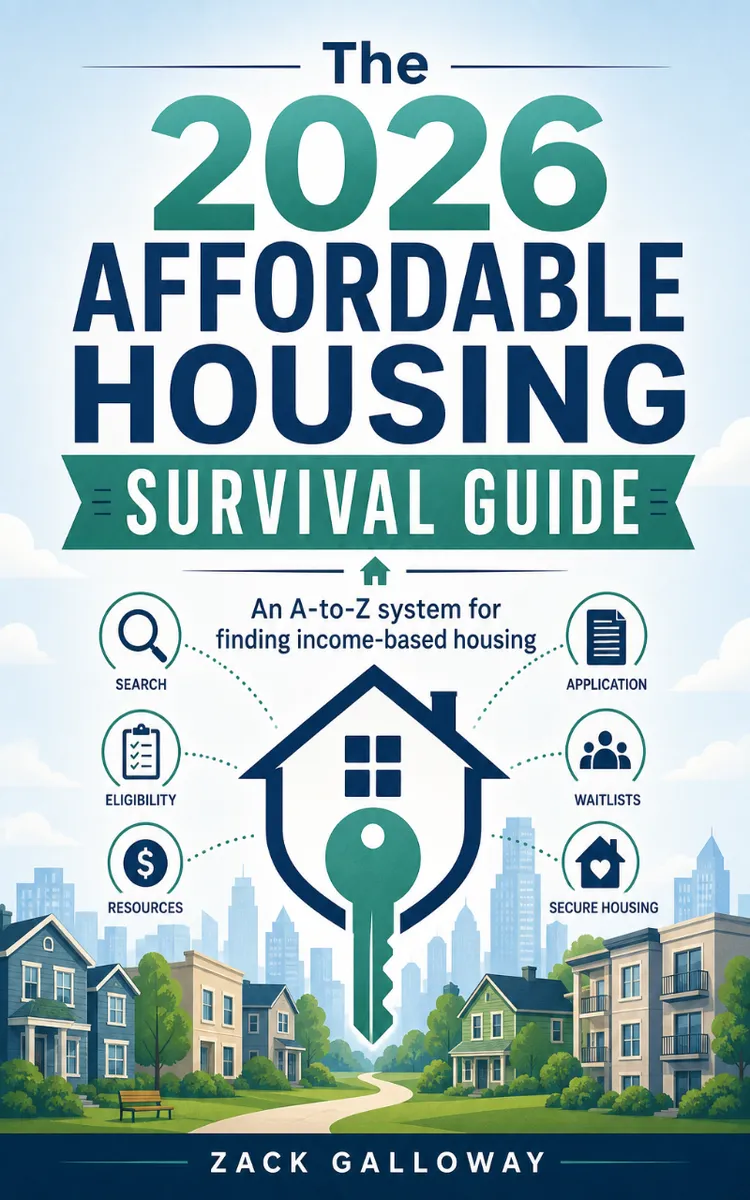
"The 2026 Affordable Housing Survival Guide" is a how-to guide book by Zack Galloway with 40 chapters and approximately 63,492 words. Finding U.S.
This book was created using Inkfluence AI, an AI-powered book generation platform that helps authors write, design, and publish complete books. It was made with the AI Ebook Generator.
Frequently Asked Questions
What is "The 2026 Affordable Housing Survival Guide" about?
Finding U.S. subsidized housing and navigating Section 8 and more
How many chapters are in "The 2026 Affordable Housing Survival Guide"?
The book contains 40 chapters and approximately 63,492 words. Topics covered include How Subsidized Housing Works, Public Housing Basics and Eligibility, Housing Choice Vouchers and Section 8, Project-Based Vouchers Explained, and more.
Who wrote "The 2026 Affordable Housing Survival Guide"?
This book was written by Zack Galloway and created using Inkfluence AI, an AI book generation platform that helps authors write, design, and publish books.
How can I create a similar how-to guide book?
You can create your own how-to guide book using Inkfluence AI. Describe your idea, choose your style, and the AI writes the full book for you. It's free to start.
Write your own how-to guide book with AI
Describe your idea and Inkfluence writes the whole thing. Free to start.
Start writingCreated with Inkfluence AI


