

Read the first chapter
The whole of chapter one, free. About 3 min. Turn the pages with the arrows, your keyboard, or a swipe.
Chapter 1
Space-Story Programming Mindset
A rover can’t just “guess” where to go in space. It needs a plan that tells it what it wants, what it can sense, and what it should do next. That same kind of plan helps you write code for rockets, games, pets, and even homework helpers.
Talia, 10, loves stargazing and LEGO building. When she builds a LEGO spaceship, she doesn’t start by snapping random pieces together. She plans: “I want the cockpit in the front, I need four wheels, and the stairs must fit.” That planning is the real superpower behind good code.
Fun fact: Code is like giving super-clear instructions to a robot brain-so it can’t get confused.
Why Is This Cool? Mission stories feel exciting because they have goals, obstacles, and results. The Mission-to-Code Map turns that excitement into a step-by-step plan you can use before you write any code.
When you map a mission, you stop guessing. You learn what to build, what inputs to use (what you start with), and what outcomes to check (what you should get back).
Bold key idea: When you plan first, your code has fewer “uh-oh” moments.
How It Works Use the Mission-to-Code Map.
• Goal (what you want): Tell the computer what “success” looks like. Example: “My robot dog should find the bowl.”
• Inputs (what you can use): List the things you can measure or read. Example: “Use the toy bowl position” or “Use the color of the floor blocks.”
• Outcomes (what you get back): Write the result you expect. Example: “It moves 3 steps toward the bowl.”
Kid-friendly example: - Pets: Goal: “Bring the leash.” Inputs: “The leash is on the hook.” Outcomes: “Pick it up and hold it.” - Food: Goal: “Make toast.” Inputs: “Bread slices, toaster heat, timer.” Outcomes: “Warm, crunchy toast.” - School: Goal: “Finish your worksheet neatly.” Inputs: “Pencil, eraser, blank lines.” Outcomes: “Answers fit inside the boxes.”
Putting It Into Practice Let’s plan a mini “space mission” for Talia: a LEGO rover that picks the right door on a toy control panel.
You will do this: 1. Pick a Goal: Write one sentence: “The rover chooses the door with the star sticker.” 2. List Inputs: Look at the panel and write what the rover can see: - “Door A has a star sticker” - “Door B has a circle sticker” 3. Write Outcomes: Decide what success means: - “The rover points to Door A.” 4. Test with pretend runs: Do 3 rounds using your own eyes first: - Round 1: If you see a star on Door A, expected outcome: points to Door A. - Round 2: If star is on Door B, expected outcome: points to Door B. - Round 3: If both have stars, expected outcome: you choose a rule (like “pick the left one”).
Quick checklist - Circle the Goal sentence. - Underline the Inputs you can actually see. - Box the Outcomes you can check. - Run 3 pretend rounds and write what you expect.
Expected outcome: your plan tells you exactly what the code must do-before you touch a keyboard.
What to Watch For Mixing up Goal and Outcomes Do this: Write success as a result you can check (“points to Door A”). Not this: Write success as a feeling (“it works well” or “it’s cool”).
Forgetting your Inputs Do this: List only what the rover can actually “see” or “read” (star sticker, door position). Not this: Add ideas like “it senses space magic” that you can’t measure.
Changing the plan mid-test Do this: Keep the same rule for all rounds (like “pick the left star”). Not this: Change the rule after Round 2 because it “feels easier.”
Before we build the code, do a quick mini-map: draw two doors on paper. Add one star sticker on one door. Then write your Goal, your Inputs, and your Outcome in three short lines. Which door should the rover pick?
End of chapter one. 4 more chapters in the full book.
Swipe or use the arrows to turn the page

What's inside: 5 chapters
- 1. Space-Story Programming Mindset
- 2. Block Logic for Rocket Decisions
- 3. Python Basics for Mission Control
- 4. Training AI to Detect Exoplanets
- 5. Computer Vision for Mars Rover Safety
About this book
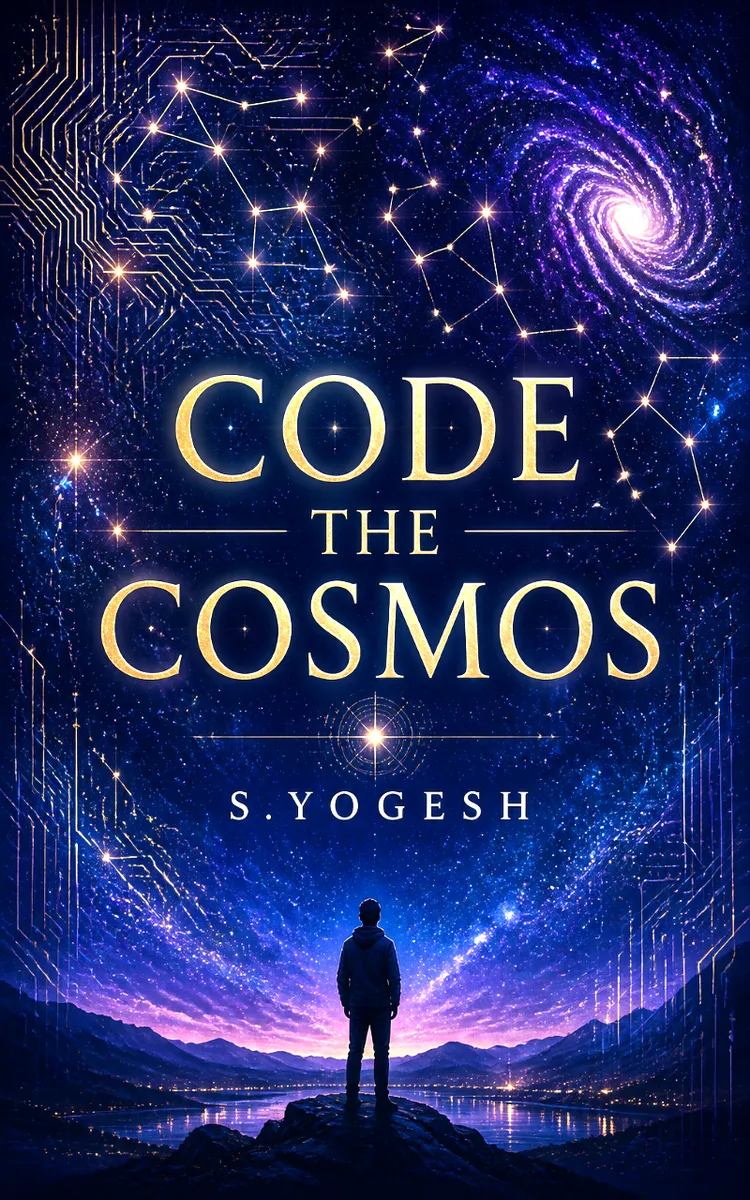
"Code The Cosmos" is a how-to guide book by yogesh sathish with 5 chapters and approximately 3,782 words. Family-friendly space-themed coding and AI learning with Python.
This book was created using Inkfluence AI, an AI-powered book generation platform that helps authors write, design, and publish complete books. It was made with the AI Ebook Generator.
Frequently Asked Questions
What is "Code The Cosmos" about?
Family-friendly space-themed coding and AI learning with Python
How many chapters are in "Code The Cosmos"?
The book contains 5 chapters and approximately 3,782 words. Topics covered include Space-Story Programming Mindset, Block Logic for Rocket Decisions, Python Basics for Mission Control, Training AI to Detect Exoplanets, and more.
Who wrote "Code The Cosmos"?
This book was written by yogesh sathish and created using Inkfluence AI, an AI book generation platform that helps authors write, design, and publish books.
How can I create a similar how-to guide book?
You can create your own how-to guide book using Inkfluence AI. Describe your idea, choose your style, and the AI writes the full book for you. It's free to start.
Write your own how-to guide book with AI
Describe your idea and Inkfluence writes the whole thing. Free to start.
Start writingCreated with Inkfluence AI


