
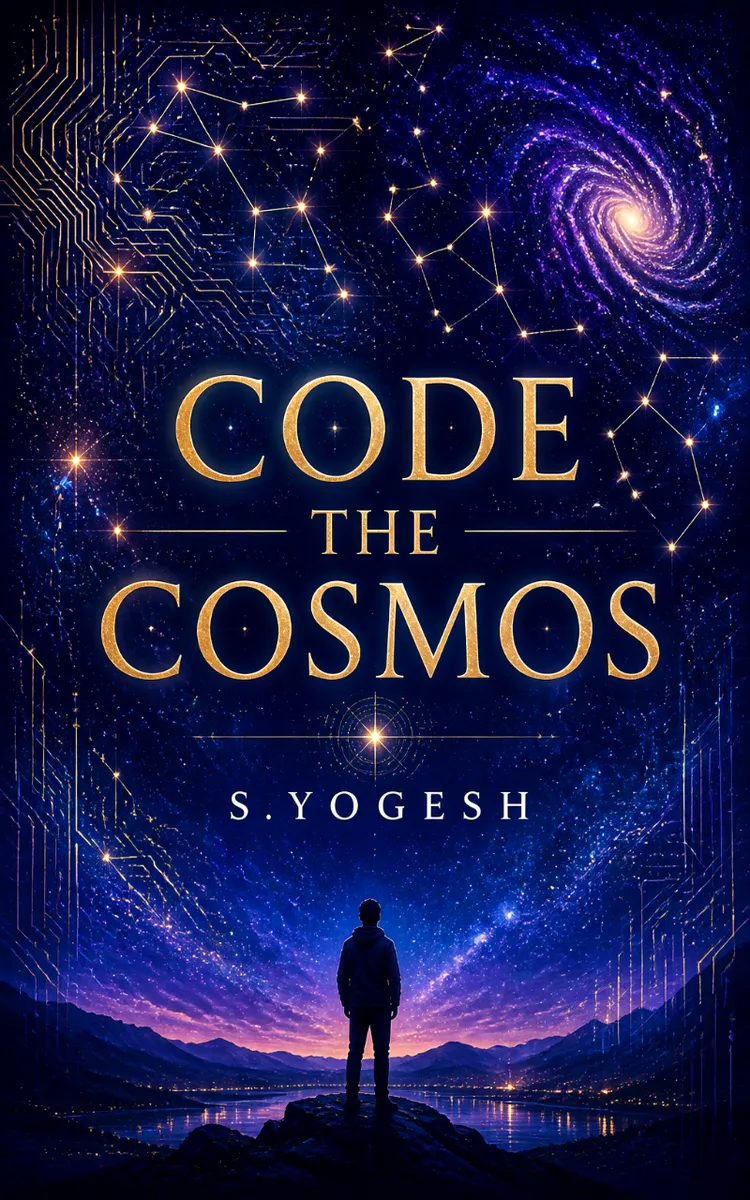

Read the first chapter
The whole of chapter one, free. About 6 min. Turn the pages with the arrows, your keyboard, or a swipe.
Chapter 1
Introduction
"Code the Cosmos" – Book BlueprintTotal Pages: 192Total Chapters: 20Average Chapter Length: ~8.5 pages (approx. 2,000–2,500 words per chapter)Core Themes: Space exploration, artificial intelligence, programming, and the future of humanity.🗺️ The 20-Chapter OutlineI’ve broken the book into four logical acts to give it a gripping narrative arc, moving from foundational ideas to practical cosmic coding, and finally into the deep, sci-fi future.Act I: The Digital Telescope (Foundations of AI & Space)Chapter 1: The Binary Universe * Concept: Introduction to how code and math are the universal languages. How bytes and bits mirror atoms and stars.Chapter 2: Algorithms in the DarkConcept: A history of how early computing helped us reach the moon, transitioning into how modern AI processes vast cosmic data.Chapter 3: Training the StargazersConcept: How neural networks are trained to recognize galaxies, stars, and exoplanets from millions of raw satellite images.Chapter 4: The Code That Sees DeeplyConcept: A look into the James Webb Space Telescope and the image processing algorithms that turn raw infrared data into breathtaking cosmic photos.Act II: Navigating the Void (AI as the Astronaut)Chapter 5: Autonomous PioneersConcept: How Mars rovers (like Curiosity and Perseverance) use AI to navigate terrain and make decisions without waiting for Earth's laggy signals.Chapter 6: Programming the Perfect OrbitConcept: The physics and code behind orbital mechanics. How AI optimizes fuel and trajectories for deep-space missions.Chapter 7: The Swarm IntelligenceConcept: Using fleets of thousands of tiny satellites (CubeSats) that communicate and coordinate with each other using decentralized algorithms.Chapter 8: Gravity’s CodeConcept: Simulating black holes and gravitational waves using Python and supercomputers.Act III: Searching for Life and Worlds (The Data Science of Astrobiology)Chapter 9: Hunting Exoplanets with PythonConcept: How machine learning sifts through light curves to find the tiny dip in brightness that signals a distant alien world.Chapter 10: The Goldilocks AlgorithmConcept: Programming parameters to identify "habitable zones" and predicting which planets could host liquid water.Chapter 11: Deciphering the Cosmic NoiseConcept: SETI (Search for Extraterrestrial Intelligence) and how AI separates background space noise from potential alien signals.Chapter 12: Synthetic Biology for Alien WorldsConcept: Using AI to design genetically modified crops or bacteria that can survive the harsh environments of Mars or Europa.Act IV: The Future of Cosmic Intelligence (Sci-Fi Reality)Chapter 13: Generation Ships and Silicon CaptainsConcept: If humans travel to distant stars, the journey will take centuries. This chapter explores AI caretakers keeping humans in stasis.Chapter 14: Von Neumann ProbesConcept: Self-replicating AI probes programmed to explore the galaxy by building copies of themselves from asteroid materials.Chapter 15: Quantum Computing on the Edge of TomorrowConcept: How quantum bits ($qubits$) will allow us to simulate the birth of the universe and map the multiverse.Chapter 16: The Simulated CosmosConcept: Are we living in a simulation? The philosophy and coding physics behind recreating a virtual universe.Chapter 17: Stellar Megastructures and AI ArchitectsConcept: Designing Dyson Spheres or space elevators using advanced AI material science.Chapter 18: Astro-Ethics and Silicon ConsciousnessConcept: If an AI becomes sentient while exploring the stars alone, what are its rights? Who owns space code?Chapter 19: The Last Line of CodeConcept: How AI might help humanity survive the ultimate death of the universe (Entropy) or escape to a new one.Chapter 20: Hello, UniverseConcept: A concluding reflection on how coding is humanity's ultimate tool for reaching our destiny among the stars.ACT I: THE DIGITAL TELESCOPEChapter 1: The Binary UniverseThe cosmos is not just made of stars, gas, and dark matter; it is made of information.When you look up at the night sky, you see points of light scattered across a velvet void. But to an astrophysicist, a software engineer, or an artificial intelligence, those points of light are a stream of incoming data. For centuries, humanity looked at the stars and saw gods, myths, and mysteries. Today, we look at the stars and see code.The idea that the universe is fundamentally computational is not as radical as it sounds. Think about the laws of physics. The gravitational force between two planets, the trajectory of a photon escaping the crushing gravity of a black hole, the precise vibration of a hydrogen atom in deep space—all of these phenomena follow strict, mathematical rules. These rules are the source code of reality.If physics is the operating system of the cosmos, then mathematics is the programming language it runs on. And just as a software engineer can reverse-engineer a competitor's application by analyzing its behavior, humanity is currently reverse-engineering the universe by writing code to decode its signals.Atoms and BitsTo understand how code and the cosmos intersect, we must look at the similarities between the building blocks of computing and the building blocks of matter. In computer science, everything reduces to the bit—a binary digit that can exist in one of two states: 0 or 1. Off or on. False or true. By combining billions of these simple binary states, we can build complex video games, stream high-definition video across oceans, and train massive artificial intelligence networks.The physical universe operates on a remarkably similar logic. Consider quantum mechanics. An electron spinning around an atomic nucleus can occupy specific, quantized energy levels. It can be in state A or state B, but it cannot exist in between. Matter itself is discrete. At its most fundamental level, nature seems to answer a series of yes-or-no questions.When we write software to simulate or analyze space, we are translating the analog grandeur of the universe into the digital language of bits. This translation is what allows artificial intelligence to become our eyes in the dark.The Scale of Cosmic DataThe marriage of AI and astronomy was born out of pure necessity. We are currently facing a data deluge. In the early days of astronomy, a scientist would sit at a telescope, look through an eyepiece, and sketch what they saw on a piece of paper. Later, photographic plates allowed us to capture static images of the sky.Today, telescopes are massive digital cameras operating across the electromagnetic spectrum. They do not sleep, and they generate more data in a single night than a human could review in a lifetime.Consider the Vera C. Rubin Observatory in Chile. When its Legacy Survey of Space and Time (LSST) begins operating at full capacity, it will capture a 3,200-megapixel image of the sky every 20 seconds. It will generate roughly 20 terabytes of data every single night, mapping billions of stars and galaxies over a ten-year period. If a human astronomer sat down to look at every single image for just five seconds, it would take them centuries to get through a fraction of the data.This is where code becomes our savior. An artificial intelligence algorithm does not blink. It does not get tired. It does not look at a galaxy and wonder what to make for dinner. It processes petabytes of data in seconds, filtering out the background noise to find the one-in-a-billion anomaly—the exploding supernova, the rogue asteroid, or the dipping light of a habitable planet.Python in the CloudsTo look at how this code looks in practice, modern astrophysicists don't just use telescopes; they use code repositories. Python has become the unofficial language of the cosmos. Thanks to open-source libraries like AstroPy, SciPy, and NumPy, complex mathematical operations that used to take months to write can now be executed in a few lines of code.Imagine a simple script designed to calculate the distance to a star based on its parallax—the apparent shift in its position as Earth orbits the Sun. The math involves trigonometry, matrix transformations, and error propagation. In pure code, it looks clean, structured, and logical:Pythonimport numpy as np
def calculate_stellar_distance(parallax_arcseconds): """ Calculates the distance to a star in parsecs using its parallax. Formula: d = 1 / p """ if parallax_arcseconds <= 0: return float('inf')
The star is too far to measure accurately
distance_parsecs = 1.0 / parallax_arcseconds distance_light_years = distance_parsecs * 3.26156
return distance_parsecs, distance_light_years
End of chapter one. 24 more chapters in the full book.
Swipe or use the arrows to turn the page

What's inside: 25 chapters
- 1. Introduction
- 2. Example: Alpha Centauri has a parallax of 0.754 arcseconds
- 3. Simulate a 4x4 meter patch of Martian terrain with a sudden rock bump
- 4. Initialize: Spacecraft starts far left, flying fast to the right
- 5. Planet is sitting at coordinates (0, 0)
- 6. Simulate a 5x5 pixel image from a telescope sensor
- 7. 10.0 represents ambient sky noise, higher values represent a galactic core
- 8. Simulate a raw pixel cross-section containing a brilliant star and an ultra-faint galaxy
- 9. 100000.0 is the brilliant star core, 2.5 is the faint, distant galaxy
- 10. Define a mesh network topology map where integers represent satellite IDs
- 11. Node 0 is linked to Node 1 and 2; Node 1 is linked to 0 and 3, etc.
- 12. Simulated raw solar radiation readings from each independent satellite sensor
- 13. Execute flight simulation: Photon starts at x = -10, passing 1.5 units above the mass
- 14. The central cosmic entity sits at coordinates (0, 0) with a mass factor of 0.8
- 15. Simulate 10 days of observations (1 reading per hour = 240 data points)
- 16. Generate normal stellar baseline flux hovering around 1.0 with 0.001 instrument noise
- 17. Simulate a planet transiting between hour 100 and hour 115
- 18. The planet blocks 1.5% (0.015) of the star's total light output
- 19. Execute the search pipeline
- 20. Profile for a candidate world orbiting a bright star (2.5 times Sun's luminosity)
- 21. The planet rests 1.4 AU away, with a physical radius 1.2 times larger than Earth
- 22. Simulate an alien civilization broadcasting at the 'Water Hole' frequency (1.420 GHz)
- 23. The alien world rotates slightly faster than Earth at 500 meters per second
- 24. Initialize a 10x10 meter simulation area with high soil toxicity levels (value = 80)
- 25. The central starting zone is pre-cleared for insertion
About this book
"Pasted Content" is a technical book by yogesh sathish with 25 chapters and approximately 12,216 words. It covers key insights and practical takeaways on the topic.
This book was created using Inkfluence AI, an AI-powered book generation platform that helps authors write, design, and publish complete books. It was made with the AI Documentation Generator.
Frequently Asked Questions
What is "Pasted Content" about?
"Pasted Content" is a technical book by yogesh sathish covering key insights and practical takeaways on the topic.
How many chapters are in "Pasted Content"?
The book contains 25 chapters and approximately 12,216 words. Topics covered include Introduction, Example: Alpha Centauri has a parallax of 0.754 arcseconds, Simulate a 4x4 meter patch of Martian terrain with a sudden rock bump, Initialize: Spacecraft starts far left, flying fast to the right, and more.
Who wrote "Pasted Content"?
This book was written by yogesh sathish and created using Inkfluence AI, an AI book generation platform that helps authors write, design, and publish books.
How can I create a similar technical book?
You can create your own technical book using Inkfluence AI. Describe your idea, choose your style, and the AI writes the full book for you. It's free to start.
Write your own technical book with AI
Describe your idea and Inkfluence writes the whole thing. Free to start.
Start writingCreated with Inkfluence AI


