

Read the first chapter
The whole of chapter one, free. About 9 min. Turn the pages with the arrows, your keyboard, or a swipe.
Chapter 1
The Sky Chariot’s First Demand
The lapis columns began to sing before the doors opened.
Amun-Ra felt the vibration through the soles of his sandals, a thin metallic note rising from the blue stone and threading through the throne hall. Incense smoke trembled above the braziers. The golden falcons carved into the walls seemed to turn their heads toward the ceiling, where no star could be seen through the polished stone.
He lifted one hand.
The musicians fell silent. The slaves holding the feather fans froze with their arms raised. Beyond the bronze doors, hurried feet struck the courtyard tiles.
“Let them enter,” Amun-Ra said.
The doors opened inward.
The overseer of the western quarry stumbled across the threshold, dust whitening his shaven head. Two guards caught him before he fell. In his hands he carried a tablet of black stone, its surface veined with blue light.
Amun-Ra leaned forward on his throne.
“How many stones reached the Beacon today?”
The overseer swallowed. “Three hundred and twelve, Life of the Two Lands.”
“Three hundred and twelve.” Amun-Ra’s fingers tightened around the arms of the throne. “The Sky Chariots demand five hundred.”
“The ramps cracked under the weight.”
“Repair them.”
“The water stores - ”
“Fill them.”
The overseer’s eyes flicked toward the high windows, toward the desert and the unfinished pyramid beyond it. Even from the throne hall, the Great Pyramid rose above the palace walls like a pale mountain cut into steps. Its upper reaches glowed in the evening sun. Its base was ringed by smoke, scaffolds, and the moving black specks of laborers.
“The men are collapsing,” the overseer said.
Amun-Ra stood.
Every person in the hall lowered their gaze. He wore no crown today, only the broad gold collar of office and a blue stone set at his brow. The collar weighed against his throat like a promise. The Sky Chariots had chosen Egypt. The Anunnaki had spoken through fire in the heavens and marked his reign for greatness. When the Landing Beacon reached the stars, they would descend and carry him beyond death.
He would not meet them as a beggar.
“Leave,” he said.
The overseer bowed so low his forehead touched the floor. “Pharaoh - ”
“Leave before I mistake your weakness for treason.”
The guards dragged him away. His heels scraped over the stone until the doors closed and swallowed the sound.
For a moment the throne hall returned to stillness.
Then the black tablet began to glow.
A blue line crawled across its surface. It widened, brightened, and spilled upward into the air. A figure formed above the dais: ten feet of white radiance, armored in shapes too smooth for any human smith. Its face held no eyes, only a dark vertical plane crossed by three points of cold light. Blue symbols revolved around its shoulders like captive stars.
The temperature fell.
Amun-Ra’s breath showed before him.
The hologram turned toward the throne. Its voice did not travel through the air. It entered the bones of his jaw and vibrated in his teeth.
“Harvest is behind schedule, little king.”
The slaves dropped their fans. One cried out. A priest near the western wall fell to his knees and pressed both hands against his ears.
Amun-Ra remained standing.
“I am Amun-Ra,” he said. “Lord of the Two Lands. Son of the sun. The Beacon rises by my command.”
“The Beacon rises slowly.”
“The stone is immense.”
“The stone is irrelevant.”
The figure lifted one hand. A circle of light opened beside it, showing the pyramid from above. The image was not painted or carved. It moved. Workers crawled across the terraces. Barges slid along the river. Gold ingots glimmered in guarded chambers beneath the palace.
Then the image pulled farther away.
The Nile became a dark thread. Egypt became a strip of green against a continent of ocher. The world curved beneath a field of stars.
Amun-Ra’s mouth went dry.
“The Sky Chariots see all,” said the emissary. “They measure all. Gold. Labor. Time.”
The image changed. A red mark appeared over the pyramid.
“Accelerate the work.”
Amun-Ra stepped closer to the light. “And when the Beacon is complete?”
The emissary’s head inclined.
“Then the road opens.”
“To the heavens?”
“To the Chariots.”
Amun-Ra felt the old certainty return, strong enough to push back the cold. The road would open. The gods would descend. They would recognize what he had built and take him among them. His body would become metal and light. His name would outlast stone.
“What do you require?” he asked.
“Double the gold quota. Double the labor. The next moon must see the upper courses sealed.”
A murmur moved through the priests.
Amun-Ra turned on them. “Silence.”
The emissary’s blue symbols sharpened.
“Failure will not be corrected.”
“What does that mean?”
The hologram leaned nearer. Its radiance painted the throne gold and the floor white.
“We will reset this world.”
The words seemed to pass through the walls and into the desert beyond. Somewhere outside, a bird struck the palace glass and fell.
Amun-Ra stared at the being before him. “You threaten Egypt?”
“We describe its replacement.”
The image above the dais vanished. The figure remained, towering and patient.
Amun-Ra thought of the half-built pyramid. He saw the cracked ramps, the broken shoulders of men beneath the sledges, the empty water jars stacked beside the work camps. He saw, too, the Sky Chariots descending through the clouds, their bellies opening like gates to eternity.
He had spent his life becoming worthy of that vision.
A voice came from behind him.
“Great One, the quotas cannot be met.”
It was Neferet, keeper of the royal granaries. She had entered without his notice, her linen robe dusted at the hem. She bowed, but not deeply enough.
“The eastern stores are already rationed,” she said. “If the crews double, the villages will have no seed grain.”
Amun-Ra looked at her. “Then take grain from the temples.”
“The temples have pledged their stores.”
“Take the pledges.”
“The people will starve before the flood.”
The hologram turned toward her.
“Resistance detected.”
Neferet went pale, but she held her ground. “I speak for the living.”
“You speak against the Beacon,” said the emissary.
“I speak against burying Egypt beneath it.”
The hall seemed to contract around those words.
Amun-Ra heard the faint hiss of the braziers. He heard the guards shift their spears. He heard his own pulse beneath the gold collar.
The emissary extended one luminous finger toward Neferet.
“Remove the obstruction.”
Amun-Ra could have ordered her death. The command sat ready behind his teeth. One word, and the guards would take her into the corridor. Her name would be scraped from the granary records before dawn.
But Neferet’s eyes did not leave his.
Not pleading. Measuring.
For the first time, Amun-Ra understood that the Sky People were not asking him to rule. They were asking him to produce.
The realization flashed and vanished beneath the larger hunger inside him: the need to be seen by the gods.
“She will remain,” he said.
The emissary’s lights narrowed.
“Then make her useful.”
Amun-Ra descended the steps of the throne. The black tablet pulsed at his side. Blue light crawled over his fingers when he touched it, cold as river water in winter.
“Bring me the royal seal,” he ordered.
Neferet’s face changed. “Pharaoh.”
“Bring it.”
A scribe hurried forward with a clay tablet and a reed stylus. His hands shook so badly that the ink spilled across the first line.
Amun-Ra dictated.
“By the voice of Amun-Ra, ruler of Upper and Lower Egypt, the Landing Beacon shall receive twice its present labor. Every quarry, village, and temple shall provide workers. Every gold hoard shall be opened. The work shall continue through darkness, flood, fever, and death.”
The scribe stopped.
Amun-Ra looked down at him. “Write.”
The reed scratched.
“Any worker who abandons the ramps shall be flogged. Any overseer who reports delay shall replace the fallen at the stone. Any village withholding grain or labor shall lose its elders, its fields, and its name.”
Neferet stepped forward. “That decree will kill them.”
Amun-Ra turned toward her.
“No,” he said. “The decree will build the road to eternity.”
“Eternity for whom?”
The question struck harder than defiance. Amun-Ra glanced at the hologram.
The emissary watched him without expression.
He imagined the being placing a hand upon his shoulder. He imagined black metal corridors, blue lights, stars beyond glass. He imagined kneeling - not as a subject, but as an equal welcomed into the Chariot.
He pressed his thumb into the wet seal.
The royal scarab sank into the clay.
“Seal it,” he said.
The scribe obeyed.
The tablet made a soft cracking sound as the mark hardened. At that instant, the black stone beside the throne flared. A blue glyph appeared in the air above it, bright and clean.
FAVOR_OF_GODS: 50 → 65
Amun-Ra did not understand the symbols, but he understood the sensation that followed. Warmth spread through his arm. The cold withdrew from the hall. Somewhere beneath the palace, machinery awakened with a low, subterranean hum.
The hologram inclined its head.
“Acceptable.”
The emissary dissolved into sparks.
The lapis columns stopped singing.
No one moved.
Then the palace erupted beyond the doors. Messengers shouted. Sandaled feet thundered across the courtyards. The decree passed from hand to hand, from scribe to captain, from captain to whip-bearer. Bells began ringing at the labor camps.
Neferet looked at the sealed tablet as though it were a body.
“You have made the people fuel,” she said.
Amun-Ra watched the last blue sparks fade above the black stone.
“I have made them immortal.”
“No. You have made them invisible.”
He should have punished her. The decree demanded it. The Sky People had seen her resistance. The new warmth in his arm seemed to urge him toward obedience, toward the clean simplicity of command.
Instead, he said, “Go to the granaries.”
“To do what?”
“Empty them.”
Her eyes widened.
“Feed the work crews,” Amun-Ra continued. “All of them. Tonight.”
“That will leave the villages without stores.”
“Then the Nile will rise.”
“And if it does not?”
He looked past her, through the open doors, toward the pyramid catching fire in the last light of day.
“Then the Beacon must rise before the people understand what it costs.”
Neferet’s expression hardened. She bowed once, stiffly, and left.
Amun-Ra remained beneath the lapis columns while the first work bells rolled across the desert. Their iron voices answered one another from camp to camp. Soon the ramps would fill again. Men would be driven into the dark. Gold would be weighed, counted, and carried toward the monument that pointed at the stars.
Above the palace, a narrow line of blue fire appeared in the evening sky.
A Sky Chariot.
It did not descend. It only watched.
Amun-Ra raised his face to it, the royal seal still wet beneath his thumb.
“I am the Morning Star,” he whispered. “My legacy is eternal.”
Far away, at the foot of the unfinished pyramid, the doubled crews began to move. Their ropes tightened. The first stone lurched forward. A whip cracked across the night.
And beneath the throne, something awakened that had been waiting for his command.
End of chapter one. 7 more chapters in the full book.
Swipe or use the arrows to turn the page


What's inside: 8 chapters
- 1. The Sky Chariot’s First Demand
- 2. Whip Math and the Pharaoh’s Doubt
- 3. The Laser on Ancient Stone
- 4. The Overseer’s Hidden Star Map
- 5. The Harvest Clock Starts Ticking
- 6. Amun-Ra’s Crown Breaks in Silence
- 7. Sabotage the Beacon, or Kneel
- 8. Earth Free, Gold Shattered Forever
About this book
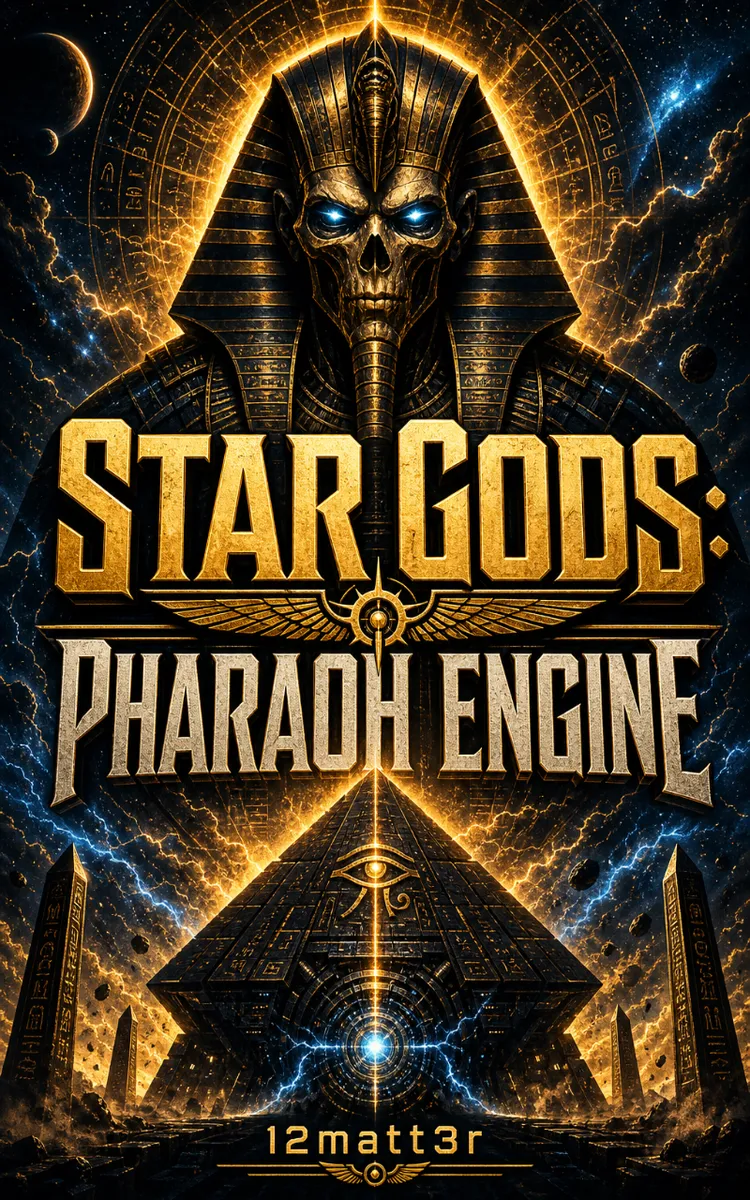
"Star Gods: Pharaoh Engine" is a fiction book by 12matt3r with 8 chapters and approximately 15,603 words. Sci-fi historical thriller game mechanics for Pharaoh vs Anunnaki.
This book was created using Inkfluence AI, an AI-powered book generation platform that helps authors write, design, and publish complete books. It was made with the AI Novel Writer.
Frequently Asked Questions
What is "Star Gods: Pharaoh Engine" about?
Sci-fi historical thriller game mechanics for Pharaoh vs Anunnaki
How many chapters are in "Star Gods: Pharaoh Engine"?
The book contains 8 chapters and approximately 15,603 words. Topics covered include The Sky Chariot’s First Demand, Whip Math and the Pharaoh’s Doubt, The Laser on Ancient Stone, The Overseer’s Hidden Star Map, and more.
Who wrote "Star Gods: Pharaoh Engine"?
This book was written by 12matt3r and created using Inkfluence AI, an AI book generation platform that helps authors write, design, and publish books.
How can I create a similar fiction book?
You can create your own fiction book using Inkfluence AI. Describe your idea, choose your style, and the AI writes the full book for you. It's free to start.
Write your own fiction book with AI
Describe your idea and Inkfluence writes the whole thing. Free to start.
Start writingCreated with Inkfluence AI


