
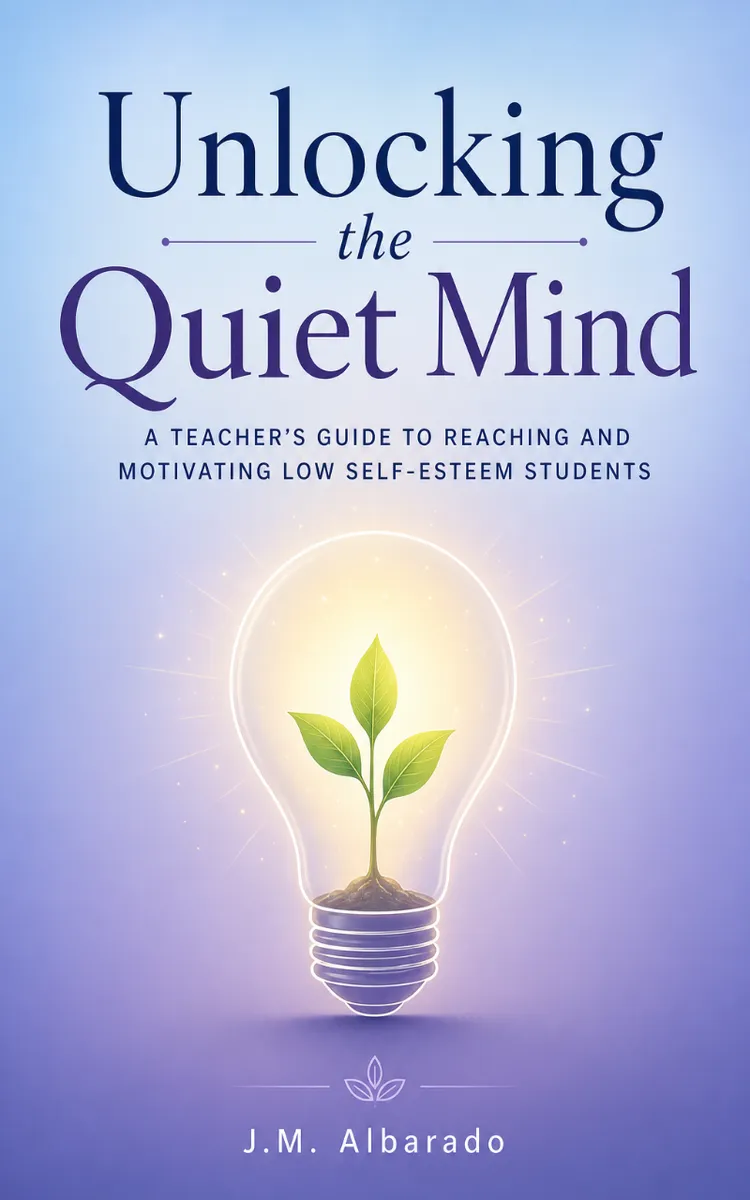
Unlocking the Quiet Mind
Created with Inkfluence AI
Classroom strategies to motivate students with low self-esteem
Table of Contents
- 1. Spotting Fear-Driven Motivation Loss
- 2. From Fixed to Growth Mindset
- 3. Designing Micro-Wins Every Lesson
- 4. Rewriting Praise and Feedback
- 5. Building High-Belonging Classroom Routines
- 6. Lowering Participation Anxiety Fast
- 7. Coaching Self-Talk During Work Time
- 8. Using Data to Celebrate Real Progress
- 9. Partnering With Families for Confidence
Preview: Spotting Fear-Driven Motivation Loss
A short excerpt from “Spotting Fear-Driven Motivation Loss”. The full book contains 9 chapters and 14,477 words.
Spotting Fear-Driven Motivation Loss (Avoidance-to-Need Map)
If a student shuts down, argues, or refuses to start, it can look like “bad behavior.” But fear often drives that behavior. Fear of failure means, “If I try, I might mess up.” Negative self-talk means, “I’m not good at this.” Academic trauma means, “Last time this happened, it hurt.” When those feelings build up, motivation drops like a toy that won’t turn on.
Here’s a fun fact: Your brain can treat school mistakes like danger - your body gets ready to protect you, even when the “danger” is just a worksheet.
This chapter helps you spot what fear looks like in real classroom moments, and use a simple tool called the Avoidance-to-Need Map to figure out what students need next.
---
What Fear Looks Like in Classroom Actions (Avoidance, Defiance, Shutdown)
Let’s name the three big ways fear shows up. You’ve probably seen them all.
Avoidance means a student tries to get away from the work. They may:
- “Forget” their pencil.
- Stare at the page without starting.
- Say, “I don’t know,” even when you know they can do parts.
Defiance means a student pushes back. They may:
- Say “No” or “I won’t.”
- Tear up paper, slam a book, or argue about rules.
- Act like the task is the enemy.
Shutdown means a student goes still. They may:
- Look frozen, stop talking, and avoid eye contact.
- Put their head down and stay quiet.
- Seem “checked out” even when you call their name.
Now add the “why” underneath those actions.
Fear of failure
This fear sounds like a thought: “If I try and get it wrong, something bad will happen.”
That “something bad” might be:
- Feeling embarrassed
- Getting in trouble
- Losing friends’ respect
- Remembering a time they got stuck before
Negative self-talk
Negative self-talk is an inner voice that talks mean. It might say:
- “I always mess up.” (kid meaning: “I will mess up again.”)
- “Other kids are smarter.”
- “I’m not the kind of person who can do this.”
When students hear those thoughts, they protect themselves by avoiding, defying, or shutting down.
Academic trauma
Academic trauma means school experiences that felt scary, painful, or humiliating. It can come from one big moment or many small ones. After that, students may act like the task is unsafe - like touching a hot pan. They don’t choose the fear; their body learns to guard them.
Concrete example (school version):
A student sees “Show your work.” Their stomach tightens. They remember a past time where their teacher said “Wrong” in a way that felt harsh, or classmates laughed. Now the student avoids because the page feels like danger.
---
Using the Avoidance-to-Need Map in a Real Lesson
Talia, a sixth-grade science teacher, notices a new student group getting stuck during lab directions. One student refuses to read instructions. Another argues about materials. Two others go quiet and stare at the table.
Talia doesn’t start with “Try harder.” She starts with the Avoidance-to-Need Map.
Step 1: Spot the action fast (What do they do?)
Watch for one clear behavior:
1. Avoidance (won’t start, hides materials)
2. Defiance (argues, refuses, “No”)
3. Shutdown (stares, freezes, head down)
Expected outcome: You stop guessing and pick one “fear pattern” to respond to.
Step 2: Listen for the fear words (What do they say or show?)
Use quick phrases that help you hear the inner worry. Try one:
- “What’s the hardest part right now?”
- “Do you feel stuck, worried, or angry?”
- “What do you think will happen if you try?”
Expected outcome: You hear the fear, not just the attitude.
Step 3: Map the action to a need (The “to-Need” part)
Use this simple connection. Fear usually creates one of these needs:
- If you see avoidance, the need often looks like: “I need a smaller start.”
- If you see defiance, the need often looks like: “I need control and safety from being judged.”
- If you see shutdown, the need often looks like: “I need help that feels doable, and a way back in without pressure.”
You don’t label the student as “fearful.” You use the map to choose your next move.
Step 4: Choose a response that matches the need (Do, then say)
Use short scripts. Keep your voice calm and your steps clear.
If the student needs a smaller start (avoidance)
Try:
- “We only do Step 1. You can do Step 1.”
- “Point to the first part you need.”
- “Do it for 10 seconds, then we check.”
Expected outcome: The student starts because the task shrinks.
If the student needs control and safety (defiance)
Try:
- “You choose: paper A or paper B.”
- “You can do the first part your way. I’ll check after.”
- “We use kind words here. I’ll help you.”
Expected outcome: The student stops fighting because the student has a safe choice.
If the student needs a way back in (shutdown)
Try:
- “I’ll do the first one with you....
About this book
"Unlocking the Quiet Mind" is a how-to guide book by J.M. Albarado with 9 chapters and approximately 14,477 words. Classroom strategies to motivate students with low self-esteem.
This book was created using Inkfluence AI, an AI-powered book generation platform that helps authors write, design, and publish complete books. It was made with the AI Ebook Generator.
Frequently Asked Questions
What is "Unlocking the Quiet Mind" about?
Classroom strategies to motivate students with low self-esteem
How many chapters are in "Unlocking the Quiet Mind"?
The book contains 9 chapters and approximately 14,477 words. Topics covered include Spotting Fear-Driven Motivation Loss, From Fixed to Growth Mindset, Designing Micro-Wins Every Lesson, Rewriting Praise and Feedback, and more.
Who wrote "Unlocking the Quiet Mind"?
This book was written by J.M. Albarado and created using Inkfluence AI, an AI book generation platform that helps authors write, design, and publish books.
How can I create a similar how-to guide book?
You can create your own how-to guide book using Inkfluence AI. Describe your idea, choose your style, and the AI writes the full book for you. It's free to start.
Write your own how-to guide book with AI
Describe your idea and Inkfluence writes the whole thing. Free to start.
Start writingCreated with Inkfluence AI


