
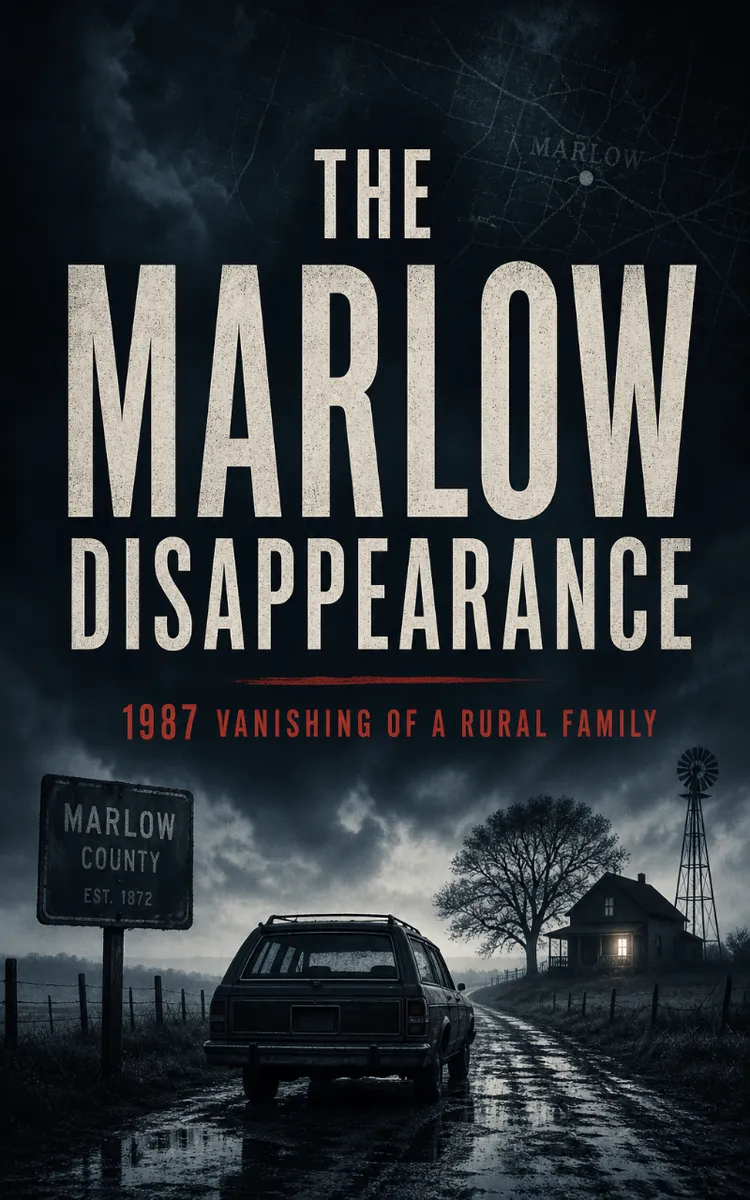

Read the first chapter
The whole of chapter one, free. About 12 min. Turn the pages with the arrows, your keyboard, or a swipe.
Chapter 1
The Marlow Farmhouse Vanishing, 1987
The Marlow farmhouse door hung open a fraction too long for habit, and the smell of cold paraffin and damp wool sat in the front room like a held breath. When the constable from the nearest station finally pushed his way inside, he found the kettle still warm enough to steam his knuckles through the enamel, the fire banked low but not quite dead, and a child’s shoe on its side in the passage as if someone had been pulled away mid-step. Outside, the night air was sharp with hedgerow damp and cut grass; it carried no obvious smoke, no shouting, no sign that an ordinary evening had turned into a disappearance.
News travelled the way it always did in that part of England-slow at first, then sudden. People came out of kitchens with their hands still smelling of onions, then stood in the road with their breath showing, watching uniformed men move like they were stepping around something fragile. The Marlow farmhouse-set back behind a line of trees, with fields sloping away toward a narrow lane-had been quiet for years, the kind of quiet that made you trust it. Now the quiet felt wrong, not theatrical, just wrong in the way a missing word can ruin a sentence.
What made the case significance beyond the obvious horror of an entire family vanishing was the way it resisted the first explanations. There was no body, no clean scene of struggle, no neat trail from the front steps to a ditch or a riverbank. The house itself-its rooms, its locks, the ordinary clutter of family life-held onto small details that refused to line up with any single version of events. Investigators could verify who had been present in the hours before the disappearance, what had been found in and around the property in the first scramble, and what the locals insisted they’d heard. But the night, as reconstructed from testimony and physical signs, kept changing its shape depending on which person you believed.
Date: 1987 (night of the Marlow family’s disappearance; first discoveries the following day) Location: Marlow farmhouse, rural English countryside Victims: The Marlow family (entire family) Status: Cold Case
The first person the case had to pass through was the one who arrived with the uniforms and the notebook. Detective Inspector [Name not provided]-the senior investigator assigned to the enquiry-was known for insisting on what could be checked, not what could be guessed. He wasn’t careless with rumours, but he treated them as dust: something that could settle on evidence if you didn’t control the air. His significance in the early days of the Marlow enquiry was that he kept the investigation anchored to verifiable facts-times, access points, and what could be physically demonstrated inside the farmhouse-while the community tried to fill the gaps with its own sense of narrative.
Then there was Sergeant [Name not provided], the officer who coordinated the first scene response and the careful, often unglamorous work of preserving what could still be preserved-touchpoints, doors, windows, and any object left in place. In a case like this, the first hours decide what kind of case it becomes. Sergeant [Name not provided] made sure the initial sweep didn’t turn into a free-for-all, and he kept locals at the edge of the property as the weather continued to press damp into every crevice. His significance was procedural, but in practice it was intimate; he was the one who told people to stop moving certain items and watched for the anger that flared when grief meets interruption.
In the farmhouse itself, the people tied to the Marlow family were the ones who made the disappearance personal. [Name not provided], a family member whose absence was part of what made the others vanish too, had left behind the kind of domestic traces that didn’t feel like a crime scene at all-things placed where they would normally be, not scattered. The significance of this role was that the house offered no obvious staging. Investigators didn’t have the comfort of a theatrical scene; they had to argue from small inconsistencies.
Outside the farmhouse, the case’s human variables were the six suspects the enquiry would revolve around. Their names were not needed in the early reconstruction to feel how tightly the net began to close around them; what mattered was what they were in the community and what they could plausibly claim about the hours in question. [Suspect 1 - Name not provided], someone with regular proximity to the Marlow property, mattered because investigators could test opportunity: whether that person’s movements could be aligned with the household’s last known normal. [Suspect 2 - Name not provided] mattered for a different reason-because their relationship to the Marlow family created suspicion even before any evidence arrived, and that sort of suspicion could either be a clue or a contamination. [Suspect 3 - Name not provided] mattered because their account, like so many in cases with missing bodies, had to survive the weight of time: clocks, weather, and the small sounds that get remembered only because they were out of place. [Suspect 4 - Name not provided] mattered for access and motive overlap; in rural cases, “means” can be a simple matter of keys and familiarity. [Suspect 5 - Name not provided] mattered because the investigation later relied on a confession connected to the disappearance; their role became a fulcrum for credibility. [Suspect 6 - Name not provided] mattered because another confession-one of three-would place them near the centre of the narrative, and investigators would have to decide whether that closeness was truth, bargaining, or a willingness to step into the story others wanted.
The turning point in reconstructing the Marlow night wasn’t a single dramatic discovery; it was the slow tightening of the timeline. Investigators built it the way you build a bridge-strand by strand-until suddenly the weight had somewhere to go.
[Evening, 1987] - The Marlow family were last seen in and around the farmhouse in the course of an ordinary day’s routine, with neighbours later agreeing on the general shape of the night’s start: lights on, voices inside, quiet outside. [Later evening, 1987] - Several people reported hearing or not hearing certain sounds-doors, vehicles, the kind of noise that travels further on a still night. Details differed, but the fact that people remembered at all told investigators the farmhouse had become unusually alert in the community’s ears. [Approx. late evening, 1987] - Investigators noted that access to the property-paths, gates, and the front entrance-was not complicated, which meant any departure could be mistaken for normal movement if the timing wasn’t anchored. [Overnight, 1987] - The house remained occupied in the sense that it did not immediately show signs of abandonment; warmth in the kettle and the way the fire was left suggested someone had treated the night as if it would continue. [Following morning, 1987] - A member of the local community raised the alarm after noticing that the household did not respond as expected-no usual early sounds, no expected movement, and the sense of interruption that rural people hear in silence. [Morning, 1987] - Police arrived and secured the scene, with Sergeant [Name not provided] controlling the perimeter while DI [Name not provided] directed the initial search for what could be verified without disturbing the layout. [Midday, 1987] - The first physical observations were recorded: the state of doors and windows, the domestic items left in place, and any evidence of disturbance outside. [Afternoon, 1987] - Neighbour testimony was gathered and compared to the physical signs. Some accounts aligned with the house’s stillness; others contradicted it in small but telling ways. [Days after, 1987] - As the six suspects were identified and questioned, their versions of the night began to diverge not only on what happened, but on what they believed the rest of the village already knew. [Weeks after, 1987] - The [TURNING POINT] arrived not with a body but with confession material: three separate confessions emerged at different points, each connected to the disappearance, and each creating a new problem for credibility rather than solving it outright.
Once the timeline narrowed, the investigation had to decide what belonged to the truth of that night and what belonged to later pressure. Evidence and accounts were treated as competing narratives until they could be tested against each other.
Physical Evidence: - The kettle and heating arrangement: investigators recorded that it suggested recent use, complicating any claim that the family had been absent for long before discovery. - The fire’s condition: it was banked rather than fully extinguished, a detail that locals later struggled to explain away. - The state of doors and windows: early notes described whether entry seemed forced or whether access might have been ordinary, which mattered immediately for the question of who could get in and out unnoticed. - Domestic items left in place: at least one child’s shoe in the passage was found lying as if movement had been interrupted, a detail that resisted tidy explanations. - Any exterior disturbance: officers looked for signs of vehicles or foot traffic, but the absence of a clear trail became part of the evidence in itself.
Witness Accounts: - Neighbours’ recollections of sound: some reported noises consistent with movement, others said the night was too quiet for what later accounts suggested. - Observations of lights: several people described whether lights in the farmhouse were on when they expected them to be, and whether they changed across the evening. - Reports of who was seen near the property: locals offered names indirectly through “I saw someone” descriptions that police later tied to the six suspects. - Accounts of early concern: people differed on how quickly they realised something was wrong, which affected how investigators weighed “last seen” claims.
Investigative Leads: 1. Access routes and gates - Investigators compared physical access points to suspect accounts of being near the property; outcome: some claims fit the geography, others didn’t match the timing implied by the house’s condition. 2. Sound carry on a still night - Officers pressed witnesses for specifics about what they heard and when; outcome: discrepancies emerged that couldn’t be smoothed over by simple memory error. 3. Vehicle presence or absence - Police checked whether any cars had been seen approaching or leaving; outcome: no single vehicle trail became decisive, leaving opportunity arguments unresolved. 4. The house’s internal warmth - Investigators treated the kettle and fire state as anchors rather than ornaments; outcome: accounts that placed the family away for a longer period were treated with suspicion. 5. Patterns of proximity to the farmhouse - Each suspect’s relationship to the Marlow property was mapped against the likely window of disappearance; outcome: two suspects’ proximity looked plausible, while four required more strain in their timelines.
The pivotal moment came, as it so often does in cases without bodies, from the words people chose when they believed the investigation might be moving past them. What Changed: The [TURNING POINT] was the appearance of confession material-three confessions connected to the disappearance-each claiming a role in what happened at the Marlow farmhouse. DI [Name not provided] did not accept them at face value. He treated confessions as both potential clarity and potential contamination, because in a small community with a major police enquiry, stories do not stay sealed. One confession suggested a certain sequence of events; another suggested a different sequence; the third sat between them, borrowing details that investigators had already heard in interviews. The inconsistencies were not only factual. They were behavioural-how each confessor spoke about the house, the timing, and what they believed police already knew.
Why It Mattered: Without bodies, the investigation’s certainty had to be manufactured carefully from what could be corroborated. The confessions, instead of closing the case, reopened the question of whether the farmhouse had been left under one set of circumstances or another. Investigators tested credibility by looking for alignment with physical signs-doors, fire state, and the kind of domestic traces that would be hard to know unless someone had been in the house or had access to detailed information. Where a confession matched the physical record, it gained weight. Where it contradicted it-or where it leaned on details that seemed to have circulated-DI [Name not provided] treated it as contamination rather than confession. The confessions became an investigative engine that drove more questions than it answered.
What Followed: - Police re-interviewed witnesses with sharper prompts about timing and sounds that the confessions had mentioned or avoided. - The six suspects were re-assessed, not just for what they said later, but for what their earlier answers had left out. - The scene record from the first day was revisited, with officers cross-checking whether early observations had been interpreted correctly.
By the time the legal system caught up, the case had already become something heavier than a disappearance in a file. It became a courtroom argument built from absences: no bodies, no definitive trajectory, and confessions that could not all be made to fit the same night.
Legal Outcome: Where prosecutions were pursued, they relied on confession evidence and the surrounding credibility-how the confessions were obtained, how they aligned with independent observations, and whether the inconsistencies could be explained without breaking the case’s central timeline. The absence of bodies remained the most stubborn problem. Even where a confession was compelling in isolation, investigators and the court had to reckon with the possibility of contamination and the practical difference between knowing what happened and knowing what could be proven. In the end, the legal outcomes did not produce the kind of closure that families and communities wanted: the case remained unresolved in the public sense, with the investigative record continuing to hold contradictions that could not be reconciled to a single, provable narrative.
Impact: - The local community’s trust fractured and then reassembled in uneasy pieces, with people arguing about who had been truthful from the start and who had shifted under pressure. - Media attention-when it arrived-focused on the unusual combination: an entire family gone, three confessions, and no bodies, creating a case that refused neat explanation. - Police procedure in later similar enquiries drew on the Marlow experience: the need to protect scene integrity early and to treat confession material as both clue and risk.
Unresolved Questions: 1. Who, in the hours before discovery, had the opportunity to move through the farmhouse without leaving a clear trail outside? 2. Which confession-if any in whole-matched the physical and testimonial record closely enough to represent the true sequence? 3. Why did the household’s internal signs (warmth in domestic fixtures, the fire’s state) appear to contradict versions of events that placed the family away for longer? 4. What happened to the Marlow family after the last confirmed normal contact, given that no bodies were found?
On the day the first formal accounts were filed, DI [Name not provided] stood at the edge of the passage where the child’s shoe had been found. The room was cooler than it ought to have been, the air tasting faintly of damp stone and old smoke from a fire that had been treated carefully, not carelessly. He listened to the quiet of the farmhouse and tried to hear the night that had vanished-door sounds that didn’t quite agree, footsteps that might have been there or might have been imagined later by people desperate for an explanation.
The difficulty wasn’t that the Marlow family disappeared. The difficulty was that the house remembered them, and the evidence-physical and spoken-kept insisting on more than one version of what the night had been. Somewhere between the confessions and the first scene record, the truth had gone to ground, and the investigation had only just begun to realise how deep the ground ran.
End of chapter one. 7 more chapters in the full book.
Swipe or use the arrows to turn the page


What's inside: 8 chapters
- 1. The Marlow Farmhouse Vanishing, 1987
- 2. Six Suspects and Their Known Motives
- 3. The Three Confessions: What Changed
- 4. Forensic and Scene Details Without Bodies
- 5. The Timeline That Didn’t Add Up
- 6. Witness Accounts, Distance, and Reliability
- 7. Key Investigative Turning Point and Reassessment
- 8. Aftermath: Cold-Case Impact and Legacy
About this book
"The Marlow Disappearance" is a true crime book by Inkfluence AI Demo with 8 chapters and approximately 21,046 words. Meticulously researched account of a baffling cold case.
This book was created using Inkfluence AI, an AI-powered book generation platform that helps authors write, design, and publish complete books. It was made with the AI True Crime Book Writer.
Frequently Asked Questions
What is "The Marlow Disappearance" about?
Meticulously researched account of a baffling cold case
How many chapters are in "The Marlow Disappearance"?
The book contains 8 chapters and approximately 21,046 words. Topics covered include The Marlow Farmhouse Vanishing, 1987, Six Suspects and Their Known Motives, The Three Confessions: What Changed, Forensic and Scene Details Without Bodies, and more.
Who wrote "The Marlow Disappearance"?
This book was written by Inkfluence AI Demo and created using Inkfluence AI, an AI book generation platform that helps authors write, design, and publish books.
How can I create a similar true crime book?
You can create your own true crime book using Inkfluence AI. Describe your idea, choose your style, and the AI writes the full book for you. It's free to start.
Write your own true crime book with AI
Describe your idea and Inkfluence writes the whole thing. Free to start.
Start writingCreated with Inkfluence AI


