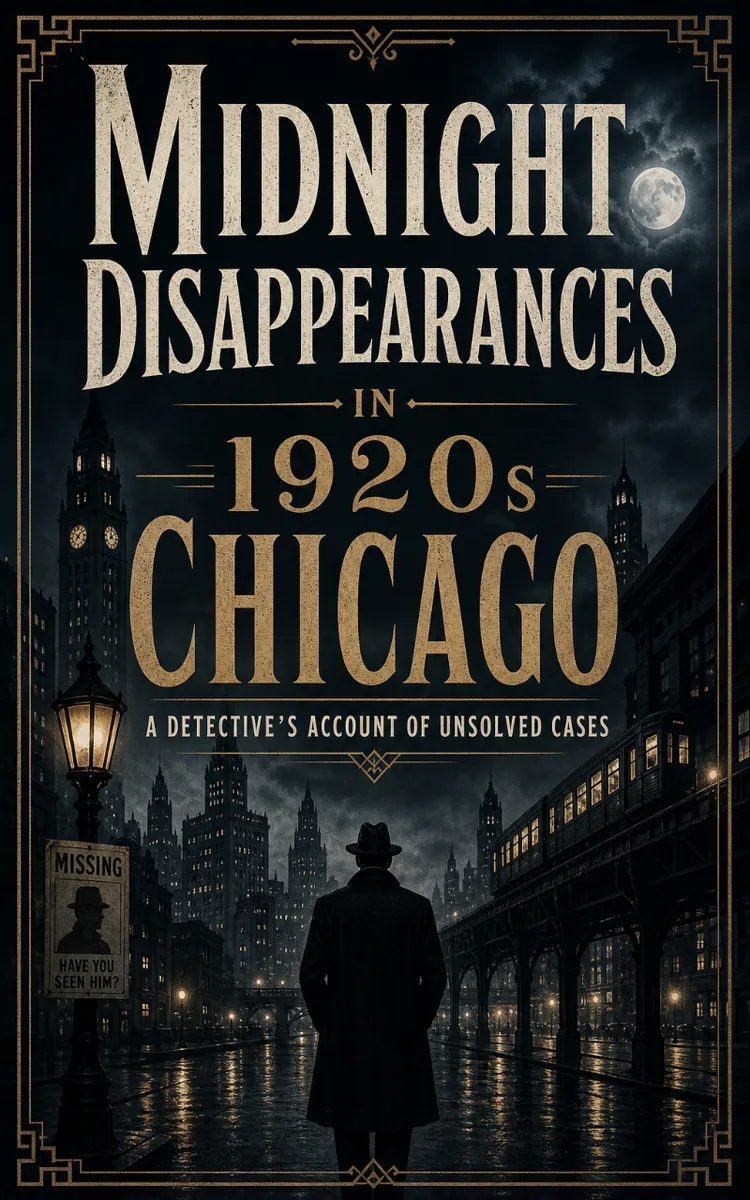
Midnight Disappearances In 1920s Chicago
True Crime

Midnight Disappearances In 1920s Chicago

by Anonymous · 2026-05-06

True-crime investigation of unsolved midnight disappearances in 1920s Chicago

1 chapters 2,576 words ~10 min read English 240 reads

Read the first chapter

The whole of chapter one, free. About 12 min. Turn the pages with the arrows, your keyboard, or a swipe.

Chapter 1

The First Midnight Vanishing on Halsted

The bell over the Halsted Street station door kept ringing after the night watchman had gone still, the sound fading under the hiss of steam from the street grates. I had just taken my coat off when the desk sergeant shoved a slip of paper toward me like it might burn through the wood. “Midnight call. Halsted,” he said. His voice was clipped, practiced at

disappointment. “Said they’d found her-found the place, anyway. No one can say where she went.”

Outside, the city held its breath in the way it does when the hour turns and the last trolley has already clattered away. Gaslight made the sidewalk slick with a weak shimmer, and the air smelled of coal smoke and damp wool. When I stepped into the hall, I heard the sergeant’s pen scratching notes and the soft, nervous shifting of boots behind me. Nobody wanted to be the first to admit what they already suspected: another midnight vanishing, and the kind that leaves you only a scene and a question.

The case was significant before I even saw it, because the call had come in with details too neat to be an accident and too confused to be a lie. The caller-female voice, strained, not drunk-had managed to describe the street corner and the building’s condition without ever mentioning a name. She used the word “gone” as if it were a tool, as if she expected the police to understand exactly what she meant. I’d heard that kind of phrasing before, in other late hours where people try to bargain with the dark by naming it. This time the bargaining had failed, and the failure had a location: Halsted Street, close enough to the line of ordinary life that it should not have allowed the ordinary rules to break.

Date: October 12, 1920

Location: Halsted Street, Chicago

Victims: One woman (unidentified in the account)

Status: Unsolved (Cold Case)

Detective (First-Person Narrator) - I was the one sent out, and I went because the night’s first report carried the shape of a pattern-too specific about where something was left behind, too vague about where it went. My job in those hours was to treat every scene like it could either explain itself or betray you. The trouble with midnight disappearances is that they often look simple until you start touching the details. Halsted would not let me do that gently. The street was busy enough earlier that the witnesses could have been careless; it was quiet enough now that any mistake would be magnified.

Desk Sergeant - He handled the call intake and kept the initial information straight when everyone else wanted to rush. He wasn’t a romantic about cases, and that made him useful. He told me what had been written down at the desk and what had not-especially the omission of a name-and he watched my face for the moment I realized the report was missing the one thing that should have been there. “She’s not giving it,” he warned, meaning the caller and meaning, perhaps, the truth.

Night Watchman - At the station, he had been the one who passed the first word along and then went quiet, as if the sound of the bell was louder than his own thoughts. He wasn’t part of the scene on Halsted, but he was part of the chain of custody for the night. His unease mattered because it suggested the caller’s story had already rattled the men before I ever arrived.

Caller (Female Voice, Unidentified) - She had described a place and a disappearance in a manner that sounded immediate, not rehearsed. She’d said there was no body, no blood, no clear struggle-only absence where there should have been presence. She also refused, or failed, to provide a name. In my experience, that could mean fear, confusion, or intent. On paper it looked like missing information; on Halsted Street it became the first piece of the puzzle that would not sit flat.

Street-Level Witnesses - At the scene, the witnesses weren’t a crowd so much as a collection of people who had woken up enough times to recognize unusual sound. They spoke in fragments: a door that shut too hard, a shadow that moved against gaslight, the faint scrape of something heavy being dragged and then nothing at all. Their significance wasn’t in any single statement, but in how their stories bent around the same small gaps-gaps that made the night’s details refuse to add up.

October 12, 1920 - 12:05 A.M. - The call came into the station, reporting a disappearance connected to Halsted Street. The caller gave a location and described what was left behind, but no name.

October 12, 1920 - 12:12 A.M. - The desk sergeant logged the report and dispatched me to Halsted. The watchman’s comment-quick, anxious-suggested the information sounded wrong in the way first reports often do.

October 12, 1920 - 12:40 A.M. - I arrived on the street and found the building’s entrance lit from within, though the room beyond had the dull quiet of something abandoned mid-act. The air carried stale cooking odors mixed with cold damp.

October 12, 1920 - 12:43 A.M. - I met the first witness, a man near the corner who kept rubbing his hands together as if the cold could be negotiated away. He said he’d heard a “commotion” and then the sound of a door closing, firm and final.

October 12, 1920 - 12:47 A.M. - Another witness, a woman in a shawl drawn tight, claimed she’d stepped outside to fetch air and found the street unusually empty for that hour. She insisted the quiet came too quickly, like someone had cut the sound off.

[TURNING POINT] October 12, 1920 - 12:52 A.M. - Inside, I found the room’s order had been disturbed without any sign of a search: a chair shifted, a small personal item left on a table where it shouldn’t have been. The absence felt staged by absence itself-someone had taken the one thing that mattered and left the rest arranged enough to mislead.

October 12, 1920 - 1:00 A.M. - I walked the doorway and threshold carefully, noting tracks in the dust and the way they ended. The pattern wasn’t consistent with a simple exit; it suggested the yard or alley had been used, but the direction didn’t match the witnesses’ descriptions.

October 12, 1920 - 1:08 A.M. - I asked about sound-what they heard, what they didn’t, what time they believed it happened. The answers collided: one man placed the door close after midnight; the woman placed it closer to one o’clock.

October 12, 1920 - 1:15 A.M. - I returned to the room and checked the window frames and sill for fresh disturbance. The glass looked intact, but the latch had been handled in a way that did not match the rest of the scene.

October 12, 1920 - 1:27 A.M. - I sent word back to the station to bring a man with better eyes for dust and prints. The sergeant’s reply was immediate and blunt: the caller had hung up without giving a name, and there was no other direct lead on file.

October 12, 1920 - 1:40 A.M. - As the extra help arrived, the street witnesses grew more guarded. People will talk until they feel the police are listening; then they begin to calculate what speaking costs. The temperature seemed to drop a degree with every minute.

The room itself was not large, but it held the kind of quiet that makes your ears strain for meaning. Coal soot marked the corners where no lamp ever quite reached. When I stepped closer to the table, I could smell the faintest sweetness of something spilled and wiped too quickly. The air didn’t carry the stink of violence; it carried neglect and cold.

Physical Evidence:

• A shifted chair placed at an angle that suggested hurried movement rather than a calm departure, offering a timeline clue about how the room was left.

• A small personal item left on the table, out of its usual place by the standards of a lived-in room, implying someone had removed the person without taking everything.

• Dust and track marks near the threshold that ended abruptly, conflicting with the direction described by at least one witness.

• A window latch that showed signs of handling, despite the glass appearing intact, raising questions about possible entry or exit routes.

• A door closure impression-witnesses described a firm shut-contrasted with the room’s overall lack of a struggle.

Witness Accounts:

• A man on the corner described hearing a commotion and then a door shutting “like it meant business,” placing it shortly after midnight.

• A woman in a shawl said the street was “too empty” when she went out, and she emphasized how quickly the quiet returned.

• Both witnesses agreed on the abruptness of the change in sound, though their times did not agree.

• A third presence-spoken of but not pinned down to a name-was mentioned as someone who might have been near the alley, but no dependable description was provided.

Investigative Leads:

• Trace the dust marks to the alley - Outcome: tracks appeared to end in a way that did not align cleanly with the witnesses’ described direction of movement.

• Re-interview the caller’s details from station logs - Outcome: the caller’s name was not recorded; only location and general description remained.

• Check the window latch and sill for fresh disturbance - Outcome: handling suggested movement, but no clear proof of a forced entry or clean exit emerged on the first pass.

• Confirm witness timeframes against street conditions - Outcome: the testimonies could not be reconciled without forcing guesses, which I refused to do.

• Identify the building’s entry access - Outcome: the door and window behavior implied more than one possible route, but the scene did not support a single, consistent path.

When the turning point arrived, it didn’t come as a confession or a sudden photograph of truth. It came as a mismatch you can feel in your teeth. I had been expecting chaos-something broken, something torn, a reason the room had to look like it had been robbed blind. Instead I found a room that looked almost respectable in its disorder, as if someone had taken care to leave it believable. The shifted chair wasn’t knocked over; it was moved. The personal item wasn’t flung; it was set down where the eye would land first. And the door-according to the witness-had slammed, yet there was no accompanying evidence of a struggle in the way a slammed door usually belongs to one.

“What time did you hear it?” I asked the woman in the shawl, and her breath puffed pale in the lamplight as she answered.

“Not long after,” she said, then corrected herself as if the correction embarrassed her. “Later than I thought. Sometime around the turning of the hour.”

A man near her cut in, impatient. “It was right after midnight. I know my own clock.”

The woman’s eyes flashed toward him, and in that moment their disagreement stopped sounding like uncertainty and started sounding like protection. I could hear the street outside through the window frame-distant wheels, a dog barking far off-but inside the air stayed still, waiting for someone to admit they’d seen more than they were willing to say.

What Changed: The discovery of the staged-seeming order-movement without wreckage, absence without mess-forced me to treat the disappearance as something planned around perception. Whoever took the woman had not only removed her; they had tried to control what the first responders would think they were seeing. That meant the call itself mattered. A caller who couldn’t provide a name, yet could provide a location and a story with just enough detail to bring the police, was not offering a simple report. She was offering a lead that would steer us into the room and then into its contradictions.

Why It Mattered: In earlier nights, when people vanished, the scene usually told you the story the body of evidence couldn’t. Here, the evidence was too tidy about the wrong things. It made the witnesses’ timing disputes more than mere human error. It suggested that either the witnesses had been distracted at the wrong moment, or they were being cautious because they understood what the scene was trying to hide. The night’s details never added up because the night had been arranged to prevent them from adding up.

What Followed:

• I requested additional coverage and a more thorough dust and print examination, knowing the first pass would miss what a second set of eyes might catch.

• The immediate pushback from witnesses tightened the circle of information; what they didn’t say became as loud as what they did.

• The lack of a caller name at the station turned into a practical obstacle: we had a scene, but we lacked the anchor to follow the chain backward.

By dawn, the legal machinery had not moved far enough to call this a case with defendants. There was no arrest to announce, no body to compel a formal charge, no confession to bind the facts into a single narrative. What we had was a missing woman and a room that refused to confess its own logic. The matter remained under police investigation, with reports forwarded and re-read as if repetition could make the contradictions collapse into coherence.

Legal Outcome: No trial, verdict, or sentencing followed from the Halsted Street disappearance of October 12, 1920. The absence remained unresolved, and the investigation stalled on the same central weakness that haunted the first night: the caller’s incomplete information and the scene’s inability to be reconciled with witness timing.

Impact:

• The Halsted Street disappearance became one of the earliest midnight incidents in the growing pattern the department could not quite explain, even as more similar reports began to circulate in the city’s nervous corners.

• The witnesses’ reluctance hardened into a community habit; people learned that speaking too plainly could bring attention they did not want.

• The station learned to treat name-less calls as more than clerical omissions, because in this case the missing name wasn’t just paperwork-it was a missing piece of the narrative.

Unresolved Questions:

• Who was the caller, and why was no name recorded when the first report was made?

• What exact route did the person who disappeared take, given the dust and track marks that did not align with witness directions?

• Was the window latch behavior consistent with an exit, an attempted exit, or an attempt to mislead?

• How did the witnesses’ times become so far apart while still describing the same abrupt change in sound?

• Why did the room’s disorder look arranged rather than chaotic, as though someone had accounted for how the police would look at it?

When I left Halsted, the street had begun to brighten in patches, as if daylight were negotiating with the buildings for permission to arrive. I kept thinking about that personal item on the table-small enough to be overlooked, careful enough to be placed. In the daylight, it would have looked like nothing. In the midnight, it had looked like intent. And intent, I learned early, is what makes a disappearance linger long after the sirens stop sounding.

End of chapter one.

1 / 11

Swipe or use the arrows to turn the page

What's inside: 1 chapter

  1. 1. The First Midnight Vanishing on Halsted

About this book

"Midnight Disappearances In 1920s Chicago" is a true crime book by Anonymous with 1 chapters and approximately 2,576 words. True-crime investigation of unsolved midnight disappearances in 1920s Chicago.

This book was created using Inkfluence AI, an AI-powered book generation platform that helps authors write, design, and publish complete books. It was made with the AI True Crime Book Writer.

Frequently Asked Questions

What is "Midnight Disappearances In 1920s Chicago" about?

True-crime investigation of unsolved midnight disappearances in 1920s Chicago

How many chapters are in "Midnight Disappearances In 1920s Chicago"?

The book contains 1 chapters and approximately 2,576 words. Topics covered include The First Midnight Vanishing on Halsted.

Who wrote "Midnight Disappearances In 1920s Chicago"?

This book was written by Anonymous and created using Inkfluence AI, an AI book generation platform that helps authors write, design, and publish books.

How can I create a similar true crime book?

You can create your own true crime book using Inkfluence AI. Describe your idea, choose your style, and the AI writes the full book for you. It's free to start.

Write your own true crime book with AI

Describe your idea and Inkfluence writes the whole thing. Free to start.

Start writing

Created with Inkfluence AI