

Read the first chapter
The whole of chapter one, free. About 6 min. Turn the pages with the arrows, your keyboard, or a swipe.
Chapter 1
Choosing Your Quiet Hour Identity
Picture This
Nadia, 34, a product manager, could feel her focus slipping before she even noticed it. Not in a dramatic way-more like her brain started doing that “tiny detours” thing. She’d sit down to work and immediately start rewriting the same plan. She’d open three tabs “just to check something,” then realize an hour went by and she hadn’t moved the needle. By late morning, her mood was tight, like her decisions were getting heavier and slower.
She wasn’t lazy. She was competent. She was also burning through something invisible: permission. Permission to trust her next decision. Permission to stay steady when the day got messy. And somewhere along the way, she’d started treating “calm morning silence” like a mood-something she needed to feel first, before it could “work.” If she didn’t wake up peaceful, she’d skip it. Or she’d try anyway, but without commitment, which is basically the same thing as skipping.
If morning silence is only a feeling, how can it ever become a reliable identity you can trust when life gets loud?
The Mindset Shift
Old Belief: Morning silence is a mood you wait for. New Reality: Morning silence is an identity you practice-so your mind learns to default to self-trust, not impulse.
Here’s the shift Nadia made that changed everything: she stopped asking, “Am I calm enough to do this today?” and started asking, “Who am I when it’s not easy?” That question matters because your brain doesn’t treat habits like separate events. It treats them like evidence. Every time you show up for the hour-even when you’re restless-you’re telling your nervous system, I keep my word to myself. That’s identity building. Not vibes.
When you practice silence as an identity, you also reduce decision fatigue. Because your morning doesn’t become a debate. You don’t spend energy negotiating with your own willpower. You follow a rule: “I do The Quiet Hour.” The “why” behind this is simple: the brain hates ambiguous instructions. Ambiguity forces more micro-decisions. Clarity removes them. And clarity, repeated daily, becomes automatic.
Nadia had a week where she woke up with her heart already racing-work emails, deadlines, the whole preloaded stress package. In the past, she would’ve called that a sign to skip. Instead, she treated it like data. She sat down for her hour anyway, even if her mind was noisy. She didn’t try to silence her thoughts like they were something to defeat. She practiced noticing them, returning to stillness, and letting the hour be an “I keep going” statement. By the time she hit her first meeting, she wasn’t magically cheerful-she was anchored. Decisions felt less like battles.
That’s the payoff: morning silence becomes the part of you that doesn’t need the day to be perfect to stay steady.
Going Deeper
The reason this works isn’t mystical. It’s behavioral conditioning plus emotional regulation training-wired into how your brain learns “what I do in hard moments.” When you treat silence as an identity, you’re not depending on your current emotional state. You’re training your response to it. That’s different.
Think of the hour like a daily rep for self-trust. You’re not trying to force calm; you’re teaching your system that discomfort doesn’t get to drive the car. The moment you sit down when you’d rather scroll, you’re rehearsing a new pattern: notice → don’t obey → return. Over time, that pattern shows up outside the hour too. It’s not that stress disappears. It’s that your relationship to stress changes. Your mind stops treating every urge as an emergency.
Signs this pattern is running your life:
1. You only do your best work when you “feel ready.” If you don’t feel ready, you delay, negotiate, or lower the bar. 2. Your mornings decide your whole day. Even one rough start turns into a cascade: slower focus, sharper reactions, more second-guessing. 3. You treat rules like suggestions. The moment motivation drops, your routine breaks-not because you’re incapable, but because you’re not practicing identity. 4. You rely on mental bargaining. “If I had more time… if I had less stress… if I slept better…” becomes your inner script.
En résumé: You don’t need a calm morning-you need a committed identity that can handle a messy morning.
And let’s be real: identity is sticky because it’s measurable from the inside. You can’t measure “calm.” But you can measure “I kept my promise.” When Nadia started showing up even when restless, the hour stopped being a reward and became a standard. That standard is what your focus and emotional regulation start to lean on.
Reflection & Self-Assessment
1. Where do you currently treat The Quiet Hour like a mood instead of a promise? Look for the moment your routine depends on how you feel. An honest answer might sound like: “If my mind is loud, I assume it won’t work, so I skip.”
2. What story do you tell yourself when you wake up tense or distracted? Your story is usually the real trigger. It might be: “I’m behind today,” or “Silence won’t help me,” or “I’ll do it later when I’m calmer.”
3. What would change if you practiced silence as proof of self-trust, not proof of calm? Try answering in plain language. For Nadia, it shifted to: “Even if I’m stressed, I’m still the person who shows up.”
4. When you skip or shorten the hour, what do you notice the rest of the day? Don’t generalize. Pick one concrete outcome-decision quality, reaction speed, focus depth, or how long it takes you to recover after a disruption.
5. What part of “identity” do you want The Quiet Hour to reinforce in you? Choose one word you can feel: steady, clear, patient, decisive, grounded. Then be specific: “I want to be the person who returns to center, even when my thoughts sprint.”
Answer these like you’re talking to someone you trust. No performance. Just truth.
Growth Challenge
Identity Switch Protocol: Keep Your Promise Hour (7 Days)
• Pick your fixed start time for the next 7 days (same time window each day-no “whenever”). Nadia used a 15-minute window and stopped negotiating. - Do the hour even when your mind is loud. Your only job is to sit and practice returning. Don’t try to “win” silence. - Use a simple internal phrase during the hour: “I return.” When thoughts pull you, you return-like a muscle. - End the hour with a 30-second check-in: What did you do, even if it wasn’t perfect? (Example: “I returned” counts.)
Expected difficulty rating: Medium (especially days 2-4, when your brain tests the new rule)
You’ll know it’s working when… - You feel less bargaining in the morning (“Maybe I’ll skip” gets quieter). - You can tell the difference between “I’m stressed” and “I’m not allowed to practice.” - Decisions later in the day feel less reactive-more like choices you own. - Even if focus isn’t perfect, you notice faster recovery after distractions.
If you miss a day, don’t punish yourself. Just return the next morning and keep the promise consistent from there. Identity grows through return, not through perfection.
Key Takeaway
Morning silence works best when you stop waiting for the right mood and start practicing the person you’re becoming.
• You’re not training calm-you’re training self-trust through a repeated promise. - Identity beats emotion because it doesn’t require you to “feel ready.” - Clarity in the morning reduces micro-decisions that drain focus later. - The hour becomes your default response when life gets loud.
Next, we’ll tighten this identity into something you can actually run every day-so the hour doesn’t depend on willpower, it depends on a simple structure your mind can follow.
End of chapter one. 7 more chapters in the full book.
Swipe or use the arrows to turn the page


What's inside: 8 chapters
- 1. Choosing Your Quiet Hour Identity
- 2. Rewiring Impulse with the Pause Signal
- 3. Designing Focus with One-Thread Attention
- 4. Turning Worry into Decisions
- 5. Building Emotional Regulation Without Numbing
- 6. Creating a Morning Silence Habit That Sticks
- 7. Communicating from Clarity, Not Reactivity
- 8. Resilience and Purpose Through Quiet Integration
About this book
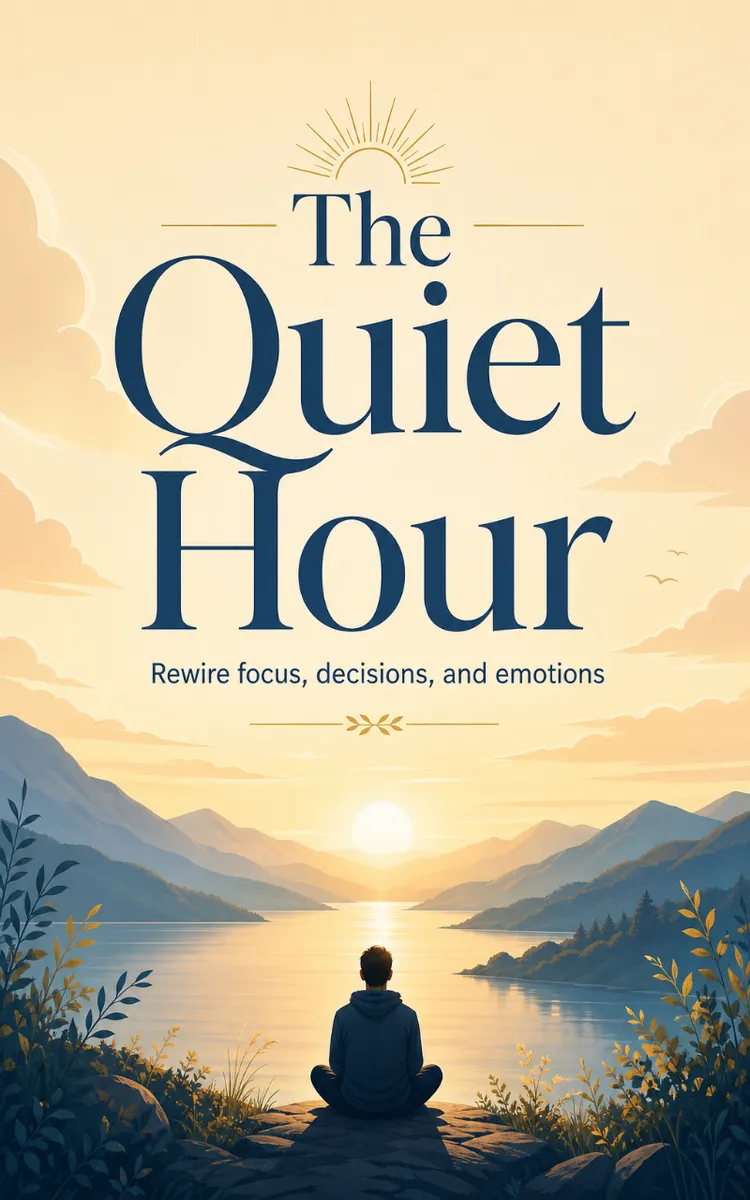
"The Quiet Hour" is a self-help book by Inkfluence AI Demo with 8 chapters and approximately 11,531 words. Using morning silence to improve focus and emotional regulation.
This book was created using Inkfluence AI, an AI-powered book generation platform that helps authors write, design, and publish complete books. It was made with the AI Self-Help Book Writer.
Frequently Asked Questions
What is "The Quiet Hour" about?
Using morning silence to improve focus and emotional regulation
How many chapters are in "The Quiet Hour"?
The book contains 8 chapters and approximately 11,531 words. Topics covered include Choosing Your Quiet Hour Identity, Rewiring Impulse with the Pause Signal, Designing Focus with One-Thread Attention, Turning Worry into Decisions, and more.
Who wrote "The Quiet Hour"?
This book was written by Inkfluence AI Demo and created using Inkfluence AI, an AI book generation platform that helps authors write, design, and publish books.
How can I create a similar self-help book?
You can create your own self-help book using Inkfluence AI. Describe your idea, choose your style, and the AI writes the full book for you. It's free to start.
Write your own self-help book with AI
Describe your idea and Inkfluence writes the whole thing. Free to start.
Start writingCreated with Inkfluence AI


