
Read the first chapter
The whole of chapter one, free. About 11 min. Turn the pages with the arrows, your keyboard, or a swipe.
Chapter 1
Shelter Drill Turns Into a Spark
The first warning siren was supposed to be part of the drill.
The second one came from Mara Calder’s radio, sharp and real, while the fairground loudspeakers cheerfully announced that all participants should proceed to the livestock pavilion in an orderly fashion.
“Orderly,” Mara muttered, watching three hundred people turn toward the same narrow gate. “A charming fantasy.”
Wind shoved across the fairgrounds, carrying the metallic smell of rain and the dusty sweetness of trampled hay. Beyond the Ferris wheel, the sky had gone the color of bruised peaches. It had darkened in less than ten minutes - faster than the forecast, faster than the county’s carefully printed schedule, faster than Mara could revise the plan without making everyone panic.
She pressed the radio to her mouth. “All stations, this is Calder. The drill is now an actual weather response. Repeat, actual weather response. Move participants to the livestock pavilion and keep the west gate clear for mobility assistance.”
A burst of static answered.
Then a man’s voice cut through it. “Calder, this is medical. Your west gate is about to become a decorative feature.”
Mara turned.
The EMT stood beside the first-aid tent, one hand braced on its metal frame as the canvas snapped behind him. He was tall, broad through the shoulders, and wearing a navy uniform already darkened at the collar by rain. His sandy hair had escaped whatever effort had once been made to control it. A red medical bag hung from one hand.
He pointed toward the gate. “People are bottlenecking there. Unless your emergency plan includes forty-seven strangers becoming one enormous, anxious person.”
“It includes staggered entry.”
“Lovely. The weather has declined to participate.”
Mara crossed the muddy grass toward him, boots sinking half an inch with every step. “Name?”
“Declan Mercer.”
“Role?”
“EMT. Occasional bearer of bad news.”
“Good. You can be useful. Take medical and mobility cases through the service lane.”
His mouth tilted. “You say that like I was hoping for a less glamorous assignment.”
“You’re welcome to stand here and critique the weather.”
“I’ve tried. It’s not listening.”
A crack of thunder rolled over the fairgrounds. The crowd’s chatter broke apart. Somewhere near the midway, a child began to cry.
Mara lifted her radio again. “All volunteers, stop directing people to the west gate. Use the service lane. Keep families together. Do not send anyone back for personal items.”
A woman in a yellow raincoat grabbed Mara’s sleeve. “My father is in the grandstand. He can’t walk fast.”
“Where is he?”
“Section C, near the concession stand.”
Mara looked toward the grandstand. The first hard drops struck the metal bleachers, ticking like thrown pebbles. “Declan, take two people and get him.”
“I’m one person.”
“Then take one.”
“Your confidence in my math is touching.”
He handed his bag to a waiting volunteer and moved before she could answer. Mara watched him cut through the gathering crowd, speaking calmly, one hand lifted to guide rather than shove. He crouched beside an older man in the grandstand and listened while the woman in the yellow coat talked over him. Declan waited until she stopped, then nodded as if the problem were solvable because he had decided it was.
That, annoyingly, made Mara notice him.
She turned away and found the service lane worse than expected. A delivery truck had been left across half the entrance, its driver nowhere in sight. People pressed toward the pavilion doors, umbrellas turning inside out in the wind.
“Move the truck,” Mara told a volunteer.
“We don’t have the keys.”
“Then find the driver.”
“He went to help at the main gate.”
“Of course he did.”
The pavilion doors opened, and the crowd surged. Mara stepped onto a concrete barrier and raised both arms. “Stop. Stop moving.”
Nobody stopped.
A gust tore the clipboard from her hand. Papers scattered across the wet pavement, the drill schedule dissolving into gray pulp.
“Excellent,” she said under her breath. “The paperwork has chosen freedom.”
Declan appeared at her side with the older man’s arm over his shoulders. “I’m beginning to suspect this isn’t going according to plan.”
“Your observational skills are exceptional.”
“Thank you. I trained for years.”
Together they got the man through the service lane, around the truck, and into the pavilion. Inside, the air smelled of wet wool, manure, and the industrial disinfectant someone had used too generously on the concrete floor. The shelter was already filling. Folding chairs scraped. Children clung to parents. A volunteer shouted that the north doors were jammed.
Mara climbed onto a low platform near the livestock pens. “Everyone, listen to me. We are moving away from the exterior walls. If you can walk, take the hand of someone who needs help and make room. If you have a medical concern, raise your hand. We will come to you.”
Her voice carried, but fear carried farther.
A man near the entrance yelled, “Where’s the tornado?”
Mara looked at the black windows. “Not here yet.”
The answer did not comfort anyone. It was not meant to.
Declan moved through the crowd, checking faces, knees, breathing, the small signs people tried to hide. When he reached the older man, he lowered him into a chair and crouched in front of him.
“Any pain?”
“Only my pride.”
“Good. Pride is rarely life-threatening.”
The man chuckled, and Mara saw his shoulders loosen.
Declan glanced up at her. “You always this reassuring?”
“Only when people are listening.”
“Then I’ll try to be more cooperative.”
“You’d have to start.”
The pavilion lights flickered. A low mechanical groan moved through the building as the wind struck the broad metal roof. Mara felt the vibration in her boots.
Her radio crackled. “Calder, radar indicates rotation west-southwest. Warning issued for the county.”
The word warning seemed to pass through the pavilion like a physical thing.
Mara’s grip tightened around the radio. The drill had been designed to teach people what to do before danger arrived. Now danger had arrived early, with no respect for educational objectives.
“Seal the exterior doors,” she said. “Keep the interior aisle open. Count heads by section.”
A volunteer hurried over. “We’re missing six from the midway.”
Mara’s stomach dropped. “Who?”
“Two vendors, four teenagers. They may have gone to the game tent.”
The game tent stood across open ground, beyond the pavilion’s east wall. Rain hammered the roof now, and the sky flashed white.
“No,” Declan said.
Mara looked at him. “That wasn’t a request.”
“It was a professional opinion.”
“I’m not leaving them out there.”
“Neither am I. I’m saying you’re not leaving.”
“I’m the emergency planner.”
“And I’m the person who gets to explain to your county administrator why I let the emergency planner sprint into a lightning storm.”
“I don’t sprint.”
“You stride aggressively.”
Another thunderclap shook the windows.
Mara stepped closer, lowering her voice. “Declan, those kids may be frightened and making bad decisions. I know the fairgrounds. I can get them in faster.”
His expression changed. The humor remained, but something firmer settled underneath it. “Then tell me the route. I’ll go.”
It was not the answer she wanted. It was the answer she trusted.
She pointed to the east service door. “Stay along the maintenance wall. Do not cross the midway. The game tent has a rear exit that opens toward the cattle pens. Bring everyone through there.”
“And if the rear exit is blocked?”
“Kick it.”
“Finally, a plan with personality.”
He grabbed his medical bag. Mara caught his wrist before she could think better of it. His skin was warm, his pulse quick beneath her fingers.
“Come back,” she said.
The words landed between them with too much weight.
Declan looked down at her hand, then at her face. “That sounded almost personal.”
“It was operational.”
“Of course.”
She let go. “Go.”
He went.
Mara forced herself back into motion. She counted sections, reassigned volunteers, got a woman with a service dog away from a panicked crowd, and found the missing truck driver wedged behind a stack of hay bales, still trying to call his supervisor. Every task was familiar. Every second felt borrowed.
The pavilion lights failed completely.
For one breath, the only illumination came from the storm outside. Faces turned pale in the blue-white flashes. Someone cried out. The wind rose, a deep, continuous roar that seemed to come from beneath the floor.
“Everyone down!” Mara shouted. “Away from the windows. Cover your head and stay where you are.”
She dropped beside a young girl in a pink raincoat who had frozen between two chairs. Mara pulled her close, covering the girl’s head with both hands.
“Is it coming?” the girl whispered.
“Something is coming,” Mara said. “But we are in the right place.”
It was the truth she could give.
A door slammed somewhere behind her. Then another. The pavilion shuddered.
Declan came through the east entrance with six people crowded around him, soaked to the skin. He shoved the door closed and leaned against it until two volunteers could secure the latch.
“Found your missing population,” he called.
Mara stood. “Any injuries?”
“Only one teenager who believes wet sneakers are a personal attack.”
“Are they?”
“Morally, yes.”
The storm passed over them in a violent, grinding rush. Rain battered the roof. The metal beams groaned. Mara kept her hand on the shoulder of the girl in the raincoat and counted breaths instead of seconds.
One. Two. Three.
Declan moved through the dark, touching shoulders, checking on people. When he reached Mara, he crouched beside her.
“You all right?”
“I’m working.”
“That wasn’t my question.”
“I’m aware.”
His face was close enough that she could smell rainwater and clean soap beneath the sharper scent of wet canvas. “You’re bleeding.”
She glanced at her palm. A thin red line ran across it, probably from the broken clipboard clip. “I’m fine.”
“Your hand disagrees.”
“My hand is dramatic.”
“Your hand is attached to you. I’m going to clean it.”
“I have antiseptic in the command kit.”
“I have some in my bag.”
“I know where the command kit is.”
“I’m sure you do. You also know where every person in this building is, which is frankly unsettling.”
The girl beside Mara peeked up. “Is he your boyfriend?”
Mara and Declan answered at the same time.
“No.”
“Not yet.”
The girl considered this. “You should be.”
Declan’s grin flashed in the dim light. Mara felt heat rise beneath her wet collar, entirely unrelated to the weather.
“Focus on staying alive,” Mara told the girl.
“I am.”
The storm weakened by degrees. First the roof stopped groaning. Then the rain softened from a roar to a hard hiss. Someone found emergency lanterns. Volunteers began checking the shelter, calling names, confirming everyone was accounted for.
Mara stayed until the last section was counted twice.
Only then did she let Declan take her hand.
He cleaned the cut with a damp pad, his fingers careful and unexpectedly gentle. Mara watched the concentration in his face. His jokes were easy; his care was not. He gave it away in small, unadvertised acts - steadying the older man, kneeling for the frightened child, returning every frightened glance with one of his own that said he had seen it and would stay anyway.
“You’re an emergency planner,” he said.
“Mara Calder.”
“Declan Mercer. EMT, occasional bearer of bad news.”
“I remember.”
“Thought I’d establish consistency.”
She looked at the bandage he wrapped around her palm. “You always flirt with people during active weather warnings?”
“Only the ones who order me into danger and then tell me to come back.”
“I told you to come back because you had the missing teenagers.”
“Whatever helps you sleep.”
“I sleep very well.”
“Liar.”
The word was soft. Not accusing. Familiar, somehow, though they had known each other less than an hour.
Mara pulled her hand back. “You’re very confident for someone who just met me.”
“I’m observant.”
“You’re reckless.”
“Caring, actually. There’s a difference.”
The answer stripped the humor from the air.
Declan looked toward the crowded shelter. “People panic when they think nobody’s paying attention. I can’t fix the weather. I can make sure they’re not alone in it.”
Mara’s throat tightened. She understood the impulse too well. “That’s not the same as being responsible for everyone.”
“No,” he said. “But it feels similar when you’re the one people look at.”
For the first time, she saw the fatigue beneath his wit. The fear he kept folded neatly behind it.
Outside, emergency vehicles began to move along the fairground road, their lights washing red across the pavilion windows. Mara should have returned to the radio. She should have checked the damage report, confirmed the shelter’s next steps, started documenting the failure points.
Instead, she stood close enough to feel Declan’s warmth through their damp clothes.
“You came back,” she said.
His gaze lowered to her mouth, then rose again. “You asked me to.”
The simple answer unsettled her more than the storm.
A volunteer called her name from across the pavilion. Mara stepped away, but the movement brought her shoulder against Declan’s chest. He caught her elbow. She turned too quickly. Their faces nearly collided.
For one suspended second, neither of them moved.
His hand remained around her arm, loose enough for her to leave. Mara could have stepped back. She knew exactly how. She also knew the shelter was safe, the doors secured, the people accounted for.
“Is this operational?” he murmured.
“No.”
“Shame.”
She should have told him to let go.
Instead, she looked at his mouth and said, “Don’t make me regret giving you my name.”
Declan’s thumb shifted once against her sleeve. “I was hoping to make you give me your number.”
The radio at Mara’s hip crackled with another update. More storms were forming west of the county. The shelter would remain open through the night.
She drew a careful breath and stepped back.
“Tomorrow,” she said.
His eyebrows lifted. “Tomorrow what?”
“Bring your medical bag to the county operations office. We need to revise the shelter plan.”
“That sounds dangerously like an invitation.”
“It’s a work assignment.”
“Of course.”
Mara turned toward the waiting volunteer, but she could still feel his eyes on her, warm as a hand between her shoulder blades.
The drill had become a real emergency. She had gotten everyone to safety. She had done exactly what she came to do.
So why did leaving Declan Mercer feel like the first dangerous decision of the season?
End of chapter one. 7 more chapters in the full book.
Swipe or use the arrows to turn the page

What's inside: 8 chapters
- 1. Shelter Drill Turns Into a Spark
- 2. His Dry Jokes Earn Her Trust
- 3. The Map Meeting That Gets Personal
- 4. What She’s Afraid to Admit
- 5. The Shelter Choice That Costs Them
- 6. When Her Control Breaks Down
- 7. Kissing Under the Siren Warning
- 8. A Future Built on Storm Maps
About this book
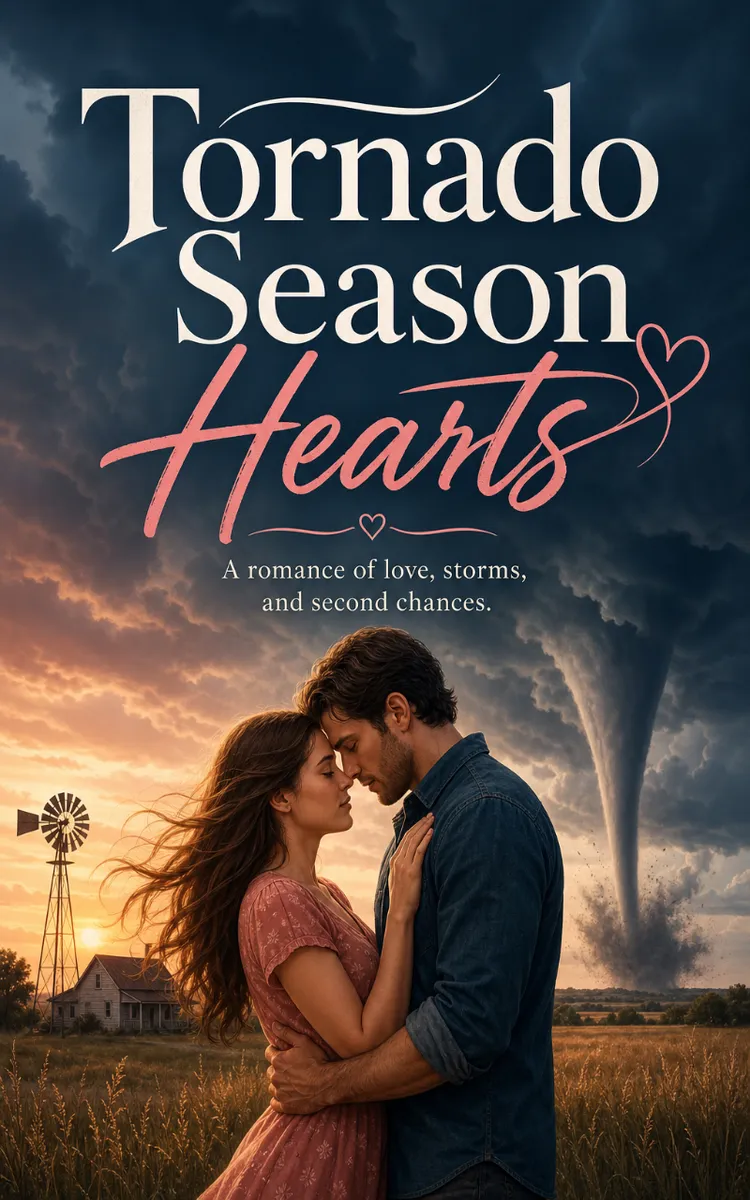
"Tornado Season Hearts" is a romance book by W.L.E with 8 chapters and approximately 18,618 words. A couple falls in love during tornado season..
This book was created using Inkfluence AI, an AI-powered book generation platform that helps authors write, design, and publish complete books. It was made with the AI Romance Novel Writer.
Frequently Asked Questions
What is "Tornado Season Hearts" about?
A couple falls in love during tornado season.
How many chapters are in "Tornado Season Hearts"?
The book contains 8 chapters and approximately 18,618 words. Topics covered include Shelter Drill Turns Into a Spark, His Dry Jokes Earn Her Trust, The Map Meeting That Gets Personal, What She’s Afraid to Admit, and more.
Who wrote "Tornado Season Hearts"?
This book was written by W.L.E and created using Inkfluence AI, an AI book generation platform that helps authors write, design, and publish books.
How can I create a similar romance book?
You can create your own romance book using Inkfluence AI. Describe your idea, choose your style, and the AI writes the full book for you. It's free to start.
Write your own romance book with AI
Describe your idea and Inkfluence writes the whole thing. Free to start.
Start writingCreated with Inkfluence AI


