
Read the first chapter
The whole of chapter one, free. About 10 min. Turn the pages with the arrows, your keyboard, or a swipe.
Chapter 1
Choosing Your Reselling Niche
Find a Niche That Can Actually Sell
What could you find, price, photograph, and list every week without running out of ideas or money? That question points toward a better niche than simply choosing a category you like. A profitable niche on Poshmark, Depop, or eBay needs three things at the same time: your interest, reliable sourcing, and buyer demand.
A niche means a focused group of products, such as women’s vintage denim, men’s outdoor jackets, designer handbags, or collectible video games. Choosing one helps you learn prices, spot quality quickly, write better listings, and attract buyers who want that type of item. Without a focus, you may buy random products that sit in different parts of your closet while you struggle to know what to source next.
The goal is not to choose a permanent identity. You need a starting lane that gives you useful practice and a reasonable chance of early sales. By the end of this section, you should have two or three possible niches to test instead of one vague idea such as “clothing.”
Start by writing down products you already understand. Include items you wear, collect, repair, follow online, or regularly shop for. Your knowledge matters because it helps you notice details that a casual seller might miss. Someone who understands running shoes may recognize a discontinued model, while another seller may overlook it because the shoes look ordinary.
Next, look at your local sourcing options. A niche only works if you can find inventory at a price that leaves room for fees, shipping supplies, and profit. Check thrift stores, outlet bins, garage sales, estate sales, clearance racks, consignment shops, and your own closet. Search each location for the same type of item during one or two shopping trips. If you cannot find examples after several attempts, treat that niche as a slower test rather than your main starting point.
Finally, check demand on the platform where you plan to list. Search completed or sold listings when the platform provides that option. On eBay, filter results to show sold items. On Poshmark and Depop, study similar listings, seller activity, likes, comments, and how many comparable items appear. These clues do not guarantee a sale, but they show whether buyers already search for the product.
Use the Niche Fit Scorecard to compare your options. Give each category a score from 1 to 5, then add the results:
1. Interest and knowledge: Score 1 if you know almost nothing about the products; score 5 if you can identify brands, materials, condition issues, and good styles quickly. Your knowledge reduces buying mistakes. 2. Sourcing access: Score 1 if you rarely see the items locally; score 5 if you can find them often and at reasonable prices. Reliable access keeps your store supplied. 3. Platform demand: Score 1 if sold examples are rare; score 5 if buyers regularly purchase similar items. Demand gives your listings a better chance to move. 4. Profit room: Score 1 if the likely sale price barely exceeds your cost; score 5 if the item can cover fees and expenses while leaving a clear profit. A popular item still creates problems when the margin is too small. 5. Listing ease: Score 1 if each item requires difficult research or testing; score 5 if you can photograph, measure, describe, and list it in about 15 minutes. Easy listings let you test more inventory.
A score of 20 or higher makes a strong first test. A score from 15 to 19 may work if you improve sourcing or pricing. A score below 15 usually needs more research before you spend money. Ask yourself one practical question: “Could I find, list, and explain ten of these items in the next two weeks?” If the answer is no, narrow your idea differently or choose another niche.
For example, “shoes” remains too broad. “Women’s trail-running shoes in common sizes” gives you a clearer search. “Clothing” becomes “men’s heavyweight flannel shirts from recognizable outdoor brands.” A tighter niche makes your searches more precise and helps you compare like with like. Record your scores in a simple notebook or spreadsheet so your choice depends on evidence rather than one exciting find.
Your practical takeaway: choose a niche that combines what you know, what you can repeatedly source, and what buyers already purchase.
Apply the Niche Fit Scorecard Before You Buy
A good scorecard uses real listings and real sourcing checks, not guesses. Pick three possible niches and spend about 30 minutes researching each one. Search the exact product type on eBay, Poshmark, and Depop. Write down the low, middle, and high asking prices, then look for sold prices where available. The middle price gives you a more useful starting point than the highest listing, because the highest price may belong to an unusually rare or perfect item.
Use this simple comparison table:
| Possible niche | Interest and knowledge | Sourcing access | Platform demand | Profit room | Listing ease | Total | |---|---:|---:|---:|---:|---:|---:| | Women’s vintage denim | 5 | 4 | 4 | 4 | 4 | 25 | | Men’s formal shirts | 3 | 5 | 3 | 2 | 5 | 18 | | Collectible mugs | 4 | 3 | 3 | 4 | 3 | 17 |
The table does not choose for you automatically. It shows where each idea needs attention. Vintage denim may offer the best starting point because the seller understands it, finds it regularly, and can expect reasonable demand. Formal shirts may be easy to list but offer less profit. Collectible mugs may sell well individually but require more careful packing and research.
Check profit room with simple math before buying. Suppose you find a pair of trail-running shoes for $8 and expect to sell them for $42. Set aside $6 for platform and payment costs, $2 for cleaning supplies and packaging, and $8 for shipping if you offer shipping support from your proceeds. Your estimated profit equals $42 minus $8, $6, $2, and $8, leaving $18 before taxes. If the same shoes sell for only $25, the remaining amount may not justify the time and storage space.
Do not treat a high asking price as proof of demand. A seller can list a jacket for $150, but that does not mean buyers pay $150. Compare several sold examples, inspect condition, and note whether the products have useful details such as a popular size, current style, rare color, or desirable material. Platform demand also changes by product. Depop may suit trend-focused vintage clothing, Poshmark may suit recognizable fashion brands, and eBay may suit collectibles, electronics, tools, and items buyers search for by exact model.
Run a small test instead of buying a large batch. Choose one niche, buy five to ten items, and list them within 48 hours. This test answers three questions: Can you find enough inventory? Can you describe and photograph it efficiently? Do buyers show interest through sales, offers, likes, or messages? Early activity helps you adjust before you spend more.
Keep your niche narrow enough to learn but broad enough to source. “Vintage concert T-shirts” may be too difficult if you rarely find them. “Graphic T-shirts from the 1990s and early 2000s” gives you more sourcing opportunities while keeping a clear buyer audience. After you gain experience, you can narrow the focus again based on what sells.
Your practical takeaway: use the scorecard to compare options, then test a small batch with real costs and real listings.
Test One Niche With a Small Inventory Batch
A practical test might focus on women’s vintage denim across Poshmark, Depop, and eBay. The seller understands denim measurements, can visit two thrift stores each week, and notices that buyers search for straight-leg, high-rise, and relaxed-fit styles. The test should measure more than sales; it should also measure sourcing time, listing time, buyer interest, and profit.
1. Choose a 10-item test limit. Search for vintage or older denim in waist sizes 26 through 32, because this gives the test a clear range. Set a maximum purchase cost of $12 per pair, keeping the total inventory budget at $120. A limit prevents one exciting shopping trip from using money needed for other expenses. 2. Research before purchasing. At each store, check the brand, waist and inseam measurements, fabric, leg shape, flaws, and tag details. Buy only pairs that match your chosen styles and show enough profit room. Reject pairs with permanent stains, broken zippers, or severe fabric damage unless you know how to repair them. 3. Record each purchase. Write down the item, cost, store, date, and expected sale price. For example, a pair costing $9 with a realistic sale price of $38 may leave room for fees, packaging, and profit. This record helps you identify which brands and styles deserve more sourcing time. 4. Prepare and photograph within two days. Wash or clean items according to the care label, remove lint, measure the waist and inseam, and photograph the front, back, brand tag, size tag, fabric label, and every flaw. Clear details reduce buyer questions and returns. 5. List on the best matching platform first. Use Poshmark for a simple fashion listing, Depop for a style-led presentation, and eBay when buyers may search by exact brand, model, or measurements. You can cross-list later, but start where your research shows the strongest buyer activity. 6. Set a price with room for offers. If sold examples cluster around $38, list at $44 rather than $70. A moderate cushion lets you accept a reasonable offer without dropping below your profit target. Avoid pricing far above the market because an item may receive views but no serious offers. 7. Review results after 14 days. Count sales, offers, likes, messages, views, and hours spent. If three pairs sell and two receive offers near your target, the niche shows useful demand. If none receive attention, check your photos, measurements, titles, condition notes, and prices before abandoning the niche. 8. Choose the next action. Buy more of the styles that received sales or strong offers, reduce spending on ignored styles, and change one factor at a time. This approach shows whether the problem came from the niche, the item selection, or the listing.
For this test, a reasonable outcome might include three sales totaling $114, with $27 in purchase costs across the sold pairs, approximately $18 in other selling and packing costs, and about $69 remaining before taxes. The unsold seven pairs still hold value, but the seller should not count them as profit until they sell. The seller should also note that a pair with many likes but no offers may need a better price, while a pair with no views may need a stronger title or a different platform.
Quick checklist
• Score three niche ideas with the Niche Fit Scorecard. - Confirm at least five realistic sold examples for each promising niche. - Set a test budget and maximum cost per item. - Buy five to ten items, not a large batch. - Record cost, expected sale price, and condition. - List every test item within 48 hours. - Review results after 14 days. - Buy more only when demand and profit support the decision.
Your practical takeaway: a small, measured test turns a niche idea into evidence you can use.
Avoid Niche Choices That Trap Your Cash
Choosing a niche because you like it
Personal interest helps, but it does not replace demand or profit. You may enjoy collecting decorative plates, yet buyers may move slowly and shipping may require bulky boxes and extra padding. A favorite category can still score poorly on sourcing, demand, or listing ease.
Do this: Give interest only one score in the Niche Fit Scorecard, then verify sold prices, sourcing access, and profit room separately. Not this: Buy a large collection because you assume other people will value it as much as you do.
Confusing active listings with sales
A crowded search page can look promising, but many listings may have remained unsold for weeks or months. Compare active listings with completed sales and check the condition, size, brand, and model before drawing a conclusion.
Do this: On eBay, filter searches to sold items and compare at least five similar results. On Poshmark and Depop, study recent seller activity and comparable listings, then treat likes as interest rather than proof of a purchase. Not this: Use the highest visible asking price as your expected sale price.
Ignoring the cost of slow or difficult inventory
A niche may show demand but still hurt your business if each item takes an hour to research, clean, photograph, and pack. Large fragile goods, untested electronics, and heavily stained clothing can consume time and create returns.
Do this: Track how many minutes each test item takes from purchase to listing, and include cleaning materials, packaging, shipping, and platform costs in your profit estimate. Not this: Count the difference between purchase price and sale price as your profit.
The right niche gives you a repeatable way to find products, recognize value, and list with confidence. Start with the Niche Fit Scorecard, test a small batch, and let actual buyer behavior guide your next purchases. That process builds the practical judgment you will use across Poshmark, Depop, and eBay.
End of chapter one. 7 more chapters in the full book.
Swipe or use the arrows to turn the page
What's inside: 8 chapters
- 1. Choosing Your Reselling Niche
- 2. Sourcing Inventory Without Overspending
- 3. Taking Listings Photos That Sell
- 4. Writing Titles and Descriptions Buyers Search
- 5. Pricing With Sold-Listing Comparisons
- 6. Packaging and Shipping for Fewer Problems
- 7. Managing Offers, Bundles, and Messages
- 8. Tracking Profits and Scaling Your Workflow
About this book
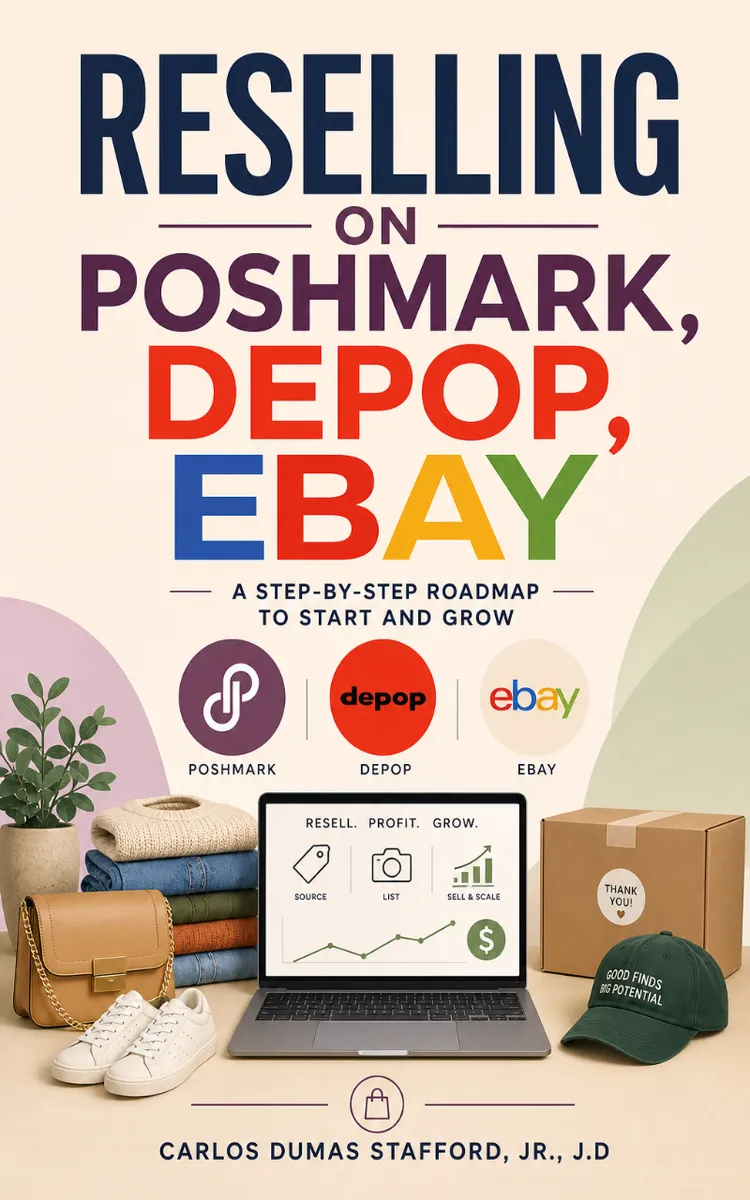
"Reselling On Poshmark, Depop, Ebay" is a how-to guide book by Anonymous with 8 chapters and approximately 14,743 words. You can list items all day and still end up with nothing but shipping labels and storage bins. The reason is rarely “bad luck,” it is a beginner’s blind spots: picking the wrong niche, buying without proof, and photographing in a way that makes buyers hesitate.
This book was created using Inkfluence AI, an AI-powered book generation platform that helps authors write, design, and publish complete books. It was made with the AI Ebook Generator.
Frequently Asked Questions
What is "Reselling On Poshmark, Depop, Ebay" about?
You can list items all day and still end up with nothing but shipping labels and storage bins. The reason is rarely “bad luck,” it is a beginner’s blind spots: picking the wrong niche, buying without proof, and photographing in a way that makes buyers hesitate. Reselling On Poshmark, Depop, and eBay shows you how to start with a niche that can sell, source inventory without overspending, and create listings that answer buyers’ questions fast. You will learn how to price with real sold data, build a simple workflow, and turn each item into a repeatable process. If you want practical steps you can apply immediately, this is your fast track.
How many chapters are in "Reselling On Poshmark, Depop, Ebay"?
The book contains 8 chapters and approximately 14,743 words. Topics covered include Choosing Your Reselling Niche, Sourcing Inventory Without Overspending, Taking Listings Photos That Sell, Writing Titles and Descriptions Buyers Search, and more.
Who wrote "Reselling On Poshmark, Depop, Ebay"?
This book was written by Anonymous and created using Inkfluence AI, an AI book generation platform that helps authors write, design, and publish books.
How can I create a similar how-to guide book?
You can create your own how-to guide book using Inkfluence AI. Describe your idea, choose your style, and the AI writes the full book for you. It's free to start.
Write your own how-to guide book with AI
Describe your idea and Inkfluence writes the whole thing. Free to start.
Start writingCreated with Inkfluence AI


