
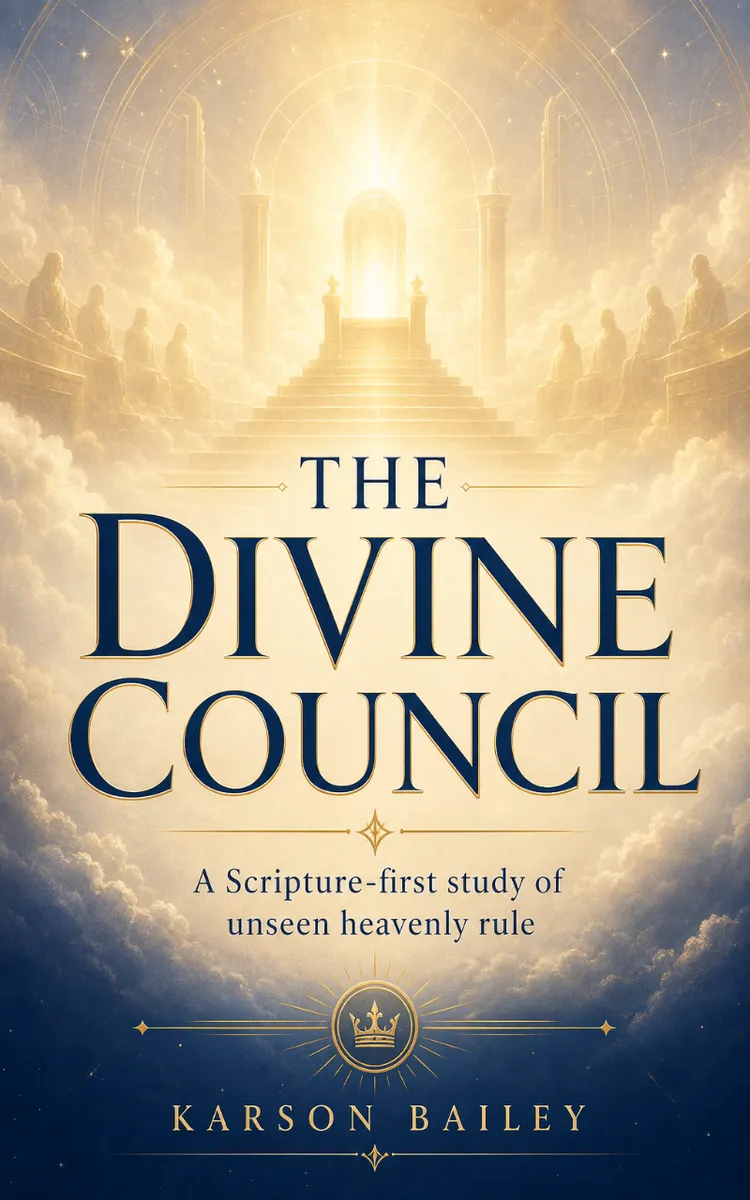
The Divine Council
Created with Inkfluence AI
Biblical theology of the divine council and spiritual powers
Table of Contents
- 1. Recovering the Bible’s Heavenly World
- 2. The Unseen Realm of Scripture
- 3. One God Above All
- 4. What Does Elohim Mean?
- 5. The Heavenly Host
- 6. The Divine Council in the Ancient World
- 7. The Sons of God in Job
- 8. Micaiah’s Vision of the Heavenly Court
- 9. Psalm 82 and the Judgment of the Gods
- 10. Psalm 89 and the Assembly of the Holy Ones
- 11. Daniel 7 and the Court of the Ancient of Days
- 12. Babel and the Division of the Nations
- 13. Deuteronomy 32 and the Sons of God
- 14. The Gods of the Nations
- 15. Principalities, Princes, and Territorial Powers
- 16. When the Heavenly Rulers Rebel
- 17. Israel as Yahweh’s Inheritance
- 18. The Angel of the LORD
- 19. The Messiah in the Heavenly Council
- 20. The Son of Man Receives the Kingdom
- 21. The Kingdom of God Invades the Kingdoms of Darkness
- 22. Jesus and the Unseen Realm
- 23. Demons, Exorcism, and the Arrival of the Kingdom
- 24. The Seventy-Two and the Fall of Satan
- 25. The Cross and the Defeat of the Rulers
- 26. Raised Above Every Rule and Authority
- 27. The Church as God’s Cosmic Witness
- 28. Spiritual Warfare Without Sensationalism
- 29. The Armor of God
- 30. Testing the Spirits
- 31. Worship Before the Throne
- 32. The Judgment of the Gods
- 33. The Saints Will Judge Angels
- 34. Christ’s Enemies Beneath His Feet
- 35. The Throne of God and of the Lamb
Preview: Recovering the Bible’s Heavenly World
A short excerpt from “Recovering the Bible’s Heavenly World”. The full book contains 35 chapters and 28,645 words.
Scripture Focus
Psalm 103:19
> The LORD has established his throne in the heavens, and his kingdom rules over all.
Most Christians can say “God is sovereign,” but Scripture shows us what that sovereignty looks like when the unseen world is actually in view - throne, court, and rule.
When you read the Bible straight through, you don’t just get God’s opinions about behavior. You get God’s reign described as real, ordered rule - over heaven and earth, over visible life and the unseen realm that supports it. The surprising part is how often that theme never becomes our daily mental map. We pray, we repent, we preach Christ, and we mean it. But we often carry a flat picture of reality: God up there, people down here, and everything spiritual stuck in the background like a quiet movie score.
Psalm 103 won’t let us keep that flat picture. “His throne in the heavens” is not poetic decoration. And “his kingdom rules over all” isn’t a vague comfort. The Bible treats the unseen realm as populated and governed - an ordered world under the King’s authority. That matters because the Bible’s conflicts aren’t only between “good people and bad people.” There’s a level deeper: kingdoms, authorities, and spiritual powers (the Bible’s categories) that operate within God’s boundaries, not outside them.
Reflection
Here’s the daily struggle: many believers live with a kind of spiritual amnesia. We remember God’s command, but we forget God’s courtroom. We remember that Christ is King, but we don’t think like kings’ subjects living under a heavenly administration. So when pressure hits - decisions at work, tension in family life, temptation that won’t quit - we default to a narrow set of tools: willpower, grit, advice, coping strategies, sometimes even silence. None of those are inherently evil. But they’re incomplete if Scripture is describing an actual throne-room reality.
The divine council theme corrects that mismatch. The Bible does not threaten monotheism by admitting that heaven has order and beings who serve. Psalm 103:19 makes it explicit: the King rules over all. In other words, the unseen realm is not a rival government. It’s a governed realm. The King’s sovereignty is not only “someday” - it is established, enthroned, and actively ruling.
That’s why this theme can feel unfamiliar. Many churches teach spiritual life as if the only “world” that counts is the one you can touch. But the Bible’s storyline keeps insisting that heaven is not empty. It’s populated. It’s also not chaotic. It’s arranged. When Scripture uses language like “throne,” “kingdom,” “heavens,” and “rule,” it’s telling you that your prayers are not reaching a distant idea. They are reaching the One who sits enthroned and governs an ordered unseen realm. That changes how you breathe when you pray. It changes how you interpret spiritual attack. It changes how you face ordinary days - because God’s rule is not limited to your church service.
So let me name the takeaway plainly: God’s sovereignty includes the unseen realm, not just the visible one. If you hold onto that, your daily faith stops being mostly reaction and becomes alignment. You’re not just asking for help in the moment; you’re learning to live under a King who governs the whole field - visible and invisible.
Practice for Today
1. Timed prayer for God’s throne-rule (5 minutes).
Set a timer. For the first minute, read Psalm 103:19 slowly. Then pray one simple sentence: “Lord, your throne is in the heavens, and your kingdom rules over all.” For the remaining four minutes, bring one concrete area of life to that throne-rule - work stress, family tension, a temptation pattern, a decision you keep avoiding. Don’t ask for generic peace. Ask for guidance under Kingly rule.
2. Journaling prompt: “What did I assume the unseen world was like?” (8 minutes).
Write two headings and answer honestly:
- I assumed: (e.g., “God is sovereign, but spiritual realities feel far away.”)
- Scripture corrects me by: (choose one phrase from Psalm 103:19 - “throne,” “heavens,” “kingdom,” or “rules over all” - and write what it means for your day.)
If you want a practical example, pick a specific moment this week when you felt spiritually dry or strangely helpless. Then ask: Did I treat the unseen realm like it was ungoverned, or did I treat God’s rule as real?
3. Service challenge: one “heavenward” act of stewardship (10-20 minutes).
Do something faithful and practical for someone else, but do it with a heaven-shaped intention. Clean up a task you’ve been avoiding (a shared space, a bill you need to pay, a message you need to send). Then pray while you work: “King, let your rule over all show up in this small corner.” The point isn’t to manufacture a spiritual vibe. It’s to train your heart to expect God’s governance to reach the ordinary.
Closing Prayer
...
About this book
"The Divine Council" is a religious devotional book by Karson Bailey with 35 chapters and approximately 28,645 words. Biblical theology of the divine council and spiritual powers.
This book was created using Inkfluence AI, an AI-powered book generation platform that helps authors write, design, and publish complete books.
Frequently Asked Questions
What is "The Divine Council" about?
Biblical theology of the divine council and spiritual powers
How many chapters are in "The Divine Council"?
The book contains 35 chapters and approximately 28,645 words. Topics covered include Recovering the Bible’s Heavenly World, The Unseen Realm of Scripture, One God Above All, What Does Elohim Mean?, and more.
Who wrote "The Divine Council"?
This book was written by Karson Bailey and created using Inkfluence AI, an AI book generation platform that helps authors write, design, and publish books.
Write your own religious devotional book with AI
Describe your idea and Inkfluence writes the whole thing. Free to start.
Start writingCreated with Inkfluence AI


