
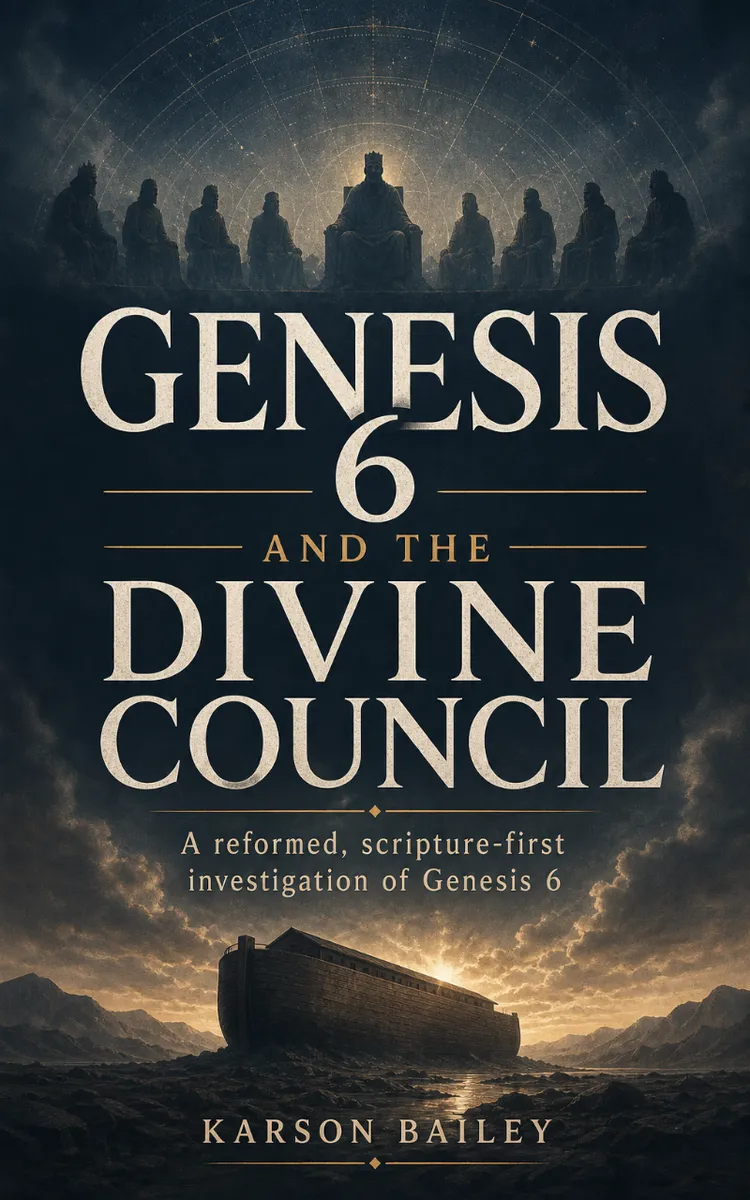
Genesis 6 And The Divine Council
Created with Inkfluence AI
Reformed biblical study of Genesis 6, sons of God, Nephilim, divine council
Table of Contents
- 1. The Supernatural Lens We Keep
- 2. Eden’s Heaven-and-Earth Map
- 3. The Divine Council Before Flood
- 4. Three Ways to Read “Sons of God”
- 5. Jude’s Key: Christ Over the Chaos
Preview: The Supernatural Lens We Keep
A short excerpt from “The Supernatural Lens We Keep”. The full book contains 5 chapters and 10,660 words.
The Supernatural World Behind a “Plain” Reading
A police report can sound straightforward right up until you realize it’s written under one set of assumptions about reality - then you notice the missing category of evidence. Genesis 6 reads like that kind of document: it uses ordinary words, but it assumes an unseen world is part of the story’s basic furniture. If you don’t start with that worldview, the passage can feel like it’s speaking in riddles, or it can be pushed into the shape of whatever modern category you already prefer.
I want to explore why Genesis 6 changes shape when you read it through the Bible’s own lens of heaven, earth, and unseen realities. The goal here is not to win an argument with a single clever interpretation, but to show how the Bible’s worldview functions like a filter - one that governs what counts as normal, what counts as evidence, and what counts as “meaningful” in the first place. When that filter is missing, readers don’t just disagree with Genesis 6; they often misunderstand what kind of sentence Genesis 6 is trying to be.
This chapter is also about why the church’s debates around Genesis 6 have been so persistent. People aren’t merely trading opinions about “what the sons of God means.” They are bumping into a deeper question: what do we think the Bible assumes about the structure of the world - especially the boundary between the seen and the unseen? What if Genesis 6 is not hard because it is unclear, but because it is clear in a universe most readers no longer inhabit?
The Scripture-First Worldview Filter: Heaven and Earth as Neighbors
To understand why Genesis 6 reads differently, we have to begin where the text begins: with the Bible’s own map of reality. The opening chapters of Scripture present heaven and earth not as poetic mood swings but as distinct domains with real relationships to one another. In Genesis 1, God speaks, and the world is structured; in Genesis 2, life is placed; in Genesis 3, the boundary between obedience and rebellion becomes catastrophic. The point for our reading is that the Bible treats “unseen” as a category with content, not as a euphemism for “spiritual feelings.”
That matters because Genesis 6 doesn’t read like an isolated curiosity. It stands in the middle of a storyline that already assumes unseen activity: God walking in the garden is not explained as metaphor; the cherubim guarding the way is not described as symbolism only; the language of judgment and providence assumes God’s governance reaches beyond what human eyes can verify. In other words, the Bible trains readers to expect that cosmic realities are not optional background - they are part of the grammar of the world.
The Bible’s own vocabulary reinforces that expectation. When Scripture speaks of the heavenly realm, it does so with concrete terms: heavens as “space,” “ranks,” and “dwelling places” (even when the author’s intent is theological rather than scientific). When Scripture speaks of divine beings, it does not treat them as props for fancy mythology. It places them inside God’s rule, under God’s authority, and within a moral order. This creates a reading posture that modern readers often lose: the assumption that “unseen” can still be historical, still be ethically charged, and still be narratively relevant.
A simple comparison helps. Imagine reading a maritime logbook with the assumption that ships never leave sight of land. Every mention of “wind,” “current,” and “depth” would feel like exaggeration, even if the writer is being careful. You might still translate the words correctly, but you would misread their function. Genesis 6 works similarly when the Bible’s unseen-world expectations are stripped away. The sentence can remain grammatically intact while its meaning gets evacuated.
This is where the Scripture-First Worldview Filter does its work. It doesn’t begin by asking, “What do I already believe about the supernatural?” It begins by asking, “What does the Bible itself treat as normal when it describes heaven, earth, and the unseen?” That question forces a different kind of attention. You start looking for how Scripture uses its categories elsewhere - especially how later texts interpret earlier ones. And you notice that Genesis 6 is not merely describing “human behavior in a cosmic vacuum.” It sits inside a worldview where heavenly realities can intersect with earthly outcomes.
The Deep Dive: When the Unseen Is Treated as Evidence, Not Decoration
Here’s the counterintuitive finding that changes the whole conversation: Genesis 6 reads most coherently when the unseen realm is treated as part of the real evidence of the event, not as an added religious gloss. If heaven is only “background spirituality,” then Genesis 6 will feel like it’s borrowing imagery from elsewhere - giants, myths, or folklore - because you’re looking for a naturalistic cause that can stand without divine categories....
About this book
"Genesis 6 And The Divine Council" is a curiosity book by Karson Bailey with 5 chapters and approximately 10,660 words. Reformed biblical study of Genesis 6, sons of God, Nephilim, divine council.
This book was created using Inkfluence AI, an AI-powered book generation platform that helps authors write, design, and publish complete books.
Frequently Asked Questions
What is "Genesis 6 And The Divine Council" about?
Reformed biblical study of Genesis 6, sons of God, Nephilim, divine council
How many chapters are in "Genesis 6 And The Divine Council"?
The book contains 5 chapters and approximately 10,660 words. Topics covered include The Supernatural Lens We Keep, Eden’s Heaven-and-Earth Map, The Divine Council Before Flood, Three Ways to Read “Sons of God”, and more.
Who wrote "Genesis 6 And The Divine Council"?
This book was written by Karson Bailey and created using Inkfluence AI, an AI book generation platform that helps authors write, design, and publish books.
Write your own curiosity book with AI
Describe your idea and Inkfluence writes the whole thing. Free to start.
Start writingCreated with Inkfluence AI


