
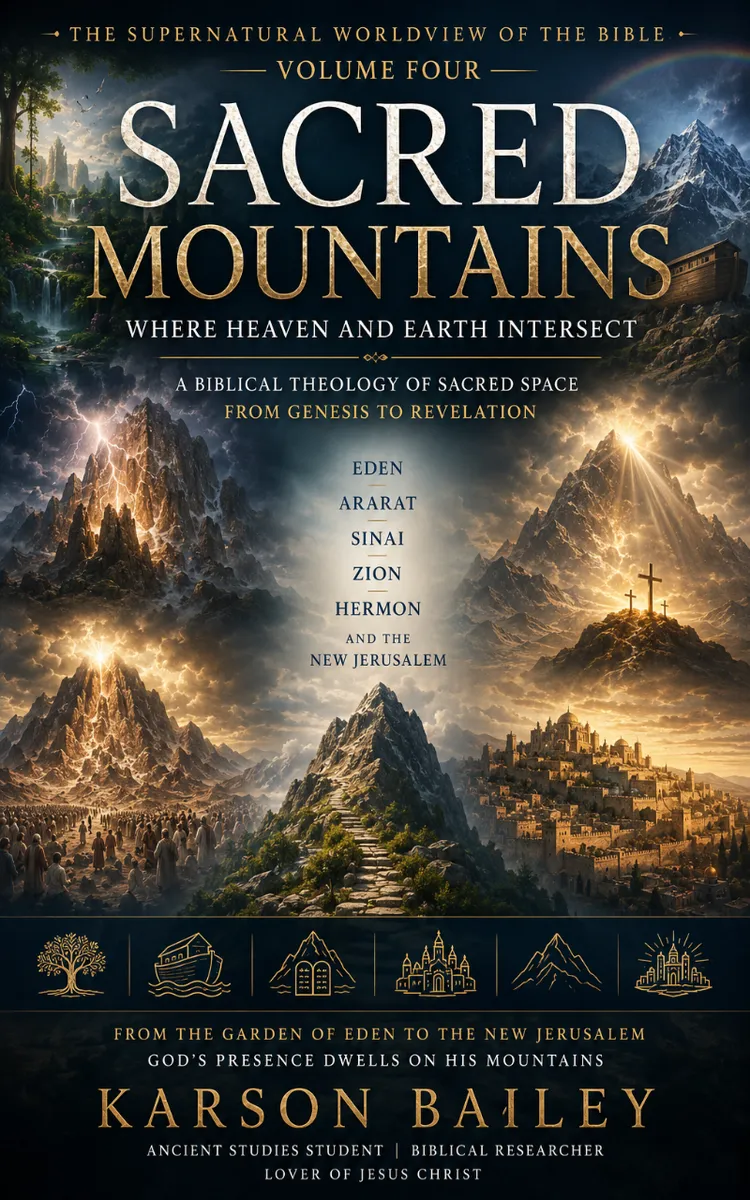
Sacred Mountains Of The Bible
Created with Inkfluence AI
Educate your understanding of biblical sacred space by learning how the Bible consistently links heaven and earth through mountains. In Sacred Mountains Of The Bible, you will trace a theology of place from Eden’s sanctuary blueprint to Revelation’s renewed world, learning to interpret sacred geography as lived doctrine. You will gain tools to connect key texts, including how Eden’s garden functions like a first sanctuary, how Ezekiel fuses garden and holy-mountain imagery, and how river-centered life imagery reinforces God’s presence as the source of sacred order. Along the way, you will develop a clearer worldview for preaching, teaching, and personal devotion. By the end, you will be able to explain why Scripture keeps returning to mountains as more than scenery, and more like a map of God’s dwelling.
Table of Contents
- 1. Eden’s Sanctuary Blueprint
- 2. Ezekiel’s Garden-Mountain Shock
- 3. Four Rivers, One Life Source
- 4. Ararat After the Flood
- 5. Moriah’s Substitution Logic
- 6. Sinai as Temporary Eden
- 7. Psalm 2’s Throne on Zion
- 8. Carmel’s Fire vs. Baal’s Smoke
- 9. Hermon and the Watcher Question
- 10. New Moses on the New Sinai
- 11. Transfiguration Glory on Hermon
- 12. Golgotha as Cosmic Moriah
- 13. Olivet’s Return-Ready Promise
- 14. Heavenly Zion and Our Worship
- 15. Isaiah’s Mountain for All Nations
- 16. New Jerusalem’s Mountain Forever
- 17. Sacred Mountains — Final Charge
Preview: Eden’s Sanctuary Blueprint
A short excerpt from “Eden’s Sanctuary Blueprint”. The full book contains 17 chapters and 31,013 words.
Eden’s Sanctuary Blueprint: Why the First Garden Reads Like a Temple
Genesis does something that feels almost backwards: it begins not with a city or a throne room, but with a garden that functions like a sanctuary. The paradox is that the “first place on earth” is also the first place where heaven and earth meet - no curtains, no altars described in detail, yet God’s presence is the center of everything.
When Genesis 2 slows down to describe Eden, it is not just pausing for scenery. It presents an architectural and theological idea: human life is meant to be lived in the orbit of God’s dwelling. This chapter explores Eden as the Bible’s opening sanctuary blueprint, the pattern that later sacred mountains will echo in different forms - covenant, worship, order, and finally restoration.
So the central mystery presses in as we read: If Eden is the first dwelling-place of God with humanity, why does the rest of Scripture keep pointing us back to mountains as though the garden were never meant to be the end?
The Sanctuary-Pattern Lens on Genesis 2
To read Eden well, we need a lens that keeps the Bible’s own logic in view. I call it the Sanctuary-Pattern Lens: sacred space in Scripture is not random geography. It is a lived theology - God’s presence shaping the world through a particular kind of “place,” where boundaries, ritual order, and covenant purpose cluster around divine indwelling.
In Genesis 2:8-9, Eden is planted “in the east,” and the text lingers on what grows there: trees that are not merely botanical. The tree of life and the tree of the knowledge of good and evil are not introduced like props for moral instruction; they are introduced as life-giving realities that belong to a location with divine intent. Then, in Genesis 2:10-14, Eden is described through rivers and boundaries. A single river “goes out” from Eden and divides into four - an image that doesn’t just explain irrigation. It describes how a sacred center organizes surrounding space.
The pattern becomes clearer when the text says, almost quietly, that God places humanity in the garden “to work it and to keep it” (Genesis 2:15). Work and keeping are not the language of leisure. They are the language of stewardship under a meaningful order - like the responsibilities assigned to those who serve in sacred precincts elsewhere in Scripture. Eden is not presented as a wild landscape where anything goes; it is a structured environment where life is meant to be cultivated within God’s boundaries.
Then there is the human vocation embedded in the narrative’s geography. In Genesis 2:19-20, Adam’s naming of the animals is not only a linguistic flourish. In an ancient worldview, naming is a way of bringing order. The garden supplies the setting where naming makes sense, where human awareness and God’s created order align. The sacred center is the place where humanity’s role - image-bearing, ordered, responsive - comes into focus.
A surprising detail often missed is that Genesis does not describe Eden’s “center” as a throne room or a temple building. Instead, Eden’s center is defined by divine presence and life-bearing trees, with rivers functioning like the veins of a sanctuary precinct. When the later Bible describes tabernacle, temple, and sacred mountains, it repeatedly returns to the idea that God’s dwelling creates a world with a distinct pattern - what is allowed, what is forbidden, what is life, and what is death.
This matters because it means we should not read Eden as a standalone myth or a purely symbolic moral tale. The text reads like an origin story of sacred space, where the first sanctuary teaches the logic of sanctuaries to come.
A Real Place in the Mind: Leah, 34, and the Problem of “Where God Is”
Leah is a small-group teacher who often works with her people on Genesis - not by rushing to conclusions, but by asking what the text actually says about God’s nearness. One evening, her group lingered over a question that rarely gets asked in Sunday-school settings: Where, specifically, does God’s presence “land” in the story? Leah noticed that Genesis 2 doesn’t treat Eden as a generic “good place.” It treats Eden as a structured environment with rivers, boundaries, trees, and a human role that fits that environment.
She used the kind of observation pastors recognize as “the text’s own emphasis.” The group traced how Genesis 1 speaks broadly - God creates - while Genesis 2 speaks locally - God plants, places, and organizes. Leah wasn’t trying to make Eden into a map lesson. She was trying to help people feel the difference between moral advice and sacred geography. In her words, “Genesis 2 feels like it’s describing a place you don’t just visit. It’s a place you live in under God.”
That conversation is more than a teaching moment; it is a worldview diagnostic. Many Christians read Genesis 2 as if it mostly teaches ethics....
About this book
"Sacred Mountains Of The Bible" is a devotional book by Karson Bailey with 17 chapters and approximately 31,013 words. Educate your understanding of biblical sacred space by learning how the Bible consistently links heaven and earth through mountains. In Sacred Mountains Of The Bible, you will trace a theology of place from Eden’s sanctuary blueprint to Revelation’s renewed world, learning to interpret sacred geography as lived doctrine.
This book was created using Inkfluence AI, an AI-powered book generation platform that helps authors write, design, and publish complete books. It was made with the AI Devotional Book Generator.
Frequently Asked Questions
What is "Sacred Mountains Of The Bible" about?
Educate your understanding of biblical sacred space by learning how the Bible consistently links heaven and earth through mountains. In Sacred Mountains Of The Bible, you will trace a theology of place from Eden’s sanctuary blueprint to Revelation’s renewed world, learning to interpret sacred geography as lived doctrine. You will gain tools to connect key texts, including how Eden’s garden functions like a first sanctuary, how Ezekiel fuses garden and holy-mountain imagery, and how river-centered life imagery reinforces God’s presence as the source of sacred order. Along the way, you will develop a clearer worldview for preaching, teaching, and personal devotion. By the end, you will be able to explain why Scripture keeps returning to mountains as more than scenery, and more like a map of God’s dwelling.
How many chapters are in "Sacred Mountains Of The Bible"?
The book contains 17 chapters and approximately 31,013 words. Topics covered include Eden’s Sanctuary Blueprint, Ezekiel’s Garden-Mountain Shock, Four Rivers, One Life Source, Ararat After the Flood, and more.
Who wrote "Sacred Mountains Of The Bible"?
This book was written by Karson Bailey and created using Inkfluence AI, an AI book generation platform that helps authors write, design, and publish books.
How can I create a similar devotional book?
You can create your own devotional book using Inkfluence AI. Describe your idea, choose your style, and the AI writes the full book for you. It's free to start.
Write your own devotional book with AI
Describe your idea and Inkfluence writes the whole thing. Free to start.
Start writingCreated with Inkfluence AI


