
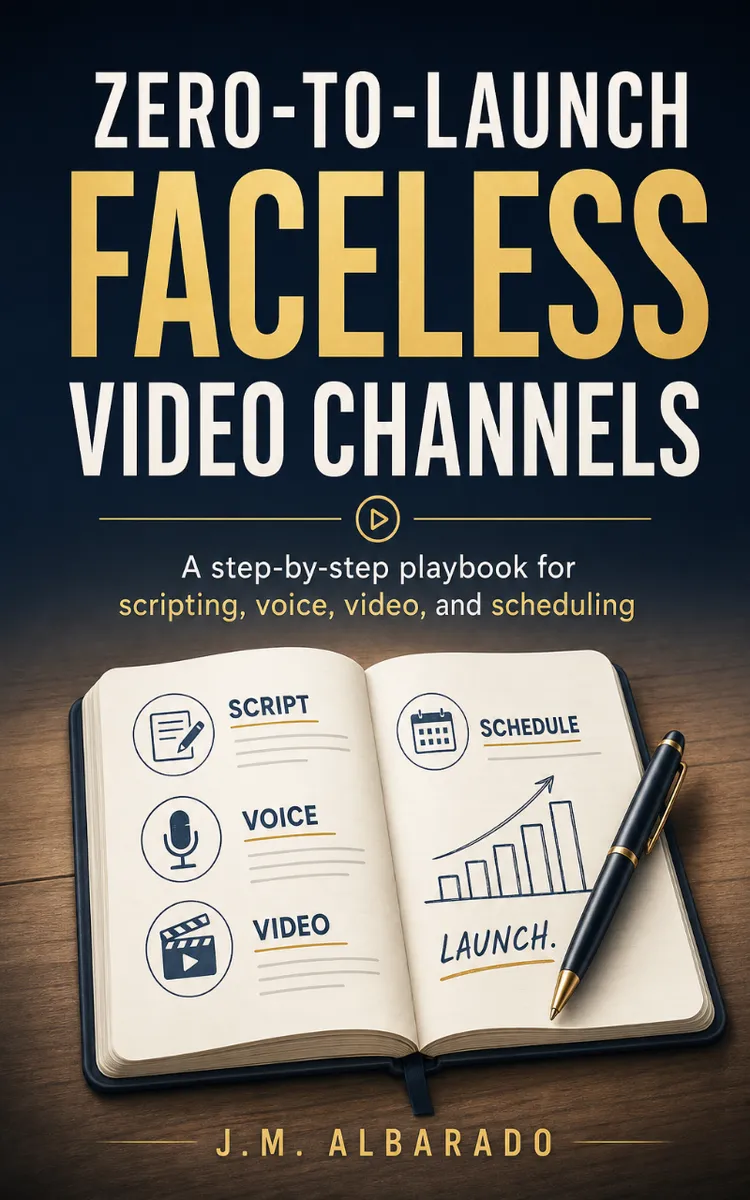
Zero-To-Launch Faceless Video Channels
Created with Inkfluence AI
Building faceless AI video channels with scripts, voiceover, generation, and scheduling
Table of Contents
- 1. The Faceless Content Engine Blueprint
- 2. Niche Selection and RPM Monetization Math
- 3. AI Scripting Factory for Ear Retention
- 4. Voiceover Engineering with ElevenLabs Settings
- 5. Generative Video Prompts for Visual Consistency
- 6. Editing for Retention: Captions and Kinetic Type
- 7. Batch Production Line for 30 Days
- 8. Scheduling and Multi-Platform Distribution Optimization
- 9. Launch Checklist and Performance Iteration System
Preview: The Faceless Content Engine Blueprint
A short excerpt from “The Faceless Content Engine Blueprint”. The full book contains 9 chapters and 16,864 words.
You can tell when a faceless channel is “real” because it runs even when you’re not in the mood to create. The moment you stop relying on your face, your personality, or your voice recordings, you need something else to carry the weight: a repeatable workflow that spits out videos on schedule without breaking your privacy.
If you’ve tried to post faceless content before, you’ve probably hit the same wall: you can write a script, but your videos feel inconsistent; you can generate clips, but the style drifts; you can schedule posts, but you still end up scrambling because your process lives in your head. This chapter fixes that by giving you a privacy-first, systemized pipeline you can run every week - no face, no real-name pressure, no “I’ll figure it out later.”
By the end, you’ll be able to build your own Frictionless Creator Paradigm workflow: a set of rules, templates, and file structure that turns one idea into a finished short-form video (script → voiceover → visuals → edit → captions → publish) with consistent output and minimal risk.
The Frictionless Creator Paradigm: A privacy-first pipeline that replaces personality branding
Personality branding works because viewers recognize a person. Faceless branding works because viewers recognize a format: the same opening style, the same pacing, the same visual look, the same caption rhythm, the same topic delivery. Your job stops being “be entertaining on camera” and becomes “run a reliable production line.”
That’s why this chapter focuses on workflow, not vibes. Privacy-first means you set up your process so you don’t accidentally leak your identity through voice, screen recordings, metadata, or inconsistent accounts. Systemized means you stop improvising. You make decisions once, save templates, and reuse them until your channel looks like a factory output - not a one-off experiment.
Here’s the core idea: you build a “video recipe” that stays the same, while only the inputs change (topic, script, visuals). When you do this, you don’t burn out after three posts. You keep batching. You keep publishing. And you keep your privacy intact even when you scale.
Ask yourself this: when you finish a video today, do you know exactly how you’ll repeat the same process tomorrow? If the answer is “not yet,” you’re about to fix that.
The four components of a frictionless faceless workflow
Use these components like building blocks. Don’t skip steps just because you’ve used AI tools before - your consistency comes from the system, not from your last prompt.
1. Identity firewall (privacy rules + account setup)
- Create a dedicated brand identity for the channel that never touches your real name, personal email, or personal voice recordings. Use separate login credentials and a separate upload folder on your computer.
- Why: you reduce the chance of accidental leaks when you switch between personal and creator tasks.
2. Recipe folder structure (the “same files, every time” rule)
- Set up a folder template on day one so every video uses the same naming style and location for scripts, audio, raw clips, and exports.
- Why: when you batch, mess kills speed. A consistent folder structure turns “searching” into “clicking.”
3. Template stack (script + voice settings + visual prompt style + edit style)
- Build templates you can reuse: a script format that matches your pacing, a voiceover configuration that sounds consistent, a visual prompt format that keeps your look stable, and an editing preset for captions and timing.
- Why: your channel consistency creates viewer trust and makes your output faster.
4. Publish loop (schedule plan + QC checklist before you hit publish)
- Publish using a repeatable schedule and run a quick quality check before posting. You track only a few signals early so you don’t get lost.
- Why: posting is the finish line. Your workflow must include “release” as a step, not as an afterthought.
Take a breath and sanity-check: if you had to make 10 more videos next week, would you still know where every file goes and which settings you used? That’s the difference between “trying” and “running a channel.”
Privacy-first rules that actually matter (not theory)
Privacy-first can sound abstract. So here are rules you can enforce immediately.
1. Never upload personal media you don’t need
- If a tool asks for an image or video input and you’re tempted to use your own footage, stop. Use stock-style visuals or AI-generated clips instead.
- Why: your own recordings often carry metadata, backgrounds, and identifiable details.
2. Use AI voice from scratch, not your voice
- Don’t record your voice “just to test.” Pick an AI voice model and commit to it.
- Why: the moment you record your voice, you create a new privacy risk and you also create inconsistency if you later switch voices.
3....
About this book
"Zero-To-Launch Faceless Video Channels" is a how-to guide book by J.M. Albarado with 9 chapters and approximately 16,864 words. Building faceless AI video channels with scripts, voiceover, generation, and scheduling.
This book was created using Inkfluence AI, an AI-powered book generation platform that helps authors write, design, and publish complete books. It was made with the AI Ebook Generator.
Frequently Asked Questions
What is "Zero-To-Launch Faceless Video Channels" about?
Building faceless AI video channels with scripts, voiceover, generation, and scheduling
How many chapters are in "Zero-To-Launch Faceless Video Channels"?
The book contains 9 chapters and approximately 16,864 words. Topics covered include The Faceless Content Engine Blueprint, Niche Selection and RPM Monetization Math, AI Scripting Factory for Ear Retention, Voiceover Engineering with ElevenLabs Settings, and more.
Who wrote "Zero-To-Launch Faceless Video Channels"?
This book was written by J.M. Albarado and created using Inkfluence AI, an AI book generation platform that helps authors write, design, and publish books.
How can I create a similar how-to guide book?
You can create your own how-to guide book using Inkfluence AI. Describe your idea, choose your style, and the AI writes the full book for you. It's free to start.
Write your own how-to guide book with AI
Describe your idea and Inkfluence writes the whole thing. Free to start.
Start writingCreated with Inkfluence AI


