

Read the first chapter
The whole of chapter one, free. About 6 min. Turn the pages with the arrows, your keyboard, or a swipe.
Chapter 1
The Words People Say (and Don’t)
Chapter 1: The Words People Say (and Don’t)
When you lose a child, you quickly learn that grief is not just something you feel. It is something other people respond to. And often, they respond with words.
Some of those words are meant kindly. Some are meant to help. And some are not helpful at all, even when the speaker has good intentions. The tricky part is that most people never set out to hurt you. They simply do not know what to say, so they grab for the safest phrases they can find.
In Volume 1, we started with the first days and the first weeks, when your world changed overnight and you were trying to learn the new normal one breath at a time. We also practiced a steady truth: you do not have to “get over it” to keep living, and you do not have to carry your grief alone.
In this volume, we turn toward another kind of support, the kind that lives in conversations. Not speeches. Not perfect answers. Real, everyday language. Because how people speak around your child can either make room for your love or push it back out of the room.
The “Right” Words People Try to Use
There are certain phrases that show up again and again after a loss. They are common because they are familiar. People say them because they believe they are comforting, or because they have seen them in other situations.
Here are a few examples of what well-meaning people might say, and what those phrases can unintentionally communicate to a grieving parent.
“At least you have other children.”
This one can land like a door slamming. Even if you do have other children, your child’s absence is still the center of your grief. This phrase often shifts the focus away from the child you lost and toward what is still present. To the speaker, it may sound like balance. To you, it can feel like replacement.
What you might hear instead: “Your pain is less important than the rest of your life.”
“Everything happens for a reason.”
Some people say this because they need the world to make sense. But grief does not become easier when you are told there is a plan you cannot see. If you are still waiting for answers, this phrase can feel like a wall.
What you might hear instead: “Do not ask questions. Accept mystery.”
“They’re in a better place.”
This may be a sincere belief. But it can also make your child sound distant, like a detail that belongs in someone else’s theology, not your daily reality. You are not just mourning a “place.” You are mourning a person you held, a voice you heard, a future you expected.
What you might hear instead: “Your child is gone, so stop reaching.”
“Time heals.”
Time does pass. That part is true. But “time heals” can imply that healing is automatic, that grief should fade on schedule, or that if you are still hurting, you are doing it wrong.
What you might hear instead: “Your grief is inconvenient.”
When Silence Becomes the Loudest Message
Sometimes the worst thing is not a phrase. It is absence.
Silence can show up when someone avoids your child’s name, changes the subject, or stops asking follow-up questions. You might notice people who knew you well in the past gradually begin to talk around you instead of to you.
They might say, “I don’t want to say the wrong thing,” and then say nothing at all. Or they might send a card that never mentions your child, as if the loss is too heavy to name.
It is understandable that people are afraid. But your grief is not a test they can fail and then walk away from. Your child is not something that becomes “too much” to talk about.
Helpful language makes room. It does not rush you past your reality.
Why People Say What They Say
Knowing why can help you take the pressure off yourself. You do not have to educate everyone who talks clumsily. You do not have to repair their discomfort so you can earn kindness.
Most of the time, these phrases come from one of three places:
• Fear. They worry they will ruin the moment or make you cry.
• They do not know how to handle the fact that this could happen to anyone.
• They are trying to “sound strong,” “sound spiritual,” or “sound appropriate” instead of sounding present.
None of these reasons make the impact disappear. But they do explain why you may hear the same handful of lines repeated, even if those lines do not fit your heart.
Helpful Language vs. Hurtful Silence
So how do you sort it out, especially when you are tired and your grief is already doing the work of a full-time job?
Try using a simple test. Ask yourself two questions after someone speaks.
1) Did they make room for your love?
A room-making response includes your child as a real person in the conversation. It does not erase the loss or try to “move on” through wording.
Room-making examples:
• “I’m so sorry. I keep thinking about their name.”
• “Would you like to talk about what you miss today?”
• “I don’t know what to say, but I’m here.”
2) Did they avoid the truth?
A truth-avoiding response might soften your child’s reality, redirect you to something else, or act like the topic is dangerous.
Truth-avoiding examples:
• Not mentioning your child at all, even when you bring them up.
• Using phrases that suggest you should stop grieving.
• Changing the subject quickly, as if your child’s name is a problem.
If the answer to either question is “no,” you are not imagining things. Language can communicate. Even when it is not meant to.
You Do Not Need to Educate Everyone
Here is something important to remember: you are grieving. You are not a training program.
You can care about people and still protect your energy. You can want connection and still refuse to become a translator between your reality and their discomfort.
In this volume, we will explore ways to guide conversations gently, and ways to ask for what you need without turning every interaction into a lesson. Sometimes that looks like direct requests. Sometimes it looks like boundaries. Sometimes it looks like choosing who gets access to your story.
And sometimes, it looks like doing nothing except naming the impact to yourself. You can say, “That phrase did not help me,” and then decide what you want next.
A Better Goal Than “Perfect Words”
Many people believe there is a single correct script you are supposed to receive. If only someone said the right thing, you would feel better.
But grief does not work like that. You do not need perfect words. You need honest presence.
What you are really asking for is simple:
• Name your child. Not as a detail. As a person.
• Stay close. Not emotionally, not with empty promises. Close in conversation.
• Let it be real. The loss happened. Your love did not stop.
In the pages ahead, we will practice specific phrases you can use, including things you can say in the moment and things you can send when talking feels impossible. We will also look at how to handle the “safe but wrong” lines people reach for, and how to respond without losing yourself.
For Today: A Small Check-In
Before you move on, take a moment to reflect on something that happened recently. Think of one conversation where a person said something (or didn’t say anything) that affected you.
Ask yourself:
• Did their words make room for your child?
• Did they avoid the truth?
• What did you wish they had said instead?
You do not have to answer this perfectly. You are not grading anyone. You are listening to yourself. That matters.
In the next chapter, we will get even more practical. We will talk about the power of naming, why “How are you?” sometimes misses the target, and how to respond when people freeze. Because you deserve language that honors your child, not language that forces you to shrink.
End of chapter one. 6 more chapters in the full book.
Swipe or use the arrows to turn the page

The World In Chaos 6x9 Interior

When Everyone Else Has Moved On 8 5x11 196p REVISED v3

The Blind Spot of Reality EDITED Garamond 6x9
What's inside: 7 chapters
- 1. The Words People Say (and Don’t)
- 2. Saying Their Name Without Flinching
- 3. Asking for Support That Shows Up
- 4. Conversations With Family and Friends
- 5. Talking With Schools, Work, and Faith
- 6. When Grief Is Public, Not Private
- 7. Building Your Support Circle
About this book
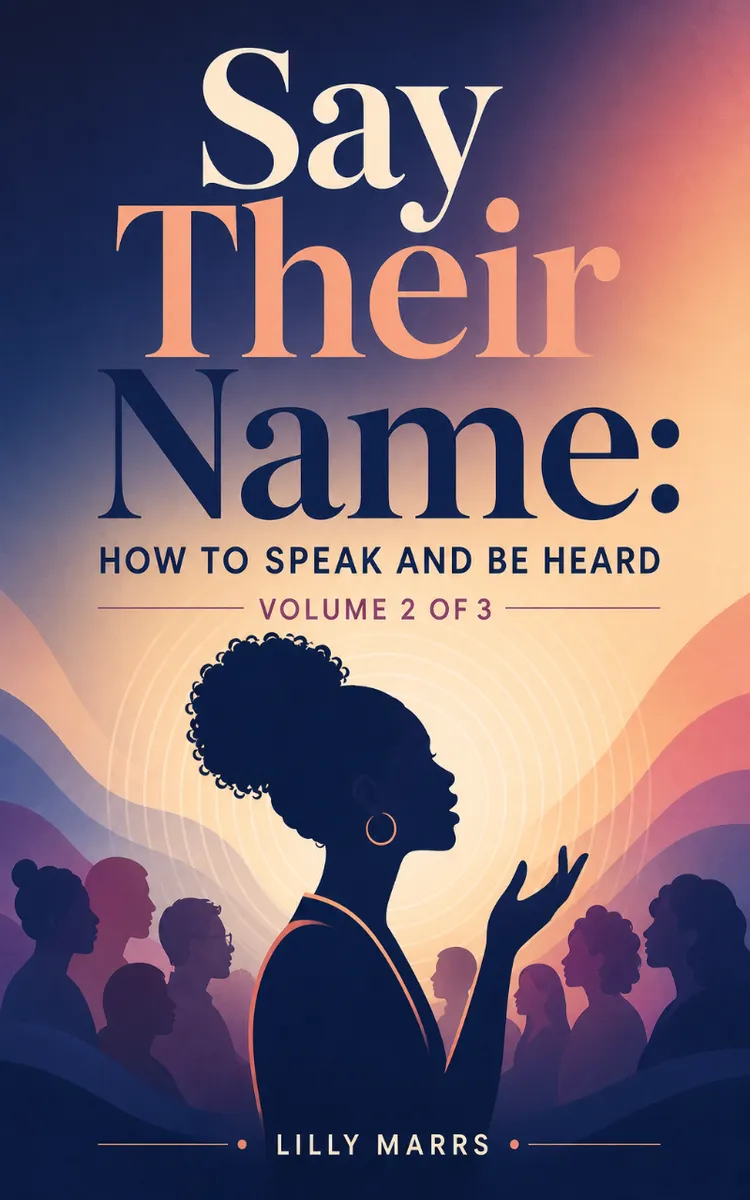
"Say Their Name: How to Speak and Be Heard" is a general book by Lilly Marrs with 7 chapters and approximately 10,601 words. A conversational guide to finding your voice after child loss—how to talk, ask, and advocate for connection, support, and understanding..
This book was created using Inkfluence AI, an AI-powered book generation platform that helps authors write, design, and publish complete books.
Frequently Asked Questions
What is "Say Their Name: How to Speak and Be Heard" about?
A conversational guide to finding your voice after child loss—how to talk, ask, and advocate for connection, support, and understanding.
How many chapters are in "Say Their Name: How to Speak and Be Heard"?
The book contains 7 chapters and approximately 10,601 words. Topics covered include The Words People Say (and Don’t), Saying Their Name Without Flinching, Asking for Support That Shows Up, Conversations With Family and Friends, and more.
Who wrote "Say Their Name: How to Speak and Be Heard"?
This book was written by Lilly Marrs and created using Inkfluence AI, an AI book generation platform that helps authors write, design, and publish books.
Write your own book with AI
Describe your idea and Inkfluence writes the whole thing. Free to start.
Start writingCreated with Inkfluence AI


