
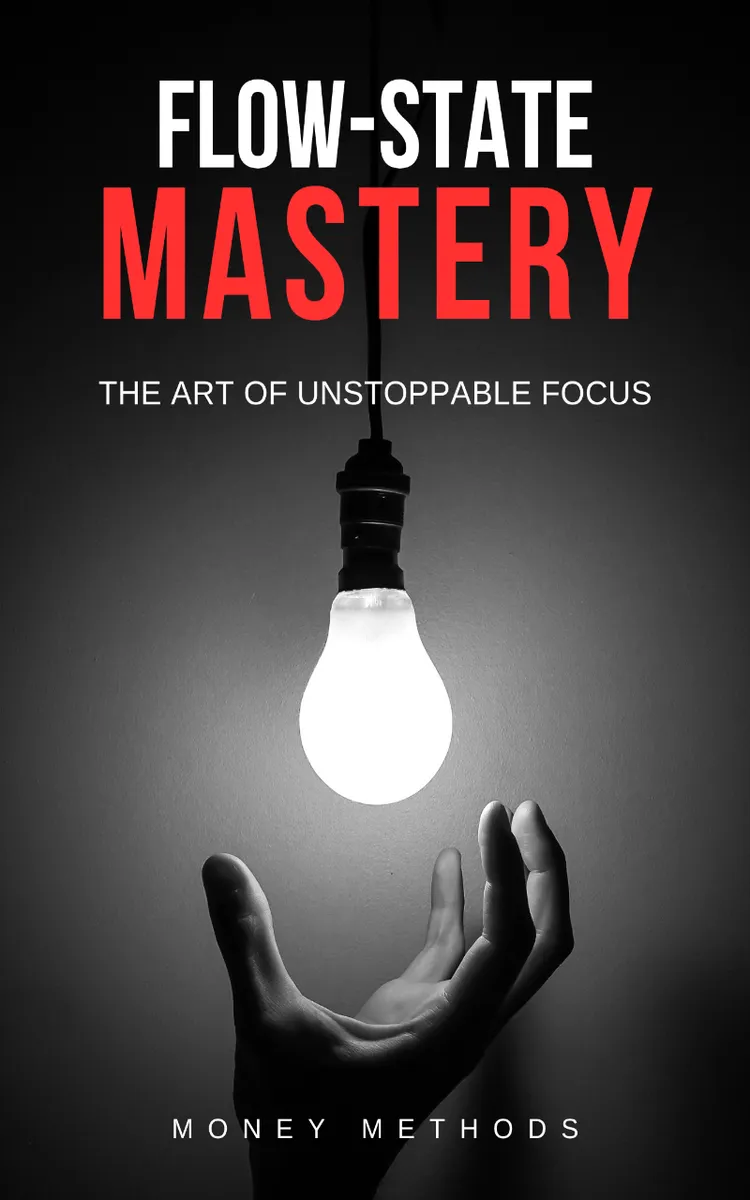
Read the first chapter
The whole of chapter one, free. About 8 min. Turn the pages with the arrows, your keyboard, or a swipe.
Chapter 1
FLOW TRIGGERS: CLEAR GOALS
Have you ever sat down to “work deeply,” stared at your task list, and still felt like your brain kept bouncing off the edges - too restless to start, too scattered to finish? That isn’t a willpower problem. It’s a goal problem. When your goal stays fuzzy, your mind can’t lock into a flow-state loop, so you drift into aimless effort that feels busy but produces little.
This chapter teaches the Clear-Goal Switch Model: how to turn a vague “do work” intention into a specific target your brain can grab. You’ll learn how to write goals that trigger flow, block the slide into random checking, and turn “I should” into “I know exactly what to do next.” By the end, you’ll be able to set one goal for a deep-focus session, break it into a tight finish line, and run a quick self-check to see whether it actually activated focus.
The payoff is simple: you stop draining motivation on half-decisions and start feeding your brain the kind of clarity that makes sustained attention feel almost automatic.
Why Specific, Meaningful Goals Trigger Flow (and Stop Aimless Effort)
Flow-state psychology cares about two things your brain wants to feel right away: direction and meaning. Direction means you know what “done” looks like. Meaning means the goal matters to you in a real, personal way - not just in theory. When both show up together, your brain spends less energy guessing and more energy performing. When either one is missing, you compensate by scanning, multitasking, and revisiting earlier choices, which drains focus fast.
Aimless effort usually starts like this: you pick a task, but you don’t define the target outcome tightly enough. Your mind keeps asking hidden questions - “Am I doing the right thing?” “How will I know it worked?” “What should I do next?” Those questions create internal friction. You may still work, but you work like you’re steering with foggy headlights. The result feels like motion without progress.
Specific goals prevent that fog. They give your attention a lane. Meaningful goals prevent the “why bother?” feeling that creeps in when effort gets hard. Put together, they do something powerful: they turn your session into a loop where you act, check your progress against the finish line, and continue because the next step becomes obvious.
Ask yourself this before you set a goal: “If someone watched me for 30 minutes, could they tell whether I’m winning?” If the answer is “not really,” your goal still has too much room for interpretation.
Practical takeaway / reflection prompt Write down one task you often start but don’t finish, then finish this sentence: “Right now I’m unclear about what ‘done’ means.” That sentence points straight to the goal trigger you’ll fix next.
How the Clear-Goal Switch Model Works (Set the Target Your Brain Can Grab)
The Clear-Goal Switch Model turns a fuzzy intention into a flow-ready target using four moves. Each move removes a type of uncertainty that steals focus.
1. Name the finish line in one sentence. Write the outcome as if you’re reporting results, not activities. Example: “Create the customer update draft that explains the outage timeline and next steps” instead of “Work on customer update.” Why it works: your brain locks onto a destination, not a wandering list.
2. Pick the smallest proof you can produce. Decide what “I’m progressing” looks like halfway through the work. Example: “By minute 20, I will have the draft sections for timeline + impact + next steps completed.” Why it works: you get fast feedback, so you keep moving instead of rethinking from scratch.
3. Attach one meaningful constraint (your ‘why’ in action). Choose a real reason that shows up in the work itself. Example: “Reduce customer confusion before the support queue spikes tomorrow morning” or “Make it easy for customers to take the next action.” Why it works: meaning stops the internal debate when the task gets boring or annoying.
4. Define the next physical action before you start. End your goal statement with a single next step: “Open the template and fill in the timeline section” or “Pull the last 3 tickets and extract common questions.” Why it works: flow hates friction. You remove the moment where your brain has to decide what to do first.
Here’s a concrete example using Nia, a 34-year-old customer success manager. When Nia says, “Work on the customer update,” she often ends up rewriting paragraphs, checking old emails, and switching between drafts and inbox replies. That goal feels active, but it doesn’t tell her what success looks like. Her attention scatters.
Instead, Nia applies the Clear-Goal Switch Model. She writes:
• Finish line: “Send a customer update draft that includes outage timeline, impact summary, and next steps.” - Smallest proof: “Have the timeline + impact sections completed within 20 minutes.” - Meaning constraint: “Reduce confusion so fewer customers ask the same ‘when will it be fixed’ question.” - Next action: “Open the update template and paste the timeline bullets.”
Now her brain knows the lane. She can feel progress quickly because she can see the proof.
Practical takeaway / reflection prompt Take one task you avoid or drift on. Convert it into a finish line sentence, then write the smallest proof you can produce in 20 minutes. If you can’t name that proof, your goal still isn’t sharp enough.
Putting It Into Practice: Run One Flow-Ready Session with Nia’s Example
Let’s run a full session setup for Nia that you can copy. She has a deep-focus window from 9:00 to 10:00 AM to produce a customer update draft. Her inbox constantly tempts her to check messages, which breaks focus.
She does this setup sequence before she touches the email client:
1. Choose one session goal (not a list). She writes: “Draft the customer update: timeline + impact + next steps.”
2. Set the finish line format. She adds: “Use the standard template headings: Timeline, What Changed, What Customers Should Do Next.” Expected outcome: she can tell instantly if the draft is aligned.
3. Define the smallest proof at the halfway mark. She sets: “Within 20 minutes, complete Timeline and What Changed sections in full.” Expected outcome: she gets early feedback and reduces the urge to re-check.
4. Add one meaningful constraint that shows up in the text. She chooses: “Make next steps unmistakably actionable.” Expected outcome: she spends less time polishing sentences that don’t help customers take the next action.
5. Lock the next physical action. She writes on paper: “Open template → paste timeline bullets → write 5 impact bullets.” Expected outcome: she starts without deciding.
6. Start a timer and remove one distraction channel. She closes the inbox tab and keeps only the template open. She sets a 20-minute timer for the proof. Expected outcome: she prevents “just checking” from hijacking the session.
Then she executes the work. At the 20-minute mark, she checks whether her proof exists: the Timeline and What Changed sections are filled, even if they’re rough. If they exist, she continues toward the next steps section. If they don’t, she stops and fixes the goal clarity instead of pushing harder.
Quick checklist (use this right before deep focus) - Finish line: I can describe what “done” looks like in one sentence. - Small proof: I can produce a visible halfway result within 20 minutes. - Meaning constraint: My goal includes a real reason that affects the outcome. - Next action: I wrote the exact first step to start immediately. - Distraction control: I removed one obvious escape hatch (like the inbox tab).
Practical takeaway / reflection prompt Before your next deep-focus block, write your goal on one line and the next physical action on a second line. If you can’t do that without rewriting it twice, your brain will likely drift - fix the goal first.
What to Watch For: Goal Traps That Kill Flow (and How to Fix Them)
Even solid intentions can fail when the goal triggers don’t match how your brain behaves. Here are the most common traps and the fixes that work fast.
Finish-line blur If your goal sounds like an activity (“work on,” “improve,” “research”), you won’t know when you’ve won. You’ll keep revisiting earlier steps because the brain never gets a clean finish line.
Do this: Replace the activity with an outcome and a format. Not this: “Work on the customer update.” Instead, use: “Draft a customer update with Timeline, What Changed, and What Customers Should Do Next headings.”
Proof missing If you don’t define a small proof you can create early, you won’t get the quick feedback flow needs. You’ll spend the first 30 minutes trying to “get ready” or “find the best approach,” and that’s where motivation leaks.
Do this: Set a 20-minute proof you can literally point to. Not this: “Write the draft.” Instead, use: “Write the Timeline and Impact bullets by 9:20 AM.”
Meaning that stays in your head If your “why” stays as a vague feeling (“this matters”), you’ll still lose focus when the work gets tedious. Flow needs meaning that shows up inside the work you produce.
Do this: Turn meaning into a constraint that changes what you write or build. Not this: “I want to help customers.” Instead, use: “Write next steps as clear actions that a customer can do in one click or one reply.”
Practical takeaway / reflection prompt After your session, answer one question: “Did I hit my small proof?” If you didn’t, don’t blame your effort - tighten your finish line and add a concrete proof. That adjustment usually fixes the flow trigger in minutes, not days.
When you treat goals like switches - clear finish lines, early proofs, and meaning that shows up in the output - you stop spending your focus budget on guessing. And once you stop guessing, your attention can finally settle into flow.
End of chapter one. 4 more chapters in the full book.
Swipe or use the arrows to turn the page
What's inside: 5 chapters
- 1. FLOW TRIGGERS: CLEAR GOALS
- 2. Designing Your Deep-Work Blocks
- 3. The Distraction Firewall Setup
- 4. Energy Management for Peak Performance
- 5. Flow Review and Continuous Upgrades
About this book
"0" is a how-to guide book by Anonymous with 5 chapters and approximately 9,188 words. Deep focus and productivity using flow-state psychology.
This book was created using Inkfluence AI, an AI-powered book generation platform that helps authors write, design, and publish complete books. It was made with the AI Ebook Generator.
Frequently Asked Questions
What is "0" about?
Deep focus and productivity using flow-state psychology
How many chapters are in "0"?
The book contains 5 chapters and approximately 9,188 words. Topics covered include FLOW TRIGGERS: CLEAR GOALS, Designing Your Deep-Work Blocks, The Distraction Firewall Setup, Energy Management for Peak Performance, and more.
Who wrote "0"?
This book was written by Anonymous and created using Inkfluence AI, an AI book generation platform that helps authors write, design, and publish books.
How can I create a similar how-to guide book?
You can create your own how-to guide book using Inkfluence AI. Describe your idea, choose your style, and the AI writes the full book for you. It's free to start.
Write your own how-to guide book with AI
Describe your idea and Inkfluence writes the whole thing. Free to start.
Start writingCreated with Inkfluence AI


