
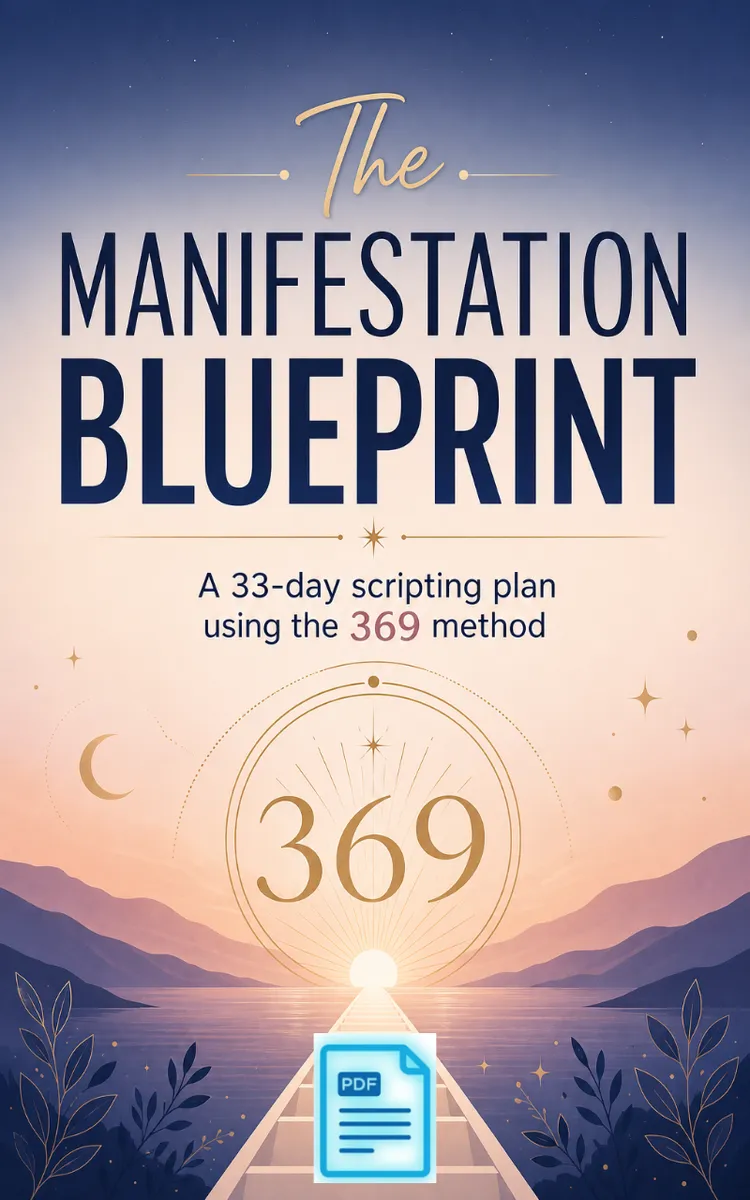

Read the first chapter
The whole of chapter one, free. About 5 min. Turn the pages with the arrows, your keyboard, or a swipe.
Chapter 1
Days 1-5: Setting the Intention Anchor
jMost people don’t fail at manifestation because they “don’t believe enough.” They fail because their desire is floating around with no end-state, no anchor, and no daily script to hold it in place. So here’s the question: what are you actually assuming is true by the time you finish your day?
For the next five days, you’re building what I call your Intention Anchor Protocol - your simple, repeatable way to lock your core desire to a clear outcome and set your brain up to cooperate. We’re using the Law of Assumption, which means you don’t need to hype yourself up all day. You need to decide what “already true” feels like, then practice that feeling with words and actions.
If you want a real-life picture, picture Talia, 34, an HR manager who’s transitioning careers. Her desire wasn’t vague (“I want something better”). It was a specific end-state, and she kept returning to it like a compass. When her days got messy, her anchor kept her from drifting into old assumptions.
Day 1: Name the Desire Like You Mean It
Tip of the Day:
If your desire is a cloud, your assumptions will stay cloudy too. Today isn’t about being poetic. It’s about being accurate. You’re going to write your core desire in a way that leaves no room for “maybe it’s this, maybe it’s that.”
Talia started by noticing her language. She’d say, “I want a career that feels right.” That’s too many exits. So she rewrote it into a clean sentence: what exactly does “feels right” look like in her life? Pay range, role type, schedule, and the kind of work she can stand waking up to - those details matter because they give your brain something real to assume.
Today's Action:
Write one sentence that states your core desire as an end-state you want in your life (include specifics like role, situation, or outcome).
Day 2: Define the End-State (No Vibes-Only Allowed)
Tip of the Day:
You’re not scripting a wish - you’re scripting an assumption. That means your end-state needs boundaries. “Better job” isn’t an end-state. “A job where I’m using X skills, making Y amount, and working Z schedule” is.
Be careful here: if you only list what you want emotionally, you’ll accidentally let your brain fill in the blanks with old patterns. Instead, decide what your life looks like when the desire has already happened. Then treat that picture like the truth you’re practicing.
Talia did this when she got anxious. She stopped scrolling and wrote: “I’m in a role that uses my HR background to lead training and culture work, with a stable income and a team that values clear communication.” Notice what she didn’t do - she didn’t argue with herself. She just clarified the target.
Today's Action:
Create a “When It’s Done” paragraph describing your end-state in 5-7 sentences (what you have, what you do, who you’re around, and what your days feel like).
Day 3: Choose Your Anchor Phrase (The One You Repeat Without Overthinking)
Tip of the Day:
Your anchor phrase is the sentence your mind will grab when it tries to wander. It’s not a mantra you perform to feel magical. It’s a statement of assumption - short enough to repeat, specific enough to mean something.
Keep it simple. If your phrase is too long, you won’t use it when you’re busy. If it’s too vague, it won’t hold you. Aim for one line that sounds like reality, not a future fantasy.
Talia’s anchor phrase ended up being something like: “I’m already in the right career lane, doing the work that fits, with money stability and a team I respect.” She didn’t say it to “convince” herself. She said it to remind her which track she was on.
Today's Action:
Write one anchor phrase (one sentence) that declares your end-state as already true for you, and put it somewhere you’ll see today (note on your phone screen, mirror sticky note, or dashboard card).
Day 4: Proof-Collecting for Assumption (Your Brain Loves Evidence)
Tip of the Day:
Here’s the trick most people miss: your brain believes the story you keep feeding it. So today you’re not trying to “manifest” from nothing - you’re collecting small proof that supports your anchor phrase.
This doesn’t mean you fake it or pretend everything is perfect. It means you notice what already points in the direction of your end-state. Even if it’s small - an email you sent, a conversation you had, a skill you practiced, a moment where you felt calmer about your future - that counts.
Talia did a quick proof list after a rough workday. She wrote down three things: she’d been recognized for her training work, she’d updated her resume with the exact role she wanted, and she’d already started networking with people in that space. None of it was the final outcome. But it was evidence that her assumptions could shift.
Today's Action:
Make a “Proof List” of 10 bullets: write 10 specific things you’ve done, noticed, or experienced that support your anchor phrase (keep it real and concrete).
Day 5: Script Your Day With the 369 Starter Page
Tip of the Day:
Today you’re preparing your 369 scripting pages so you can use them consistently without friction. The Law of Assumption works best when you repeat your chosen statement in a structured way. Not randomly. Not when you feel inspired. On purpose.
Your job is to write your “end-state statement” exactly as you’ll use it in your 369 practice. Then you’ll set up a simple routine: morning, midday, evening. You don’t need a dramatic life overhaul today. You need repetition that tells your nervous system, “We’re doing this now.”
Talia kept her 369 statement tight because she was busy. Her morning version matched her end-state paragraph, her midday version was the anchor phrase, and her evening version was the same line again - no wobbling, no rewriting every time her mood changed. That consistency did the heavy lifting.
Today's Action:
Draft your 369 end-state statement (one sentence) and schedule your three daily repetition times for the next 3 days (morning, midday, evening) on a calendar or reminder app.
Your Intention Anchor Protocol is already working the moment you stop treating your desire like a guess. Next, you’ll move from anchoring to repeating with intention - so your words don’t just sound good, they start to behave like instructions for your reality. Keep your anchor phrase close. Your future self is already listening.
End of chapter one. 6 more chapters and about 6,269 words in the full book.
Swipe or use the arrows to turn the page


What's inside: 7 chapters
- 1. Days 1-5: Setting the Intention Anchor
- 2. Days 6-10: Training Belief with Assumption
- 3. Days 11-15: Scripting the 369 Sequence
- 4. Days 16-20: Clearing Resistance and Doubt
- 5. Days 21-25: Aligning Actions with Assumption
- 6. Days 26-30: Deepening Visualization with “Living Proof”
- 7. Days 31-33: Sealing the Blueprint and Receiving
About this book
"The Manifestation Blueprint" is a day challenge book by NextGen PDF with 7 chapters and approximately 6,269 words. Structured manifestation practice using the Law of Assumption.
This book was created using Inkfluence AI, an AI-powered book generation platform that helps authors write, design, and publish complete books.
Frequently Asked Questions
What is "The Manifestation Blueprint" about?
Structured manifestation practice using the Law of Assumption
How many chapters are in "The Manifestation Blueprint"?
The book contains 7 chapters and approximately 6,269 words. Topics covered include Days 1-5: Setting the Intention Anchor, Days 6-10: Training Belief with Assumption, Days 11-15: Scripting the 369 Sequence, Days 16-20: Clearing Resistance and Doubt, and more.
Who wrote "The Manifestation Blueprint"?
This book was written by NextGen PDF and created using Inkfluence AI, an AI book generation platform that helps authors write, design, and publish books.
Write your own day challenge book with AI
Describe your idea and Inkfluence writes the whole thing. Free to start.
Start writingCreated with Inkfluence AI


