
Read the first chapter
The whole of chapter one, free. About 5 min. Turn the pages with the arrows, your keyboard, or a swipe.
Chapter 1
Days 1-5: Build Your Emotional Baseline
The fastest way to lose your cool isn’t a big blow-up - it’s the tiny moment right before it. The second you notice that tight chest, the hot face, the urge to fire back… that’s your real starting line. Days 1-5 are about finding that line and marking it clearly, so you can respond with clarity instead of reaction.
Nadia, a 34-year-old customer support manager, told me something that sounds small until you’ve lived it: “I used to think I was reacting to the customer. Turns out I was reacting to my own body.” She didn’t change her job, her inbox, or her customers overnight. She just started tracking what came first - trigger, feeling, and what she did next. Then she got options. Real ones.
These first five days build your emotional baseline using one simple tool: the Feelings-to-Choices Baseline Map. Not a fancy chart you’ll forget. A practical way to notice what’s happening, name it, and choose your next move on purpose.
---
Day 1: Name What’s Already There
Tip of the Day: A lot of people skip the “name it” part because it feels too simple. But your emotions don’t become manageable just because you ignore them. They get louder. For Nadia, it was the same pattern: a rude message would land, and her body would jump first - tight throat, quick pulse, then the urge to defend herself.
Today, you’re not trying to control anything. You’re just learning the language your feelings use when they show up. When you can label what you feel (even roughly), you buy yourself a few seconds of space. That space is where choice lives.
Today's Action: Pick one moment today where you felt even mildly activated (annoyed, stressed, embarrassed). Write one sentence: “When _ happened, I felt _ in my body.” Keep it simple.
---
Day 2: Track Your Trigger Like a Detective
Tip of the Day: Triggers are sneaky. They rarely announce themselves with a dramatic soundtrack. Most of the time they’re quick: a tone of voice, a typo, a late payment, someone not replying, a comment that lands wrong. If you only track the feeling, you’ll miss the pattern. If you track the trigger too, you start seeing your personal “hot spots.”
Nadia noticed hers weren’t random. It was usually messages that sounded dismissive, plus the fear that she’d be judged for not fixing it fast enough. That mix created the same inner alarm every time. Once she could point to the trigger, her feelings stopped feeling like a mystery.
Today's Action: Write down 3 triggers from today (they can be small). For each, add: “My likely feeling afterward is ___.” Don’t overthink - first honest answer wins.
---
Day 3: Use the Feelings-to-Choices Baseline Map
Tip of the Day: Here’s the magic: feelings aren’t commands. They’re signals. The Feelings-to-Choices Baseline Map helps you see that signal and connect it to what you do next - before you do it on autopilot.
Your map has three parts: what happened (trigger), what you felt (body + emotion), and what you chose (your action). The goal isn’t to “be calm.” The goal is to notice, then choose a response that fits the situation - not the adrenaline.
Try this with Nadia’s real-life pattern: rude message → tight throat and anger → she used to send a sharper reply. When she mapped it, she could spot the moment she was about to escalate. Then she could choose a slower, clearer first sentence instead. Same job. Different outcome.
Today's Action: Make one mini-map for today on paper or notes: Trigger: _ Feeling: _ (include body) Choice you made: _ Choice you wish you made next time: _
---
Day 4: Catch the “Auto-Reply” Before It Ships
Tip of the Day: Some reactions are so automatic you don’t even feel them as choices. They show up as the first words you type, the first sentence you blurt out, the quick decision you make “because it’s obvious.” Nadia realized her auto-reply was often defensive: she’d answer the problem, but in a way that sounded like she was bracing for blame.
Today you’re going to interrupt that auto-reply. Not by forcing yourself to be different. By adding a tiny delay and checking what’s underneath.
When you catch the urge, ask one question: “What am I actually protecting right now?” Sometimes it’s respect. Sometimes it’s fairness. Sometimes it’s just that you don’t want to feel embarrassed. Naming the protection helps you pick a choice that still protects you - without starting a fight.
Today's Action: When you feel the urge to respond quickly today, pause for 10 seconds and do this phrase in your head: “Trigger → feeling → choice.” Then send your reply or make your decision.
---
Day 5: Celebrate Your Evidence (Yes, Evidence)
Tip of the Day: Resilience isn’t just about getting better under pressure. It’s also about noticing where you already did it. If you only look at what went wrong, your brain will keep score in a way that feels personal. Instead, start collecting evidence that you can notice your feelings and steer your choices.
Nadia didn’t become a different person after Day 1 through Day 4. But she did start building proof. Proof that she could catch the moment earlier. Proof that she could choose a calmer first line. Proof that her feelings didn’t have to run the show.
Take a moment and scan the last few days. Even tiny wins count: you paused, you used a softer tone, you asked a clarifying question, you didn’t send the message you wrote, you took a breath before you spoke. That’s not “luck.” That’s your baseline getting stronger.
Today's Action: Write down 2 moments from today where you used awareness to choose a better response. For each, finish the sentence: “I noticed, so I chose.”
---
By the end of Day 5, you’ll have something most people never build: a clear picture of how your triggers turn into feelings, and how those feelings push you toward choices. That map becomes your anchor as the program continues - because the next time your buttons get pressed, you won’t have to guess what’s happening. You’ll already know where to look, and what to do next.
End of chapter one. 4 more chapters in the full book.
Swipe or use the arrows to turn the page

What's inside: 5 chapters
- 1. Days 1-5: Build Your Emotional Baseline
- 2. Days 6-10: Rewire Thoughts in Real Time
- 3. Days 11-15: Strengthen Boundaries and Self-Respect
- 4. Days 16-20: Train Calm Under Pressure
- 5. Days 21-21: Lock In Your Resilience Lifestyle
About this book
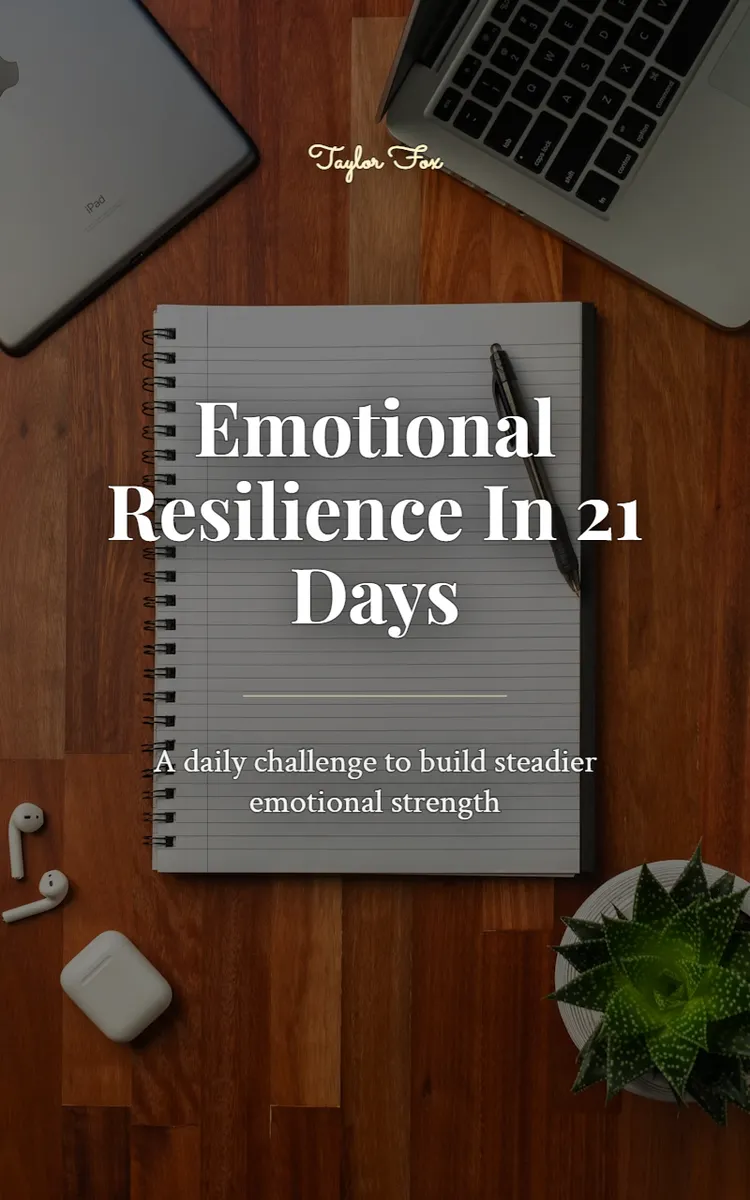
"Emotional Resilience In 21 Days" is a day challenge book by Taylor Fox with 5 chapters and approximately 4,177 words. A 21-day program to build emotional resilience.
This book was created using Inkfluence AI, an AI-powered book generation platform that helps authors write, design, and publish complete books.
Frequently Asked Questions
What is "Emotional Resilience In 21 Days" about?
A 21-day program to build emotional resilience
How many chapters are in "Emotional Resilience In 21 Days"?
The book contains 5 chapters and approximately 4,177 words. Topics covered include Days 1-5: Build Your Emotional Baseline, Days 6-10: Rewire Thoughts in Real Time, Days 11-15: Strengthen Boundaries and Self-Respect, Days 16-20: Train Calm Under Pressure, and more.
Who wrote "Emotional Resilience In 21 Days"?
This book was written by Taylor Fox and created using Inkfluence AI, an AI book generation platform that helps authors write, design, and publish books.
Write your own day challenge book with AI
Describe your idea and Inkfluence writes the whole thing. Free to start.
Start writingCreated with Inkfluence AI


