

Read the first chapter
The whole of chapter one, free. About 8 min. Turn the pages with the arrows, your keyboard, or a swipe.
Chapter 1
The Night You Finally Stopped
The Doorway Moment
The text says, Where are you? You stare at it while sitting in your car outside the house. The engine is off. Your phone is at 3 percent. There’s an empty can under the passenger seat, a story ready in your mouth, and a knot in your chest that has been there so long you’ve started calling it normal.
You could say traffic. You could say your phone died. You could say you needed space. You’ve said versions of all three before. The words come easily now. That’s part of the problem.
Inside, somebody is waiting for you to come through the door. Maybe it’s your partner. Maybe it’s your child. Maybe it’s an empty apartment and the quiet consequence of having pushed everyone away. You know the truth, or enough of it to feel its weight. Still, denial offers one more small kindness: it lets you postpone becoming the person who has to face what happened.
How long can a lie protect you before it begins destroying the life it was meant to preserve?
The Lie That Kept You Alive
Old Belief: If I admit the truth, everything will fall apart.
New Reality: The truth may expose what has already fallen apart, but it also gives you something solid to rebuild from.
Denial rarely begins as a grand decision to deceive everybody. More often, it starts as protection. You’re overwhelmed, ashamed, frightened, or desperate to avoid one more argument. So you shave off a detail. You leave out the part about using again. You call the missed payment a mistake instead of admitting you spent the money somewhere else. You say you’re “fine” because explaining the truth feels impossible.
For a while, this works. That matters. Denial survives because it provides immediate relief. It lowers the heat in the room. It keeps somebody from leaving tonight. It lets you sleep for a few hours without looking directly at the damage. The trouble is that relief isn’t repair. It’s borrowed time, and the interest keeps growing.
Consider the person in the car. They finally walk inside and say they were delayed at work. The argument is avoided. But now there’s another lie to remember. Tomorrow, they’ll need to support it. Then another detail will need covering. Soon the problem isn’t only the drinking, the drug use, the gambling, the rage, or the disappearing. The problem is the whole structure built around hiding it.
Honesty doesn’t magically fix that structure. It does something more basic and more important: it stops adding new rooms to the wreckage. You can’t rebuild a house while insisting there’s no fire. You can, however, turn off the gas, step outside, and tell the truth about what burned.
When Denial Is Driving
Denial has a particular sound. It often sounds reasonable.
You tell yourself you’re not lying; you’re protecting someone. You’re not avoiding responsibility; you’re waiting for the right time. You’re not out of control; you’re under stress. You’re not hurting people; they’re overreacting. Some of these explanations may contain a small piece of truth. That’s what makes denial so slippery. It rarely uses a completely false story. It takes one true detail and builds a shelter around it.
The Stop-Truth Index helps you notice the moment when protection has become avoidance. It isn’t a score that proves whether you’re good or bad. It’s a pause. When you catch yourself explaining, minimizing, blaming, or preparing a version of events that sounds better than the real one, stop and ask: What truth am I trying not to say?
The answer may be simple and ugly: “I used.” “I took money.” “I scared my daughter.” “I promised something I had no plan to keep.” “I don’t know how to stop on my own.” These sentences don’t make you worthless. They make the situation visible. Visibility is where accountability begins.
Signs this pattern is running your life:
1. You rehearse your explanation before anyone asks a question. You’re not preparing to communicate. You’re preparing to control what the other person is allowed to know.
2. You feel relief when a conversation gets postponed. The relief is real, but notice what follows it. Usually, the problem grows while you enjoy the temporary quiet.
3. You use technically true statements to hide the larger truth. “I only had one” may be accurate while still concealing the ten that came before it.
4. You’re more focused on being believed than becoming trustworthy. Being believed is about somebody’s opinion today. Trustworthiness is what your behavior proves over time.
The Stop-Truth Index in Plain Language
When you feel the strongest urge to manage someone’s understanding, there is probably a truth you need to face before you manage anything else.
That doesn’t mean you confess every private thought to every person. Honesty isn’t reckless oversharing. It means you stop using confusion as cover. If professional help, a recovery group, or a trusted support person is needed, reach for one. A book can help you name the problem, but it can’t safely carry you through withdrawal, crisis, or serious danger.
Your first honest sentence may not sound impressive. It may be, “I need help.” It may be, “I’ve been lying about how bad this is.” It may be, “I don’t expect you to trust me yet.” Those words can feel like losing control. In reality, they’re the first control you’ve had in a long time - the kind that doesn’t depend on making everybody else see things your way.
Questions You Can’t Outsmart
1. What happened the last time you told a half-truth to avoid an immediate consequence? Write down the short-term benefit and the longer cost. For example: “I avoided an argument that night, but my partner stopped believing my schedule.”
2. Which sentence do you repeat when you want to make your behavior sound less serious? It might be “I had a rough week,” “Nobody got hurt,” or “I can stop whenever I want.” Ask what that sentence helps you avoid admitting.
3. Who has been forced to live with the consequences of a truth you refused to face? Be specific. Maybe someone covered your rent, picked up your child, answered your employer, or learned not to rely on you.
4. What truth could you say today without demanding forgiveness, trust, or immediate closeness? A clean truth doesn’t include a hidden request. “I broke my promise, and I understand why you’re keeping your distance” is different from “I broke my promise, but you need to give me another chance.”
5. What would accountability look like in the next twenty-four hours? Not a speech. Not a promise about the rest of your life. One action. Make the call, return the money, tell the person affected, remove access to what you misuse, or ask qualified support for help.
Answer these with facts instead of courtroom arguments. You don’t need to prosecute yourself, and you don’t need to defend yourself. Both habits keep the spotlight on your feelings rather than your choices. The goal is not to produce the most painful confession. The goal is to become accurate.
The Seven-Day Stop-Truth Challenge
For the next 7 days, use the Stop-Truth Index before you explain, deny, or make a promise.
• Keep a note on your phone titled Stop-Truth Index. - Each time you feel the urge to hide, soften, blame, or delay, write three short lines: What I’m about to say: What I don’t want to say: What is actually true: - Tell one safe, appropriate person one truth you’ve been avoiding. Don’t attach a demand for forgiveness. - Take one repair action connected to that truth. If money is involved, name the amount. If time is involved, acknowledge the time. If safety is involved, contact qualified help and create distance from the danger. - At the end of each day, write one sentence beginning with: “Today, I was accountable when I…” - If honesty could put you at risk of violence, retaliation, or immediate harm, don’t confront the person alone. Speak with a qualified professional or trusted support service first.
Difficulty: Hard
You’ll know it’s working when...
• You catch yourself before the explanation leaves your mouth. - Your truth becomes shorter and more specific. - You stop adding promises you can’t keep. - You take one repair action without waiting to feel ready. - You can hear someone’s anger without rushing to prove you’re the victim. - You understand that a consequence is not always an attack.
The challenge feels hard because denial has been doing a job. It has helped you escape shame, conflict, fear, and consequences. Removing it can leave you exposed. That doesn’t mean you’re failing. It means you’re finally standing where the real work can reach you.
The First Honest Brick
A second chance doesn’t begin when everybody believes you’ve changed. It begins when you stop requiring belief before you behave differently.
• Denial often starts as protection, but repeated protection becomes another form of harm. - Honesty means naming what happened without minimizing it, decorating it, or using it to control someone’s response. - Accountability is more than confession; it includes a concrete action that addresses the damage. - The Stop-Truth Index helps you notice the moment an explanation is trying to replace the truth. - You don’t need to handle dangerous situations alone. Qualified treatment, peer support, and professional care may be necessary parts of rebuilding.
The truth may not save the life you were pretending to have, but it can become the first brick in the life you’re finally willing to build.
For now, let the door open only as far as honesty allows. You don’t have to repair every broken relationship tonight. You do have to stop making the wreckage harder to see. The next part of rebuilding will ask what happens after the truth is spoken - when the apology is made, the answer is uncertain, and your old life no longer gives you instructions.
End of chapter one. 24 more chapters in the full book.
Swipe or use the arrows to turn the page


What's inside: 25 chapters
- 1. The Night You Finally Stopped
- 2. Guilt Versus Responsibility Inventory
- 3. Why Understanding Isn’t Excusing
- 4. Your Relapse Timeline, Not Your Relapse Story
- 5. Interrupting the Shame Spiral
- 6. Regulating Anger Without Exploding
- 7. Breaking the “I’m Fine” Lie
- 8. Building a Life With Structure
- 9. The Apology That Doesn’t Demand Forgiveness
- 10. Writing the Unsent Letter First
- 11. Amends Letters With Clear Boundaries
- 12. Relationship Audit: Trust Takes Time
- 13. Healthy Communication After Betrayal
- 14. When Reconciliation Doesn’t Happen
- 15. Parenting From a Distance With Love
- 16. Apologies to Your Child: What to Say
- 17. Money Conversations Without Chaos
- 18. Debt, Restitution, and Repair Steps
- 19. Relapse Temptation: The Moment You Quit Trying
- 20. Money, Work, and Identity After Failure
- 21. Sleep, Health, and the Body’s Memory
- 22. Love Without Rescue: Partner Responsibility
- 23. Conflict Repair: Repair Attempts That Count
- 24. Becoming Dependable When Nobody Applauds
- 25. Second Chance Is an Obligation
About this book
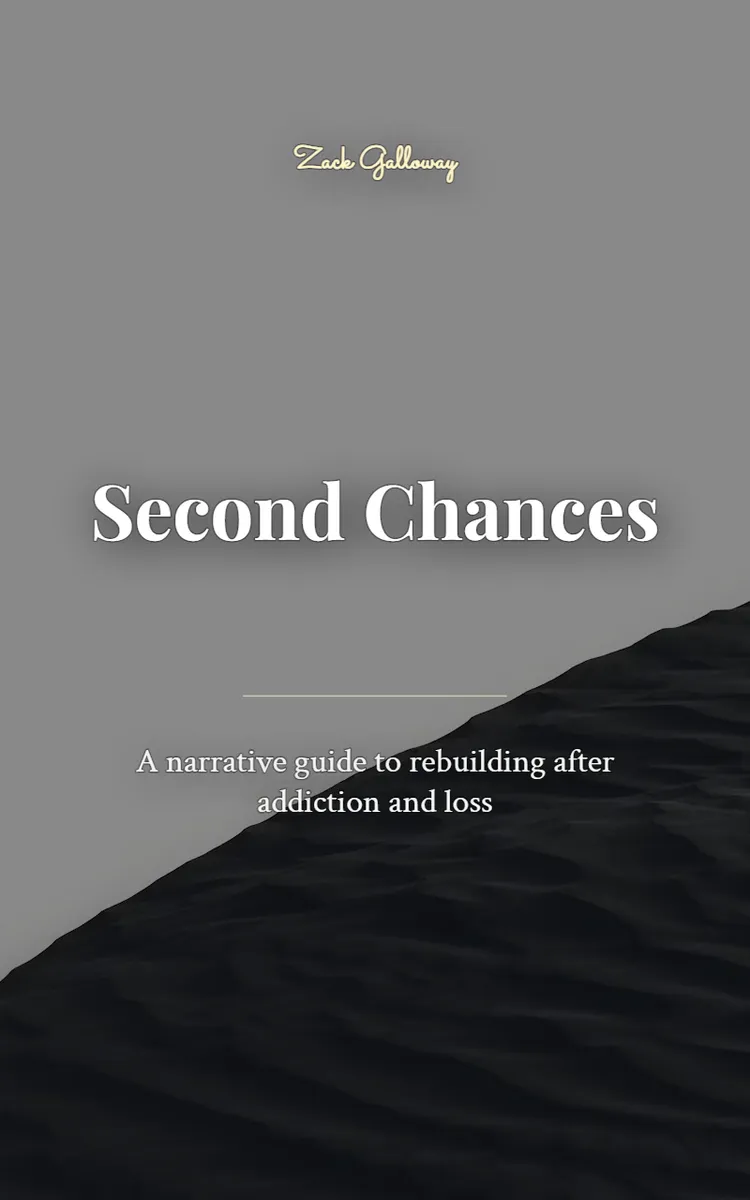
"Second Chances" is a self-help book by Zack Galloway with 25 chapters and approximately 48,056 words. Recovery, accountability, and rebuilding life after addiction and broken relationships.
This book was created using Inkfluence AI, an AI-powered book generation platform that helps authors write, design, and publish complete books. It was made with the AI Self-Help Book Writer.
Frequently Asked Questions
What is "Second Chances" about?
Recovery, accountability, and rebuilding life after addiction and broken relationships
How many chapters are in "Second Chances"?
The book contains 25 chapters and approximately 48,056 words. Topics covered include The Night You Finally Stopped, Guilt Versus Responsibility Inventory, Why Understanding Isn’t Excusing, Your Relapse Timeline, Not Your Relapse Story, and more.
Who wrote "Second Chances"?
This book was written by Zack Galloway and created using Inkfluence AI, an AI book generation platform that helps authors write, design, and publish books.
How can I create a similar self-help book?
You can create your own self-help book using Inkfluence AI. Describe your idea, choose your style, and the AI writes the full book for you. It's free to start.
Write your own self-help book with AI
Describe your idea and Inkfluence writes the whole thing. Free to start.
Start writingCreated with Inkfluence AI


