
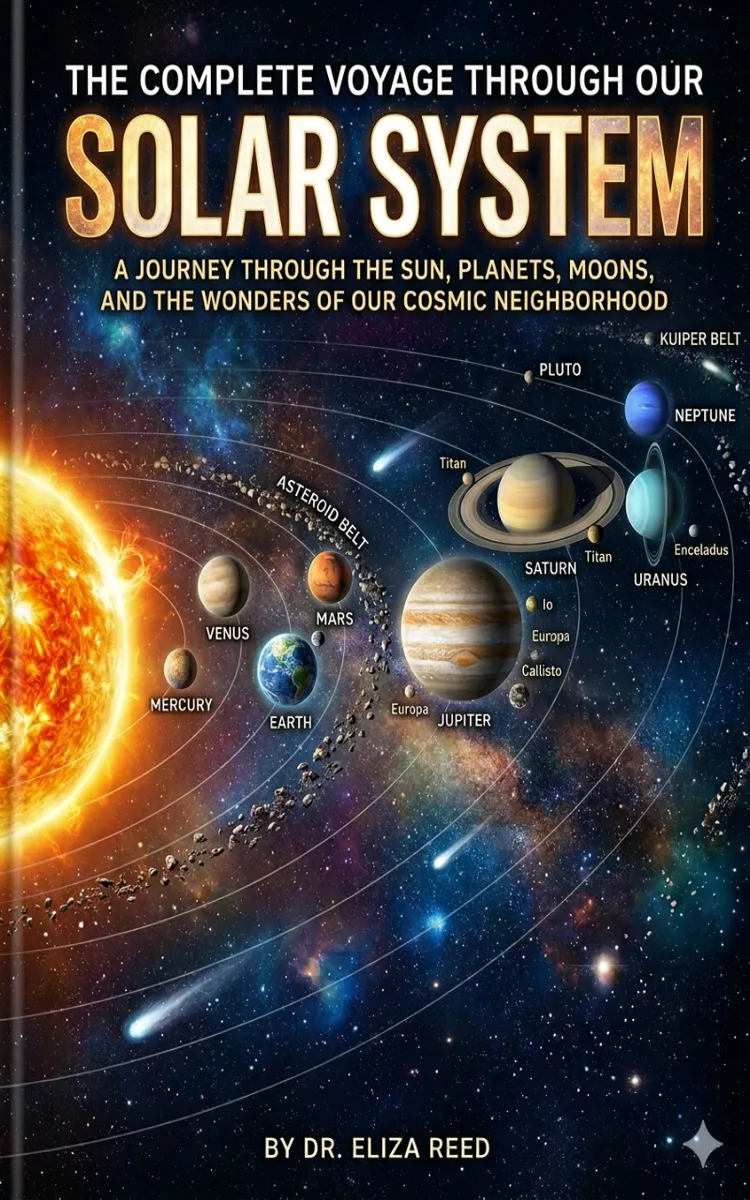
Read the first chapter
The whole of chapter one, free. About 2 min. Turn the pages with the arrows, your keyboard, or a swipe.
Chapter 1
The Solar System and Its Parts
What You'll Find Out The Sun is the centre of our Solar System, and it acts like a bright “lamp in space” that helps planets stay in their paths. We’ll meet the planets, and we’ll also learn about dwarf planets, moons, asteroids, and comets-different space objects that each have their own features.
We’ll also figure out the basic order of these objects from the Sun. And we’ll learn how scientists group space objects by what they are like, not just by where they are.
This is fun because you can compare space things to everyday objects-like comparing a moon to a toy that moves around a bigger toy, or comparing asteroids to space rocks.
How It Works Here’s the main idea: the Solar System is like a set of paths around the Sun.
• Sun: the star (a hot, glowing ball of gas) at the centre. - Planet: a large object that orbits the Sun and is round enough to be pulled into a ball by its own gravity. - Dwarf planet: also orbits the Sun and is round, but it has not cleared its path like a planet does. - Moon: an object that orbits a planet. - Asteroid: a rocky or metal space object, usually smaller than planets. - Comet: an icy space object that can form a glowing “tail” when it gets closer to the Sun.
Basic ordering from the Sun goes like this (starting closest): 1. Mercury 2. Venus 3. Earth 4. Mars 5. Asteroid belt (many asteroids live here) 6. Jupiter 7. Saturn 8. Uranus 9. Neptune 10. Dwarf planets like Pluto (found farther out)
Scientists classify objects by their size, shape (round or not), and what they are made of (rocky, icy, or gas), plus how they move.
Let's Try It Together We’ll use a simple toy example to remember “orbits” and “types.”
1. Put a small ball (the Moon) next to a bigger ball (a Planet). 2. Move the small ball in a circle around the bigger ball. 3. Stop and look: the smaller ball is orbiting-moving around. 4. Now swap the small ball for a pebble (an Asteroid). 5. Keep the pebble moving around the same planet. 6. Swap again for a cold, chalky piece (an Comet) and notice it’s “different” because it’s icy and can form a tail near the Sun. 7. Finally, place a warm lamp in the centre to represent the Sun.
Answer: The Sun stays in the centre, and other objects move around it (or around planets).
Your Turn! - Draw: Draw the Sun in the centre, then sketch 3 planets around it in the right order (closest to farthest). - Circle: Draw 6 space objects and circle the moons (objects orbiting planets). - Match: On a sheet, match each word to a picture you draw: asteroid (rock), comet (icy with a tail), dwarf planet (small round), planet (bigger round). - Colour: Colour the asteroid belt area between Mars and Jupiter, and add lots of tiny “rock dots.”
Can you find and colour one asteroid, one comet, and one moon in your drawing today?
End of chapter one. 4 more chapters in the full book.
Swipe or use the arrows to turn the page
What's inside: 5 chapters
- 1. The Solar System and Its Parts
- 2. Planet Motions: Orbits and Rotation
- 3. Inner vs Outer Planets Characteristics
- 4. Moons, Asteroids, and Comets
- 5. Using AI Images for Solar Learning
About this book
"Solar System Book For Class 6" is a education book by Divyansh Kumar with 5 chapters and approximately 2,694 words. Solar system education for sixth-grade students.
This book was created using Inkfluence AI, an AI-powered book generation platform that helps authors write, design, and publish complete books. It was made with the AI Lesson Plan Generator.
Frequently Asked Questions
What is "Solar System Book For Class 6" about?
Solar system education for sixth-grade students
How many chapters are in "Solar System Book For Class 6"?
The book contains 5 chapters and approximately 2,694 words. Topics covered include The Solar System and Its Parts, Planet Motions: Orbits and Rotation, Inner vs Outer Planets Characteristics, Moons, Asteroids, and Comets, and more.
Who wrote "Solar System Book For Class 6"?
This book was written by Divyansh Kumar and created using Inkfluence AI, an AI book generation platform that helps authors write, design, and publish books.
How can I create a similar education book?
You can create your own education book using Inkfluence AI. Describe your idea, choose your style, and the AI writes the full book for you. It's free to start.
Write your own education book with AI
Describe your idea and Inkfluence writes the whole thing. Free to start.
Start writingCreated with Inkfluence AI


