
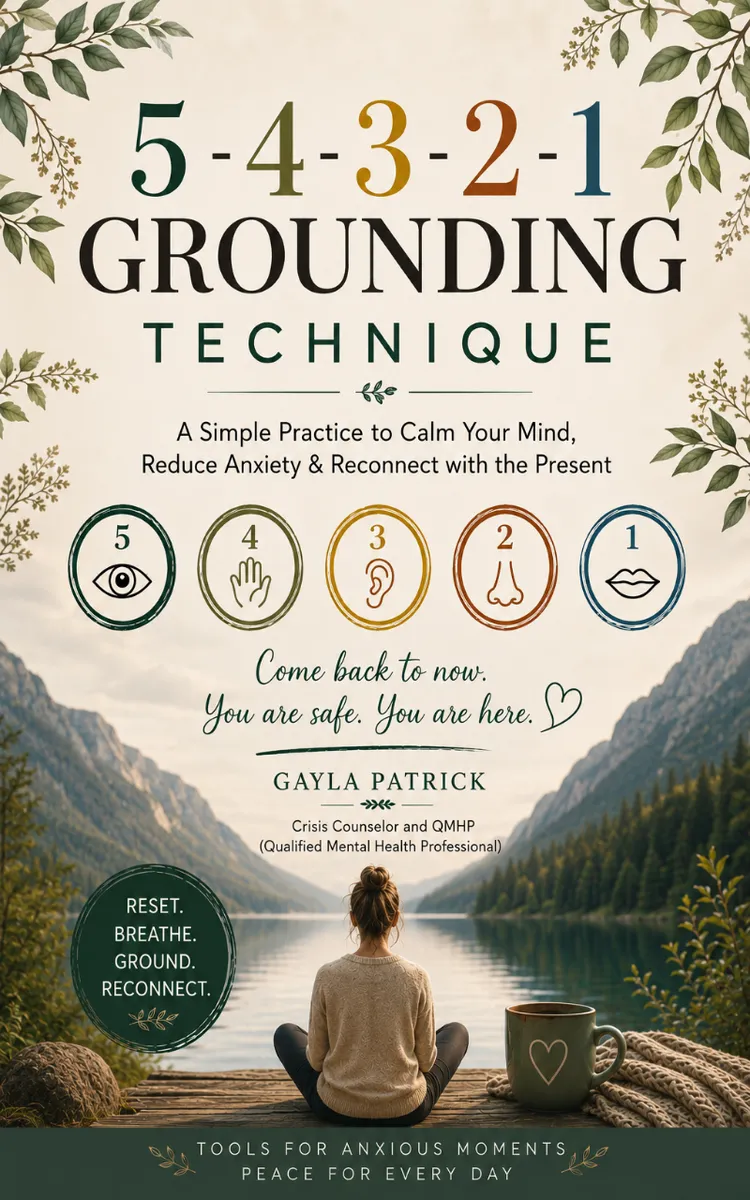

Read the first chapter
The whole of chapter one, free. About 8 min. Turn the pages with the arrows, your keyboard, or a swipe.
Chapter 1
Reclaiming Control With the 5 Senses
Your anxiety gets louder when your attention stays trapped in thoughts - so the fastest way to regain control is to switch your attention into your senses.
Picture this: you’re about to start your day and your brain is already running the “what if” movie. For Tanya, 34, an ER nurse, it hits right before her shift - phone buzz, badge on, boots laced, and suddenly her chest feels tight like she’s bracing for impact. She can’t even point to a single problem yet. It’s just the feeling. The urgency. The sense that something bad is about to happen.
And here’s the frustrating part: the more she tries to “think her way out,” the more her thoughts spool up. The body feels alarmed, the mind tries to solve it, and then the alarm gets a microphone. That’s your opening - because if you can change what you’re paying attention to, you can change how your nervous system responds.
• The 5 senses sequence isn’t “positive thinking” - it’s attention control. - Grounding works fastest when you stop arguing with thoughts and start tracking what’s actually here. - The Attention Switch Ladder helps you move from “inside my head” to “outside my body” in a few breaths. - You can do this even when you’re busy, standing, or moving - no yoga mat required.
The Pattern
The pattern usually looks like this: you feel the first spark of anxiety - tight chest, shaky hands, a buzzing stomach - and your mind immediately tries to explain it. Why am I like this? What’s coming? What if I can’t handle it? Then you scan for danger like it’s your job. You re-read conversations in your head. You replay worst-case outcomes. You search your body for proof that the fear is “real.” It’s exhausting, and it makes the anxiety feel justified.
For Tanya, it’s the exact same rhythm every shift. She stands in the locker area, trying to get ready, and her brain starts pulling up images - patients, emergencies, the burden of “needing to be ready.” Her breathing goes shallow. Her thoughts speed up. She tells herself she has to calm down right now, which only gives her brain another thing to monitor. She’s not wrong to want safety. She’s just trying to find it by digging deeper into the only place that’s currently loud: her thoughts. Do you recognise that loop - feel the anxiety, investigate it, and accidentally make it bigger?
A New Perspective
What if your anxiety isn’t asking for answers - it’s asking for attention?
That question flips the whole game. Because when your mind is panicking, it treats the current feeling like a problem that must be solved. It keeps generating “answers” (thoughts), but the answers don’t land because your body is still in alarm mode. Grounding doesn’t require you to convince yourself you’re safe. It requires you to prove something else to your nervous system: I can feel the present moment with my senses.
Here’s a before-and-after that’s close to Tanya’s real life. Before: she catches the anxiety spike and instantly starts bargaining with her brain. “Don’t be scared. You’ve done this before. Stop thinking about it.” She stands there trying to “win” against the thoughts. The thoughts keep coming. Her chest stays tight. After: she doesn’t debate the fear. She switches attention on purpose. She starts the senses sequence - 5 things she can see, then 4 she can feel, then 3 she can hear, 2 she can smell, 1 she can taste - not as a performance, but as a way of loading her brain with real-world data.
The difference isn’t that the fear disappears instantly. The difference is that the fear stops being the only channel. Her mind still shows up with “what ifs,” but she’s not feeding them. She’s stepping sideways into sensory input, and that gives her nervous system a clear signal: the moment is here, not back in the future.
And this is where the Attention Switch Ladder comes in. Think of it like climbing out of your head one rung at a time. Instead of jumping straight to “calm,” you aim for “present.” The senses are the rungs. Thoughts can stay in the background while you climb.
Breaking It Down
1. When you notice the anxiety spike (tight chest, racing thoughts, stomach drop), you start hunting for meaning in your head. 2. You feel trapped - like you need to figure out what’s wrong before you can move. 3. So you try to control it with more thinking, more checking, more reassurance. 4. Which leads to your attention staying locked on the threat story, and your body keeps getting the “danger” signal.
That chain makes sense… and it still hurts.
Try the alternative chain instead:
1. When you notice the anxiety spike, you deliberately stop the “meaning hunt” and turn toward the room - starting the 5-4-3-2-1 sequence. 2. You feel a small shift: your attention lands somewhere specific (a texture, a sound, a smell), and the anxiety has less space to expand. 3. So you keep your focus moving through the sequence (5 → 4 → 3 → 2 → 1) instead of stopping to argue with every thought. 4. Which leads to your nervous system getting repeated evidence that you’re here, now - right in front of you.
For Tanya, this can be as simple as doing the sequence while she’s already dressed. She doesn’t need to sit. She can scan: the seam of her glove, the weight of her badge, the hum of the hallway lights. Then she hears the small sounds she normally ignores - doors, footsteps, a distant cart. Smell and taste can be quick too: mint gum, coffee breath, the faint disinfectant in the air. Those details anchor her attention so the panic story loses its grip.
Your senses aren’t a distraction from anxiety - they’re the steering wheel.
Check In With Yourself
You don’t need to “be good at grounding.” You just need to notice your habits so you can change them. Rate yourself honestly, 1-10, or answer yes/no.
1. When anxiety starts, how quickly do you look for answers in your thoughts? (1 = almost never, 10 = immediately every time) If you’re high, it means your brain is doing its usual job - explaining. Grounding will work best when you treat thoughts like background noise instead of a command.
2. While anxious, do you still notice the outside world at all (sounds, textures, smells), or does it all feel blurred? (Yes/No) If it’s “no,” the anxiety is taking over your input. The senses sequence becomes your way back - your first step is noticing, not fixing.
3. How often do you complete the full sequence (5-4-3-2-1) instead of stopping at “I’m trying”? (1 = rarely, 10 = often) If you stop early, you’re probably waiting for a feeling to “arrive.” The point is the attention shift, not the perfect calm.
4. When you do the sequence, do you usually do it while your body is still tense (standing, walking, working), or only when you’re already settled? (1 = only when calm, 10 = even while tense) If it’s closer to 1, you’ll want to practice in real conditions - because anxiety doesn’t ask permission before it shows up.
Quick interpretation guide: - Mostly 1-3s: you’re stuck in the thought loop. Choose the full sequence even if it feels weird at first. - Mostly 4-7s: you can shift attention sometimes - now you’ll make it more consistent. - Mostly 8-10s: your attention-control is already there; refine it by noticing what rungs you skip when anxiety spikes.
Take Action
The Attention Switch Ladder (5-4-3-2-1) in 90 seconds
1. Set a timer for 60 seconds and do the full 5-4-3-2-1 sequence once, out loud if that helps. Start with what’s easiest to spot right now - don’t hunt for “perfect” sensory details. - Expected difficulty: Easy - During this minute, your job is only to name what you notice, not to judge how you feel.
2. Take 2 slow breaths and then repeat the sequence - but this time, move through each number faster than you think you “should.” - Expected difficulty: Medium - The point is to keep attention moving. Anxiety hates momentum because it can’t hold you in one thought long enough to inflate.
3. Finish with a one-sentence check-in: “Right now, my body is __ and my attention is on __.” (Write it in your notes app or say it quietly.) - Expected difficulty: Easy - This helps you separate the sensation from the story. Sensation is information; story is interpretation.
You’ll know it’s working when… - You can name at least 4-5 distinct sensory items without needing to “push” your mind. - The anxiety intensity drops even a little, or it changes from “I’m trapped” to “I can manage this.” - Your thoughts still show up, but they don’t take over the steering wheel.
Even if you only get through it once, it counts. Tanya noticed that after doing this right before her shift, the panic wave still came - but it arrived with less force, like a wave that hits further up the shore instead of right at her feet.
What You Now Know
You can’t always stop anxiety from appearing - but you can change where your attention goes the moment it shows up.
Now you know what to do when anxiety tries to pull you into a thought-only world. The 5-4-3-2-1 senses sequence isn’t a magic spell. It’s a practical attention shift. And when you pair it with the Attention Switch Ladder - moving rung by rung - you’re teaching your brain a new response: present moment input first, threat story second.
So the next time your body starts sounding the alarm, you don’t have to wait for your mind to “calm down” first. You can meet yourself where you are. You can anchor in what’s seeable, touchable, hearable, smellable, and tasteable - right now, mid-shift, mid-moment, mid-breath.
And that sets you up for the next step: how to keep grounding from turning into another thing you “fail at,” by learning to work with your attention instead of wrestling your thoughts - so it actually sticks when anxiety returns.
End of chapter one. 4 more chapters in the full book.
Swipe or use the arrows to turn the page
What's inside: 5 chapters
- 1. Reclaiming Control With the 5 Senses
- 2. Turning Catastrophes Into Neutral Facts
- 3. Building a Personal 5-4-3-2-1 Script
- 4. Using Grounding to Regulate Breathing and Body
- 5. Staying Grounded Through Setbacks and Triggers
About this book
"5-4-3-2-1 Grounding For Anxiety" is a self-help book by Gayla Patrick with 5 chapters and approximately 8,785 words. Using the 5-4-3-2-1 grounding technique to reduce anxiety.
This book was created using Inkfluence AI, an AI-powered book generation platform that helps authors write, design, and publish complete books. It was made with the AI Self-Help Book Writer.
Frequently Asked Questions
What is "5-4-3-2-1 Grounding For Anxiety" about?
Using the 5-4-3-2-1 grounding technique to reduce anxiety
How many chapters are in "5-4-3-2-1 Grounding For Anxiety"?
The book contains 5 chapters and approximately 8,785 words. Topics covered include Reclaiming Control With the 5 Senses, Turning Catastrophes Into Neutral Facts, Building a Personal 5-4-3-2-1 Script, Using Grounding to Regulate Breathing and Body, and more.
Who wrote "5-4-3-2-1 Grounding For Anxiety"?
This book was written by Gayla Patrick and created using Inkfluence AI, an AI book generation platform that helps authors write, design, and publish books.
How can I create a similar self-help book?
You can create your own self-help book using Inkfluence AI. Describe your idea, choose your style, and the AI writes the full book for you. It's free to start.
Write your own self-help book with AI
Describe your idea and Inkfluence writes the whole thing. Free to start.
Start writingCreated with Inkfluence AI


