
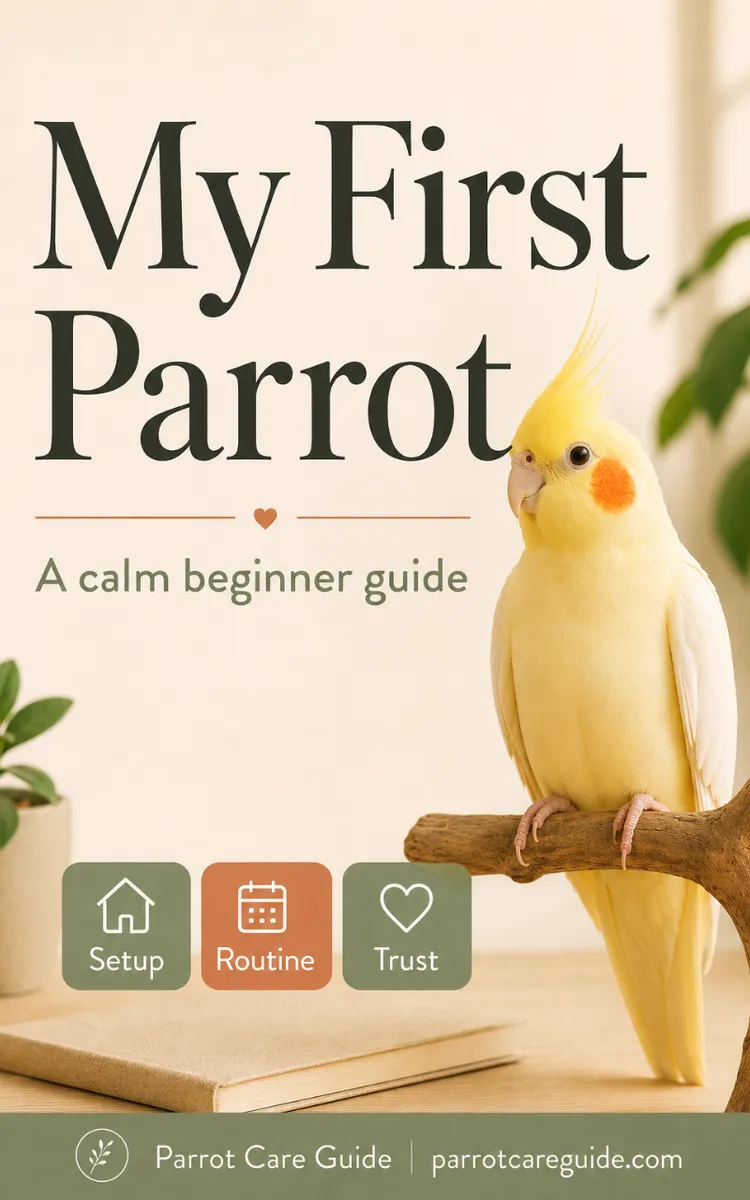

Read the first chapter
The whole of chapter one, free. About 6 min. Turn the pages with the arrows, your keyboard, or a swipe.
Chapter 1
Why the Beginning Matters More Than Most People Realise
Why This Matters
The day you bring a parrot home looks like the beginning, but what really shapes your life together started days or weeks earlier. The species you picked, the cage you ordered, the sleep schedule you planned, and the tone you set for handling all become the habits your bird learns. Those early choices create daily patterns that either support a confident, calm parrot or quietly stack small problems that grow into big challenges.
Most beginner mistakes don’t come from bad intent; they come from missing details and weak guidance. That matters because parrots learn fast and remember a routine. If the routine begins around inconsistent feeding, bright lights at night, or frequent surprise handling, the parrot adapts to those realities. You’ll change behavior faster when you correct setup and routine early than you will after years of undoing habits. After reading this, you’ll be able to spot the critical decisions to make before arrival, set a clear, low-stress plan for day one, and choose the single habit to protect that matters most for long-term trust.
How It Works
Parrots form expectations through repetition: the same cue, same outcome, same time. That repetition becomes a pattern. For example, if you let household visitors pick up a new parrot on day one, the bird learns that strangers equal being grabbed. Later, the parrot will be anxious around guests and may bite. The underlying mechanism is simple: parrot brains link events to outcomes quickly and hold onto those links. That makes prevention more effective than repair.
Think of the beginning as four linked steps: Decision → Setup → Routine → Trust. Each step feeds the next.
• Decision - Choose species and source you can realistically support. Match the bird’s average daily noise level and space needs to your home life. Pick a species with energy and lifespan you can accept; that choice frames everything that follows.
• Setup - Build a physical environment that enforces good habits: the right cage size, safe perches, and a quiet sleep area. A cage that’s too small or placed in a chaotic corner trains stress and overactivity.
• Routine - Fix consistent wake times, feeding times, and sleep times from day one. Parrots thrive on predictable schedules; a steady routine reduces anxiety and unwanted behaviors like screaming.
• Trust - Grow trust slowly with short, positive interactions. Trust comes from predictable, non-threatening exchanges. Rushing physical handling and social pressure create resistance; calm, repeated small wins build lasting confidence.
Concrete example: you choose a medium conure (Decision) because you live in an apartment and want a smaller bird. You set up a cage that’s 24" x 24" x 30" with a quiet corner and a covered sleep perch (Setup). You establish lights-off at 9 p.m. and two 20-minute play windows at 10 a.m. and 4 p.m. (Routine). You begin handling with single 3-minute sessions near the cage, offering a treat when the bird steps up voluntarily (Trust). These four choices, made before and during day one, shape the bird’s expectations for months.
One clear rule helps synthesize these ideas: the Better Beginning Rule - pick the smallest, simplest change that assures a predictable, low-pressure experience for both of you. That might mean delaying full free-flight for a month, using a sleep cover, or asking just one household member to do initial handling.
Putting It Into Practice
You’ll get the most mileage by setting three specific pre-arrival actions and following a day-one plan that protects sleep, routine, and trust. Below is a realistic scenario and exact steps.
Scenario: You bring home a young African grey on a Saturday. You live with two roommates and work from home four days a week.
Steps:
• Before arrival - Decide who will be the primary handler. One person should take responsibility for training and daily care for the first 4-8 weeks. Clear this role now so the bird receives consistent cues. Expected outcome: the bird learns one voice and one set of expectations, reducing confusion and stress.
• Two days before - Prepare the cage in a quiet room you can keep dim in the evenings. Fit the cage with two natural wood perches, a chew toy, and three food bowls spaced evenly. Expected outcome: the parrot has safe, familiar perches and predictable feeding locations from day one.
• Night before and day one - Enforce a lights-out policy: simulate a 10 p.m. lights-off time for the bird’s room both nights. On arrival day, maintain the lights schedule even if everyone feels excited. Expected outcome: the bird gets the sleep it needs and won’t start the habit of nighttime fussing.
• First two hours at home - Place the cage where you planned, open the travel carrier in front of the cage entrance, and allow the bird to come out in its own time. No forced grabbing. Expected outcome: the bird perceives the cage as a safe fallback and starts to explore on its terms.
• First week - Offer three short, scheduled interactions daily: two 10-15 minute supervised play sessions and one evening calm session where you sit quietly near the cage and speak softly. Use high-value treats for voluntary stepping-up only. Expected outcome: the bird begins to link you with predictable, positive encounters and avoids forced handling.
Quick checklist:
• Choose one primary handler and confirm responsibilities.
• Buy a cage sized for the species and place it in a dimmable, quiet room.
• Set a sleep schedule and enforce lights-off times immediately.
• Prepare at least two safe perches, three bowls, and one chew toy before arrival.
• Plan short, scheduled interactions and reward voluntary approach only.
What to Watch For
Rushed handling
If you pick the bird up for long cuddles on day one because you want to bond fast, you risk teaching resistance to touch and flapping that can escalate to biting.
Do this: Start with short, voluntary stepping-up sessions of 30-90 seconds. Reward stepping up with a treat, then stop while the bird stays calm. Repeat three times a day.
Not this: Forcing the bird onto your hand for long periods or pushing past obvious avoidance signals. That creates escape-driven behavior you’ll have to undo.
Unclear sleep routine
Allowing lights to stay on and guests to bustle around at night trains the parrot to expect constant activity and short, fragmented sleep. Sleep loss breeds irritability and loud calls.
Do this: Set a firm lights-off time (for example, 10 p.m.) and cover the cage at that time. Keep the room below conversational noise levels. Expect a few nights of adjustment; that’s normal.
Not this: Letting the bird nap irregularly or keeping it near TV noise and overhead lights. That erodes the parrot’s ability to self-soothe and increases nighttime vocalizing.
Too many handlers, too soon
If every family member tries to be the “bonded” person at once, the parrot gets mixed signals. The bird will switch preference rapidly and may act out to control interactions.
Do this: Limit primary handling to one or two consistent people for the first 6-8 weeks. Rotate secondary interactions gradually, under controlled conditions.
Not this: Allowing a parade of people to pick up, feed, and train the bird without a clear schedule. That creates inconsistency and stress.
Chapter takeaway: the visible welcome is only the start. Your choices before and during day one regarding species decision, physical setup, sleep routine, and a calm, stepwise approach to trust - produce the daily patterns your parrot will live by. Preventing problems by setting a predictable, low-pressure beginning is faster and kinder than fixing habits later. Take one small step now: name your primary handler and enforce a consistent lights-out time from the first night. You’ll feel the difference in the bird’s calmness within a week, and you’ll both be on a smoother path forward.
End of chapter one. 29 more chapters in the full book.
Swipe or use the arrows to turn the page


What's inside: 30 chapters
- 1. Why the Beginning Matters More Than Most People Realise
- 2. Are You Ready for a Parrot?
- 3. Choose the Right Bird, Not Just the Cutest One
- 4. The Seven Decisions to Make Before Your Parrot Comes Home
- 5. The Setup Shapes the Outcome
- 6. Cage Placement, Security, and Room Flow
- 7. Perches, Bowls, Carriers, Cleaning, and Safe Basics
- 8. What Parrots Actually Need Every Day
- 9. Sleep, Light, Rhythm, and Rest
- 10. Enrichment Is Not Just More Toys
- 11. The First 48 Hours
- 12. The First Seven Days
- 13. How to Build a Calm First Routine
- 14. What Progress Really Looks Like
- 15. What Not to Rush
- 16. Why Parrots Behave Differently From What Beginners Expect
- 17. Body Language and Early Warning Signs
- 18. Why Quiet Is Not Always Calm
- 19. Why Biting Is Not Where the Problem Started
- 20. How to Avoid Turning Early Tension Into a Pattern
- 21. Trust Grows From Repeated Safe Experiences
- 22. Positive Reinforcement for Complete Beginners
- 23. Step-Up Should Not Be the First Test of Trust
- 24. How to Reduce Pressure Before Behaviour Escalates
- 25. Common Beginner Mistakes and What to Do Instead
- 26. Your First-Week Checklist
- 27. Your First-Month Routine Map
- 28. Your Observation Pages
- 29. Your Setup Review
- 30. What to Do Next
About this book
"My First Parrot" is a general book by Parrot Care Guide with 30 chapters and approximately 37,036 words. It covers key insights and practical takeaways on the topic.
This book was created using Inkfluence AI, an AI-powered book generation platform that helps authors write, design, and publish complete books.
Frequently Asked Questions
What is "My First Parrot" about?
"My First Parrot" is a general book by Parrot Care Guide covering key insights and practical takeaways on the topic.
How many chapters are in "My First Parrot"?
The book contains 30 chapters and approximately 37,036 words. Topics covered include Why the Beginning Matters More Than Most People Realise, Are You Ready for a Parrot?, Choose the Right Bird, Not Just the Cutest One, The Seven Decisions to Make Before Your Parrot Comes Home, and more.
Who wrote "My First Parrot"?
This book was written by Parrot Care Guide and created using Inkfluence AI, an AI book generation platform that helps authors write, design, and publish books.
Write your own book with AI
Describe your idea and Inkfluence writes the whole thing. Free to start.
Start writingCreated with Inkfluence AI


