

Read the first chapter
The whole of chapter one, free. About 5 min. Turn the pages with the arrows, your keyboard, or a swipe.
Chapter 1
Choose For Real Life, Not Just Looks
Many people begin their parrot journey with a picture in their mind.
A bright bird on a shoulder. A clever talker on a video. A gentle cockatiel whistling from a perch. A playful conure tucked into someone’s hand. A beautiful ringneck with clear eyes and perfect feathers. A macaw or grey that seems almost human in the way it watches the world.
It is easy to understand why people fall in love with parrots before they fully understand them.
Parrots are beautiful. They are intelligent, expressive, social, curious, and full of personality. They can make a home feel alive in a way few animals can. But the same qualities that make parrots so appealing are also the qualities that can make them difficult when the match is wrong.
A parrot is not just a colour, a voice, a size, or a species name.
A parrot is a daily life commitment.
The better question
Many beginners ask:
“What is the best parrot for beginners?”
That is a reasonable question. It usually comes from a good place. People want to choose wisely. They want a bird they can care for well. They do not want to make a mistake.
But the question is incomplete.
A better question is:
“Which parrot fits my real life?”
Real life includes your home, your work hours, your noise tolerance, your budget, your family, your other pets, your patience, your routine, and your willingness to keep learning after the excitement of bringing a bird home has passed.
A budgie may be a wonderful fit for one person and still be underestimated by another.
A cockatiel may suit a calm household beautifully, but still need more daily attention, cleaning, and emotional steadiness than someone expected.
A conure may be affectionate and funny, but also loud, intense, and demanding in a busy or noise-sensitive home.
An Indian ringneck may look elegant and independent, but still need careful handling, patient training, and respect for its boundaries.
A larger parrot may seem impressive, but size often brings more noise, more cost, more strength, more mess, more long-term responsibility, and more serious consequences when behaviour is misunderstood.
There is no single perfect beginner parrot.
There is only a better or worse match between the bird’s needs and the life you can realistically provide.
Why looks are not enough
Looks matter emotionally. They are often what make people notice a species first.
But looks do not tell you whether a bird’s daily needs will fit your home.
A bird’s colour does not tell you how much noise your neighbours can tolerate.
A talking video does not show the hours of routine, repetition, cleaning, observation, and patient handling behind the scenes.
A cute baby bird does not show adult behaviour, seasonal changes, confidence, fear, biting pressure, or long-term care needs.
A low purchase price does not mean low lifetime cost.
A small body does not mean small needs.
A bird that appears calm in a shop, aviary, rescue, or breeder setting may behave differently once it is in a new home, learning a new routine, and responding to new people, sounds, rooms, and expectations.
This does not mean you should feel worried about every choice. It means you should slow down enough to choose with clearer eyes.
Choosing well is not about perfection
You do not need to become an expert before choosing a parrot.
You do need to be honest.
Honest about your household.
Honest about your time.
Honest about noise.
Honest about money.
Honest about how much daily mess you can manage.
Honest about whether you want a bird because you like the idea of one, or because you are ready to build a routine around a real animal with real needs.
This guide is not here to scare you away from parrots. It is here to help you choose with more clarity.
A good match gives both the person and the bird a better chance.
When a bird’s needs fit the household, the owner is more likely to stay patient, consistent, and curious. The bird is more likely to feel secure, understood, and supported. Problems may still happen, but they are easier to work through when the foundation is realistic.
When the match is poor, even a loving owner can become overwhelmed. Noise feels personal. Biting feels like failure. Mess feels endless. The bird’s normal needs begin to feel like problems. That is when frustration, guilt, pressure, and rehoming thoughts can appear much earlier than people expected.
The goal is not to choose the easiest bird.
The goal is to choose with enough understanding that you are less likely to be surprised by the daily reality.
What this guide will help you consider
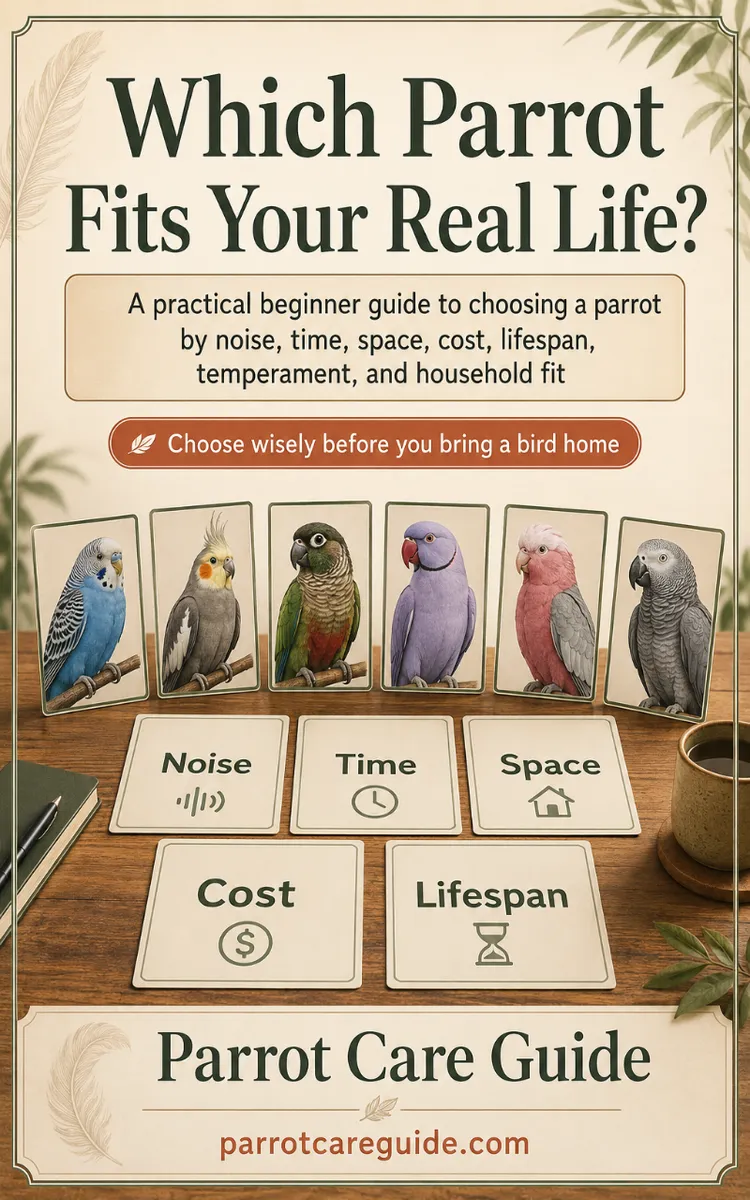
This guide will help you look beyond simple species lists and think about the real-life factors that matter most:
Noise
How much sound can your household, neighbours, and nervous system realistically handle?
Time and attention
How much daily interaction, cleaning, feeding, observation, training, and supervision can you provide?
Space and home fit
Where will the bird live? Is the home safe? Are there other pets, children, kitchens, fumes, fans, or open-door risks?
Budget and lifespan
Can you afford the cage, vet care, food, toys, enrichment, emergency care, and long-term commitment?
Temperament and handling fit
Are you drawn to a species because it looks friendly, or because its likely needs match your patience, confidence, and learning style?
Species reality
What do beginners often underestimate about budgies, cockatiels, conures, quakers, ringnecks, Alexandrines, galahs, Amazons, and African greys?
Your shortlist
Which two or three species genuinely fit your life well enough to keep researching?
The answer may not be the bird you first imagined.
That is not a failure.
Sometimes the wisest choice is choosing a smaller species than planned. Sometimes it is waiting six months. Sometimes it is meeting more birds before deciding. Sometimes it is realising that the bird you love online may not be the bird that fits your actual home.
That kind of clarity is valuable.
Pause Before You Choose
Before moving on, take a moment to think honestly.
What kind of daily life can I realistically offer a parrot?
What would be difficult for my household to manage?
Am I choosing this bird for real-life fit, or mainly because I like the idea of the species?
A calm choice now can prevent a stressful mismatch later.
In the next chapter, we will look more closely at the real beginner question: not “What bird is easiest?” but “What bird can I understand, support, and live with well?”
End of chapter one. 10 more chapters in the full book.
Swipe or use the arrows to turn the page


What's inside: 11 chapters
- 1. Choose For Real Life, Not Just Looks
- 2. The Real Beginner Question
- 3. Noise Fit
- 4. Time and Attention Fit
- 5. Space and Home Fit
- 6. Budget and Lifespan Fit
- 7. Species Reality Snapshots
- 8. Your Shortlist
- 9. Before You Decide
- 10. Chapter 10
- 11. Chapter 11
About this book
"Which Parrot Fits Your Real Life" is a general book by Parrot Care Guide with 11 chapters and approximately 13,622 words. It covers key insights and practical takeaways on the topic.
This book was created using Inkfluence AI, an AI-powered book generation platform that helps authors write, design, and publish complete books.
Frequently Asked Questions
What is "Which Parrot Fits Your Real Life" about?
"Which Parrot Fits Your Real Life" is a general book by Parrot Care Guide covering key insights and practical takeaways on the topic.
How many chapters are in "Which Parrot Fits Your Real Life"?
The book contains 11 chapters and approximately 13,622 words. Topics covered include Choose For Real Life, Not Just Looks, The Real Beginner Question, Noise Fit, Time and Attention Fit, and more.
Who wrote "Which Parrot Fits Your Real Life"?
This book was written by Parrot Care Guide and created using Inkfluence AI, an AI book generation platform that helps authors write, design, and publish books.
Write your own book with AI
Describe your idea and Inkfluence writes the whole thing. Free to start.
Start writingCreated with Inkfluence AI


