
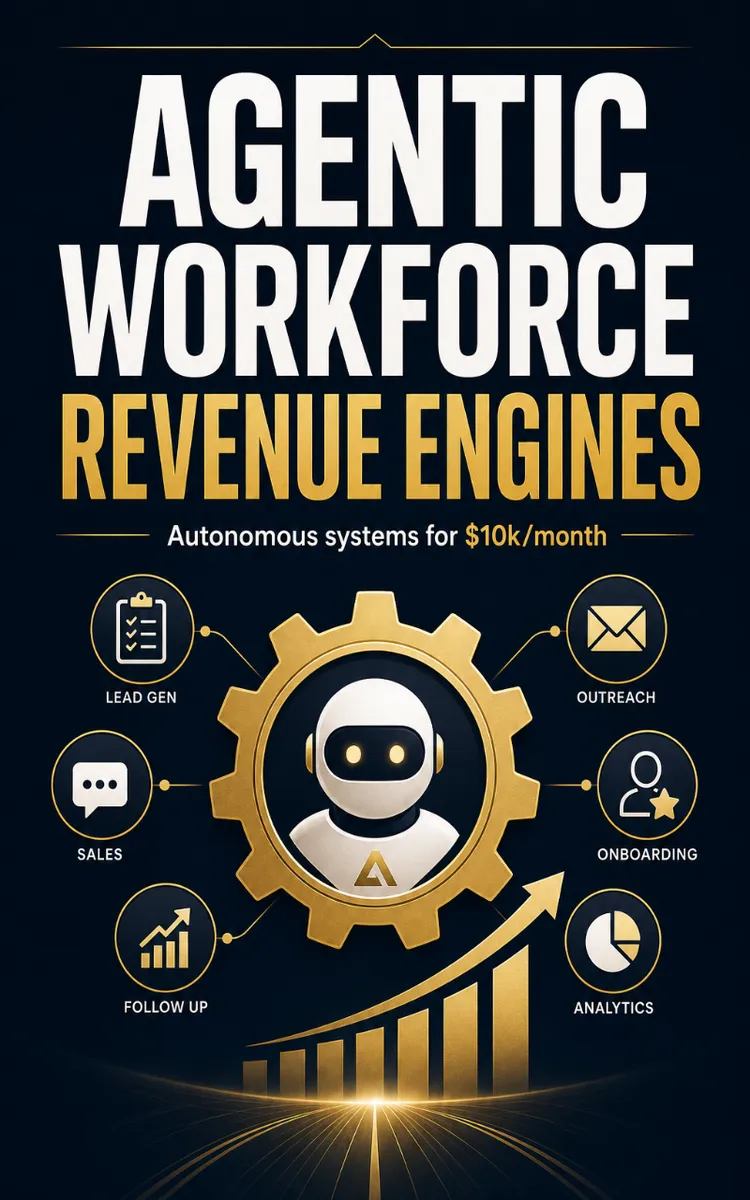
Preview: The $10K/Month Revenue Blueprint
A short excerpt from “The $10K/Month Revenue Blueprint”. The full book contains 8 chapters and 15,721 words.
A real $10k/month digital product machine usually fails for one boring reason: you build content and hope it turns into sales, instead of building a system that turns intent into checkout and then into repeatable revenue reporting. If you run solo and you cannot hire a team, you need one thing more than tools: a plan that tells you exactly what your Workforce of One must do every day, every week, and every quarter.
This chapter gives you that plan. You will define your Workforce of One goal (what you want the system to accomplish with minimal human time), pick the Volume Path versus the Value Path (how you want to win in the market), and map how automation supports both paths until both converge on Stripe reporting. You will also get the North Star diagram-The Agentic WorkforceBuilding Autonomous Revenue Engines in 2026Global Surgical Blueprint | Alhakim Digital20-PAGE VISUAL-FIRST LAYOUT - FULL ARCHITECTURESECTION I: THE GLOBAL ARCHITECTUREPages 1-4 | Autonomous Workflow Tree Diagrams-so you always know where you are in the build.
Before you touch Make.com, Perplexity API, or Claude API, you need to lock the goal and the path. Otherwise you’ll ship a bunch of working parts that never agree on a single number: revenue captured, accounted, and tracked inside Stripe.
---
What You Need to Know
Workforce of One means a system that runs sales and delivery with one human operator doing reviews, not daily execution. You still own the decisions, but you do not “clock in” to push tasks around. You design the workflow once, then the system keeps moving on its own.
Autonomous Revenue Engine means a pipeline that turns customer intent into outputs (content, offers, checkout, delivery) without you manually stitching steps together. It uses agents to research and draft, automation to route and publish, and payment tools to collect revenue.
Volume Path means you sell at higher throughput: more customers, more checkout events, and simpler offer mechanics. You win by keeping the sales loop tight and repeatable.
Value Path means you sell fewer customers with higher deal size or higher perceived value. You win by making the offer and delivery feel tailored, and you protect conversion with stronger qualification and positioning.
Here’s the differentiator you should care about: both paths still converge into the same revenue truth-Stripe reporting. You do not get to “feel” revenue. You must capture it, attribute it, and review it inside one place so your next build cycle actually improves outcomes.
North Star: the Global Architecture | Page 1 of 4 map shows the whole machine in one view: input flows in, agents process, delivery channels output, and Stripe becomes the final measurement point. The workforce of one goal sits at the top as the constraint that shapes everything below.
---
Breaking It Down
You will follow the Revenue Decomposition Ladder, a simple idea: break your $10k/month goal into layers you can automate, then make sure every layer feeds the next. When you do this, you stop guessing and you start building.
Step 1: Define the Workforce of One goal as a constraint, not a wish
Start by writing your top constraint in plain terms.
For the North Star architecture, your target is:
- Revenue Target: $10k/month
- Niche: Digital Products / Services / Agency
- Delivery Model: Async / Automated / Scalable
- [WORKFORCE OF ONE - OPERATOR] | v [INTENT DEFINITION]
That “intent definition” layer matters because automation needs stable inputs. If your intent is fuzzy, your agents will produce fuzzy outputs, and your sales channels will drift.
Step 2: Pick Volume Path or Value Path (one first, not both)
Choose the path that matches how you want your system to behave.
A clean way to decide:
- If you can crank out offer variants quickly (or you already have a backlog of proven topics), start with Volume Path.
- If you need deeper positioning, qualification, or custom delivery logic, start with Value Path.
Use a concrete rule: if your offer requires you to explain the “why you” story differently for every buyer, you’re closer to Value Path. If your offer is mostly the same per buyer and you just need more consistent conversion, you’re closer to Volume Path.
Step 3: Map automation support for each path until both converge on Stripe
Now you wire the system logic so the path differences live early, and the reporting converges late.
Think of the machine in layers that match the diagram’s color coding:
- Input (blue): what triggers the workflow and what data it receives
- Process (orange): where agents research, draft, and generate outputs
- Output (green): where the customer experiences the offer and delivery
- Human decisions appear as red nodes with ⚠️ icons at the three critical chokepoints where review is required
...
What's inside: 8 chapters
- 1. The $10K/Month Revenue Blueprint
- 2. Master Architecture North Star Diagram
- 3. Agent Hierarchy and Quality Gates
- 4. Make.com Orchestration: Master Router
- 5. Perplexity Research Agent Setup
- 6. Claude Content Agent Delivery Engine
- 7. Stripe Webhooks and Global Checkout
- 8. Scaling, KPI Dashboard, and Maintenance Protocol
About this book
"Agentic Workforce Revenue Engines" is a business book by Jaafar Alhakim with 8 chapters and approximately 15,721 words. Designing AI-agent workflows to build automated revenue systems.
This book was created using Inkfluence AI, an AI-powered book generation platform that helps authors write, design, and publish complete books. It was made with the AI Business Book Writer.
Frequently Asked Questions
What is "Agentic Workforce Revenue Engines" about?
Designing AI-agent workflows to build automated revenue systems
How many chapters are in "Agentic Workforce Revenue Engines"?
The book contains 8 chapters and approximately 15,721 words. Topics covered include The $10K/Month Revenue Blueprint, Master Architecture North Star Diagram, Agent Hierarchy and Quality Gates, Make.com Orchestration: Master Router, and more.
Who wrote "Agentic Workforce Revenue Engines"?
This book was written by Jaafar Alhakim and created using Inkfluence AI, an AI book generation platform that helps authors write, design, and publish books.
How can I create a similar business book?
You can create your own business book using Inkfluence AI. Describe your idea, choose your style, and the AI writes the full book for you. It's free to start.
Write your own business book with AI
Describe your idea and Inkfluence writes the whole thing. Free to start.
Start writingCreated with Inkfluence AI


