
Read the first chapter
The whole of chapter one, free. About 9 min. Turn the pages with the arrows, your keyboard, or a swipe.
Chapter 1
Rebuilding Your Bipolar Identity
Your identity doesn’t have to be “the person who smokes when life gets loud.”
I still remember Tanya - 34, ER nurse shift lead - telling me how her day would start totally fine, then one small thing would hit and suddenly she was bargaining with herself like, Just one hit and I’ll feel normal. She’d crack open her vape after a rough call, or after a family interaction that left her wired. The weird part? She didn’t feel like “a pothead.” She felt like a person trying to survive her own brain.
Then she’d come down from it, and the mood swings would feel even sharper the next day. She’d look at the calendar and realize she wasn’t just using marijuana - she was using it to patch a hole in her sense of self. And once you see it like that, quitting stops being only about willpower. It becomes about rebuilding who you are when cravings show up.
• This isn’t just a craving problem - it’s an identity-and-mood pattern. - When you tie your self-worth to episodes and urges, you keep the cycle alive. - A new “who am I?” answer makes cravings feel less like commands. - You can practice a reset in small, real-time moments - starting today.
The Pattern
Tanya described the same loop so clearly I could practically hear it in her voice. After a shift, she’d replay what went wrong. Not in a gentle “process it” way - more like an endless replay where every scene got darker. Her body would feel tense, restless, almost buzzing. If she could name it, she would’ve called it stress or agitation, but the marijuana part happened fast: she’d reach for it before she even finished thinking. Then she’d tell herself it was “medicinal” or “just to take the edge off,” even when what she really meant was I can’t stand being inside my own mind right now.
The pattern had a shape: a mood shift or stress spike would land, then her brain would treat the urge like proof of what she “needs.” She’d become the person who smokes to regulate, and after a while, that identity stuck. Even when she didn’t smoke, she’d still talk like the craving was the boss - like her job, her relationships, and her stability all depended on whether she could get that relief. And because bipolar already swings your internal weather, it’s easy for marijuana to become the “weather control button.” You stop believing you can calm down any other way.
Do you recognize that kind of loop - the part where you don’t just want marijuana, you start acting like that want is the real you?
A New Perspective
Here’s a question that might feel almost rude to ask, but it’s the one that changes everything: What if your craving isn’t a need - it’s a role you learned?
Not “a feeling you have.” Not “a symptom.” A role. Like your brain trained you to play it the same way you train for a job. For Tanya, the role was something like: When I’m activated, I’m the kind of person who fixes it with weed. The problem wasn’t that she wanted relief. The problem was that she handed over the steering wheel.
So we flipped it. Instead of asking, “How do I stop craving?” Tanya tried asking, “Who am I when I’m activated and I don’t reach for marijuana?” That sounds simple, but it’s not. It forces you to face the fact that the craving has been wearing a costume. Underneath, there’s usually a story like: If I don’t use, I’ll spiral. If I don’t use, I’ll feel too much. If I don’t use, I’ll fall behind. The role keeps that story alive.
A before-and-after moment Tanya described: one night after a tough shift, she felt the usual buzz and irritability. Before, she’d reach for her vape and tell herself she was being responsible - self-care, right? After the identity shift, she paused and said out loud, “I’m the nurse who can get through this moment. I’m not the person who needs a hit to be okay.” She didn’t magically feel calm in ten seconds. But she did something different: she delayed the action by five minutes and did a body reset - slow breathing and cold water on her wrists. The craving didn’t vanish instantly. It just stopped being the only option in the room. That’s the difference between craving as a command and craving as a signal.
And once you start treating marijuana as a role you can step out of, the whole quitting process gets clearer. You’re not fighting yourself. You’re changing the part you play.
Your craving can show up without being your identity.
Breaking It Down
Here’s the cause-and-effect chain you’ve probably been living inside. See if it matches your pattern:
1. When you hit a trigger (a rough shift, an argument, a night where your mind won’t turn off, that “too wired” feeling), your brain goes searching for the familiar exit. 2. You feel tension, restlessness, or mood pressure - and the craving pops in like it’s the fastest door. 3. So you reach for marijuana, because it’s been tied to relief in your nervous system. 4. Which leads to a reinforced identity: “I’m the kind of person who has to use to cope,” and your brain learns that coping equals weed.
Now the alternative chain - this is the Identity-First Reset Map in real life (not a theory you nod at and forget):
1. When you hit a trigger, you still feel the intensity, but you add one sentence: “This is a craving role showing up.” 2. You notice the feeling without obeying it, like you’re watching a wave instead of jumping into the water. 3. So you choose an identity action that matches who you’re becoming (for Tanya, it was delay + body reset, like cold water and slow breathing). 4. Which leads to a new identity loop: “I’m the kind of person who can ride out intensity without handing over control,” and your cravings start losing their authority.
The “why” matters. Marijuana works partly because it changes your internal state fast. Your brain then tags that as the way to survive. But bipolar already makes internal states intense. So when cravings show up, your mind assumes, I need the shortcut. Identity-First Reset breaks the assumption by giving you another script - one that doesn’t require you to believe you’ll feel perfect immediately. You just need to believe you can act differently while the urge is still loud.
Cravings get weaker when you stop treating them like a command.
Check In With Yourself
Let’s slow it down and actually look at your role, not just your behavior. Rate yourself honestly from 1 to 10. No judgment - just data.
1. How strongly do you feel that marijuana is the only thing that helps you come down or steady out? (1-10) If you rate it high, your identity is probably fused to the substance. If it’s lower, you have more “choice space” than you think.
2. When cravings hit, do you catch yourself saying “I have to” or “I can’t handle this without it”? (Yes/No) Yes usually means your brain is using language like a contract. No means you can interrupt the script before it becomes action.
3. How often do you use marijuana within the first 10-20 minutes after a trigger? (0-5 times/week / 6+ times/week) Higher frequency usually means the behavior is automatic and emotional, not planned. If it’s occasional, you can build on what’s already working.
4. After you use, do you feel more like “me,” or do you feel like you’re hiding from “me”? (More like me / More like hiding) “More like me” suggests relief that supports your values. “More like hiding” suggests your identity is splitting - like you’re escaping yourself instead of regulating.
Quick interpretation guide: - High “only thing” + “I have to” + fast use = your identity is probably locked into the craving role. - Lower “only thing” + fewer automatic uses = you can strengthen the new identity faster. - “Hiding” after use = you’ll benefit from replacing the escape with a coping ritual that still respects your nervous system.
Answering these doesn’t fix anything by itself. But it tells you exactly where to put your energy: identity (who you think you are), timing (how fast you act), or language (what you believe the craving means).
Take Action
You don’t need a perfect week. You need a practice you can do while life is still messy. Here’s a concrete 3-step challenge to start today.
Action Title: The 5-Minute Identity Reset
1. Set a timer for 5 minutes the next time you feel a strong urge (Difficulty: Medium). Don’t debate with the craving. Just buy yourself time.
2. Say one identity sentence out loud while the timer runs (Difficulty: Easy). Use something like: “I’m not the role that needs marijuana. I’m the version of me who can wait.” Keep it simple - no speeches.
3. Do a body reset for 2 minutes at the end of the 5 (Difficulty: Easy/Medium). Pick one: slow breathing (inhale 4, exhale 6), cold water on wrists, or a short walk around the room/house. Then stop. Don’t turn it into a whole workout.
You'll know it's working when… - The urge feels less like an order and more like noise you can tolerate. - You can describe the moment in one sentence without blaming yourself (“I’m activated; the role is showing up”). - After the reset, you still have your agency - you chose something that matches who you’re becoming.
Tanya told me the first time she tried this that she didn’t feel “better.” She felt different. Like she had a little space between the trigger and the decision. That space is where change lives.
What You Now Know
You’re not starting from scratch. You already learned something by surviving bipolar and managing stress the best way you could. What you’re doing now is taking that same survival brain and swapping the tool it reaches for - while also changing the story it tells about who you are.
When marijuana has been your go-to, your identity can quietly shrink to fit one job: relief. But you can widen it again. You can be the person who rides out intensity. You can be the person who uses your hands and your breath instead of your stash. You can be the person who doesn’t need every feeling to be solved instantly.
And here’s the part that matters most: bipolar doesn’t get to be the only author of your life. Cravings don’t get to be the narrator either. Once you start treating them as a role you learned - not a truth you must obey - you begin building a self that lasts longer than mood episodes.
In the next chapter, we’ll take what you’re learning about identity and turn it into a way to handle the “right now” moments - the cravings and the mood pressure - without losing yourself in the middle of them. What would it feel like to keep your sense of self while your brain is screaming for an escape?
End of chapter one. 7 more chapters in the full book.
Swipe or use the arrows to turn the page
What's inside: 8 chapters
- 1. Rebuilding Your Bipolar Identity
- 2. Challenging the “Self-Medication” Belief
- 3. Using the Bipolar Craving Trigger Ladder
- 4. Building a Sleep-Support Plan Without Weed
- 5. Replacing Rituals With the Urge Surf Routine
- 6. Designing a No-Marijuana Environment
- 7. Communicating Boundaries During Mood Swings
- 8. Preventing Relapse With the 72-Hour Reset
About this book
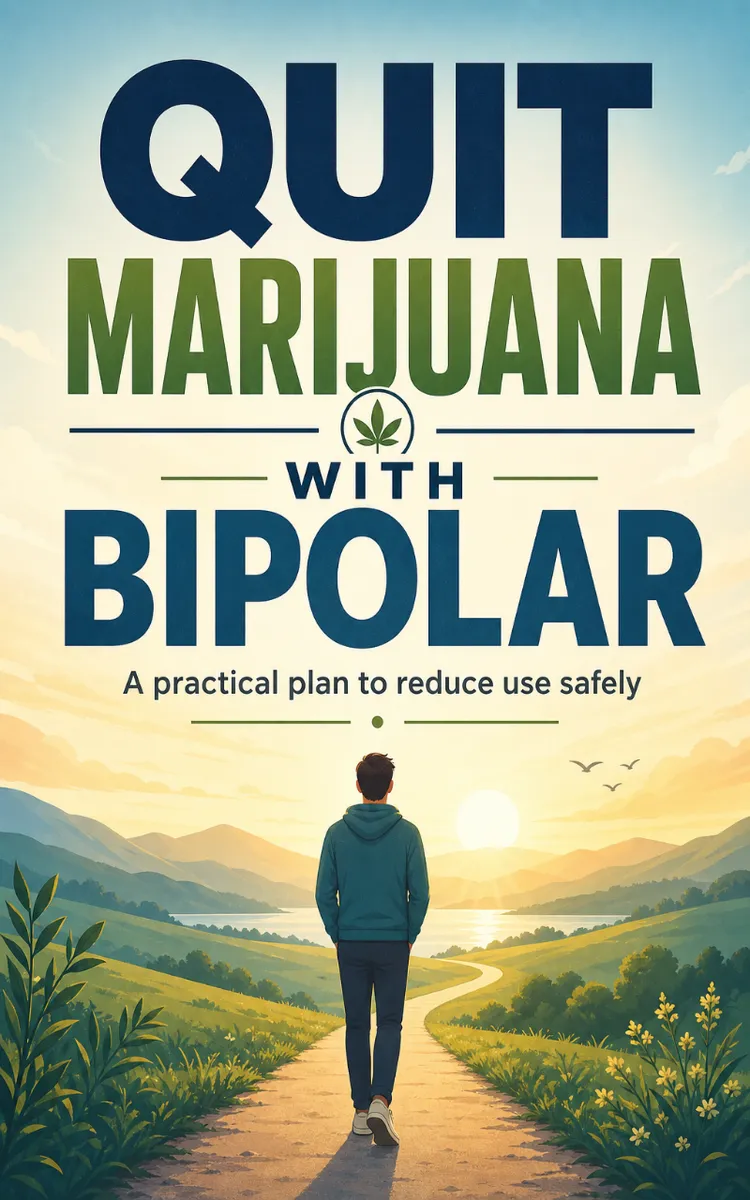
"Quit Marijuana With Bipolar" is a self-help book by Anonymous with 8 chapters and approximately 14,485 words. Quitting marijuana use for people with bipolar disorder.
This book was created using Inkfluence AI, an AI-powered book generation platform that helps authors write, design, and publish complete books. It was made with the AI Self-Help Book Writer.
Frequently Asked Questions
What is "Quit Marijuana With Bipolar" about?
Quitting marijuana use for people with bipolar disorder
How many chapters are in "Quit Marijuana With Bipolar"?
The book contains 8 chapters and approximately 14,485 words. Topics covered include Rebuilding Your Bipolar Identity, Challenging the “Self-Medication” Belief, Using the Bipolar Craving Trigger Ladder, Building a Sleep-Support Plan Without Weed, and more.
Who wrote "Quit Marijuana With Bipolar"?
This book was written by Anonymous and created using Inkfluence AI, an AI book generation platform that helps authors write, design, and publish books.
How can I create a similar self-help book?
You can create your own self-help book using Inkfluence AI. Describe your idea, choose your style, and the AI writes the full book for you. It's free to start.
Write your own self-help book with AI
Describe your idea and Inkfluence writes the whole thing. Free to start.
Start writingCreated with Inkfluence AI


