
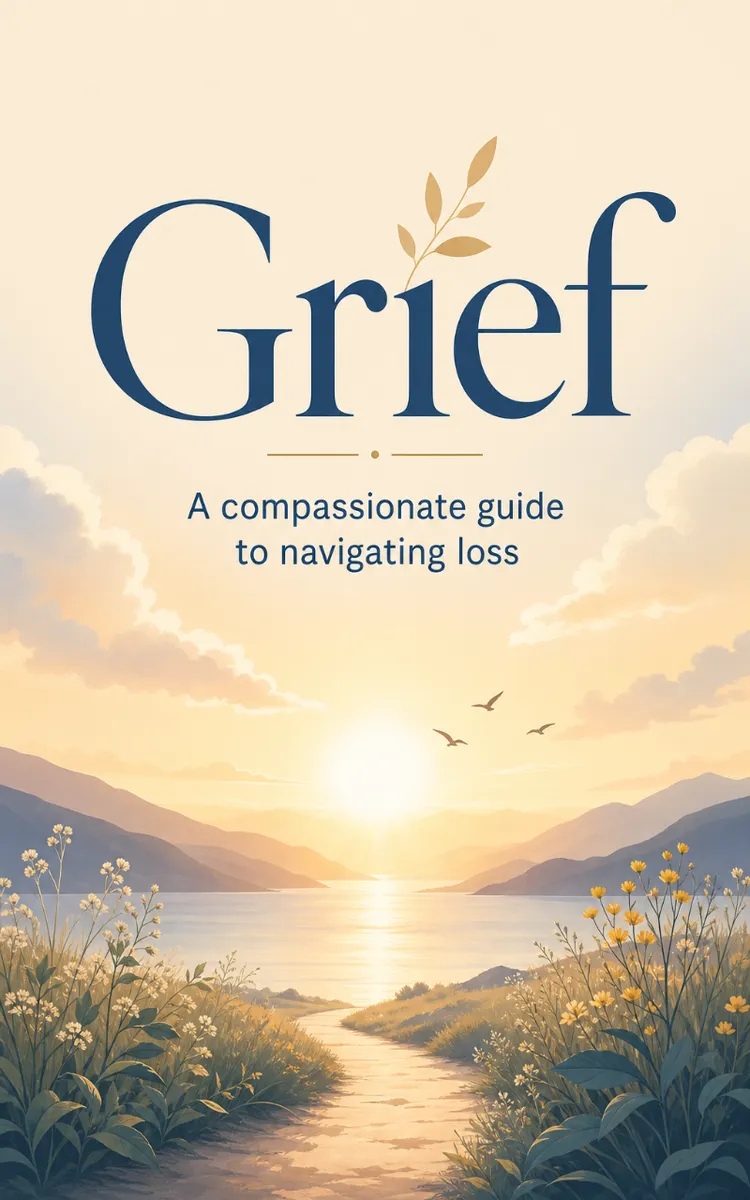
Read the first chapter
The whole of chapter one, free. About 8 min. Turn the pages with the arrows, your keyboard, or a swipe.
Chapter 1
Rebuilding Identity After Loss
The Morning You Don’t Recognize Yourself
Talia used to be the kind of person who moved through the day on autopilot - in a good way. She’d be the calm nurse in the hallway, the steady hand at home, the one who remembered birthdays without even trying. Then her partner died, and “autopilot” broke like a snapped watch spring. One morning, she reached for her phone the way she always had - same motion, same muscle memory - and froze when she realized there was no one to call. Not even a voice-mail. Just silence.
Later, she tried to get dressed for work and caught her reflection looking… wrong. Not ugly. Not sick. Just unfamiliar. As if grief hadn’t only taken someone from her, but quietly edited who she was allowed to be. That’s when the real fight started: not the pain itself, but the question underneath it - If what I cared about is gone, what am I supposed to be now?
How do you keep your worth intact when the life you built it on has disappeared?
---
The Identity Rebuild Map: Separating Your Worth From What’s Gone
When grief hits, it’s common to treat your identity like it’s made of the person you lost, the role you had, or the future you planned. Your mind tries to “solve” the loss by shrinking you down to match it. And the smaller you get, the more you feel like you’re surviving correctly - until you realize you’re disappearing.
Here’s the shift that changes everything - your worth stops being a “thing that happened,” and becomes a “thing you carry,” even while it hurts.
Old Belief: “If my partner is gone, then the version of me that loved them is gone too. I’m not the same person anymore, so I must be less.” New Reality: “The loss changed my life, but it didn’t erase my worth. I’m still me - just in a new season - and I can rebuild a stable sense of self without pretending nothing happened.”
Why this matters is simple: if you tie your identity to what’s gone, every reminder feels like proof you’re failing. Talia noticed it most on days she had “too many” good moments. If she laughed at a coworker’s joke, her chest would tighten like she’d betrayed her partner. Her brain was trying to enforce a rule: If you feel okay, you’re dishonoring what you lost.
But when she began separating her worth from the absence, the good moments didn’t feel like betrayal anymore. They felt like evidence that love didn’t vanish just because a person did. She started treating grief like a visitor who could share the room without owning the house. One afternoon after a tough shift, she sat in her car before going in and said out loud, “I can miss you and still live.” That sentence didn’t erase the pain. It stopped the punishment.
That’s the heart of the Identity Rebuild Map: it helps you rebuild a self that doesn’t depend on the lost person being present, the old routines being intact, or the future behaving the way you hoped it would.
---
Signs You’re Letting the Loss Define Your Worth
Your mind doesn’t usually decide to “erase you” on purpose. It does it the way water finds the lowest point - slowly, indirectly, and without asking permission. The pattern shows up in what you say to yourself when nobody’s listening.
Signs this pattern is running your life 1. You measure your value by what you can’t do anymore. If you can’t do the same things you used to do, your brain labels you as “less.” 2. You feel guilty for having a normal day. Joy makes you feel like you’re betraying the person you lost, even when you’re just breathing. 3. You treat change as proof you failed. If your mood shifts, you assume you’re doing grief wrong instead of noticing that grief moves. 4. You freeze when you think about the future. Not because you don’t want it - because your identity is chained to the “before,” and anything new feels unsafe.
That last one can be brutal. Talia would try to picture her next year - just next year - and her mind would slam the brakes. Not because she didn’t want peace, but because she believed wanting peace meant she was moving on too fast. The Identity Rebuild Map gives your mind a different job: not “forget,” not “replace,” but “rebuild.”
You don’t need to earn your identity by staying broken - you need to relearn what your worth is made of.
---
Going Deeper: How Your Identity Gets Trapped
So what’s actually happening under the hood?
After loss, your brain is trying to make sense of a reality that won’t cooperate. When something foundational disappears, it reaches for the closest explanation it can find. Often, that explanation sounds like: “If the thing that mattered is gone, then the self that depended on it must be gone too.” It’s not logical, but it feels safe. If you decide you’re smaller, you avoid the risk of hoping - because hope can hurt worse when it collapses.
But identity isn’t only the “roles” you had. It’s also the values you still carry, the way you respond to life, the boundaries you set, and the meaning you make from your experiences. Loss can take away a person, a routine, a home, a future. It can’t take away your capacity to choose who you become next - unless you hand it over.
The Identity Rebuild Map works by helping you separate three things that often get tangled:
First, the person or role you lost (real, gone, mourned). Second, the version of you that existed because of that person or role (changed, not erased). Third, your core worth (still yours, even in grief).
Talia’s “role” as a partner didn’t vanish. It transformed into something quieter - love that lives in memory and continues to shape her choices. Her day-to-day habits changed, sure. Her confidence wobbled. But her worth didn’t become negotiable.
Try this mental image: grief can be loud, but it doesn’t get to rewrite your entire operating system. You can feel devastated and still hold the truth that you deserve care, dignity, and steadiness.
---
Reflection Prompts to Rebuild a Stable Sense of Self
Answer these questions honestly, even if the first answer is messy. You’re not trying to impress anyone. You’re trying to locate where your worth got tangled up.
1. What part of “me” do I keep trying to protect by pretending I’m the same as before? If your answer sounds like “nothing,” dig one layer deeper. People often mean, “I’m trying to avoid the pain of admitting I’ve changed.”
2. When I feel guilty for feeling okay, what rule am I enforcing? You might notice a rule like “If I’m not hurting, I’m disrespecting them.” Naming the rule helps you stop obeying it like law.
3. What evidence do I have that my values survived the loss? For Talia, it might be the way she still shows up for patients with patience, even when her personal life feels shattered. Values often keep moving even when everything else shifts.
4. Where do I confuse “changed” with “less worthy”? A simple example: “I can’t do all the same tasks, so I must be failing.” That sentence is doing a lot of work - check what it’s assuming.
5. If my core worth wasn’t up for debate, what would I allow myself to do this week? This is where you get specific. “Rest” counts. “Ask for help” counts. “Try something new” counts.
Let your answers be imperfect. The point isn’t a perfect self-story. The point is to stop letting grief write your identity like it’s the only author in the room.
---
The Identity Rebuild Map Challenge (7 Days): Claim Your Worth in Small, Real Ways
You don’t rebuild identity by thinking about it harder. You rebuild it by practicing new truths until your body believes them a little.
Challenge Title: Worth Without Permission (7-Day Identity Rebuild Map)
• Day 1: Write one sentence: “The loss changed my life, but it did not change my worth.” Then add one concrete example from your day that proves you’re still you. - Day 2: Choose one “former you” label you’ve been using (like “I’m not dependable anymore,” “I’m not the same person,” or “I’m not strong”). Rewrite it as a “new you” statement that doesn’t shrink your value. - Day 3: Do a 10-minute “core values” check-in. Ask: What do I still stand for, even today? Write three values (keep them simple - kindness, honesty, steadiness, courage). - Day 4: Make one request for support. It can be small: cover a shift, a ride, a check-in text, a meal dropped off. Worth grows when you let yourself be helped. - Day 5: Create one boundary that protects your identity. Example: “I’m not going to punish myself for laughing,” or “I’m allowed to enjoy a song without it meaning I’m moving on.” - Day 6: Take a 20-minute walk or drive without “solving grief.” Your job is just to notice: What do I feel in my body? What do I sense in the world? - Day 7: Write a letter to your “new self” that starts with: “I know you’re carrying a lot, and I want you to remember…” Finish with one sentence that separates worth from what’s gone.
Expected difficulty rating: Medium
You’ll know it’s working when... - You catch yourself saying “I’m less” and can replace it with “I’m changed, not diminished.” - You feel a little less guilt when you have a good moment. - Your days include at least one act of self-respect that isn’t earned by suffering.
This isn’t about forcing positivity. It’s about giving your identity a steady foundation you can stand on - even while grief is still in the room.
---
Key Takeaway: What’s Gone Can Hurt You, But It Doesn’t Get to Define You
When you separate your worth from what’s gone, something subtle happens: grief stops being the judge of your character. It becomes what it actually is - an experience you’re living through, not a verdict on who you are.
Your identity isn’t the life you lost - it’s the worth you rebuild while you’re still standing.
• You can mourn deeply without turning grief into a rulebook for self-worth. - “Changed” doesn’t have to mean “less.” - Your core values can survive even when routines, roles, and futures collapse. - Small daily actions - requests, boundaries, value check-ins - teach your body a new truth.
And once your worth stops wobbling, the next step gets easier: you can start building stability in the places grief wrecked most - your days, your habits, and your sense of safety in your own life.
End of chapter one. 7 more chapters in the full book.
Swipe or use the arrows to turn the page


What's inside: 8 chapters
- 1. Rebuilding Identity After Loss
- 2. Challenging the “Should Be Over” Belief
- 3. Practicing Grief-Safe Self-Talk
- 4. Turning Triggers Into Gentle Signals
- 5. Designing a Loss-Friendly Daily Routine
- 6. Asking for Support Without Explaining Everything
- 7. Setting Boundaries With Grief in Public
- 8. Building Purpose Through Ongoing Love
About this book
"Grief" is a self-help book by Kisha with 8 chapters and approximately 13,980 words. Coping with grief and rebuilding after loss.
This book was created using Inkfluence AI, an AI-powered book generation platform that helps authors write, design, and publish complete books. It was made with the AI Self-Help Book Writer.
Frequently Asked Questions
What is "Grief" about?
Coping with grief and rebuilding after loss
How many chapters are in "Grief"?
The book contains 8 chapters and approximately 13,980 words. Topics covered include Rebuilding Identity After Loss, Challenging the “Should Be Over” Belief, Practicing Grief-Safe Self-Talk, Turning Triggers Into Gentle Signals, and more.
Who wrote "Grief"?
This book was written by Kisha and created using Inkfluence AI, an AI book generation platform that helps authors write, design, and publish books.
How can I create a similar self-help book?
You can create your own self-help book using Inkfluence AI. Describe your idea, choose your style, and the AI writes the full book for you. It's free to start.
Write your own self-help book with AI
Describe your idea and Inkfluence writes the whole thing. Free to start.
Start writingCreated with Inkfluence AI


