

Read the first chapter
The whole of chapter one, free. About 10 min. Turn the pages with the arrows, your keyboard, or a swipe.
Chapter 1
The Weekly Shoot That Changes
The last shot of the Wrenfield house showed the brass umbrella stand exactly where Mara Ellison had left it: beside the foyer table, its crooked handle pointing toward the blue ceramic bowl.
She checked the image on her camera’s rear screen, then glanced through the open front door at the real stand. Same position. Same bowl. Same pale rectangle of afternoon light lying across the floorboards.
“Good,” she murmured.
Consistency was the whole point of the weekly shoot. The listing had been active for nearly two months, and the agency wanted fresh photographs every Friday without making the property look different. Mara had learned the house’s angles the way a pianist learned scales. Wide shot from the foyer. Living room from the threshold. Kitchen from the corner beside the pantry. Upstairs landing, primary bedroom, bath.
Twenty minutes, if the house cooperated.
She lowered the camera and reached for her equipment bag.
The front door clicked shut behind her.
Mara turned.
The umbrella stand was gone.
For a moment, she stared at the empty patch beside the table. The bowl remained. The sunlight remained. A faint gray scuff marked the floor where the stand’s base had been.
She looked down at her camera screen again. The stand occupied the edge of the frame, black and unmistakable.
“Wind,” she said, though the foyer was still.
She opened the door. Cold daylight spilled across the threshold. The stand wasn’t on the porch. She checked the narrow hall, the living room, even the coat closet. Nothing.
Her phone buzzed in her jacket.
Jules from Northline Realty.
Mara answered. “I’m done.”
“Please tell me you got the kitchen brighter this time.”
“I got the kitchen.”
“And the bedroom?”
“Got it.”
“Then I owe you coffee. The sellers are asking whether the house looks smaller in the photos.”
“It looks exactly the same.”
Mara glanced at the empty space beside the bowl.
Jules laughed. “That confidence is why I keep sending you back.”
Mara forced a smile, though Jules couldn’t see it. “Upload in ten.”
She ended the call and stepped fully outside. The Wrenfield house sat at the end of a quiet cul-de-sac, its white siding clean beneath a sky the color of wet cement. No cars moved on the street. A plastic swing in the neighboring yard creaked once, then stopped.
Mara locked the front door and walked toward her hatchback, camera bag knocking against her hip.
At the curb, she paused.
A second-floor window flickered with reflected light.
Not movement. Just the sun slipping behind a cloud.
She got into the car, set the camera on the passenger seat, and drove away.
The next Friday, the umbrella stand was back.
Mara noticed it before she had taken two steps inside. It stood beside the foyer table, handle tilted toward the bowl, precisely as it appeared in the photograph from the previous week.
She stopped with one hand on the door.
“Cute,” she said to the empty house.
The word fell flat. The foyer seemed longer than she remembered. The ceiling light hung farther away, and the hall leading toward the kitchen appeared to angle slightly left. She blamed the weather, then the wide-angle lens she had been carrying, then the fact that she had spent the morning rushing between three listings.
Her goal was simple: finish before noon, upload the images, and make it to a client meeting across town. She had promised Jules a clean, consistent set. No delays. No strange seller complaints. No explaining why a hallway looked different from one week to the next.
She set her tripod beneath the staircase.
The staircase had six steps before the landing. She knew that because she had photographed it so often.
Today there were seven.
Mara counted again.
One. Two. Three. Four. Five. Six. Seven.
At the top, the landing opened onto the hall. The bathroom door should have been on the right, with a narrow linen closet opposite it.
The bathroom door was gone.
In its place was a stretch of wallpaper patterned with tiny green leaves.
Mara touched the wall. The paper was cool and faintly ridged beneath her fingertips. No seam. No handle. No outline.
Her phone buzzed.
Jules again.
“Tell me you’re not still there,” he said.
“I just arrived.”
“You sound weird.”
“I’m looking for the bathroom.”
A pause. “It’s upstairs.”
“I know where it is.”
“Then why are you looking?”
Mara looked at the blank wall. “The door moved.”
Jules gave a short laugh. “The door moved?”
“Forget it.”
“Are the sellers there?”
“No.”
“Then photograph the rooms we need and get out before the rain starts. The appraiser’s using your images this afternoon.”
She ended the call before he could ask another question.
Mara set the phone beside the camera and began working.
The living room was where it belonged, though the sofa faced the wrong direction. Last week it had sat beneath the front windows, angled toward the fireplace. Now it faced the foyer, its back turned to the glass.
She photographed it anyway.
The kitchen had changed more. The island was shorter, and the refrigerator stood where the pantry door had been. When Mara opened it, she found shelves filled with empty glass jars. The refrigerator hummed with a low, uneven vibration that she felt in her teeth.
She shut it and moved on.
The camera behaved normally. That steadied her. Aperture, shutter speed, focus. Numbers did not care about strange walls. Numbers did not invent missing doors.
At the foot of the staircase, she reviewed the images.
The living room appeared as it did now. Sofa facing the foyer. Fireplace on the left. Wide-angle distortion, but nothing impossible.
She scrolled to the foyer shot.
The umbrella stand was there.
Mara looked up.
It stood beside the table.
She had not seen it when she crossed the room.
A small sound came from upstairs.
Not a creak. A soft knock, followed by another.
Mara tightened her grip on the camera.
“Hello?”
The house answered with a click.
Somewhere beyond the blank wall, a latch released.
She climbed the stairs.
The wallpapered section had changed. A narrow door now interrupted the green leaves. Its brass knob shone as if someone had polished it. Mara reached for it, then stopped.
The bathroom had never been there.
She took a photograph.
The flash burst white across the hall. For an instant, a figure stood reflected in the dark glass of the framed print opposite her: a woman in a long gray dress, face turned away, one hand resting against the wall.
Mara spun around.
The hall was empty.
The framed print showed a black-and-white photograph of the house’s exterior. No woman. No reflection. Just the front facade beneath a blank sky.
Her pulse thudded hard enough to blur the edges of the room.
She raised the camera again and photographed the door.
The image on the screen showed the same door, but behind its glassy surface stood a second hallway. It ran deeper than the house could possibly contain. At the far end, a child’s red ball rested beneath a ceiling light.
Mara lowered the camera.
The door opened by itself.
Only an inch.
Cold air slipped through the gap, carrying the faint scent of dust and something metallic. From inside came a whisper, too low to understand.
She stepped back.
The door swung wider.
A room waited beyond it. Not the bathroom. Not any room she knew. Its walls were painted the same muted blue as the living room, and a wooden desk sat beneath the window. On the desk rested a black monitor with no visible cables.
The screen glowed.
Mara’s camera beeped.
She looked down. The display had switched from photo review to a live view. In the center of the frame, the monitor showed her standing in the doorway.
The image on the monitor lifted one hand.
Mara did not.
She dropped the camera.
It struck the floor with a crack.
The monitor went dark.
For several seconds, nothing moved. Then the house gave a deep, settling groan. The new door shuddered in its frame.
Mara backed down the hall, keeping her eyes on it. At the bottom of the stairs, she snatched up the camera and ran for the front door.
The umbrella stand toppled as she passed. Its metal rim clanged against the floor.
She yanked the door open.
The porch was empty. Rain had begun, fine and silver against the street.
Mara stepped outside and pulled the door shut behind her.
Through the glass, she saw the foyer.
The stand lay on its side.
Then the bowl slid across the table.
It moved slowly, scraping over the wood, and stopped at the edge. The front door’s lock turned with a precise mechanical click.
Mara froze on the porch.
The house was rearranging itself.
The umbrella stand rose first.
No hand touched it. It lifted from the floor and settled upright beside the staircase. The bowl followed, gliding back to the center of the table. Behind them, the staircase compressed with a series of soft wooden knocks.
Six steps.
The hallway stretched.
A wall shifted inward, swallowing the coat closet. The front room door narrowed, its frame drawing tight until it vanished beneath the paint. Furniture moved in the rooms beyond, muted thumps traveling through the walls.
Mara raised the camera.
Her hands shook, but the autofocus caught.
She photographed through the glass.
The flash illuminated the foyer, and for one frame she saw the woman in gray standing behind the table.
Her face was pale and indistinct, as though reflected through deep water. One hand pressed against the wood. The other pointed toward the staircase.
Then the flash faded.
The woman was gone.
Mara stepped off the porch, backing toward her car. The camera strap cut into her neck. She wanted to leave, to drive straight to Northline and throw the memory card onto Jules’s desk.
But the listing photos were still inside the camera.
She needed them.
If she uploaded nothing, Jules would call. If she uploaded the wrong layout, the appraiser would flag the property. If she said the house had changed, someone would ask whether she had been alone, whether she was tired, whether she needed help.
Mara looked at the rain-dark windows.
“Fine,” she whispered. “One more time.”
She went back inside.
The foyer had settled into a new arrangement. The staircase now began beside the front door, and the living room opened where the hall had been. The umbrella stand rested beneath the first step. The ceramic bowl sat on the floor.
Mara moved through the house with the camera held against her chest. She did not search for the bathroom. She photographed what she could find: the living room, the kitchen, the blue-painted room upstairs, the narrow passage that appeared behind the fireplace.
The camera timestamps remained steady.
10:14:03.
10:14:19.
10:14:47.
The rooms changed between exposures.
In one photograph, the sofa faced the windows. In the next, it faced the door. A chair appeared beside it, upholstered in a floral fabric Mara had never seen. The kitchen island shifted six inches between frames.
She kept shooting.
At last, standing in the center of the unfamiliar blue room, she took the final image.
The monitor on the desk flickered awake.
This time it displayed a photograph, not a live view.
Mara stared at the screen.
It showed her in the foyer, camera raised, wearing the same black jacket she had on now.
The image was dated seven days earlier.
Behind the photographed Mara, the bathroom door stood open.
A figure in gray watched from inside.
The monitor went black.
Mara backed toward the doorway, her heel striking something hard. She looked down.
A brass key lay on the floor.
She picked it up.
The key was warm.
Outside, her car’s horn began to sound, one sharp blast after another, though the doors were locked and the keys were in her hand.
Mara ran.
She reached the porch, crossed the wet pavement, and threw herself into the car. The horn stopped as soon as she slammed the door.
For several moments, she sat with both hands on the steering wheel, rain ticking against the windshield.
Then she inserted the memory card into her laptop.
The photographs loaded in a clean grid.
Every room she needed was there. Bright, sharp, professionally composed.
Consistent enough to send.
Mara opened the first foyer image.
The umbrella stand was beside the table.
She opened the next.
The umbrella stand was beneath the stairs.
The third showed no stairs at all.
At the bottom of the screen, the image metadata displayed the address, the date, and a location tag she had never entered.
BASEMENT LEVEL.
Mara stared at the words while the Wrenfield house stood dark in her rearview mirror.
There was no basement in the listing.
There had never been a basement.
Her phone buzzed again.
Jules.
Mara let it ring.
On the laptop, a new photograph appeared at the end of the grid. She had not taken it. It showed a concrete stairwell descending beneath the house.
At the bottom stood the woman in gray.
This time, her face was turned toward the camera.
End of chapter one. 9 more chapters in the full book.
Swipe or use the arrows to turn the page

What's inside: 10 chapters
- 1. The Weekly Shoot That Changes
- 2. Doors Vanish Between Clicks
- 3. Furniture Rebuilds the Floorplan
- 4. The Basement Door Appears Once
- 5. Photos of Mara in Storage
- 6. The Company’s Scripted Explanation
- 7. Cutting the Adaptive Architecture Feed
- 8. Silent Aperture
- 9. Proof, Ghosts, and a Locked Door
- 10. Silent Verdict
About this book
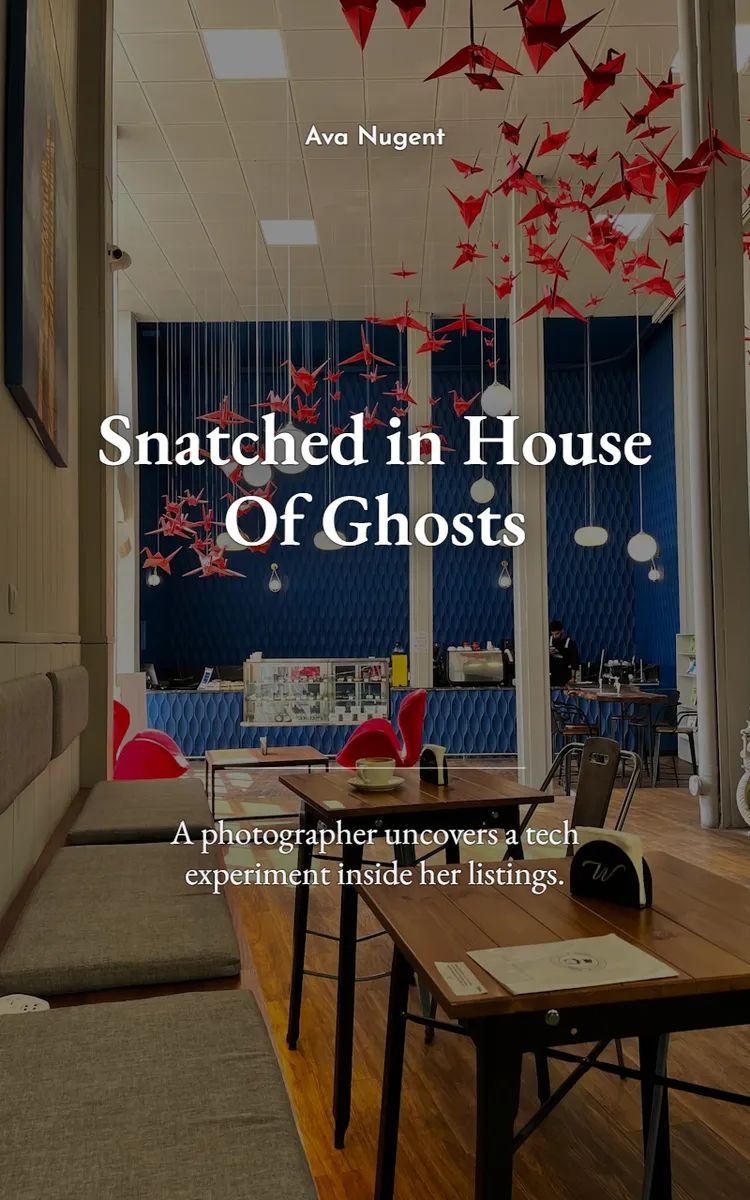
"Snatched in House Of Ghosts" is a fiction book by Ava Nugent with 10 chapters and approximately 18,320 words. A real estate photographer investigates a house that rearranges itself..
This book was created using Inkfluence AI, an AI-powered book generation platform that helps authors write, design, and publish complete books. It was made with the AI Novel Writer.
Frequently Asked Questions
What is "Snatched in House Of Ghosts" about?
A real estate photographer investigates a house that rearranges itself.
How many chapters are in "Snatched in House Of Ghosts"?
The book contains 10 chapters and approximately 18,320 words. Topics covered include The Weekly Shoot That Changes, Doors Vanish Between Clicks, Furniture Rebuilds the Floorplan, The Basement Door Appears Once, and more.
Who wrote "Snatched in House Of Ghosts"?
This book was written by Ava Nugent and created using Inkfluence AI, an AI book generation platform that helps authors write, design, and publish books.
How can I create a similar fiction book?
You can create your own fiction book using Inkfluence AI. Describe your idea, choose your style, and the AI writes the full book for you. It's free to start.
Write your own fiction book with AI
Describe your idea and Inkfluence writes the whole thing. Free to start.
Start writingCreated with Inkfluence AI


