
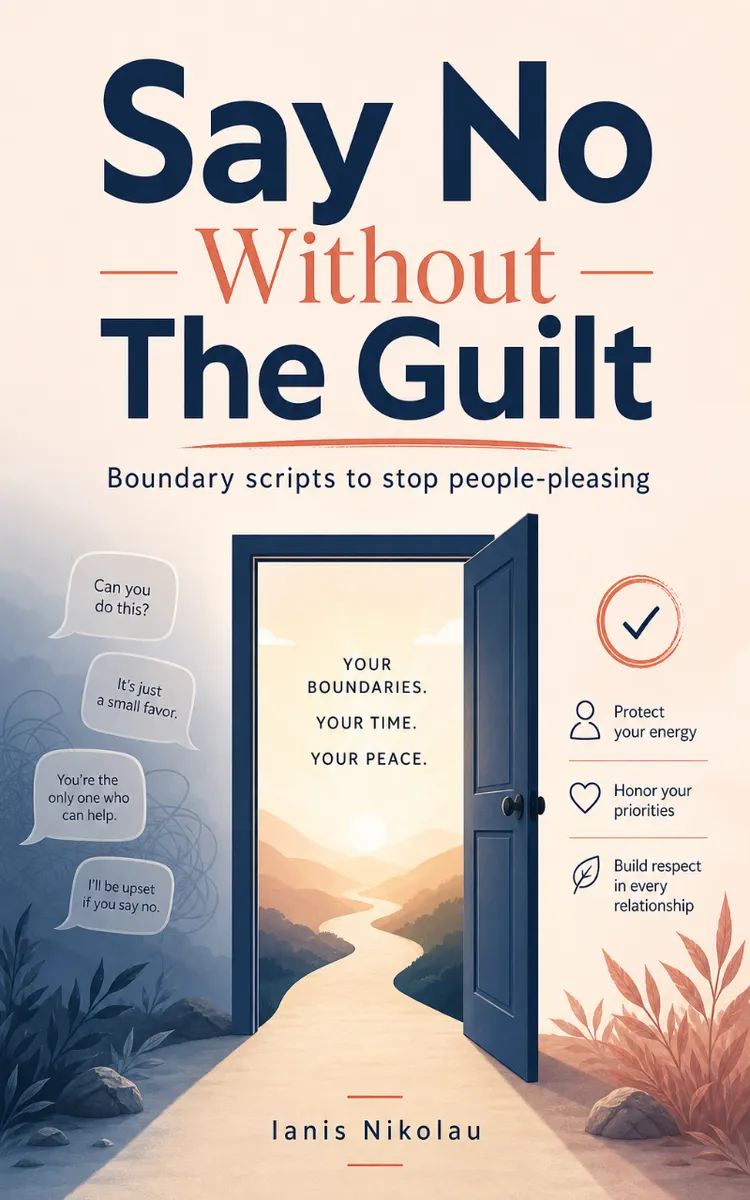
Read the first chapter
The whole of chapter one, free. About 14 min. Turn the pages with the arrows, your keyboard, or a swipe.
Chapter 1
The difference between kindness and self-abandonment.
You agree to help and feel your chest sink. You cancel your plans, rearrange your day, and tell yourself it’s fine. Maybe you even sound cheerful while doing it.
That may look like kindness from the outside. Inside, it can feel like disappearing.
Kindness considers another person without erasing you. Self-abandonment makes their comfort, urgency, or approval more important than your own limits. The two can look almost identical in a single moment, which is why people-pleasing is so confusing. You may be generous and still be running on empty. You may care deeply and still need to say no.
The question isn’t, “Am I a good person if I refuse?” A better question is, “Am I choosing this freely, or am I abandoning myself to avoid someone else’s reaction?”
What Kindness Actually Includes
Kindness is an offering. You have something to give, and you decide to give it.
That decision can involve effort. You might help a friend move, listen to a difficult story, cover a shift, or change your plans. But underneath the inconvenience, there’s still a sense of choice. You may not be thrilled about the task, yet you don’t feel trapped by it.
Kindness also leaves room for honesty. You can say, “I can help for an hour, but I can’t stay all afternoon.” You can care about someone’s problem without becoming responsible for solving it. You can be warm without being endlessly available.
Self-abandonment feels different. It often arrives quickly, before you’ve checked what you want or what you can manage. Your mouth says yes while your body says, “Absolutely not.” You agree because you fear being called selfish, difficult, unreliable, or uncaring. Then you carry the cost privately.
Notice the difference in these two responses:
“I’m tired, but I’d like to help for a little while.”
“I don’t have the energy, but they need me. I’ll just deal with it.”
The first includes your reality. The second removes it.
This doesn’t mean every uncomfortable yes is self-abandonment. Sometimes we choose inconvenience because something matters. The key is whether your needs remain part of the decision. Kindness says, “Your needs matter, and mine do too.” Self-abandonment says, “Your needs matter, so mine must disappear.”
The Hidden Cost of Being the Easy Person
People-pleasing often earns quick rewards. Someone is relieved. A conflict disappears. You receive praise for being dependable. You get to avoid the awkward pause that follows a refusal.
But the relief doesn’t last if the agreement cost more than you could afford.
You may begin to resent the person who asked, even though they didn’t know you were agreeing against yourself. You may become short-tempered, exhausted, or quietly scorekeeping: “After everything I’ve done…” You may withdraw instead of admitting that your yes was never wholehearted.
This is one reason self-abandonment damages connection. It creates a relationship built on information that isn’t true. The other person thinks you’re available. You know you aren’t. They think you’re willing. You’re actually overwhelmed. Eventually, the hidden no leaks out as silence, irritation, missed messages, or a sudden explosion.
A clear no can feel uncomfortable for a few minutes. An unspoken no can poison a relationship for weeks.
That doesn’t mean you need to announce every private feeling dramatically. It means your relationships deserve accurate information. If you can’t help, saying so gives the other person a chance to make another plan. If you keep saying yes while becoming resentful, neither of you gets that chance.
Try this today: think of one recent agreement you regretted. Don’t judge yourself. Write three plain sentences:
• What did the person ask?
• What did I actually have the time, energy, or willingness to do?
• What was I afraid would happen if I said no?
The third answer often reveals the real pressure. Maybe you feared disappointment. Maybe you feared being seen as selfish. Maybe you believed a good friend, partner, child, or colleague should always be available.
That belief is worth questioning. Being caring doesn’t require being constantly accessible.
The Body’s Early Warning Signs
Your body may notice self-abandonment before your thoughts catch up.
You might feel your stomach tighten when a request arrives. Your shoulders may rise. You may reread the message several times, already searching for a way to agree. Perhaps you feel a flash of irritation, followed by guilt for feeling irritated. These reactions aren’t proof that the other person has done something wrong. They’re information about your own capacity and willingness.
Pay attention to the difference between a thoughtful yes and a pressured yes.
A thoughtful yes usually has some openness in it. You may feel nervous about the effort, but there’s also a sense of alignment. You know why you’re choosing it.
A pressured yes often feels narrow and urgent. You want the conversation to end. You’re focused on managing the other person’s feelings rather than considering your own answer. You start explaining before you’ve even decided.
When you notice that pattern, don’t force yourself to produce a perfect boundary immediately. Simply name what’s happening: “I’m feeling pressure to agree before I’ve checked in with myself.”
That sentence creates a small amount of space, which matters because self-abandonment thrives on automatic reactions. It asks you to move from request to agreement without stopping at your own needs.
You can also use a simple check:
“Do I want to do this?”
“Can I do this without harming my health, rest, work, finances, or other commitments?”
“Am I choosing this, or am I trying to prevent a reaction?”
You don’t need a dramatic reason to decline. Lack of capacity is enough. Lack of desire is also information. You’re allowed to make decisions based on your actual life, not an imaginary version of yourself who never gets tired.
Kindness With a Boundary Attached
A boundary doesn’t cancel kindness. It gives kindness a shape you can sustain.
Instead of agreeing to host a friend for an entire weekend, you might offer dinner. Instead of taking over someone’s task, you might explain one part. Instead of listening to a difficult conversation late at night, you might say you can talk tomorrow.
This is not a trick for making every no sound nicer. It’s a way to separate the care you genuinely want to offer from the amount you cannot give.
Try these sentences aloud:
“I care about you, and I can’t take this on today.”
“I’m not available for the full request, but I can offer this smaller piece.”
“I understand why you’re asking. I’m going to say no.”
“I’d rather be honest than agree and become resentful.”
Notice how none of them contain a courtroom defense. You don’t need to prove that your limit is reasonable before it becomes real.
Sometimes the kindest choice is a clean refusal. If you’re too exhausted to help, offering a reluctant yes may create more trouble than saying no. If you don’t have the skills, pretending you can manage may leave the other person with a bigger problem. If you agree only to avoid disappointment, the agreement may not be as generous as it appears.
A boundary can protect the quality of what you do choose to give. When your yes is not automatic, it becomes more trustworthy.
A Small Practice for Choosing Yourself
For the next day, don’t try to fix your whole personality. Just watch for the moment before agreement.
When someone asks for something, notice your first impulse. Do you feel willing, uncertain, or trapped? What would you answer if you knew the other person could handle disappointment? What would be true if you weren’t trying to look easygoing?
Then write a private version of your honest answer. It doesn’t need to be polished.
“I don’t want to.”
“I’m too tired.”
“I can help, but not in that way.”
“I need the evening for myself.”
“I’m saying yes because I’m scared they’ll be upset.”
This exercise isn’t about rejecting every request. It’s about hearing yourself before you respond to someone else.
After that, choose one low-risk place to practice honesty. You might decline an invitation you don’t want, stop volunteering for an extra task, or tell someone you can only stay for a short time. Keep the message simple. Don’t add five explanations to make the limit easier for them to accept.
You may feel selfish at first. That feeling doesn’t automatically mean you’ve acted selfishly. It may simply mean you’re doing something unfamiliar: including yourself in the decision.
Kindness is not measured by how often you override your needs. It’s measured by the care and honesty you bring to your choices. You can be generous without being endlessly available. You can disappoint someone without betraying them. You can love people and remain present in your own life.
The next time a request lands in your lap, don’t ask only, “What do they need from me?” Ask, “What is true for me?” Your answer belongs in the conversation too.
A sharp, familiar scene you’ve lived: saying yes while your body says no
You feel the text buzz in your pocket during the one hour you carved out for yourself. It’s a friend asking for help the next morning - can you pick up their kid, cover a shift, or proofread a client email? Your throat tightens, and you already know saying yes will cost you sleep, focus, or the small margin of calm you’ve been saving.
Still, you type: “Sure, I can do that. ” Then you tuck your phone away and breathe shallowly all night while your brain runs through what you’ll have to give up.
That moment looks like kindness. It feels like duty. But later, when you’re late, drained, or resentful, it feels like you disappeared for someone else’s comfort. Is that kindness - or self-abandonment?
Which would you prefer to be known for: always-available-helpful, or someone who keeps promises to themselves so they can actually show up for others when it matters?
You can be kind and also protect your time and energy.
Old belief vs. new reality: why this shift matters
Old Belief: Saying no is unkind, selfish, or evidence you don’t care enough.
New Reality: Boundaries are an act of kindness - to yourself and others - because they let you give what you mean to give without burning out.
This shift matters because kindness that springs from scarcity - from depleted energy and obligation - rarely lands as intended. For example: you say yes to host a weekend family dinner even though you’re exhausted. You cancel your only recovery plan, spend the day distracted, and snap at someone over a small thing.
Your family leaves fed but unsettled; you’re left depleted and ashamed. Contrast that with saying, “I can host for two hours on Sunday or help plan a potluck instead. ” You stay within your limits, you still contribute, and you model a way of caring that’s sustainable.
When you refuse from presence instead of fear, people get a clearer version of you. They learn what you can count on and what you can’t. That clarity reduces surprise, friction, and eventual resentment. It’s kinder in the long run - to them, and especially to you.
Why we confuse kindness with self-abandonment
Most of us learned a version of kindness that equated being likable with being available. Early praise, culture, or pressure often taught us the quickest route to belonging: say yes, fix problems, absorb others’ frustration. Over time that pattern gets wired into quick reactions.
Saying no feels risky because it threatens the reward we learned: approval, safety, or avoidance of conflict.
Signs this pattern is running your life:
1.
You say yes immediately without checking your calendar or energy level.
2.
You feel shame or worry after setting a boundary, even when the request was reasonable.
3.
You repeatedly do favors that cost you clear plans or rest.
4.
You apologize repeatedly for the limits you set, as if they were a moral failing.
In short: kindness doesn’t require your collapse. Saying no preserves your ability to be genuinely present later.
Questions to help you see where you’re folding into yourself
1.
When did you last say yes out of fear of disappointing someone, not because you wanted to help? - An honest answer might be: “Last week, I covered my colleague’s shift even though I needed that day to finish a project.” That shows where your fear of letting others down costs you.
2.
What part of saying no feels most scary: the imagined reaction, losing approval, or the hassle of explaining? - You might notice the fear is about an imagined argument rather than any past evidence. That tells you where to test reality gently.
3.
What would happen if you offered a smaller, boundary-respecting option instead of full compliance? - Example: “I can’t babysit all evening, but I can take them for two hours at 5.” Trying a partial offer shows you can help without disappearing.
4.
Which relationships reward your yeses and which take them for granted? - Think: “My sibling asks for help weekly without reciprocating; my neighbor helped me move last year.” This helps allocate where to be generous.
5.
How do you physically feel after you say yes? Energized, neutral, or checked-out and anxious? - Noticing the pattern - checked-out after most yeses - signals the need for clearer limits.
Answering these honestly is a soft, workable way to map your default reactions. You’ve got this; start small and be kind to yourself in the process.
A 7-day challenge to sharpen your kindness without self-abandonment
Challenge title: 7 Days of Conscious Yes/No
• Instructions:
• For the next 7 days, pause before answering requests that will cost you time or energy. Count to 10, say, “Let me check,” or use a short script: “I need to check my schedule; can I get back to you by [specific time]?” - Each day, set one clear boundary: a time you’ll stop work, a limit on weekend help, or a fixed hour for alone time. Communicate it once, kindly, and without over-explaining. - Keep a small journal: note the request, your response, and how you felt afterward (energy level, guilt, relief).
• Expected difficulty: Medium
• You’ll know it’s working when...
• you feel fewer surprises and less exhaustion, - you notice people adjusting without drama, - and your “yes” starts to feel like a real choice instead of a reflex.
One sentence that sticks - plus a quick recap and next step
Kindness that costs your peace isn’t kindness - it’s disappearance disguised as generosity.
• You can be generous without erasing your needs.
• Immediate yeses often come from fear, not generosity.
• Small, consistent boundaries protect your ability to show up for others when it matters.
• Pausing before answering is a simple habit that changes everything.
Try the 7-day challenge - you’ll find out how much more authentic your kindness can feel. Next, we’ll look at why guilt doesn’t always mean your boundary is wrong, and how to hold limits when your heart and your past are arguing.
Giorni 15-21: Mantieni la linea senza giustificarti e gestisci le ricadute
In quest’ultima fase impari a restare saldo dopo il primo no. Prepara frasi brevi per ripetere il limite e uno script per quando vacilli:
• Frasi di tenuta (da ripetere): “Questo non va bene per me.” “Ho già risposto, non intendo discuterne.”
• Script per ricadute: se cedi e poi ti senti male, usa subito: “Sono dispiaciuto/a, ho cambiato idea, ma ora ho bisogno di rimediare.” Offri un’azione riparatrice concreta: “Posso restituire il favore la prossima settimana o trovare un’altra soluzione.”
• Gestione dell’escalation: se la persona insiste, chiudi con: “Devo interrompere questa conversazione.” Poi allontanati fisicamente o chiudi la chat.
• Esercizio finale e misura del progresso: scegli un punto ricorrente di pressione e applica la frase di tenuta ogni volta che appare. Alla fine del giorno 21 conta: quante volte hai fatto pausa, quante volte hai mantenuto il no, quante volte hai dovuto usare una frase di riparazione. Non cerchi la perfezione; cerchi dati utili e abitudini ripetute.
Giorni 8-14: Linguaggio chiaro e breve, con opzioni a scalare
Questa settimana sostituisci spiegazioni lunghe con frasi pulite. Scegli una situazione frequente e prepara quattro versioni della risposta, da usare a seconda di quanto vuoi essere fermo:
• Gentile (basso impegno): “Grazie per avermi pensato, ma non posso.”
• Diretta (medio): “Non sono disponibile.”
• Professionale (lavoro): “Non posso assumermi questo entro la scadenza richiesta.”
• Se insistono (tenuta): “Capisco la delusione, ma la mia risposta resta no.”
• Opzioni a scalare per iniziare: se vuoi più morbidezza, aggiungi una frase di disponibilità futura: “Posso aiutare la prossima settimana.” Se vuoi meno coinvolgimento, resta con la versione diretta.
• Esercizio e tracciamento: pronuncia ogni frase ad alta voce, usa una per ogni ruolo (amico, collega, familiare), e registra dopo: cosa temeva che accadesse e cosa è realmente successo. Questo ti dà dati concreti per valutare il cambiamento.
Giorni 1-7: Nota il tuo “sì” automatico
Per la prima settimana, non cercare gesti eroici. Inizia invece col riconoscere i momenti in cui dici sì prima ancora di pensarci. Segui questi passi:
• Esempi pratici da usare: quando un collega propone di coprire un turno extra, quando un amico ti chiede un favore dell’ultimo minuto, o quando un familiare ti telefona per chiedere aiuto la domenica mattina.
• Esercizio quotidiano: ogni volta che senti l’impulso a dire sì, annota: cosa è stato chiesto, come ti sentivi (ansia, rabbia, sollievo), e cosa avresti voluto dire.
• Metrica semplice: conta le pause che usi ogni giorno e mira a 1, 3 pause quotidiane la prima settimana.
• Pratiche progressive: il giorno 4 usa la pausa standard: “Fammi controllare e ti faccio sapere.” Il giorno 5 prova a dichiarare la tua capacità: “Ho circa venti minuti oggi.” Il giorno 6 rifiuta un impegno a basso rischio. Il giorno 7 rivedi le note: quali richieste erano vere scelte? quali ottennero un sì perché evitavi il disagio?
End of chapter one. 11 more chapters in the full book.
Swipe or use the arrows to turn the page
What's inside: 12 chapters
- 1. The difference between kindness and self-abandonment.
- 2. Why guilt does not always mean that a boundary is wrong.
- 3. How to stop giving immediate answers.
- 4. Boundaries with family members.
- 5. Boundaries with friends.
- 6. Boundaries at work.
- 7. Boundaries in romantic relationships.
- 8. Boundaries around money and favors.
- 9. Boundaries in texting and digital communication.
- 10. Responding to pressure, anger, and guilt-tripping.
- 11. Repairing a boundary communicated badly.
- 12. A 21-day boundary-building plan.
About this book
"Say No Without The Guilt" is a self-help book by Anonymous with 12 chapters and approximately 18,863 words. People-pleasing boundaries, guilt, and ready-to-use refusal scripts.
This book was created using Inkfluence AI, an AI-powered book generation platform that helps authors write, design, and publish complete books. It was made with the AI Self-Help Book Writer.
Frequently Asked Questions
What is "Say No Without The Guilt" about?
People-pleasing boundaries, guilt, and ready-to-use refusal scripts
How many chapters are in "Say No Without The Guilt"?
The book contains 12 chapters and approximately 18,863 words. Topics covered include The difference between kindness and self-abandonment., Why guilt does not always mean that a boundary is wrong., How to stop giving immediate answers., Boundaries with family members., and more.
Who wrote "Say No Without The Guilt"?
This book was written by Anonymous and created using Inkfluence AI, an AI book generation platform that helps authors write, design, and publish books.
How can I create a similar self-help book?
You can create your own self-help book using Inkfluence AI. Describe your idea, choose your style, and the AI writes the full book for you. It's free to start.
Write your own self-help book with AI
Describe your idea and Inkfluence writes the whole thing. Free to start.
Start writingCreated with Inkfluence AI


