

Read the first chapter
The whole of chapter one, free. About 8 min. Turn the pages with the arrows, your keyboard, or a swipe.
Chapter 1
Clearinghouse Role in Derivatives
A single trade can look simple until you trace the payments. A trader agrees a price with a counterparty, but the cash and risk never truly settle between those two lines of paper once the clearinghouse steps in. When the clearinghouse interposes, it changes who owes what, when collateral moves, and how failures get contained. If you miss that shift, you misread your exposure and you mis-handle your margin calls.
Nadia, 34, derivatives operations analyst, learned that the hard way during a routine end-of-day process. A desk reported “we’re hedged,” but the clearing system still demanded variation margin because the clearinghouse had replaced the original bilateral risk with new obligations against the clearinghouse itself. The trade hadn’t failed; the interpretation had. After she mapped the interposition points and checked the margin streams, the apparent mismatch disappeared.
After this chapter, you will be able to (1) trace how the clearinghouse becomes the buyer to every seller and the seller to every buyer, (2) connect that legal and operational interposition to margining and default controls, and (3) run a practical walkthrough for a clearing member’s daily lifecycle checks using a tool-agnostic approach. You will also know what to watch when the plumbing and the risk model disagree.
Why Clearinghouse Interposition Matters for Every Trade Lifecycle
Clearinghouses interpose by design: they stand between counterparties so that each side faces the clearinghouse rather than the other side. In operational terms, that means the clearinghouse creates new, separate obligations that mirror the economic deal but change the credit exposure. Instead of “Counterparty A might default on this swap,” the trader’s member faces “the clearinghouse might demand margin, and the member must meet it.” That swap in perspective drives nearly every risk control: initial margin, variation margin, intraday calls, default fund contributions, and the default waterfall.
This matters because derivatives markets run on a tight sequence of “measure → collect → settle → manage.” If you treat the original bilateral contract as the whole story, you will mis-time your cash planning, you will misread your netting set, and you will under-estimate how quickly risk controls react. Margining triggers on mark-to-market and on portfolio risk; default controls trigger on member stress. Those controls only work if you understand that the clearinghouse has replaced the counterparty relationship with a clearinghouse-to-member relationship.
The Interposition Map gives you a concrete way to track the obligation chain across the lifecycle. It forces you to label where risk lives at each step and which system component owns the measurement or payment. You do not need a full legal memo to use it; you need a repeatable mapping that aligns your operations work with the clearinghouse’s risk controls.
Here is the core technique in practice - build the map, then use it to verify that every cash movement and risk update corresponds to the correct obligation.
1. Identify the economic trade and its lifecycle events (trade date, valuation times, settlement/termination, and any corporate actions). This step anchors your timeline. For example, a daily valuation time drives variation margin (the daily mark-to-market payment), so you must align your operational batch schedule with that valuation.
2. Replace the bilateral link with clearinghouse obligations (each original counterparty becomes a clearing member-facing obligation). You write two “legs” on your map: Member A vs Clearinghouse, and Member B vs Clearinghouse. The economic payoff stays the same; the credit exposure changes.
3. Label the margin type that applies at each event (initial margin vs variation margin). Initial margin (IM) covers potential future exposure under normal market moves; variation margin (VM) covers current mark-to-market. If you see a cash call during a valuation window, you treat it as VM unless your system explicitly tags it as IM.
4. Connect risk controls to the map nodes (IM model, VM calculation, collateral eligibility, and default waterfall funding). You do not guess. You point to the clearinghouse-owned measurement that triggers the action. For example, if you see an intraday VM call, you map it to the clearinghouse’s intraday valuation trigger, not to a late-day settlement job.
Putting It Into Practice: Build and Use the Interposition Map
Use a realistic workflow: take one cleared interest rate swap (IRS) and walk it from trade capture to end-of-day cash. Nadia’s operational habit was simple: she stopped talking about “counterparty risk” in the abstract and started drawing the interposition chain before she touched the reconciliation.
Assume the following concrete setup for your walkthrough: two clearing members, Member X and Member Y, clear an IRS through the same central counterparty. You want to understand what happens to obligations and margin calls after execution and after the next valuation.
1. Create an Interposition Map worksheet for the trade with three rows: “Original bilateral agreement,” “Clearinghouse interposition,” and “Margin and settlement actions.” Expected outcome: you can point to the exact moment the clearinghouse replaces the bilateral risk.
2. Record the valuation schedule you actually run (for example, “daily valuation at 16:00 local exchange time; end-of-day reconciliation at 18:00”). Expected outcome: your operational cutover aligns with when VM gets calculated and when your treasury needs cash.
3. Mark the obligation direction for each member-facing leg: - If Member X pays the net VM to the clearinghouse at the valuation time, write “Member X → Clearinghouse: VM.” - If Member Y receives, write “Clearinghouse → Member Y: VM.” Expected outcome: your reconciliation matches the cash flow direction you see in your bank statements and clearing reports.
4. Attach margin collection mechanics to each node by tagging which margin you expect: - At or near trade acceptance: IM setup (initial margin) may be posted or updated. - At valuation times: VM movement happens. Expected outcome: you stop blaming “system noise” when the call matches a known lifecycle event.
5. Validate netting set ownership (do you have one netting set for VM and a separate structure for IM, depending on product and clearing rules). Expected outcome: your totals tie out at the level your clearing reports show. If they don’t, you fix mapping or portfolio grouping, not your risk intuition.
6. Run the end-of-day cash and position reconciliation against the map: You confirm that the cleared position exists under the clearinghouse account, that the margin call fields map to the correct margin type, and that collateral movements happened under the correct collateral instructions. Expected outcome: your “hedged” claim becomes measurable: you see the VM effect and you see the IM requirement change (if the risk changed enough).
Quick checklist
• Confirm the trade exists in the clearinghouse-facing position book under the correct member account. - Verify the valuation timestamp you use matches the clearinghouse’s VM calculation timing. - Tag each cash movement as VM or IM using the clearing report fields (do not infer from sign alone). - Check that the cash flow direction matches your Interposition Map leg (Member → Clearinghouse or Clearinghouse → Member). - Tie totals at the report granularity you receive (netting set and margin type), then fix mapping gaps.
This walkthrough matters because it links interposition to operations reality. The clearinghouse interposes not as a concept, but as a switch that determines who sends cash, who receives cash, and which risk controls trigger the next action. Once you can trace that chain for one IRS, you can replicate the method for other products with different valuation and margin conventions.
What to Watch For: Mistakes and Edge Cases in Interposition Mapping
Most failures in clearing operations do not come from misunderstanding margin formulas. They come from mapping errors: you connect the wrong obligation leg to the wrong risk control, or you assume the margin report means what you think it means. Here are the common ones.
Treated “counterparty hedged” as a clearinghouse truth Do this: You replace the bilateral assumption with the clearinghouse-facing legs and check VM at the valuation timestamp. If the clearing report shows VM due, you plan cash even if the desk still holds an offsetting trade elsewhere. Not this: You interpret “hedged on the street” as “no VM impact.” That breaks the interposition logic: hedges only reduce exposure when they fall into the same clearing and netting structures that the clearinghouse uses for margin.
Mixed up initial margin and variation margin during reconciliation Do this: When you see a margin call, you tag it explicitly as initial margin or variation margin using the clearing report labels, then you reconcile to the correct collateral movement and timing. Not this: You treat every call as “margin” and net everything together. That hides timing risk: VM hits treasury immediately, while IM behaves more like a risk-based requirement that can change with portfolio composition and model assumptions.
Misread netting set boundaries and collateral eligibility Do this: You verify that the position you think belongs to a netting set actually sits in that netting set in the clearinghouse report, and you check collateral eligibility rules for the instruments you posted. Not this: You assume netting happens at your internal trade label level or you assume all posted collateral is interchangeable. When netting sets split (for example, across product buckets or risk classes), your map nodes will not tie out, and you will chase “phantom” discrepancies.
A final edge case worth operationalizing: intraday risk controls. If your clearinghouse issues intraday calls, you must extend the Interposition Map beyond end-of-day and include the intraday valuation triggers as separate lifecycle nodes. When you ignore that, you will under-prepare liquidity and you will treat a later-day shortfall as a surprise rather than a scheduled interposition-driven action.
The takeaway is simple but hard to execute: clearinghouse interposition turns “counterparty credit” into “clearinghouse operational obligations,” and your risk controls only protect you if your mapping matches how the clearinghouse measures and calls margin. When your Interposition Map stays accurate, your margin calls stop feeling arbitrary and your default risk controls stop being abstract. The next step in this book builds on that: you will connect this interposition chain to how margining feeds the default waterfall and how stress tests validate that the system holds under real market moves.
End of chapter one. 7 more chapters in the full book.
Swipe or use the arrows to turn the page


What's inside: 8 chapters
- 1. Clearinghouse Role in Derivatives
- 2. Initial Margin Calculation Basics
- 3. Variation Margin and Settlement Cycles
- 4. Margin Calls, Transfers, and Liquidity
- 5. Default Waterfall Mechanics by CCP
- 6. Porting, Auctions, and Close-Out Process
- 7. Stress Testing Margin and Liquidity
- 8. Operational Readiness for Clearing Failures
About this book
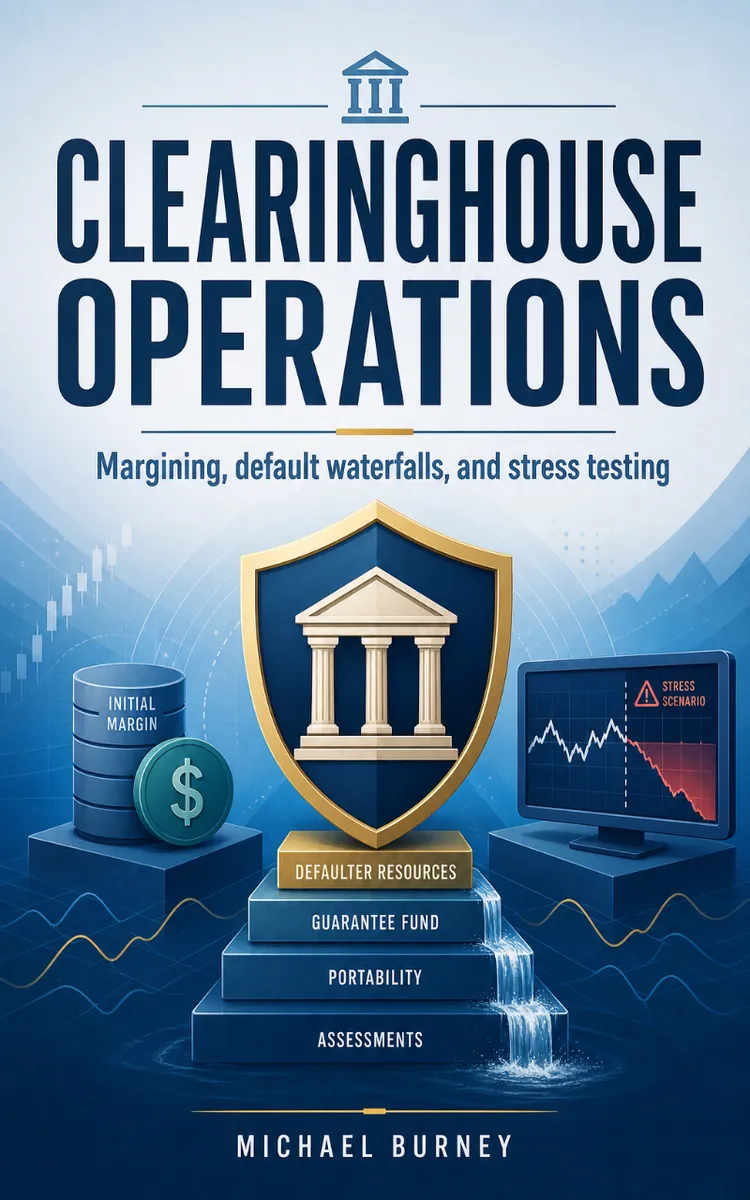
"Clearinghouse Operations" is a finance book by Michael Burney with 8 chapters and approximately 15,986 words. Clearinghouse margining, default waterfalls, and stress testing.
This book was created using Inkfluence AI, an AI-powered book generation platform that helps authors write, design, and publish complete books. It was made with the AI Ebook Generator.
Frequently Asked Questions
What is "Clearinghouse Operations" about?
Clearinghouse margining, default waterfalls, and stress testing
How many chapters are in "Clearinghouse Operations"?
The book contains 8 chapters and approximately 15,986 words. Topics covered include Clearinghouse Role in Derivatives, Initial Margin Calculation Basics, Variation Margin and Settlement Cycles, Margin Calls, Transfers, and Liquidity, and more.
Who wrote "Clearinghouse Operations"?
This book was written by Michael Burney and created using Inkfluence AI, an AI book generation platform that helps authors write, design, and publish books.
How can I create a similar finance book?
You can create your own finance book using Inkfluence AI. Describe your idea, choose your style, and the AI writes the full book for you. It's free to start.
Write your own finance book with AI
Describe your idea and Inkfluence writes the whole thing. Free to start.
Start writingCreated with Inkfluence AI


