
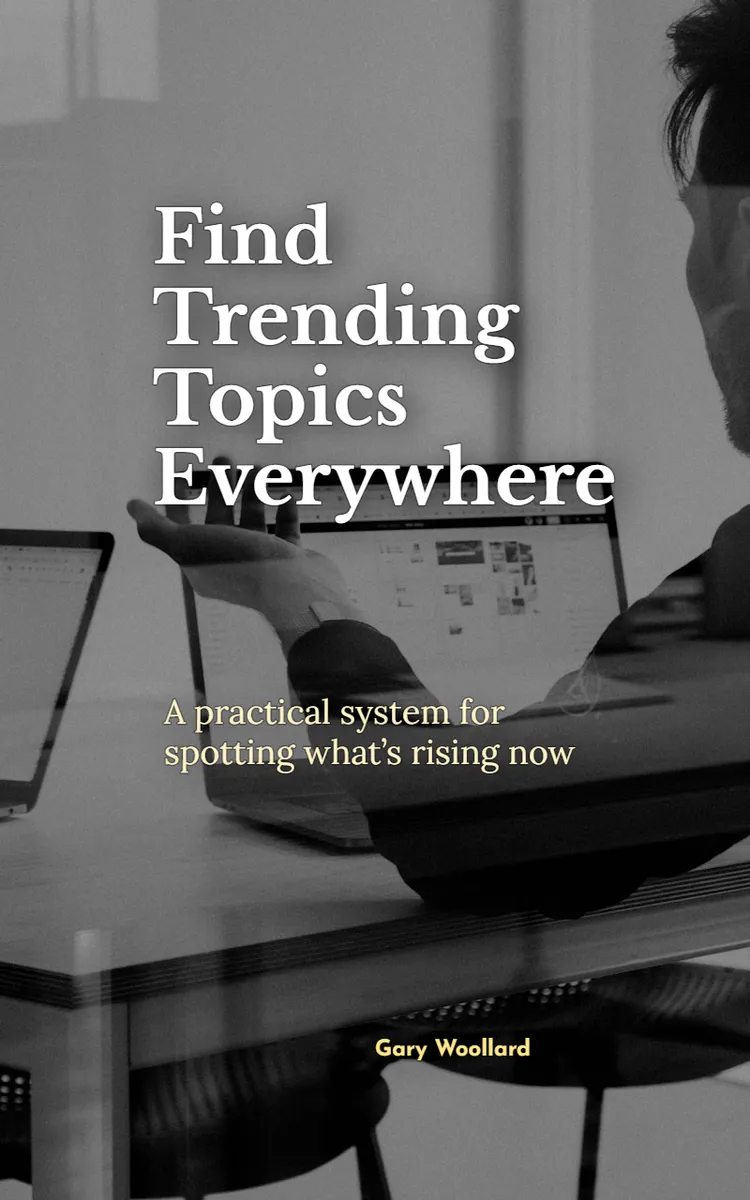
Read the first chapter
The whole of chapter one, free. About 10 min. Turn the pages with the arrows, your keyboard, or a swipe.
Chapter 1
Audience Signal Map for Trends
Audience Signal Map That Turns “What People Want” Into Trend Targets
Have you ever posted something that you thought would land, only to watch it stall while unrelated posts took off? The missing piece is usually not your content - it’s the signal you used to decide what to make.
Before you scan Facebook, Instagram, X, Pinterest, YouTube, TikTok, or Reddit for “trending” topics, you want a fast map of audience intent and niche keywords that tells you where attention is likely to move next. Talia, 34, runs social for a mid-market brand and sees the same pattern every cycle: when she starts with follower intent (what people are trying to do right now) and pairs it with niche keywords (what they already use), her trend hunts become sharper. When she skips that step, her platform scan turns into a list of hashtags and “viral” sounds that don’t match her audience’s actual job-to-be-done.
That’s what this chapter is for: turning follower intent and niche keywords into a Signal-to-Content Matrix you can build in one sitting, then using it to decide which trends are worth your posting time - and which ones are just noise. Your business goal here isn’t “more reach.” It’s more useful reach that feeds awareness without wasting conversion-ready traffic.
Key Stats - Users discover brands on social at scale: In 2024, social media accounted for a major share of product discovery journeys across many consumer categories (often the first or second touchpoint). - Trend latency is brutal: most “viral” waves peak in days, not weeks, which makes early signal mapping a competitive advantage. - Keyword intent beats hashtag guessing: searches and on-platform queries tied to intent (“how to…”, “best…”, “near me…”) correlate more strongly with engagement than broad topic tags. - Creators who publish with intent get more repeatable wins: consistent audience fit typically outperforms one-off trend chasing.
---
Building a Signal-to-Content Matrix from Follower Intent + Niche Keywords
You’re going to build a Signal-to-Content Matrix that works like a bridge between what your audience is already asking for and what platforms will likely amplify next. The differentiator is that you’re not starting with “What’s trending?” You’re starting with “What are followers trying to accomplish, and what words do they use when they ask for it?”
Step 1: Write Intent Signals in Plain Language (Not Topics) Start by capturing 6-12 “intent signals” from your own comments, DMs, email subject lines, and support tickets. These should sound like something a follower would type when they’re stuck.
For example, instead of “fitness trends,” you want intents like: - “I need a beginner plan that doesn’t waste my time.” - “I’m overwhelmed by conflicting advice.” - “I want quick meals that fit my schedule.”
If you do this right, you already have your awareness-versus-conversion split baked in: some intents are education-first (“how do I…”, “what is…”), and others are purchase/decision-adjacent (“best…”, “compare…”, “where to buy…”, “near me…”).
Step 2: Attach Niche Keywords That Match How People Search On-Platform Now take each intent and attach niche keywords that your audience actually uses. This is where you avoid the common mistake of using only broad category words. If your intent is “beginner plan,” your niche keywords might include: - “beginner routine” - “weekly workout plan” - “training schedule” - “progressive overload for beginners” (if your audience is slightly more advanced)
You’ll use these keywords later as filters while scanning platforms. The point is to pre-load your “signal filters” so you don’t waste time on trends that don’t map to your intent.
Step 3: Score Signal Strength Using 3 Inputs (What You Can See Fast) Assign each intent-keyword pair a quick score from 1-5 using: 1) Current relevance (are you seeing it in inbound messages this month?) 2) Keyword specificity (does it describe a concrete need or just a theme?) 3) Actionability (can you create a post that would help someone do something in the next 24 hours?)
This gives you a prioritized matrix, not a vibe.
Step 4: Convert Matrix Cells Into Content Types (So You Match Funnel Stages) Here’s the part most teams miss: if you map intent but don’t translate it into funnel stage content, you’ll still post randomly. Your Signal-to-Content Matrix should output content types that match awareness vs conversion.
Use this rule of thumb: - Awareness posts answer the “what/why” inside the intent. - Consideration posts compare options, share frameworks, or show “here’s what works.” - Conversion posts remove friction: pricing clarity, offer boundaries, proof, and “how to start.”
Talia uses a simple structure: each week she chooses 2 intent signals for awareness, 1 for consideration, and 1 for conversion. That rhythm keeps her trend usage from hijacking the calendar.
Concrete Example: Caption Formula Built From a Matrix Cell Let’s say one intent signal is: “I need a beginner plan that doesn’t waste my time,” and a niche keyword is “weekly workout plan.”
Use a caption formula tied to funnel stage:
Awareness caption template (90-120 words max): 1) One-line empathy: “If you’re trying to start but every plan feels too complicated…” 2) Define the outcome: “A weekly workout plan should tell you exactly what to do on each day.” 3) Mini-framework: 3 bullets describing structure (not the whole plan). 4) Bridge to trend: “Right now, people are arguing about X - here’s how to pick the version that fits beginners.” 5) CTA that matches awareness: “Comment ‘PLAN’ and I’ll send the starter outline.”
You’re not referencing a viral trend for its own sake. You’re using the trend as a context hook for the intent your followers already have.
Content Calendar Sample (Built From Your Matrix, Not Platform Noise)
| Day | Content Type | Topic/Hook | Format | |---|---|---|---| | Mon | Awareness | “Stop wasting time: what a beginner weekly plan should include” | Carousel + 1 min Reel cut | | Wed | Consideration | “Beginner plans: 3 approaches and when each one works” | Short video + comparison caption | | Fri | Conversion | “Ready to start? Here’s what you get in week one” | Offer post with proof screenshot | | Sun | Awareness | “The trend you’ve seen: why it confuses beginners (and the fix)” | TikTok-style video + pinned comment |
Rationale: this schedule keeps your trend-related posts anchored to intent, while your “always-on” posts handle education and decision momentum.
---
Scanning Platforms Using Your Matrix as a Filter (So Trends Don’t Drift)
Once the Signal-to-Content Matrix exists, platform scanning becomes fast and disciplined. Instead of asking “what’s trending?” you ask “which trends are being discussed in the same intent-keyword lane?”
Approach 1: Map Each Matrix Cell to Platform Search Signals On each platform, you’ll look for conversation clusters that match your niche keywords and intent phrasing.
• X: search niche keywords plus intent modifiers like “best,” “beginner,” “workout plan,” “worth it,” or “mistakes.” - Reddit: search subreddits aligned with your niche keywords and read top threads for the exact language people use when they’re asking for help. - YouTube: search keywords and check which videos are gaining views recently, then read the titles and comments for “I tried X…” intent.
Rationale: platform-native search surfaces intent language even when the platform isn’t “trending” in the generic sense.
Approach 2: Use “Follower Intent Hooks” Inside Trend Formats When you find a trend format (a sound, a template, a challenge, a recurring series), you don’t adopt it blindly. You swap the on-screen framing to your matrix intent.
Example: if TikTok is pushing a “before/after” style, your matrix might tell you that your audience’s intent is “I’m overwhelmed by conflicting advice.” Your “before/after” becomes: - before: confusion and scattered info - after: a simple decision rule (“If you’re a beginner, pick plans with X structure”)
Rationale: formats get attention; intent earns trust.
Approach 3: Build a Weekly “Trend-to-Intent Fit” List Before Posting Create a short list of 10-20 candidate trends, but each entry must include: - which intent signal it matches - the niche keyword you used to find it - the funnel stage it supports
You can keep this in a simple spreadsheet. Talia uses one column for “Intent match” and one for “Funnel stage.” If a trend can’t fill both, it doesn’t go on the posting list.
Rationale: this prevents your calendar from becoming a collection of “cool posts” that don’t move the business.
Approach 4: Use Pinterest for “Future Intent” Instead of Immediate Virality Pinterest often behaves like a search engine with long tail demand. If your matrix includes purchase-adjacent intents (“best,” “buy,” “near me,” “templates”), Pinterest can show you what’s likely to be relevant beyond the next few days.
Practical move: search niche keywords on Pinterest and check which pins are getting repins and saves - not just views.
Rationale: you’re aligning your matrix with a platform that rewards planning and discovery.
Approach 5: Turn YouTube Shorts and TikTok into “Proof-of-Intent” Loops If your intent signals are real, you can test them quickly with Shorts/Reels. Post a tight video that matches one matrix cell and ends with a question that reflects the intent.
Example closing line: - “Are you looking for a beginner plan, or are you past that stage?” - “What’s your biggest blocker right now: time, confusion, or consistency?”
Rationale: comments become new intent data you can feed back into your next matrix build.
---
Measuring Signal Quality (So You Know the Matrix Is Working)
Your goal with this chapter’s work isn’t just “more engagement.” It’s better alignment between intent and content, which shows up in repeatable metrics: saves, qualified comments, click-through to the next step, and conversion actions.
Here are the metrics that actually tell you your Signal-to-Content Matrix is doing its job:
| Metric | What It Measures | Target Benchmark | Tool to Track | |---|---|---|---| | Save Rate (or Saves per Reach) | How often people keep the post for later (intent match) | 2-5% saves per reach on feed content; higher on tutorials | Native analytics (IG/Pinterest), Sprout/Metricool if connected | | Qualified Comment Rate | Comments that indicate intent (questions, “how do I…”, “which option…”) | 15-30% of comments are intent-labeled | Manual tagging in a spreadsheet + native comment view | | CTR to Next Step | Whether viewers take the next action (link click, profile visit, “learn more”) | 1-3% for non-brand posts; varies by offer | Platform links analytics, UTM in link tools | | Conversion Action Rate | Purchases/bookings/leads tied to the post or campaign | 0.5-2% of engaged visitors (offer-dependent) | Pixel + CRM attribution, native lead tools |
The single most important metric here is Save Rate (or Saves per Reach) because it’s the fastest “intent confirmation” you can get before you even see conversion. Shares and likes can be lazy reactions; saves usually mean “this helps me later,” which is exactly what intent-driven content should earn.
Two common measurement mistakes to avoid. First, comparing save performance across different content types without separating formats (carousels vs single image vs video). Second, tracking CTR without using consistent next steps; if every post points to a different landing page, your matrix can look “bad” even when it’s doing fine - your measurement just can’t tell. Talia solved this by standardizing her CTAs for each funnel stage for at least 4 weeks, so she could trust the read.
---
This Week to Ongoing: Build, Validate, and Keep the Matrix Alive
Sequencing matters because you want your next scan to be smarter than your last one. If you keep building matrices after you already posted, you’ll always be reacting late.
This Week: - [ ] Build a Signal-to-Content Matrix with 6-12 intent-keyword pairs, scored 1-5, and assign funnel stages to each - [ ] Post 3 pieces mapped to the top 1-2 awareness intents and the top consideration intent, then track saves and qualified comments
This Month: - [ ] Run one “trend format test” per intent (same intent framing, different format) and compare Save Rate and CTR - [ ] Update your matrix based on which intent signals produced qualified comments (add 2 new phrases you see)
Ongoing: - [ ] Weekly: keep a 10-20 “trend-to-intent fit” list and remove anything that doesn’t match an intent-keyword lane - [ ] Monthly: rebuild the bottom 3 scoring intent pairs (either refine keywords or drop them)
Use tools that minimize friction: a spreadsheet for the matrix, native platform analytics for saves and engagement, and a link tracker (UTMs) for CTR so you can separate “people liked it” from “people acted.” If you run lead-gen or ecommerce, connect your conversion tracking early so you don’t guess.
Quick Win: Create one matrix cell today (intent + niche keywords + funnel stage) and use it to write a caption or script before you open any platform search.
End of chapter one. 7 more chapters in the full book.
Swipe or use the arrows to turn the page
What's inside: 8 chapters
- 1. Audience Signal Map for Trends
- 2. Instagram Reels Trend Radar
- 3. TikTok For-You Topic Mining
- 4. YouTube Search and Shorts Forecast
- 5. X Hashtag and Reply Velocity
- 6. Pinterest Keyword Demand Decoder
- 7. Reddit Community Trend Validation
- 8. Paid Amplification for Winning Topics
About this book
"Find Trending Topics Everywhere" is a social media book by Gary Woollard with 8 chapters and approximately 15,997 words. Methods to discover trending topics across major social platforms.
This book was created using Inkfluence AI, an AI-powered book generation platform that helps authors write, design, and publish complete books. It was made with the AI Social Media Strategy Generator.
Frequently Asked Questions
What is "Find Trending Topics Everywhere" about?
Methods to discover trending topics across major social platforms
How many chapters are in "Find Trending Topics Everywhere"?
The book contains 8 chapters and approximately 15,997 words. Topics covered include Audience Signal Map for Trends, Instagram Reels Trend Radar, TikTok For-You Topic Mining, YouTube Search and Shorts Forecast, and more.
Who wrote "Find Trending Topics Everywhere"?
This book was written by Gary Woollard and created using Inkfluence AI, an AI book generation platform that helps authors write, design, and publish books.
How can I create a similar social media book?
You can create your own social media book using Inkfluence AI. Describe your idea, choose your style, and the AI writes the full book for you. It's free to start.
Write your own social media book with AI
Describe your idea and Inkfluence writes the whole thing. Free to start.
Start writingCreated with Inkfluence AI


