
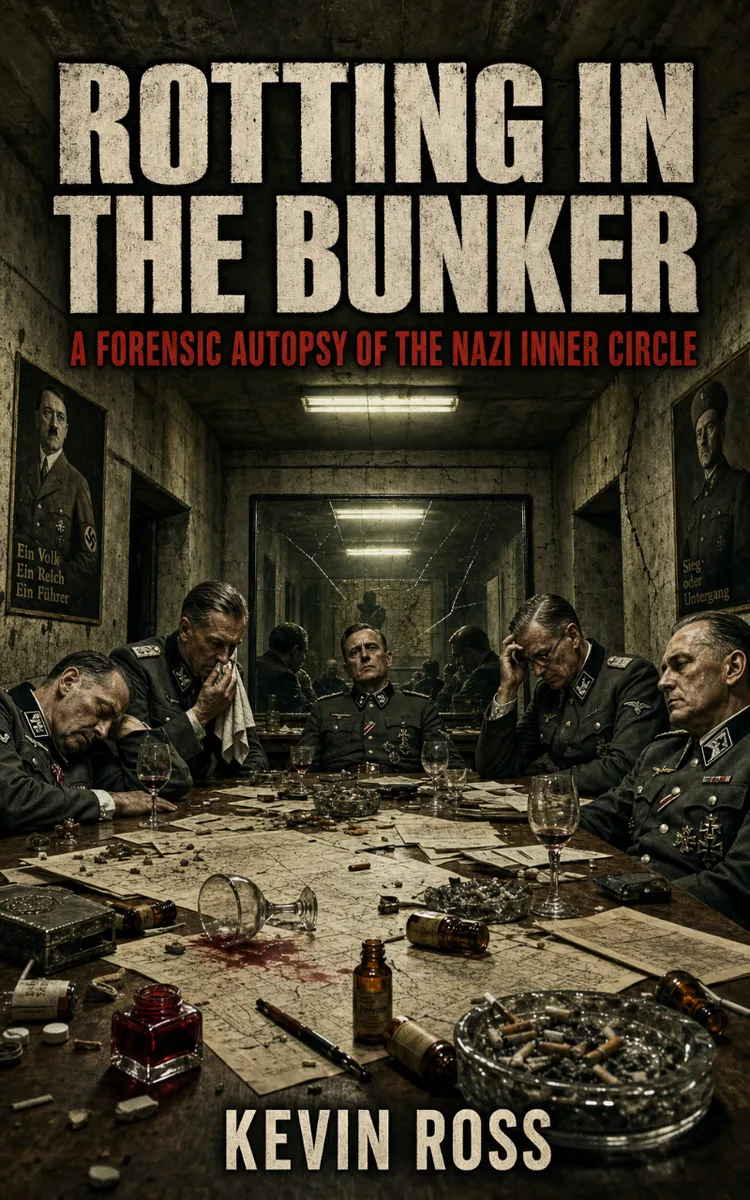
ROTTING IN THE BUNKER: Ego, Madness, and the Men Who Wore Hitler's Empire Like a Costume
Created with Inkfluence AI
Table of Contents
- 1. Chapter 1
- 2. Chapter 2
- 3. Chapter 3
- 4. Chapter 4
- 5. Chapter 5
- 6. Chapter 6
- 7. Chapter 7
- 8. Chapter 8
- 9. Chapter 9
- 10. Chapter 10
- 11. Chapter 11
Preview: Chapter 1
A short excerpt from “Chapter 1”. The full book contains 11 chapters and 39,654 words.
The Costume Party: How Men of Catastrophic Mediocrity Dressed Themselves in a Thousand-Year EmpireThere is a photograph taken at Carinhall in the summer of 1940 that tells you almost everything you need to know about the men who ran the Third Reich, provided you know how to read it. Hermann Göring stands at the center of the frame in a white uniform of his own design - not the white of military dress whites, which carry their own specific grammar of formality, but a theatrical, operatic white, the white of a man who has decided that the existing vocabulary of military dress is insufficient to express the scale of his own importance. The uniform is adorned with a jeweled field marshal's baton that Göring had also designed himself, because the standard-issue field marshal's baton was, apparently, not jeweled enough. He is smiling. He is always smiling in these photographs, with the wide, unguarded smile of a man who genuinely cannot imagine that the spectacle he is presenting might read, to anyone capable of clear sight, as grotesque.
The visiting officers in that photograph are not smiling in quite the same way.
Carinhall sat in the Schorfheide forest north of Berlin, roughly sixty miles from the capital, and it was less a house than a declaration of psychological need rendered in timber and stone. Göring had named it after his first wife, Carin, who had died in 1931, and had built it, rebuilt it, and expanded it in successive waves of construction throughout the 1930s until it occupied a scale that strained the vocabulary of domestic architecture. The great hall ran to Norse-hall proportions - beamed ceilings, a fireplace you could park a staff car in, walls hung with paintings whose provenance would eventually require an international restitution commission to untangle. There were Rembrandts and Vermeers, acquired through the particular purchasing power available to a man who controlled access to most of occupied Europe's art market. There were antlers. There were many antlers. Göring was a passionate hunter, and Carinhall's interior reflected this with an emphasis that crossed the line from enthusiast into something that a forensic psychologist might find professionally interesting.
On the morning in question - a meeting with senior Luftwaffe officers in the autumn of 1940, documented in the diary of one attendee and corroborated by at least two others - Göring received his guests in a pale blue uniform, custom-dyed in a shade that existed nowhere in the official Wehrmacht color palette because it had been invented specifically for him. By eleven o'clock, he had disappeared briefly and returned in the white. By noon, when the working lunch was served on china bearing his personal monogram, he was wearing something that several witnesses independently described as resembling a medieval hunting costume - a belted tunic in forest green, high boots, a short cape. He had changed three times before the first course was cleared.
The officers ate their lunch and said nothing. This was the correct response. One of them wrote in his diary that evening that the morning had resembled "attending a costume ball hosted by a man who had forgotten to tell the guests it was fancy dress." Another, years later in his published memoirs, recalled thinking that Göring looked "like a circus ringmaster who had been given command of an air force." Count Galeazzo Ciano, Mussolini's foreign minister, who visited Carinhall on a separate occasion, used a phrase that is perhaps the most precise: he wrote that Göring entered the room "like a high-grade prostitute on her way to an important engagement." Ciano meant it as a class insult. But the metaphor is more forensically useful than he intended, because what he was observing was the specific quality of a man whose identity was entirely externally constructed, who required the costume to feel real, who changed uniforms the way an anxious actor checks a mirror - not out of vanity alone, but out of the terror of being caught without a character to play.
Göring employed a personal tailor on Wehrmacht payroll. This is documented. The tailor's name was Georg Kurz, and his position was listed in the Luftwaffe's administrative records as a kind of aide-de-camp for "special uniform requirements," which is a bureaucratic formulation whose euphemistic elegance deserves a moment of appreciation. Kurz traveled with Göring on official state visits. He was present at Carinhall for extended periods. His work was ongoing, because Göring's uniform requirements were ongoing, because Göring was a man for whom the question of how he presented himself to the world was never settled, never completed, never satisfactory - always one more alteration away from expressing whatever it was he needed it to express.
What did the uniform express? Power, obviously. Status....
About this book
"ROTTING IN THE BUNKER: Ego, Madness, and the Men Who Wore Hitler's Empire Like a Costume" is a general book by Kevin Ross with 11 chapters and approximately 39,654 words. It covers key insights and practical takeaways on the topic.
This book was created using Inkfluence AI, an AI-powered book generation platform that helps authors write, design, and publish complete books.
Frequently Asked Questions
What is "ROTTING IN THE BUNKER: Ego, Madness, and the Men Who Wore Hitler's Empire Like a Costume" about?
"ROTTING IN THE BUNKER: Ego, Madness, and the Men Who Wore Hitler's Empire Like a Costume" is a general book by Kevin Ross covering key insights and practical takeaways on the topic.
How many chapters are in "ROTTING IN THE BUNKER: Ego, Madness, and the Men Who Wore Hitler's Empire Like a Costume"?
The book contains 11 chapters and approximately 39,654 words. Topics covered include Chapter 1, Chapter 2, Chapter 3, Chapter 4, and more.
Who wrote "ROTTING IN THE BUNKER: Ego, Madness, and the Men Who Wore Hitler's Empire Like a Costume"?
This book was written by Kevin Ross and created using Inkfluence AI, an AI book generation platform that helps authors write, design, and publish books.
Write your own book with AI
Describe your idea and Inkfluence writes the whole thing. Free to start.
Start writingCreated with Inkfluence AI


