
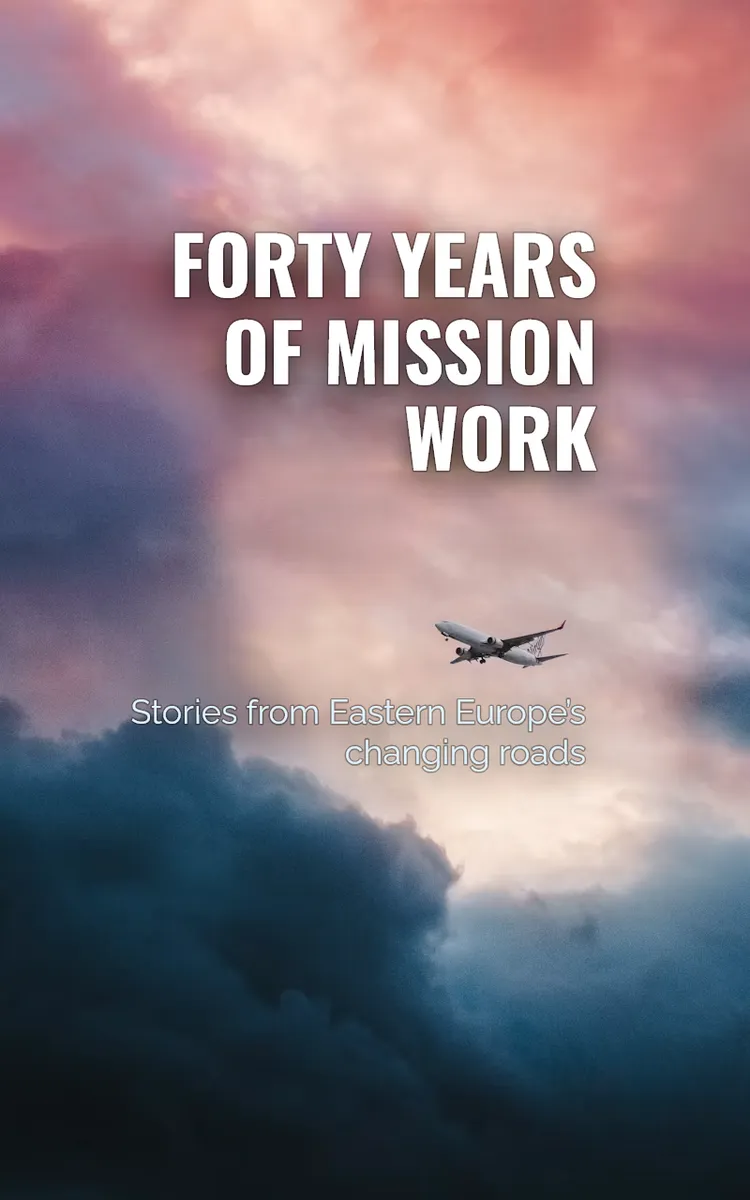
Read the first chapter
The whole of chapter one, free. About 12 min. Turn the pages with the arrows, your keyboard, or a swipe.
Chapter 1
Arriving in Eastern Europe Mission Field
The first sound that reached me after the border was not the officer’s voice but the rumble of trucks idling behind the concrete barriers, engines coughing into the cold air. My fingers had gone stiff around my passport in the queue, and the paper felt suddenly too thin for what it was meant to protect. When I finally stepped into the transit hub, the ceiling seemed low and the windows were filmed with condensation. People moved with purposeful slowness, coats pulled tight, eyes trained on exits and clocks. Even the vending machines gave off a tired hum, as if they had learned not to hope.
I was twenty-something then, newly arrived in a border city that served as a corridor for everyone - workers, travelers, men with suitcases that looked too heavy for their smiles. I had come with careful intentions and a borrowed address written in pencil that smudged every time I touched it. The plan was simple on paper: find a stable local presence, establish a workable route for ministry, and begin serving people without putting anyone in unnecessary danger. In my mind, I could already see the faces I wanted to meet and the places where we might gather. In my body, all I felt was the ache of standing too long, the dryness of my throat from speaking too softly, and the persistent awareness that my name was a small piece of information that could be used to open or close doors.
At the information booth, a woman in a dark uniform watched me as I asked about bus schedules. Her gaze stayed on my mouth when I spoke, as if she expected my accent to give me away. “Which apartment block?” she asked, not about the bus at all. I gave the number I had been told to use, and her pen paused over a form. The ink scratched once, then moved again. When she handed me a small paper ticket, the edge was damp, and I noticed her nails were bitten down to the quick. She did not smile, but she also did not refuse me.
Outside, the air smelled of wet stone and diesel. I walked past the depot offices and the chain-link fencing where notices curled at the corners. A notice in thick black letters reminded everyone of registration requirements, and another one - smaller, tucked beneath - listed hours for documentation services. I stood there long enough to feel my confidence drain, then folded the papers into my coat pocket as if hiding them could keep them from becoming real.
In the apartment blocks nearby, corridors echoed with footsteps that belonged to other people’s lives. I found the building by the landmarks I had memorized during the journey - an iron stairwell painted the color of old tea, a broken window above the entryway, a tree whose branches scraped the balconies. When I knocked, the sound traveled too loudly, a sharp knock in a place built to carry secrets. A man opened the door only a crack. He looked at me the way you look at a package you’re not sure you ordered.
“You’re Elena?” he asked.
“Yes,” I answered, keeping my voice steady. I introduced myself with the name on the paperwork, the one I could say without thinking. His eyes moved over my coat, my hands, the small bag at my feet. Behind him, I heard a television playing low, a commentator’s voice flattening the room into something ordinary.
He studied my face for a moment longer than politeness required. “Come in,” he said, and the door swung open just enough to let me pass. The hallway smelled of boiled cabbage and dust. A radiator ticked as it warmed, and the floor under my shoes was cold, gritty with old grit.
The apartment itself was spare - two rooms, a kitchen with a sink stained from years of use, and a table with a cloth that had been washed and rewashed until it felt thin. A woman sat by the window, her hands folded on her lap. She did not rise when I entered. When I offered my thanks, she nodded once, as if she had practiced that movement.
“You should sit,” she said. “You’re tired.”
“I’m all right,” I replied, though my legs were weak and my stomach tightened at every distant sound outside the walls. I had learned the hard way that fatigue could be read as vulnerability. I set my bag down carefully, listening for the building’s noises - the scrape of someone in the next apartment, the clatter of keys, the soft thud of a door closing too slowly.
We spoke in low tones. I asked after stable contacts, after a place where people could meet without drawing immediate attention. I asked about neighborhood patterns - where people were more likely to notice strangers, where authorities seemed to linger, which streets were watched more closely. My questions sounded harmless, but I felt every word I spoke settle into the air like a weight.
The man rubbed his forehead. “You came at a time when everyone is watching everyone,” he said. His voice carried a tired bitterness, the kind that comes from being disappointed too many times. The woman’s gaze remained steady, her eyes measuring my reaction.
“I don’t want trouble,” I said, and meant it so deeply that it frightened me. “I want to serve.”
She shifted slightly, and I heard the fabric of her skirt whisper against her chair. “Serving is not the problem,” she answered. “Serving tells others you believe something. And belief has paperwork.”
I did not understand at first how closely they spoke to each other about invisible realities. I thought they were warning me in general terms, but their words kept returning to specific names of offices and officials, as if they had memorized patterns of power the way other people memorized hymns. When I asked who handled documentation in this city, the man leaned forward and lowered his voice further.
“Some officials are strict because they can be,” he said. “Others are strict because they are afraid. Either way, you don’t see their fear until it comes with a stamp.”
He mentioned neighborhoods and streets as if he had walked them for years, as if each corner had taught him what kind of attention it attracted. The woman added small details - how certain buildings had a habit of reporting strangers, how a neighborhood’s reputation could spread faster than truth. She did not speak about religion directly, but I recognized the caution behind her words. Even without naming it, she was telling me where our work would be tolerated and where it would be treated as a threat.
When I asked about meeting places, I expected a list of options. Instead, they offered a single suggestion, spoken carefully, as if it were a fragile object. A small room connected to a community center, they said, had a reliable rhythm - classes, small gatherings, ordinary conversations. But the center’s administrator, they warned, had recently started requesting more information about attendees. “He is not openly hostile,” the man said. “He is just careful. And careful people can become tools.”
I held onto that word - tools - because it explained more than their tone ever could. In that moment, I realized that my desire to be useful would not automatically protect me. My sincerity could be used against me. The very effort to serve could become evidence.
I spent the next day moving through the city with a kind of deliberate humility. I bought bread from a shop where the cashier watched my hands more than my face. I asked about the community center in a roundabout way, letting my questions sound like those of an ordinary newcomer looking for civic information. I studied the transit hub again, not for schedules but for patterns - the direction people walked when they saw uniforms, the pauses that happened when someone’s name was called.
At midday, I sat on a bench near a row of apartment blocks and watched a family carry groceries up the stairs. A man in a gray coat lingered near the entryway, his posture too relaxed to be random. Every few minutes, he glanced toward the street, then toward the building’s door. I watched him long enough to feel the muscles in my jaw tighten.
When I stood to move on, my coat caught on a rough patch of the bench. The fabric tugged, and for a moment I felt the same sensation I had felt crossing the border - the reminder that small things could betray you. The man in gray shifted his weight as if he had felt me look. I looked away first, because I had learned that confidence could be mistaken for recklessness.
By evening, my borrowed address had turned into a careful route. I returned to the apartment and found the woman at the table with a stack of forms. She did not tell me she had prepared them. She simply slid one toward me, and I saw that the paperwork wasn’t for me to fill out. It was for her - an attempt to stay registered properly, to show conformity through the language the authorities understood. There were dates and stamps, the kind of evidence that could keep a door open.
“Tomorrow,” she said, “you will meet someone. Not for long. Not in the open. If you ask questions too loudly, you will close your own path.”
I nodded. “Who will it be?”
She hesitated, and in that hesitation I felt the weight of her caution. “A person who knows the office staff,” she answered. “A person who has learned what not to ask.”
The man added, “And you must be careful what you bring. They notice objects as much as people.”
I had expected to feel grateful for the opportunity. Instead, I felt a tightening in my chest, the uncomfortable realization that our first steps would be shaped less by spiritual urgency and more by surveillance and bureaucracy. I had come believing that if I worked diligently enough, doors would open. Now I was beginning to see that doors were already mapped - some locked from the outside, others locked from within.
The next morning, we made ourselves ordinary. I wore the same coat, carried the same small bag, and kept my eyes on the ground when we walked past a building with a notice board crowded by announcements. At the transit hub, the air carried the sharp smell of car exhaust and wet wool. People lined up where they were told, and their faces were set in the expressions of those who had learned that asking too many questions could lead to delays.
The meeting itself took place in a nearby room that smelled faintly of disinfectant, the kind used to wipe down surfaces that were meant to look clean. A desk sat by the window; a chair creaked when someone shifted their weight. The person who came to us - someone I had been told about but never met - kept their hands folded and their voice careful.
“You want a place,” they said, as if reading my purpose from my posture. “You want a route. You want people to feel safe.”
“Yes,” I answered, though I felt my throat tighten. “We want to serve.”
They nodded once. “Then you need to know which places become problems. It’s not only the officials who watch. It’s the neighbors. It’s the clerk who gets bored. It’s the person who thinks reporting is a way to be helpful.”
I listened, absorbing the details the way I had once absorbed Scripture - slowly, with respect, aware that each word could carry consequences. The person spoke about which offices had recently increased checks, which neighborhoods produced more complaints, which streets had a history of being singled out. They did not name every official, but they described the patterns: where documents were scrutinized, where permission was required for gatherings that looked harmless to outsiders, where one misunderstanding could lead to a sudden inspection.
When I asked about the community center the woman had mentioned, I saw the person’s eyes shift, just slightly. Their answer came with a careful neutrality.
“That place can work,” they said, “but it will change. If you use it now, you will need to do it in a way that looks like everyone else’s normal life. You cannot arrive with the expectation that the room belongs to you. It belongs to whoever can explain it.”
I now understand how quickly hope can become a liability. At the time, I wanted to argue, to insist that God’s work did not need permission. But I did not have the luxury of believing things that ignored reality. My mission had always been about serving people, not making myself the center of a confrontation.
After the meeting ended, we walked back through the apartment blocks. A cold wind pushed at the edges of the stairwell, and somewhere a radio played a song that sounded familiar only in fragments. The woman kept her gaze forward. The man spoke less than usual.
On the way, I noticed a new sign posted near a doorway - fresh paper, still crisp at the corners. It listed documentation rules and warned about unauthorized gatherings. I stopped long enough to read it, and the ink seemed darker than the older notices nearby, as if someone had taken special care to make it visible.
“Is this because of us?” I asked, and the question came out sharper than I intended.
The man did not answer immediately. He looked at the sign as if it were a living thing. “It’s because of what they fear,” he said finally. “And they fear what they can’t control.”
I swallowed, tasting metal from my own nerves. We reached the apartment, and before I could sit down, the woman began to gather her forms again, moving with practiced urgency. There was no panic in her movements, only the determination of someone who had learned to respond fast enough to prevent worse outcomes.
“They will ask for more paperwork,” she said. “Not today. Soon.”
I stared at the table, at the thin cloth and the faint stain near the edge. “Then how can we meet safely?” I asked.
“We will meet,” she answered. “But not the way we first thought.”
Something shifted in me then. I had arrived searching for stable contacts and a workable route for ministry, believing that once I found the right people and places, the work would settle into a rhythm. That belief had been a kind of comfort, a hope that the world would cooperate with sincerity. Now I understood that stability in that city would not come from wishful planning. It would come from learning which officials were most restrictive, which neighborhoods carried the most risk, and how quickly monitoring could turn a permitted gathering into a revoked one.
That evening, as the radiator ticked and the television murmured from the next room, I sat quietly and sorted my thoughts by what could be trusted. I could not control surveillance. I could not erase bureaucratic barriers. What I could do was adjust - carefully, consistently, with respect for the reality around us.
When I finally closed my eyes, I did not feel defeated. I felt chastened. The first meeting point had been secured, a fragile opening in a city that watched closely, but the paperwork and monitoring were already pressing forward like a tide. We had taken the step I came for, and the price was immediate: our first plans could be shut down, not because anyone denied the need, but because the system demanded proof and the neighbors demanded compliance. I had wanted to begin serving people safely, and in the same breath I had learned that safety would require constant attention, not only to the heart of the work, but to the corners of the city where decisions were made.
End of chapter one. 4 more chapters and about 14,701 words in the full book.
Swipe or use the arrows to turn the page
What's inside: 5 chapters
- 1. Arriving in Eastern Europe Mission Field
- 2. Choosing Faithful Service Over Safety
- 3. Tracing Lost Contacts Through Church Records
- 4. Rebuilding After a Raid on the Meeting
- 5. Training a New Generation of Volunteers
About this book
"Forty Years Of Mission Work" is a biography book by Anonymous with 5 chapters and approximately 14,701 words. A memoir of decades of mission work in Eastern Europe.
This book was created using Inkfluence AI, an AI-powered book generation platform that helps authors write, design, and publish complete books. It was made with the AI Biography Writer.
Frequently Asked Questions
What is "Forty Years Of Mission Work" about?
A memoir of decades of mission work in Eastern Europe
How many chapters are in "Forty Years Of Mission Work"?
The book contains 5 chapters and approximately 14,701 words. Topics covered include Arriving in Eastern Europe Mission Field, Choosing Faithful Service Over Safety, Tracing Lost Contacts Through Church Records, Rebuilding After a Raid on the Meeting, and more.
Who wrote "Forty Years Of Mission Work"?
This book was written by Anonymous and created using Inkfluence AI, an AI book generation platform that helps authors write, design, and publish books.
How can I create a similar biography book?
You can create your own biography book using Inkfluence AI. Describe your idea, choose your style, and the AI writes the full book for you. It's free to start.
Write your own biography book with AI
Describe your idea and Inkfluence writes the whole thing. Free to start.
Start writingCreated with Inkfluence AI


