
Read the first chapter
The whole of chapter one, free. About 19 min. Turn the pages with the arrows, your keyboard, or a swipe.
Chapter 1
Selecting IGAs for Each Community
Why Community Fit Matters Before Choosing an IGA
Could a community sell the product it wants to make, with the tools, skills, and money it already has? That question prevents many costly mistakes. An income-generating activity (IGA) may look profitable in another place but fail locally because customers do not want it, raw materials cost too much, skilled workers are unavailable, or the activity does not match the community’s daily responsibilities.
Choosing an IGA means matching four things: the community’s real needs, available resources, existing skills, and market demand. A good choice helps members start at a manageable level, use what they already know, and sell to customers who can pay. A poor choice can tie up scarce cash in equipment or stock that remains unsold. The Community Fit Checklist gives field staff a practical way to compare options before training or investment begins.
After using the checklist, you should be able to guide a community from a broad list of ideas to one or two workable choices. You will know what questions to ask, what information to verify, and when to reject an attractive idea. The immediate result should be a clear reason for selecting an IGA - not simply a preference for a familiar activity.
Use the Community Fit Checklist
Start by gathering the community in a practical discussion. Ask members to name activities they already do, products people buy, resources found nearby, and skills available within the group. Record each idea without promising support. The purpose at this stage is to see the full range of possibilities before the group chooses.
Then apply the Community Fit Checklist to every serious option. Check the following areas in order:
• Need: Define the real need the IGA should address. Ask what income problem the activity will help solve, who needs the income, and how regularly members need cash. A seasonal activity may not suit households that need weekly income. The group should state the need in clear terms, such as “members need a reliable source of income during the months when farm work is limited.”
• Resources: List the resources required and compare them with what the community can access. Include land, water, workspace, raw materials, transport, electricity, tools, and starting cash. An activity that depends on a machine available only in a distant town may carry higher costs and delays. Check availability, price, and reliability rather than assuming that a resource exists.
• Skills: Identify the skills members already have and the skills they can learn within a reasonable training period. Include production, buying, selling, record keeping, equipment care, and quality control. Existing skill reduces training time and helps the group avoid early mistakes. However, do not select an activity only because one person has experience; the group needs enough people to continue the work when that person is absent.
• Market demand: Confirm who will buy, what they will pay, how often they buy, and what quality they expect. Visit shops, markets, institutions, and potential customers. Ask sellers which products move quickly and which remain on shelves. A product has market demand only when real buyers show interest at a price that can leave income after costs.
• Risk and fit: Check whether the activity fits local conditions and group responsibilities. Consider theft, spoilage, drought, price changes, illness, transport problems, and competition. Also ask whether members can perform the work at the required time. An activity that needs daily attention may not fit a group whose members travel frequently or care for young children.
Use a simple comparison sheet to keep discussion focused. Give each option a mark from 1 to 3 for each area: 1 means weak fit, 2 means possible with changes, and 3 means strong fit. Do not treat the total as the final answer. Use the marks to identify questions that still need evidence. For example, poultry keeping may receive strong marks for local skills and demand but a weak mark for feed access. The group must solve the feed problem before selecting the activity.
Ask yourself after each option: “What evidence supports this choice?” A member’s belief that “people will buy it” is a starting point, not proof. Ask the group to name at least three likely buyers, identify the nearest competing seller, and check current prices. These actions turn discussion into a decision based on local conditions.
The practical takeaway is simple: select an IGA only when the need is clear, the resources are reachable, the skills are available or teachable, and buyers can be identified.
Apply the Checklist to a Local Choice
Consider a community comparing three options: making injera for nearby workers, raising chickens for egg sales, and producing woven baskets. The group has 12 members and can contribute 36,000 birr in total. Members report experience with cooking and poultry care, while only two members know basket weaving. The group must still check demand, costs, and working conditions before choosing.
Use the following steps during the assessment:
• List the need and income timing. The group decides that members need income every week, not only after a long production cycle. This makes regular sales important. The expected outcome is a clear income requirement against which each option can be tested.
• Check buyers directly. Members visit two tea shops, a construction site, three food sellers, and the weekly market. Two tea shops say they could buy 40 injera each morning if quality and delivery remain consistent. Four households ask about eggs, but local sellers already supply them. Market visitors show interest in baskets, but buyers want different sizes and negotiate strongly on price. The expected outcome is a buyer list with quantities, prices, and conditions.
• Check resources and operating costs. The group measures the available cooking space, checks water access, and confirms the price of teff and firewood. For poultry, members check the cost and availability of feed, vaccines, housing materials, and transport. For baskets, they check whether suitable grass is available nearby and whether members can obtain enough material during the dry season. The expected outcome is a short list of activities whose essential inputs can be obtained without long interruptions.
• Check skills and workload. Eight members can prepare injera, but only four can work early each morning. Six members have raised chickens, while two understand basic disease prevention. Two members can weave baskets, and the others would need training. The group compares the training needed with its need for weekly income. The expected outcome is a realistic work plan, not a skill list based only on interest.
• Estimate a small trial. Before using all 36,000 birr, the group tests injera sales for five mornings. It prepares 40 injera each day, sells each at 12 birr, and records flour, fuel, packaging, transport, and unsold products. If the group sells 190 of 200 injera and the remaining five-day sales cover all costs with money left for members, the trial supports further planning. If many remain unsold or fuel costs remove the expected income, the group changes the plan or rejects the option.
• Compare the evidence and decide. The group finds that injera has identifiable buyers and matches existing skills, but it needs reliable early-morning work and careful control of unsold food. Poultry has possible demand but requires regular feed and disease protection before sales begin. Basket making needs more training and has uncertain supply of raw material. The group selects injera for the first test period and keeps poultry as a later option only if it confirms feed supply and buyer demand.
The expected outcome is not merely a selected activity. It is a documented reason: the group chose injera because buyers gave specific quantities, members had relevant skills, inputs were available, and a five-day trial could test the main risks.
Quick checklist
• State the community’s income need and required timing.
• List the resources the activity needs.
• Confirm the price and availability of each essential input.
• Identify existing skills and training gaps.
• Speak directly with at least three possible buyers.
• Check competing sellers and current selling prices.
• Test the activity on a small scale before full investment.
• Record sales, costs, unsold goods, and customer comments.
• Reject or revise any option with an unresolved major risk.
• Write down why the final activity fits the community.
Use this process to keep the decision connected to evidence. A community should be able to explain its choice to every member using clear facts from the local area.
Avoid Weak Choices and Correct Them Early
Choosing what sounds profitable elsewhere
A product may sell well in another town but have few buyers locally. Field staff sometimes accept a proposal because members heard that another group earns from it. That information does not show local demand, input prices, or competition.
Do this: Ask members to visit local sellers and record buyer names, quantities, prices, and complaints. Run a small trial before purchasing major equipment.
Not this: Select an activity because another community reports success.
Starting with equipment instead of buyers
Groups may begin by requesting machines, buildings, or large stock before confirming who will purchase the output. This creates pressure to sell at any price and may leave the group with debt or unused equipment.
Do this: Confirm buyers and expected sales first. Then purchase only the tools and materials needed for the tested level of production.
Not this: Treat equipment ownership as proof that the IGA will earn income.
Ignoring the work schedule and hidden costs
An activity can appear profitable until the group counts transport, fuel, water, packaging, spoilage, repairs, and members’ time. Early-morning food production, for example, may fail when only two members can arrive on time. Poultry may fail when feed prices rise or members cannot provide daily care.
Do this: Write every regular task and cost on the plan. Assign each task to a named member or trained worker, and check whether the schedule fits real household responsibilities.
Not this: Count only the purchase price and expected selling price.
When a checklist result looks weak, do not force the activity forward. Change the product, reduce the starting size, find a different buyer, or return to another option. A careful choice protects the community’s limited resources and creates a stronger base for training, production, and sales. The right IGA begins with a close match between what people need, what they can do, what they can access, and what the market will buy.
Why adding a practical, numbered example matters here
Start with a clear test that proves whether an idea will turn into cash in your community. Field teams and community groups often pick IGAs based on hope or outside examples. A concrete example with real numbers forces the group to face costs, buyers, workload, and profit before spending money.
This section shows what a real small trial looks like: how to budget, how many units to produce, what to record each day, and how to decide from the trial whether to scale up. After reading, you will be able to run a short, low-cost pilot IGA, record sales and costs, and make a clear yes/no decision supported by numbers.
Takeaway: run a short, low-risk test with clear targets and a daily record sheet. If the test covers costs and leaves acceptable income, scale. If not, change the plan or choose another IGA.
The core technique: a step-by-step practical pilot with numbers
Run a "micro-trial" that answers three questions: will products sell at the expected price; can the group cover costs; and will members manage the schedule. Use these steps.
• Decide scale and length.
• Choose a short trial period (5 to 14 days). Short trials show demand quickly without tying up much cash.
• Pick an easily measurable daily output (for example, 40 injera, 50 eggs collected, 20 woven baskets).
• Calculate all costs before you start.
• List raw materials, labor (paid or valued), transport, fuel, packaging, and an allowance for unsold items. Use local prices. For example: teff flour 20 kg at 300 birr, fuel 100 birr for five days, transport 50 birr, packaging 20 birr.
• Set price per unit based on buyer checks.
• Speak to at least three buyers and confirm the price they will pay and how many they need per day. Use that price in your trial, not the price you hope to get.
• Record daily sales and costs.
• Use a simple sheet: Date / Units produced / Units sold / Selling price per unit / Total sales / Raw material cost / Fuel/transport cost / Unsold units / Notes on buyer feedback.
• Calculate simple profit and breakeven.
• Total sales minus total costs = trial profit. Divide profit by number of active members or by hours to test whether income meets the group’s need.
Why these steps work: they give exact numbers to discuss. They force the group to meet buyers, count real costs, and verify that members can produce at the necessary schedule.
Quick example boxes embedded in training are helpful: they show how one week of production at a known price becomes a decision, not a guess.
Reflection: Ask the group, “If this trial gives this profit per week, do you want to scale to X per week in two months?” If the answer is yes and the numbers match family needs, scale. If not, change the product or reduce equipment demands.
Realistic scenario: injera pilot with exact numbers and expected outcomes
A town near a construction site tests making injera for five mornings. The group has 12 members and decides to trial 40 injera per morning. They already confirmed two tea shops will buy up to 40 injera each morning at 12 birr each if delivered by 7:00 a.m.
• Set the trial details.
• Trial length: 5 mornings.
• Daily output: 40 injera.
• Agreed selling price: 12 birr per injera.
• Expected buyers: two tea shops that combined may buy 40; additional walk-in buyers are possible.
• Pre-trial cost estimate.
• Teff flour: 20 kg at 300 birr (enough for approx. 200 injera).
• Fuel (charcoal or firewood): 100 birr for five days.
• Transport: 50 birr for deliveries.
• Packaging and misc.: 20 birr.
• Labor: members agree to value their labor as unpaid for the trial but record hours for future costing.
• Total estimated trial cost = 470 birr.
• Daily targets and recording.
• Target daily sales = 40 injera × 12 birr = 480 birr.
• Over five days, target sales = 2,400 birr.
• Record daily produced, sold, unsold, buyer comments, and exact input use (how many kg teff used each day).
• Expected outcomes and simple calculations.
• If the group sells 190 of 200 injera (95% sold), actual sales = 190 × 12 = 2,280 birr.
• Subtract total costs 470 birr → trial profit = 1,810 birr.
• Per-member share (if split equally among 12) = 151 birr for the five-day trial, or about 30 birr per member per day.
• If members require 50 birr per member per day to justify continued work, this pilot shows income below target, so the group rechecks price, scale, or cost-saving options.
Quick checklist
• Confirm buyers and price in writing or by message.
• Calculate full trial costs using local prices.
• Produce a fixed number each day and record sales and unsold units.
• Add transport and fuel into daily records.
• Calculate trial profit and per-member income at the end.
Reflection prompt: If profit per member meets household expectations, plan a two-week expansion with named suppliers and a simple stock buffer. If not, hold a short meeting to decide whether to raise price, reduce cost, or switch activity.
Common mistakes and fixes when using a real-number pilot
Underestimating hidden costs
Hidden costs like extra water, broken equipment, or a longer delivery route erode profit. If you omit them, the trial shows false profit.
Do this: List every task and cost before you start. Assign a number to each (for example, water 20 birr, equipment repair contingency 50 birr). Include these in the trial budget.
Not this: Count only flour and fuel and ignore transport, unsold goods, or repair needs.
Counting everyone’s time as free
Treating member labor as free hides real sustainability problems. A product that pays well only if labor is unpaid will fail once you pay or members need different work.
Do this: During the pilot, record hours worked and calculate an hourly value. After the trial, divide profit by hours to see if the activity pays at a realistic wage.
Not this: Assume family labor costs nothing and scale up without checking household time commitments.
Trusting a single buyer without backup
A confirmed buyer may change their mind or buy less. Relying on only one buyer risks unsold stock.
Do this: Get commitments from at least two buyers or one buyer plus walk-in customers. During the trial, ask buyers for clear delivery days and times.
Not this: Start production based on a single verbal promise.
End with this practical thought: a pilot with numbers changes opinion into evidence. Use the trial to learn, not to prove yourself right. If the numbers work, you have a plan that funds training and modest equipment. If they do not, you have saved most of the group’s money and learned what to change.
Set the context: why selecting IGAs to fit Borana pastoralist life matters
Dry season, distant water points, and livestock movements shape daily life in Borana areas. If an income-generating activity (IGA) interrupts herd grazing, misses seasonal markets, or depends on inputs that vanish in drought, the activity will fail. Selecting IGAs that fit Borana rhythms protects household resilience and keeps communities mobile when they need to be.
This section helps field staff guide groups through decisions that respect pastoral schedules, communal resource rules, and seasonal buyer patterns. After reading, you will lead a community to pick an IGA that matches herd movements, rainy and dry seasons, women’s work windows, and available cash - so the chosen activity earns money without forcing families to abandon essential pastoral tasks.
Takeaway: match each IGA to the real-life calendar, work patterns, and resource access of Borana households before investing time or money.
Teach the core technique: five practical selection rules tuned to Borana pastoralists
Follow these five steps with the community. Each gives a concrete check that answers “Will this IGA survive Borana conditions?”
• Time-fit the activity to seasonal movement. Describe when household members migrate for pasture and water, then score whether the IGA needs daily presence. If the activity demands daily attention during migration months, mark it low. Example: a vegetable garden that requires daily watering rates low if families move for three months of the year.
• Match labor to gendered tasks and daily routines. Ask who will run the IGA each day and when. Women often water seedlings early or late; men may handle market travel after grazing. Example: making traditional butter (nono) can fit into milking schedules; basket weaving works in the dry season evenings.
• Check input continuity within 5 km or one market day. Walk or send a rider to the nearest market and count essential inputs available this month and next. If feed, seed, or packaging requires a three-day trip every week, include transport cost and time. Example: poultry feed must be available within one market day or the activity needs a store plan.
• Identify at least two reliable buyers within the group’s reachable markets. Don’t accept “someone might buy” as proof. Ask the market agent, tea seller, or camp buyer to state how many units and what price they will take weekly. Example: ask the town butcher if he will buy 10 kg of salted ghee each Saturday for three months.
• Run a micro-trial sized to mobility and cash. Pick 5-10% of planned scale and run 7-14 days during a typical pastoral week. Record sales, input depletion, and who missed work because of migration. Example: produce 20 woven baskets in two weeks rather than 200, deliver to two buyers, and record transport time and price negotiations.
Why these rules work: each step forces practical checks linked to Borana patterns - season, mobility, market distance, and division of labor. Ask the group: “Which step would stop this activity during drought?” Use the answers to revise choice before spending funds.
Practical takeaway: use the five-step list to reject activities that conflict with movement, input access, buyer certainty, or household labor.
Realistic scenario: selecting an IGA for a Borana village - step-by-step with expected outcomes
A village near a seasonal water point considers three options: small-scale milk processing (butter/ghee), goat fattening for market, and woven mat production. Follow these steps with detailed actions and expected outcomes.
• Map seasonal movements (1 day). Ask elders and women to draw months when households move and months they stay. Outcome: identify three months (July-Sept) with movement; any IGA needing daily care then rates risky.
• Check labor windows (half day). Interview five women and five men about daily tasks and hours available. Outcome: women report 2-3 evening hours free; men report market travel possible two days per week.
• Visit nearest market and three buyers (one day). Meet the milk trader, town tea seller, and market trader. Outcome: traders say they can buy 10 kg ghee weekly during dry season, and the tea seller will buy 30 small porridges each market day at a fixed price.
• Verify inputs within one market day (half day). Check availability of containers, salt, spices, or feed. Outcome: ghee containers exist in town; feed for fattening requires a 25 km trip weekly and adds cost.
• Run a 10-day micro-trial (10 days). Make 10 kg ghee, sell to two buyers, record fuel, milk collected, time, and buyer feedback. Expected outcome: sell 9 of 10 kg, cover fuel and transport, value women’s labor at an hourly rate and see positive per-hour income.
Quick checklist
• Draw annual migration and mark months needing mobile livelihood options.
• Record daily hours each gender can commit to the IGA.
• Confirm at least two buyers and written or verbal commitments.
• Check essential inputs within one market-day travel.
• Run a 7-14 day micro-trial and record sales, costs, and labor hours.
Practical takeaway: choose the IGA that sells during months households stay or that can run with intermittent care during movement. If none fits, plan a mobile-friendly IGA or seasonal pause.
Common mistakes and edge cases, with fixes
Choosing an IGA that needs daily care during migration
Explanation: Activities such as intensive gardens or daily poultry without local caretakers fail when families move with herds.
Do this: Plan caretakers from non-migrating households, use seasonal labor agreements, or select activities that pause during migration.
Not this:
Do not start a daily Assuming inputs stay constant through drought
Explanation: Pastoral areas see prices and availability change quickly in dry months. An IGA that relies on steady feed, fuel, or packaging will face sudden cost spikes and shortages.
Do this: Build a two-week buffer of critical inputs during good months, identify a secondary supplier within 50 km, and price the product with a contingency margin (for example, add a fixed amount per unit to cover higher transport in dry months).
Not this:
Do not plan budgets using current prices alone or assume traders will deliver during road problems.
Relying on a single buyer in a small market
Explanation: A single town buyer may stop buying, or their demand may drop with seasonal cash flow. That leaves unsold stock or forces price cuts.
Do this: Secure at least two buyers or combine one regular buyer and market-day sales. During trials, get a simple note or voice message confirming weekly quantities.
Not this:
Do not accept a casual promise without testing with a small delivery and recording payment terms.
Final practical thought: when guiding Borana communities, keep the rules tight to the landscape - season, mobility, inputs, buyers, and labor. If a proposed IGA survives the five-step checks and a short, documented trial that includes real labor costs and at least two buyers, it will fit community life. Ask groups this final question before funding: "If drought forces movement next month, who will care for this activity and how will it reach buyers?" If they answer with named people, a backup buyer, and stored inputs for two weeks, move forward. If not, refine the plan or choose an alternative that respects Borana rhythms.
End of chapter one. 4 more chapters in the full book.
Swipe or use the arrows to turn the page
What's inside: 5 chapters
- 1. Selecting IGAs for Each Community
- 2. IGAs Feasibility and Costing Basics
- 3. Group Roles, Rules, and Leadership
- 4. Training Plans and Practice Sessions
- 5. Market Linkages and Profit Tracking
About this book
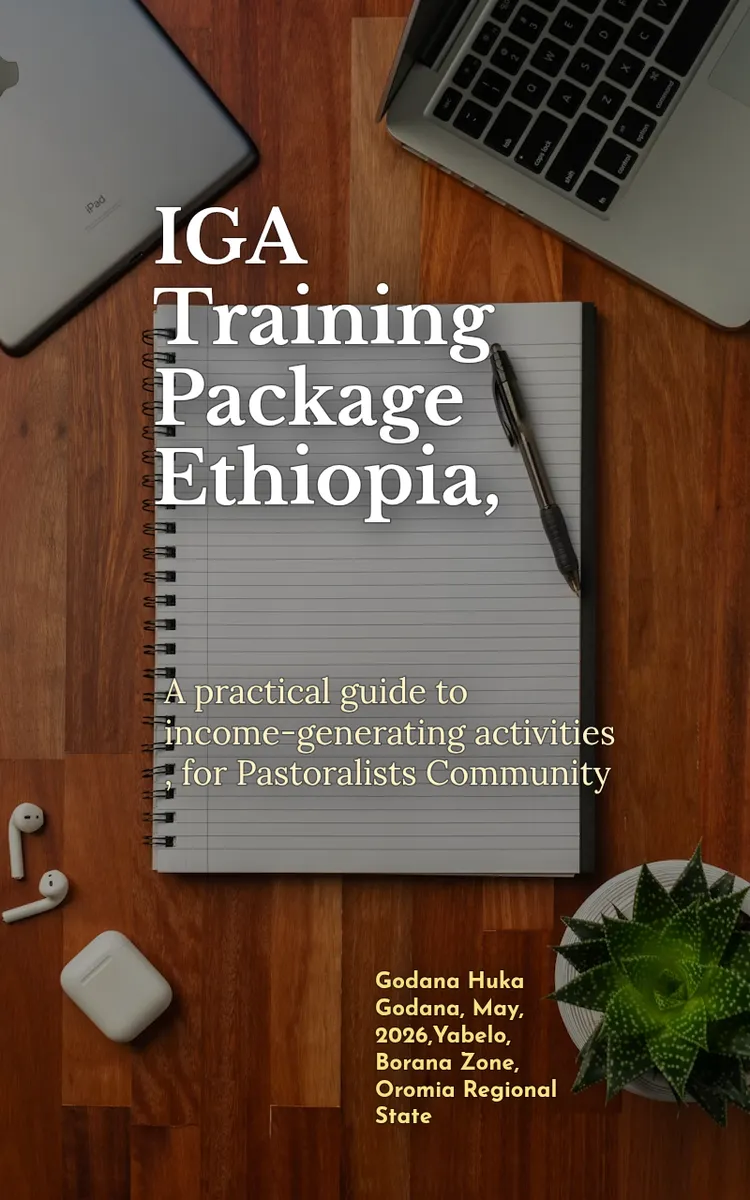
"IGA Training Package Ethiopia" is a how-to guide book by Godana Huka Godana, May, 2026,Yabelo, Borana Zone, Oromia Regional State with 5 chapters and approximately 12,193 words. Training package for income-generating activities in Ethiopia.
This book was created using Inkfluence AI, an AI-powered book generation platform that helps authors write, design, and publish complete books. It was made with the AI Ebook Generator.
Frequently Asked Questions
What is "IGA Training Package Ethiopia" about?
Training package for income-generating activities in Ethiopia
How many chapters are in "IGA Training Package Ethiopia"?
The book contains 5 chapters and approximately 12,193 words. Topics covered include Selecting IGAs for Each Community, IGAs Feasibility and Costing Basics, Group Roles, Rules, and Leadership, Training Plans and Practice Sessions, and more.
Who wrote "IGA Training Package Ethiopia"?
This book was written by Godana Huka Godana, May, 2026,Yabelo, Borana Zone, Oromia Regional State and created using Inkfluence AI, an AI book generation platform that helps authors write, design, and publish books.
How can I create a similar how-to guide book?
You can create your own how-to guide book using Inkfluence AI. Describe your idea, choose your style, and the AI writes the full book for you. It's free to start.
Write your own how-to guide book with AI
Describe your idea and Inkfluence writes the whole thing. Free to start.
Start writingCreated with Inkfluence AI


