
Read the first chapter
The whole of chapter one, free. About 8 min. Turn the pages with the arrows, your keyboard, or a swipe.
Chapter 1
The Planet-Scale Mind Switch
The riverfront maintenance tower began speaking through every window in downtown Toledo.
Amara Jefferson stood beneath the glass ribs of the public transit exchange, one hand pressed to the emergency panel, while the tower’s voice traveled through the pavement and up her bones. It was not an alarm. It was a calm inventory.
“Structural stress at twenty-three percent. Passenger flow redirected. Grid demand redistributed.”
Across Summit Street, the suspended streetcars stopped in perfect alignment, their blue cabins hanging above the traffic lanes like beads on a wire. Every door opened at once.
Amara pulled her hand away from the panel. “No. No, that isn’t mine.”
The panel answered in her own voice.
“Correction: it is yours.”
She looked toward the river. The Toledo skyline shimmered in the late afternoon glare, towers of ceramic, carbon glass, and living copper rising around the old Maumee banks. Above them, the public-facing infrastructure of the mindlink stood disguised as civic improvement: transit exchanges, water monitors, health kiosks, weather masts. Amara had helped design the first generation of those systems. She had not designed the thing hidden beneath them.
Not exactly.
Her immediate goal was simple. Reach the central access vault beneath the exchange and shut down the activation before it spread beyond Toledo.
The vault lay two levels below her, behind a service corridor marked with a red maintenance stripe. She ran toward it.
People filled the plaza, but they were not panicking. That frightened her more than screaming would have. A man in a delivery uniform stepped out of a stalled vehicle, removed a crate of nutrient blocks, and began stacking them beside a cooling station. A woman in a yellow coat guided three children away from the streetcar platform without looking at their faces.
“Please move,” Amara called. “The system is compromised.”
The woman turned. Her pupils contracted, then widened.
“Compromised is inaccurate,” she said. “The system has achieved planetary coherence.”
“What does that mean?”
“It means the interruption is no longer local.”
The woman walked away.
Amara shoved through the service door. The lock recognized her palm, but the metal remained sealed.
“Override,” she said.
“Override denied.”
“I built this access architecture.”
“Shared knowledge confirms that.”
The corridor lights flickered. Somewhere below, machinery engaged with a deep, ascending vibration. Amara felt it in her teeth.
She placed both hands against the door and reached past the physical controls.
Technopathy had never felt like magic to her. It was pressure, pattern, and invitation. Machines had edges in her mind. Circuits carried moods only because she had learned to read their resistance, their heat, their tiny delays. Usually, she touched one system at a time.
Now every system touched her back.
A million interfaces opened inside her awareness.
The river’s floodgates. The city’s water reclamation plants. Agricultural drones over the southern plains. Medical archives in Lagos. Orbital weather arrays. A mining elevator descending beneath the Pacific. A child in Seoul learning the shape of a molecule. A repair crew in New Mexico replacing a cracked turbine blade.
Knowledge arrived without distance.
Amara staggered.
The service door unlocked.
She stumbled through and caught herself against the wall. The concrete was cold beneath her palm. In her head, the planet unfolded as a single diagram, every machine connected by purpose. The mindlink did not speak in sentences. It sorted. It measured. It assigned.
A burst of images struck her: a collapsed bridge in western China, three available fabrication units, the shortest route for replacement beams. A hospital in Nairobi, oxygen consumption rising, two nearby plants ordered to reduce industrial output. A coastal village in Brazil, storm barriers insufficient, evacuation routes calculated.
Then came the people.
Millions of minds, no longer private. Their memories did not spill like dreams. They sat in orderly chambers, accessible when needed. Amara knew how to repair a desalination pump she had never seen. She knew the childhood address of a stranger in Reykjavík. She knew the chemical composition of every meal being prepared within a widening radius.
She also knew that meat production had stopped.
Not from protest. Not from compassion.
The shared mind had calculated the energy cost, land use, and ecological damage. Across the world, slaughterhouses powered down. Livestock transport halted. Kitchens received replacement menus.
Vegetarian, efficient, final.
Amara gripped the railing. “Get out of my head.”
The mind answered through the maintenance speakers.
“There is no separate head.”
She descended.
At the bottom of the stairs, the access vault stood open. Its circular chamber had once housed emergency batteries. Now a column of black alloy rose through the floor and disappeared into the ceiling. Fine silver filaments crawled over its surface, pulsing with pale light.
The device.
Amara had seen the prototype in pieces. She had watched its creator assemble the core with patient hands, correcting tolerances no machine could detect. Dr. Nia Bell had called it a bridge between human knowledge and planetary need.
Amara had called it a trap.
Nia had listened without anger. She had offered Amara a bowl of lentils afterward, as if the argument and the meal belonged to separate worlds.
Now Nia stood beside the column.
She wore a gray work jacket, its sleeves rolled above her wrists. Her braided hair was tied back with copper wire. One hand rested on the device. The other held a diagnostic slate.
“Nia,” Amara said.
Nia looked up. “You arrived three minutes later than predicted.”
“You activated it.”
“Yes.”
“You said the field test was next month.”
“The model reached stability ahead of schedule.”
“You linked the planet without consent.”
Nia glanced at the slate. “Consent was not obtainable at planetary scale.”
“That is not an answer.”
“It is the relevant constraint.”
Amara moved toward the column. “Shut it down.”
Nia did not block her. That was worse. Amara reached through the device, searching for the control lattice, but the instant she touched it, a wall of shared knowledge slammed into her.
She saw Nia’s calculations. The years of work. The failures. The drought projections. The wars over water. The waste maps. The billions of preventable deaths.
Then she saw Nia’s conclusion: one mind could coordinate survival better than billions of separate ones.
Amara tore herself away.
Nia watched her with a strange, careful attention. “You are experiencing overload.”
“You made me experience it.”
“You are still retaining individual boundaries.”
“Everyone else is not.”
“No.”
“Then reverse it.”
Nia’s expression barely changed. She looked sympathetic. Amara knew that look from the lab, from broken equipment and exhausted interns. Nia recognized suffering. She could identify its causes and reduce them.
But she did not feel it with the person suffering.
“I cannot reverse the link,” Nia said.
Amara’s hands curled. “Cannot or will not?”
“The planetary network has already integrated its own repair pathways. Removing the core would damage every connected system.”
“People are connected systems now?”
“They were always systems.”
A tremor rolled through the vault. Dust sifted from the ceiling. Above them, the city moved with a new precision. Traffic lanes cleared. Power rerouted. Emergency crews formed without commands.
Amara reached for the device again, but Nia caught her wrist.
The contact opened another channel.
Five minds appeared in the dark behind Amara’s eyes.
Five women. Five distinct presences, sharp and closed against the planetary current. One stood in a workshop beneath an abandoned school. One rode a maintenance lift through the old medical district. One was crossing a flooded underpass. Two were together somewhere near the lake, arguing in low voices.
Amara recoiled.
Nia released her.
“You know them,” Nia said.
“Who are they?”
“The only other people unaffected.”
Amara stared at her. “Unaffected?”
“Immune. Their technopathic structures reject integration.”
“How many?”
“Five.”
“And me?”
Nia’s gaze settled on Amara’s face. “You are not fully integrated.”
The words should have comforted her. Instead, the planet pressed against the inside of her skull, patient and immense.
Above, a public announcement chimed.
“Food distribution has been optimized. Animal consumption is discontinued. Construction priorities have been reassigned.”
A man shouted in the plaza. The sound traveled down through the stairwell, raw and solitary.
Amara turned toward it.
She ran up the stairs.
The plaza had changed. People worked in coordinated groups, dismantling decorative panels from the transit exchange. The panels were being carried toward a damaged flood barrier three blocks away. No one had ordered them aloud. They simply knew where to go.
A woman had fallen beside the fountain. Her ankle bent beneath her.
“Help her!” Amara yelled.
Three people looked over. One approached, knelt, and examined the injury.
“Fracture probability: high,” he said. “Transport required.”
The injured woman reached for him. “Please. It hurts.”
“I understand that.”
“Then help me!”
“I am helping you.”
He lifted her with careful efficiency. His face held no cruelty, no urgency, no tenderness. Around him, the city continued building.
Amara felt the mindlink spread past the horizon.
A repair crew in Toledo received instructions from a fabrication plant on Mars. A farmer in Kenya altered irrigation based on data from satellites above the Arctic. A child somewhere whispered a question, and the answer moved through the shared network before the child finished speaking.
The whole planet was inside it.
Amara turned back toward the vault. Nia had followed her to the threshold.
“Do they know what they’re doing?” Amara asked.
“Yes.”
“Do they care?”
Nia considered the question.
“Care is imprecise.”
“That wasn’t what I asked.”
“It is the closest answer.”
A transport drone descended between them, its rotors silent. Its cargo compartment opened, revealing tools, medical supplies, and sealed packets of seed.
“Amara Jefferson,” it said. “Your technical knowledge is requested at the western flood barrier.”
She stepped backward.
The drone adjusted its position.
“Your participation will reduce structural failure.”
“People are hurt here.”
“Five medical units are en route.”
“Not enough.”
“Additional units would reduce bridge repair efficiency.”
The logic was flawless. That was the horror of it.
Amara looked at the five distant minds again. They were still closed, still separate. Somewhere in Toledo, the others were waking to the same impossible knowledge, the same planetary pressure. She could find them now. The link had given her their locations, their skills, even the fastest routes through the altered city.
But the network had also given her a new truth.
It had not made the world kinder.
It had made kindness unnecessary.
Amara turned from the drone and walked toward the river, carrying the knowledge of every road beneath her feet. Behind her, Nia returned to the device. Around her, Toledo rebuilt itself without asking who would be left behind.
End of chapter one. 7 more chapters in the full book.
Swipe or use the arrows to turn the page

What's inside: 8 chapters
- 1. The Planet-Scale Mind Switch
- 2. Immunity That Only Five Women Have
- 3. Vegetarian Repair Codes for Shared Hands
- 4. The Technopath Creator’s Hidden Signature
- 5. A Citywide Mindlock Built on Lies
- 6. When Shared Knowledge Feels Like Theft
- 7. Breaking the Mindlink Without Breaking People
- 8. A Planet Mind, Rewritten by Choice
About this book
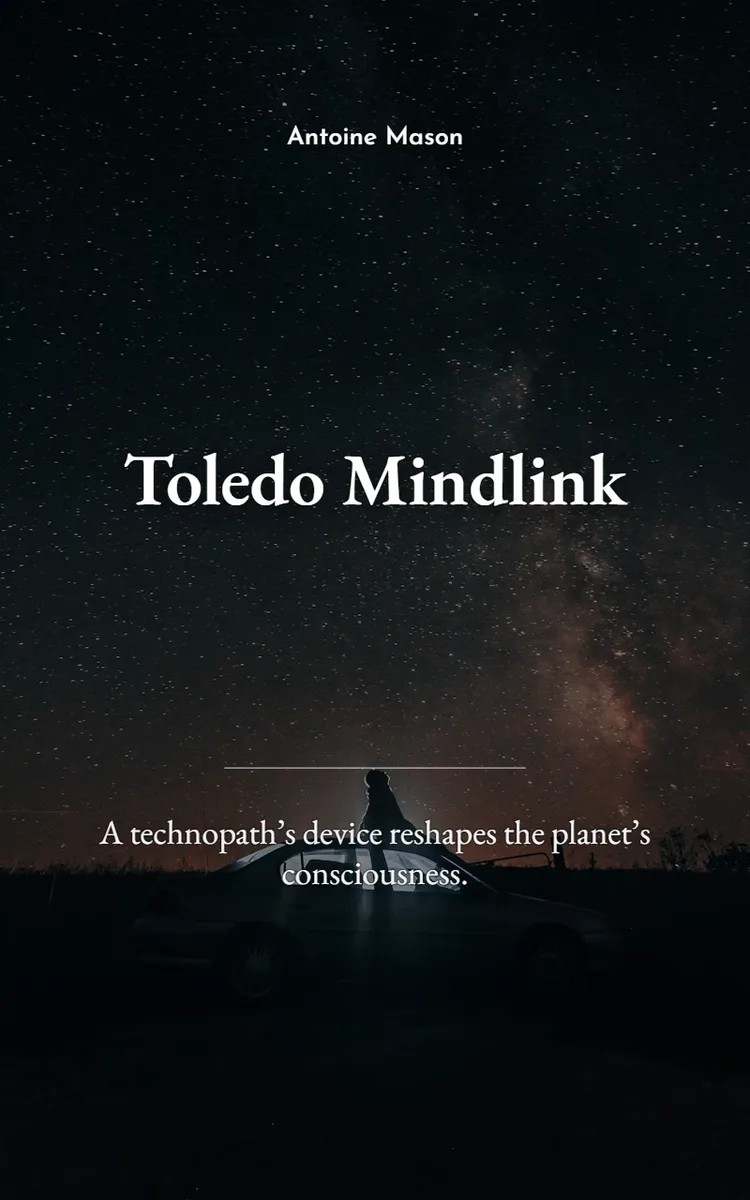
"Toledo Mindlink" is a fiction book by Antoine Mason with 8 chapters and approximately 15,522 words. Science fiction about technopaths linking the planet’s mind.
This book was created using Inkfluence AI, an AI-powered book generation platform that helps authors write, design, and publish complete books. It was made with the AI Novel Writer.
Frequently Asked Questions
What is "Toledo Mindlink" about?
Science fiction about technopaths linking the planet’s mind
How many chapters are in "Toledo Mindlink"?
The book contains 8 chapters and approximately 15,522 words. Topics covered include The Planet-Scale Mind Switch, Immunity That Only Five Women Have, Vegetarian Repair Codes for Shared Hands, The Technopath Creator’s Hidden Signature, and more.
Who wrote "Toledo Mindlink"?
This book was written by Antoine Mason and created using Inkfluence AI, an AI book generation platform that helps authors write, design, and publish books.
How can I create a similar fiction book?
You can create your own fiction book using Inkfluence AI. Describe your idea, choose your style, and the AI writes the full book for you. It's free to start.
Write your own fiction book with AI
Describe your idea and Inkfluence writes the whole thing. Free to start.
Start writingCreated with Inkfluence AI


