
Read the first chapter
The whole of chapter one, free. About 3 min. Turn the pages with the arrows, your keyboard, or a swipe.
Chapter 1
Days 1-9: Essential Greetings and Introductions
Overview
In Days 1–9 you learn the essential phrases for greeting people, introducing yourself, and exchanging basic personal details. This chapter focuses on practical language you will use the first time you meet someone: saying hello, asking and answering “How are you?”, giving your name, asking where someone is from, and sharing simple personal facts (job, phone number, or age). You’ll get short, usable phrases, notes on pronunciation and tone basics, and sample dialogs you can practice in real situations.
Learning objectives for these nine days - Recognize and use common greetings for different times of day. - Introduce yourself and ask someone’s name. - Ask and answer “How are you?” and give simple responses. - Say where you are from and ask the same. - Share one or two personal facts (job, student, phone number) politely.
Study plan (Days 1–9) - Days 1–3: Greetings and “How are you?” - Days 4–6: Names and introductions - Days 7–9: Origin and basic personal facts + simple role-play
Pace yourself: short daily drills (10–20 minutes) and one longer practice session every third day.
Core Content
Essential greetings - Hello: 你好 (nǐ hǎo) — Use any time. Casual but polite. - Hi (casual): 嗨 (hāi) — Borrowed sound; informal. - Good morning: 早上好 (zǎoshang hǎo) — Morning only. - Good afternoon / evening: 下午好 (xiàwǔ hǎo) / 晚上好 (wǎnshang hǎo)
Tip: Say the phrase clearly and pause. Native speakers expect short greetings before more talk.
“How are you?” and responses - How are you?: 你好吗?(nǐ hǎo ma?) or 你怎么样?(nǐ zěnmeyàng?) - I’m fine/very good: 我很好 (wǒ hěn hǎo) or 我很好,谢谢 (wǒ hěn hǎo, xièxie) - So-so: 马马虎虎 (mǎmǎhūhū) — informal, means “mediocre/so-so” - Not good: 我不太好 (wǒ bù tài hǎo)
Practice tip: When someone asks 你好吗, a common short reply is 好, 你呢? (hǎo, nǐ ne?) — “Good, and you?”
Introducing names - What is your name?: 你叫什么名字?(nǐ jiào shénme míngzi?) or simpler 你叫什么?(nǐ jiào shénme?) - My name is [X]: 我叫 [X] (wǒ jiào [X]) — The most natural way to introduce yourself. - Nice to meet you: 很高兴认识你 (hěn gāoxìng rènshi nǐ) or simply 幸会 (xìnghuì) in very formal contexts.
Example dialog — first meeting A: 你好!(Nǐ hǎo!) B: 你好!你叫什么名字?(Nǐ hǎo! Nǐ jiào shénme míngzi?) A: 我叫李明,很高兴认识你。(Wǒ jiào Lǐ Míng, hěn gāoxìng rènshi nǐ.) B: 我叫Anna,也很高兴认识你。(Wǒ jiào Anna, yě hěn gāoxìng rènshi nǐ.)
Asking and saying where you’re from - Where are you from?: 你是哪里人?(nǐ shì nǎlǐ rén?) or 你来自哪里?(nǐ láizì nǎlǐ?) - I am from [country/city]: 我是 [country/city] 人 (wǒ shì [country/city] rén) or 我来自 [place] (wǒ láizì [place]) Example: 我是美国人 (wǒ shì měiguó rén) — “I’m American.”
Sharing basic personal facts Useful short phrases: - I’m a student: 我是学生 (wǒ shì xuésheng) - I work as [job]: 我是老师 / 我是工程师 (wǒ shì lǎoshī / wǒ shì gōngchéngshī) - This is my phone number: 这是我的电话号码 (zhè shì wǒ de diànhuà hàomǎ)
Politeness and follow-up - Thank you: 谢谢 (xièxie) - You’re welcome: 不客气 (bú kèqi) - Excuse me / Sorry (to get attention): 对不起 / 劳驾 (duìbuqǐ / láojià) When you meet someone, a quick polite phrase after an introduction helps the conversation keep going.
Tone and pronunciation notes - Mandarin is tonal: the same syllable can mean different things with different tones. Don’t panic — prioritize clarity over perfect tones at first. - Practice with audio or language partners on Days 1–3 to get basic tone shapes for nǐ (third tone) and hǎo (third tone). In natural speech they often rise: sounding like “nee how” may be close enough for starters.
Practice exercises (daily) Day 1–3: Repeat greetings aloud, record 1-minute self-introductions. Day 4–6: Role-play name exchanges with friends or language partners. Day 7–9: Combine origin and job sentences into a 30–60 second dialog; swap and respond.
Quick drill examples to repeat - 你好,我叫[Your Name]。(Nǐ hǎo, wǒ jiào [Your Name].) - 你是哪里人?我是[Country]人。(Nǐ shì nǎlǐ rén? Wǒ shì [Country] rén.)
Summary
By the end of Day 9 you should comfortably greet people, ask “How are you?”, introduce your name, say where you’re from, and share one or two basic facts about yourself. Focus on short, repeatable phrases, practice tones with audio or partners, and build confidence with three daily drills: greetings, name exchanges, and origin/job dialogs. These are the building blocks for every social interaction in Mandarin — master them, and the rest of the course will feel much easier.
End of chapter one. 4 more chapters in the full book.
Swipe or use the arrows to turn the page
What's inside: 5 chapters
- 1. Days 1-9: Essential Greetings and Introductions
- 2. Days 10-18: Navigating Transportation and Directions
- 3. Days 19-27: Ordering Food and Dining Out
- 4. Days 28-36: Shopping and Bargaining Skills
- 5. Days 37-42: Handling Emergencies and Health
About this book
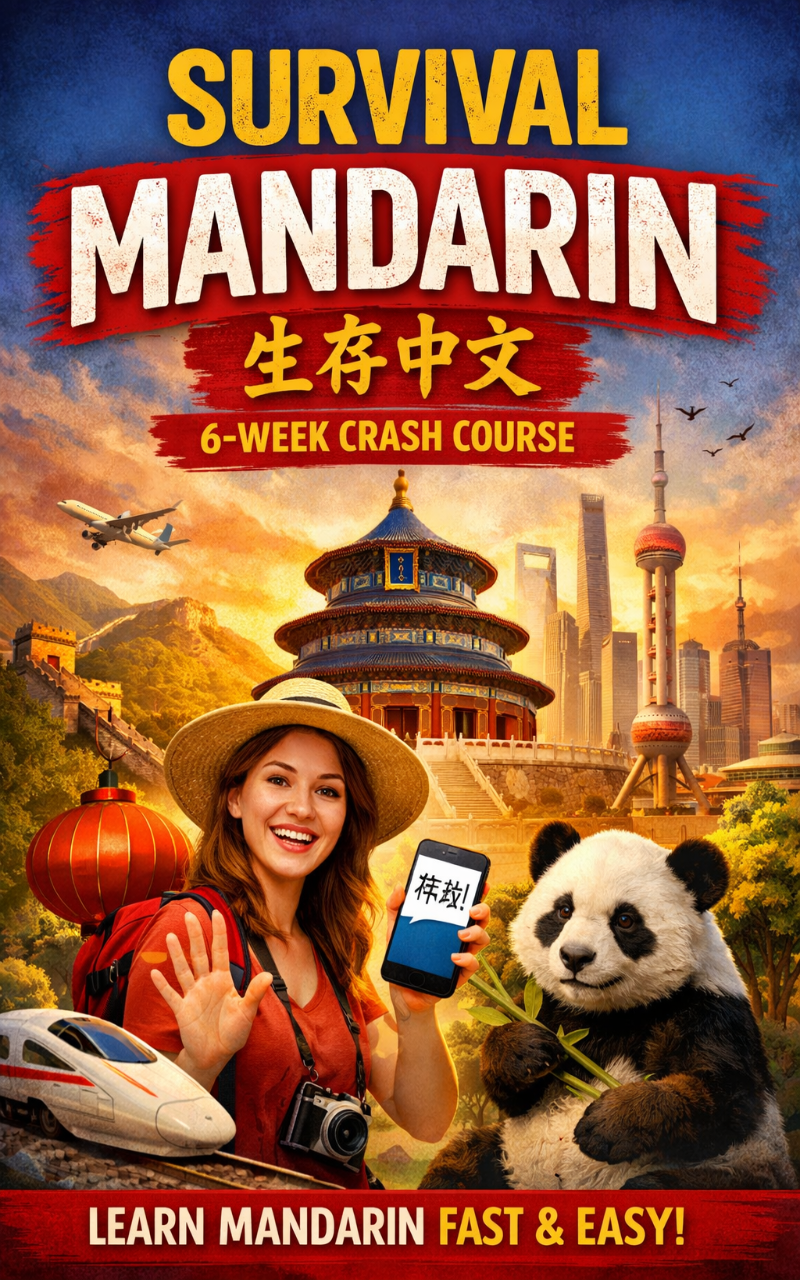
"6-Week Survival Mandarin Course" is a education book by Shaun Holder with 5 chapters and approximately 3,531 words. A practical Mandarin language course for everyday survival communication.
This book was created using Inkfluence AI, an AI-powered book generation platform that helps authors write, design, and publish complete books. It was made with the AI Lesson Plan Generator.
Frequently Asked Questions
What is "6-Week Survival Mandarin Course" about?
A practical Mandarin language course for everyday survival communication
How many chapters are in "6-Week Survival Mandarin Course"?
The book contains 5 chapters and approximately 3,531 words. Topics covered include Days 1-9: Essential Greetings and Introductions, Days 10-18: Navigating Transportation and Directions, Days 19-27: Ordering Food and Dining Out, Days 28-36: Shopping and Bargaining Skills, and more.
Who wrote "6-Week Survival Mandarin Course"?
This book was written by Shaun Holder and created using Inkfluence AI, an AI book generation platform that helps authors write, design, and publish books.
How can I create a similar education book?
You can create your own education book using Inkfluence AI. Describe your idea, choose your style, and the AI writes the full book for you. It's free to start.
Write your own education book with AI
Describe your idea and Inkfluence writes the whole thing. Free to start.
Start writingCreated with Inkfluence AI


