
Read the first chapter
The whole of chapter one, free. About 8 min. Turn the pages with the arrows, your keyboard, or a swipe.
Chapter 1
Rewrite Identity Through Habit Loops
The Habit That Survives the Night Shift
At 7:10 a.m., Talia leaves the emergency department after a twelve-hour night shift. Her feet hurt, her brain feels like static, and the only plan she can manage is coffee, a hot shower, and bed. She’s also a coach, and she’s promised herself she’ll train before sleeping.
Some mornings, she changes into workout clothes and gets it done. Other mornings, the clothes stay folded on the chair while she scrolls for “just five minutes.” By the time she looks up, forty minutes are gone. Talia doesn’t lack discipline. Her routine simply depends on a version of herself who has more energy than the one standing in the kitchen at 7:10 a.m.
That’s the real problem with many habits: they’re built around wishes, not identity. Will your habits prove who you want to become, or keep rehearsing who you’re trying to leave behind?
From Proving Yourself to Practicing Your Identity
Old Belief: I need more motivation before I can build a lasting habit.
New Reality: A lasting habit becomes easier when each repetition confirms the identity I’ve chosen.
Motivation asks, “Do I feel like doing this?” Identity asks, “What does someone like me do next?” That second question is more useful because feelings change quickly. Your chosen identity gives the action a stable reason to exist.
Talia could say, “I need to work out more.” That goal is vague, and it creates a daily argument. She could instead choose: “I’m a coach who protects her strength, even after a difficult shift.” Now the workout isn’t punishment for eating badly or a test of willpower. It’s evidence. Every session tells her, “This is how I operate.”
The action still has to fit real life. Talia doesn’t pretend she can complete a demanding workout after every night shift. She creates two versions: a twenty-five-minute strength session when her energy is steady, and a five-minute mobility routine when she’s exhausted. Both support the same identity. The smaller version keeps the loop alive instead of turning one hard morning into a lost week.
This distinction matters because habits are not only things you do. They are votes for the person you believe you are. One skipped workout doesn’t define you, but repeated choices create a pattern. If the pattern says, “I only keep promises when conditions are perfect,” that belief gets stronger. If it says, “I adapt and still show up,” that belief gets stronger instead.
The Identity Loop Protocol turns this idea into something you can use:
1. Choose the identity. Name the person you’re becoming in plain language. 2. Attach a cue. Connect the behavior to an event that already happens. 3. Run the routine. Make the action small enough to complete on an ordinary day. 4. Claim the reward. Mark the evidence so your brain notices the identity being reinforced.
For Talia, the loop might look like this: after she removes her work badge, she changes into training clothes. She completes either the planned workout or five minutes of mobility. Then she records one line in her phone: “I protected my strength today.” The note is brief, but it gives the action meaning.
How the Identity Loop Takes Hold
A habit loop begins with a cue. The cue can be a time, place, emotion, object, or completed action. The routine is the behavior itself. The reward tells your brain that the sequence was worth remembering.
The important detail is consistency. If your cue changes every day, the habit has to be rediscovered every day. Talia’s cue isn’t “whenever I have time.” That cue is too slippery. It’s “after I remove my work badge.” Her shift ends at different times, but the badge-removal moment is reliable.
The reward also needs to arrive quickly. Long-term benefits matter, but your brain responds strongly to what happens now. Talia gets the long-term benefit of better strength and recovery. Immediately, she gets a shower, a checkmark in her habit tracker, and the satisfaction of keeping a promise. The immediate reward helps the loop become familiar.
Watch for these signs that an identity loop is running your life:
1. You describe yourself with a fixed label. “I’m not a morning person,” “I’m terrible with money,” or “I never finish anything” sounds like a fact. Often, it’s a repeated pattern wearing a name tag.
2. Your habit depends on ideal conditions. You train only when you sleep well, write only when the house is quiet, or eat well only when your schedule behaves. The routine has no backup version.
3. One miss becomes a personal verdict. Missing Tuesday turns into “I always quit.” That interpretation creates shame, and shame makes returning harder.
4. The reward fights the identity. You say you’re building focus, then reward a completed task with an hour of distracting scrolling. The brain learns that the old behavior is still the most satisfying destination.
The Identity Loop Protocol makes consistency more important than intensity.
You don’t need to perform the biggest version of a habit every time. You need a repeatable cue, a realistic routine, and a reward that makes the chosen identity feel true.
Consider a small business owner who wants to become “the kind of owner who follows up.” The cue could be closing the last customer invoice. The routine is sending one follow-up message before leaving. The reward is marking the contact in a simple tracker and reviewing the growing list every Friday. The action is modest, but it directly trains the identity.
That’s the psychology underneath the method: your brain pays attention to repeated connections. When the same cue leads to the same kind of action, the decision becomes less expensive. When the action produces a clear reward, the sequence becomes easier to remember. When you name the identity, the behavior stops feeling random.
Questions That Expose Your Current Loop
1. What identity are your current habits already proving? Don’t answer with the identity you want. Look at the last seven days. If you avoided difficult conversations, your pattern may be proving, “I protect comfort before progress.” That isn’t a permanent label; it’s useful evidence.
2. Which behavior would make your chosen identity visible today? If you want to be a dependable professional, it might be sending the overdue message before lunch. If you want to be a strong person, it might be completing ten controlled squats instead of waiting for a perfect workout.
3. What existing event can become your cue? Choose something that already happens. After brushing your teeth, after opening your laptop, or after removing your uniform is stronger than “at some point this afternoon.”
4. What is the smallest routine that still counts? Talia’s five-minute mobility routine counts because it protects the identity of someone who maintains her body. Your smallest version might be opening the document and writing three sentences, or transferring a small amount into savings.
5. What immediate reward will help you respect the repetition? Use something visible and clean: a checkmark, a short note, a cup of tea, or two minutes to acknowledge what you completed. The reward shouldn’t erase the habit’s purpose. It should help your brain register the win.
Be honest here. If your plan requires heroic effort, it’s not a habit plan yet. It’s a performance fantasy. Build for the tired version of you, the busy version, and the version who has already had a difficult day.
The Seven-Day Identity Loop Challenge
Challenge: Prove One Identity for Seven Days
Choose one identity and build a single loop around it. Keep the target narrow. “I’m becoming organized” is too broad. “I’m the kind of person who resets the workspace before ending work” is clear enough to act on.
• Write one identity statement: “I am someone who ______.” - Choose one existing cue that happens daily. - Define a full routine and a minimum routine. - Decide on an immediate reward. - Complete the loop once each day for seven days. - Record the cue, action, and reward in a note titled “Identity Evidence.” - If you miss, restart at the next cue. Don’t add punishment or attempt to compensate with an oversized routine.
For example, Talia might write: “I am a coach who protects her strength.” Her cue is removing her work badge. Her full routine is twenty-five minutes of strength training. Her minimum routine is five minutes of mobility. Her reward is a checkmark and the sentence, “I kept the promise in a realistic way.”
Difficulty: Medium
You’ll know it’s working when...
• You begin the routine with less internal debate. - You use the minimum version instead of skipping completely. - Your chosen identity feels connected to a specific action. - A missed day becomes a correction, not a character judgment. - You can point to seven pieces of evidence that support the person you’re becoming.
Don’t judge the challenge by how impressive the routine looks. Judge it by whether the loop survives ordinary life. A habit that works only on calm days has not earned your trust yet.
Your Identity Becomes Visible Through Repetition
You don’t change your identity by declaring it; you change it by repeatedly giving yourself evidence.
• A chosen identity gives your habits direction and meaning. - A cue makes the behavior easier to begin. - A realistic routine keeps the loop alive when energy and time are limited. - An immediate reward helps your brain remember that the action matters. - The Identity Loop Protocol turns small repetitions into proof of personal change.
Talia’s strength wasn’t created by one perfect workout after a night shift. It was built through a series of practical decisions: badge off, clothes on, routine adjusted, evidence recorded. That same structure can shape how you work, communicate, manage money, and influence the people around you. Once your behavior becomes consistent, your presence becomes more credible - and credibility is where real influence begins.
End of chapter one. 4 more chapters in the full book.
Swipe or use the arrows to turn the page
What's inside: 5 chapters
- 1. Rewrite Identity Through Habit Loops
- 2. Break Procrastination With Tiny Wins
- 3. Persuade Ethically Using the Message Ladder
- 4. Read People With Micro-Signal Patterns
- 5. Build Lasting Influence With Seven Principles
About this book
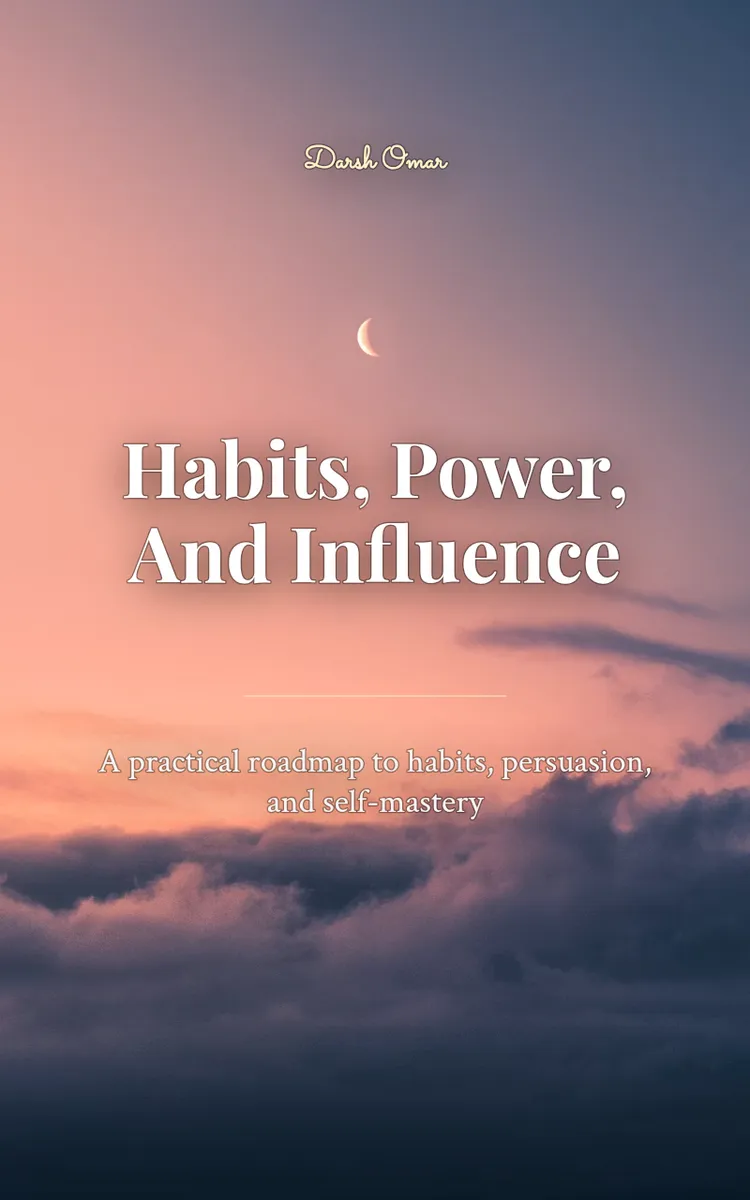
"Habits, Power, And Influence" is a self-help book by Darsh Omar with 5 chapters and approximately 8,262 words. Self-help strategies for habits, power, persuasion, and influence.
This book was created using Inkfluence AI, an AI-powered book generation platform that helps authors write, design, and publish complete books. It was made with the AI Self-Help Book Writer.
Frequently Asked Questions
What is "Habits, Power, And Influence" about?
Self-help strategies for habits, power, persuasion, and influence
How many chapters are in "Habits, Power, And Influence"?
The book contains 5 chapters and approximately 8,262 words. Topics covered include Rewrite Identity Through Habit Loops, Break Procrastination With Tiny Wins, Persuade Ethically Using the Message Ladder, Read People With Micro-Signal Patterns, and more.
Who wrote "Habits, Power, And Influence"?
This book was written by Darsh Omar and created using Inkfluence AI, an AI book generation platform that helps authors write, design, and publish books.
How can I create a similar self-help book?
You can create your own self-help book using Inkfluence AI. Describe your idea, choose your style, and the AI writes the full book for you. It's free to start.
Write your own self-help book with AI
Describe your idea and Inkfluence writes the whole thing. Free to start.
Start writingCreated with Inkfluence AI


