

Read the first chapter
The whole of chapter one, free. About 8 min. Turn the pages with the arrows, your keyboard, or a swipe.
Chapter 1
SSDI vs SSI: The Real Difference
Learn How SSDI and SSI Differ in Eligibility
Could the same disability qualify one person for SSDI, another person for SSI, and neither person for the program they first applied for? Yes. The medical disability is only one part of the decision. The program also looks at your work record, income, and financial resources. Confusing these rules can lead to a wrong application, an incorrect budget, or the mistaken belief that one benefit automatically unlocks every other program.
The Two-Track Eligibility Compass keeps the difference clear. The first track asks, “Did I work and pay enough Social Security taxes to earn disability insurance?” That track points toward Social Security Disability Insurance (SSDI). The second asks, “Do I have a qualifying disability and very limited income and resources?” That track points toward Supplemental Security Income (SSI). Some people qualify for one track. Some qualify for both. Some qualify for neither, even when a health condition seriously limits daily life.
SSDI is an insurance benefit based mainly on your work history. You earn work credits by working and paying Social Security taxes. Social Security checks your age and work record to decide whether you have enough recent and total credits. The exact credit requirement changes with age, so verify your situation directly with the Social Security Administration (SSA). A person who worked steadily before becoming disabled may qualify for SSDI even if that person has savings or other income.
SSI works differently. SSI provides cash assistance to people with qualifying disabilities, blindness, or age-related eligibility who have limited income and limited countable resources. It does not require the same work history as SSDI. SSI examines money coming in and certain things you own. Rules about income, resources, living arrangements, and support from other people can affect the payment. Because these rules can change, verify current limits with SSA before relying on a specific amount.
Ask yourself three questions before you assume which program fits: Did I work long enough under Social Security? What income comes into my household each month? What resources do I own, and which ones might the rules count? Write the answers down. The questions place you on the correct track before you spend time gathering the wrong documents.
A person may receive SSDI and still have too much income or too many resources for SSI. Another person may receive SSI because a limited work record prevents SSDI eligibility. A person may qualify for both when the SSDI payment falls below the SSI payment level and the person meets SSI’s financial rules. In that situation, SSI may add a payment rather than replace SSDI. SSA calculates the actual amount after reviewing income and living arrangements.
This difference matters because SSDI and SSI use different financial tests. SSDI generally does not reduce because you have a modest bank balance, own a vehicle for personal use, or receive help from a family member. However, work and other income can affect SSDI under separate rules. SSI generally examines income and countable resources, so a change in support, household costs, or money held in an account can affect eligibility or payment.
Do not treat a disability approval as a complete benefits approval. SSDI does not automatically make you eligible for food benefits, Medicaid, housing assistance, utility help, or any other need-based program. Each program has its own rules. SSI may make some people more likely to meet another program’s income test, but it still does not guarantee approval. State rules, household size, expenses, immigration requirements, age, and program funding may matter.
Use this short comparison when organizing your records:
• SSDI: Work-based disability insurance; work credits matter; financial resources usually do not decide basic eligibility. - SSI: Need-based cash assistance; income, resources, and living arrangements matter; a work history is not required in the same way. - Both programs: SSA must find that you meet the disability rules; approval for one program does not guarantee approval for another. - Neither program: A medical condition alone may not satisfy the disability definition, work-credit rules, or financial rules.
A practical way to apply the Two-Track Eligibility Compass involves three actions. First, check your Social Security earnings record and disability benefit estimate through your secure SSA account or by contacting SSA. Second, list every source of household income, including wages, pensions, support, and other benefits. Third, list major resources, such as bank accounts, cash, vehicles, and property, then ask SSA which items count under current SSI rules. These actions matter because memory often misses small accounts, irregular payments, or support that an agency must consider.
Keep a separate note for facts that can change: work credits, SSI income limits, SSI resource limits, and state payment rules. Mark each item “verify before applying” rather than copying an old number from a website, letter, or conversation. A rule that applied last year may not apply today. Current verification protects your budget from a payment estimate that never arrives.
The key takeaway is simple: SSDI follows the work-insurance track, while SSI follows the limited-income track. Start by identifying your track, then verify the current rules instead of guessing from the name of your diagnosis or the amount of help you need.
What Each One Can and Cannot Fund
A benefit payment gives you spending power, but it does not come with a promise to pay every disability-related bill. SSDI and SSI are generally cash benefits. You can use the money for ordinary living costs, but the payment may need to cover far more than one expense. Rent, food, utilities, transportation, clothing, personal care, and medical costs can all compete for the same dollars.
SSDI does not function like an account reserved for doctor visits or equipment. You may use it for rent, groceries, transportation, phone service, debt payments, or other lawful household needs. SSI also provides cash for basic needs, but its rules connect the payment to financial need. If another person pays expenses or gives you money, that help may affect SSI under current rules. Ask SSA how a specific arrangement affects your payment before you build a budget around it.
Neither program automatically pays for a wheelchair, home aide, prescription, accessible vehicle, rent deposit, or home repair. Other programs may help with some of those costs, but each one requires a separate eligibility decision. Medicare, Medicaid, housing programs, food programs, charitable funds, and local services follow their own application and verification rules. Keep these categories separate in your records so you do not mistake a possible referral for approved funding.
A useful household table can prevent false assumptions:
| Expense or need | What SSDI or SSI may do | What it usually does not promise | |---|---|---| | Rent or mortgage | Provide cash that you may use toward housing | Pay the full housing cost | | Food | Provide cash for groceries | Replace SNAP or guarantee food assistance | | Medical bills | Provide cash that may help with costs | Cover every service, medicine, or device | | Transportation | Provide money you may use for rides or fuel | Guarantee medical transportation | | Utilities | Provide general cash for bills | Automatically enroll you in utility aid | | Personal care | Provide general cash support | Guarantee paid attendant services | | Home modifications | Provide money you may save or use | Pay for a ramp or repair automatically | | Debt payments | Provide cash you may apply to debt | Cancel or reduce a debt by itself |
For example, suppose a person receives an SSDI payment of $1,240 and pays $780 for rent, $160 for utilities, $210 for food, and $125 for transportation. The total listed costs equal $1,275, leaving a $35 shortfall before medicine, clothing, phone service, or emergencies. SSDI can legally help cover those costs, but it cannot make the budget balance. The person must examine other eligible programs, negotiate bills where possible, and adjust spending without assuming SSDI will fund a missing category.
Now consider SSI. Suppose a person receives an SSI payment and a relative regularly pays the electric bill. That support may affect SSI depending on the facts and current rules. The person should report the arrangement and ask SSA for a written explanation. Hiding the support can create an overpayment later. Reporting it early gives the agency a chance to calculate the correct payment and gives the household time to revise its plan.
Use a funding check before you count any program in your budget:
• Name the exact expense. - Identify the program you believe may help. - Confirm that the program covers that expense. - Check current income, resource, household, and disability rules. - Ask whether the program pays you, pays a provider, or provides a discount. - Obtain an approval notice before treating the help as guaranteed income.
This check prevents a common budgeting error: subtracting a hoped-for benefit before approval. If you expect a utility program to pay an overdue bill, but the agency has not approved the request, your budget still carries the full bill. Record possible help in a “pending” column, not in the “available money” column.
SSDI and SSI can also interact with other benefits in ways that require care. A payment from one program may count as income for another program. A change in living arrangement may affect SSI. A new job, pension, settlement, or regular family support may change an agency’s calculation. Do not rely on a friend’s payment amount or an old online chart. Ask the agency that runs the program and keep the response with your records.
Before you finish your eligibility review, make two columns on paper. In the first, write “cash I can use now,” including approved SSDI or SSI. In the second, write “help I must apply for,” including possible food, medical, housing, utility, or transportation assistance. Only the first column belongs in your current budget. Move an item into the first column after you receive approval and understand the payment or service terms.
The practical lesson is not that SSDI or SSI fails to help. These benefits can provide the base that keeps a household functioning. The lesson is that a base payment is not the same as full coverage. Know what the cash can fund, identify what it cannot promise, and verify every additional program before counting it. That habit turns benefit knowledge into a safer household plan - and gives you a clear starting point for making a fixed income cover real life.
End of chapter one. 39 more chapters in the full book.
Swipe or use the arrows to turn the page


What's inside: 40 chapters
- 1. SSDI vs SSI: The Real Difference
- 2. How Social Security Disability Claims Work
- 3. Reading Your SSA Award Notice
- 4. Reporting Rules That Protect Your Benefits
- 5. Representative Payees and Safe Money Handling
- 6. Medicare Basics for Disability Beneficiaries
- 7. Medicaid Basics: When It Applies
- 8. Financial Records That Make Benefits Easier
- 9. Medicare Savings Programs Eligibility
- 10. Extra Help for Prescription Costs
- 11. Prescription Assistance Beyond Medicare
- 12. SNAP (Food Benefits) Application Guide
- 13. SNAP Recertification and Benefit Stability
- 14. Food Banks and Local Pantry Networks
- 15. Senior Food Resources and Commodity Programs
- 16. LIHEAP for Heating and Cooling Costs
- 17. Utility Hardship Programs and Payment Plans
- 18. Lifeline and Affordable Internet Options
- 19. Weatherization and Home Energy Upgrades
- 20. Housing Assistance Basics: Section 8 Pathways
- 21. Public Housing and Project-Based Options
- 22. Section 811 Supportive Housing for Disability
- 23. Home Repair and Accessibility Modification Programs
- 24. Transportation Assistance for Medical Appointments
- 25. Area Agencies on Aging and ADRCs
- 26. Centers for Independent Living and Nonprofit Navigators
- 27. 211, Community-Action Agencies, and Local Grants
- 28. Property-Tax Relief and Renter Assistance Programs
- 29. Medicaid Home- and Community-Based Services (HCBS)
- 30. Personal Assistance Services Eligibility and Planning
- 31. Medical Transportation Under Medicaid
- 32. Durable Medical Equipment (DME) and Supplies
- 33. Nonprofit Assistance and Local Disability Programs
- 34. Rural Resources and Transportation Alternatives
- 35. Fixed-Income Budgeting That Survives Real Life
- 36. Banking, Automation, and Bill-Pay Safety
- 37. Emergency Funds and Sinking Funds for Disability Costs
- 38. Debt Reduction, Credit Repair, and Predatory Loan Avoidance
- 39. Work Incentives Overview for SSDI and SSI
- 40. Earnings Reporting, Overpayments, Appeals, and Annual Review
About this book
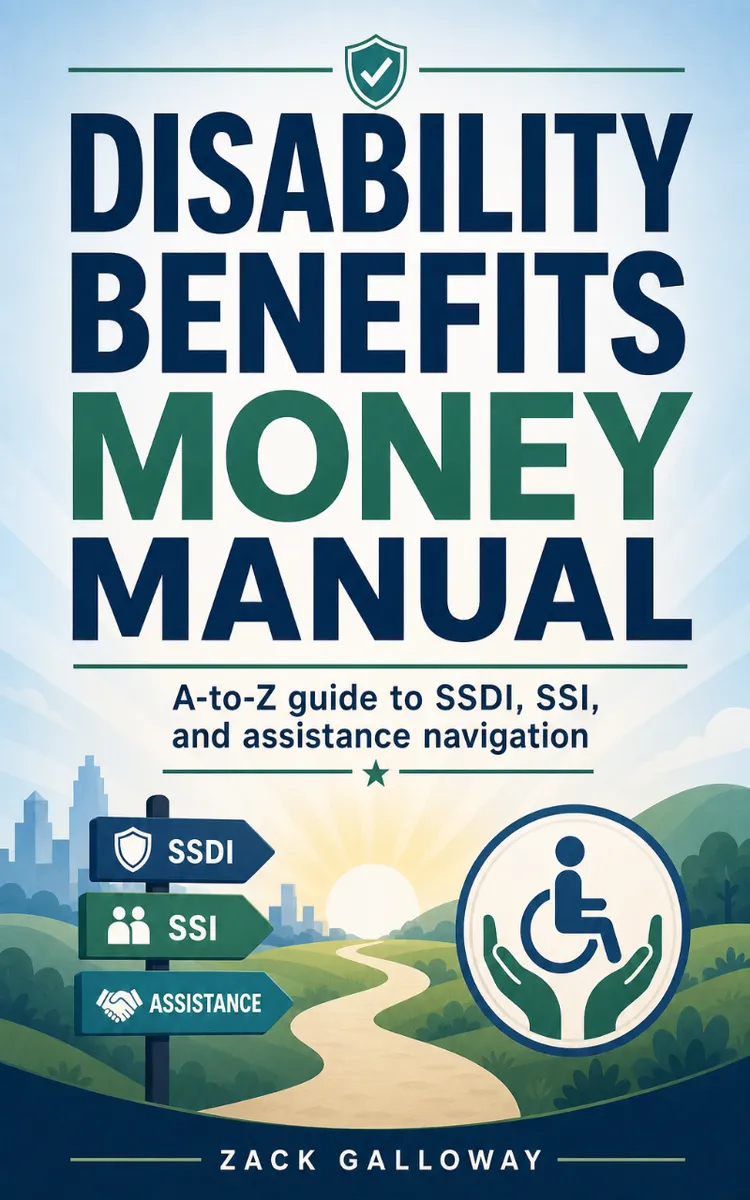
"Disability Benefits Money Manual" is a how-to guide book by Zack Galloway with 40 chapters and approximately 63,144 words. How to apply, manage, and budget disability benefits and supports.
This book was created using Inkfluence AI, an AI-powered book generation platform that helps authors write, design, and publish complete books. It was made with the AI Ebook Generator.
Frequently Asked Questions
What is "Disability Benefits Money Manual" about?
How to apply, manage, and budget disability benefits and supports
How many chapters are in "Disability Benefits Money Manual"?
The book contains 40 chapters and approximately 63,144 words. Topics covered include SSDI vs SSI: The Real Difference, How Social Security Disability Claims Work, Reading Your SSA Award Notice, Reporting Rules That Protect Your Benefits, and more.
Who wrote "Disability Benefits Money Manual"?
This book was written by Zack Galloway and created using Inkfluence AI, an AI book generation platform that helps authors write, design, and publish books.
How can I create a similar how-to guide book?
You can create your own how-to guide book using Inkfluence AI. Describe your idea, choose your style, and the AI writes the full book for you. It's free to start.
Write your own how-to guide book with AI
Describe your idea and Inkfluence writes the whole thing. Free to start.
Start writingCreated with Inkfluence AI


