
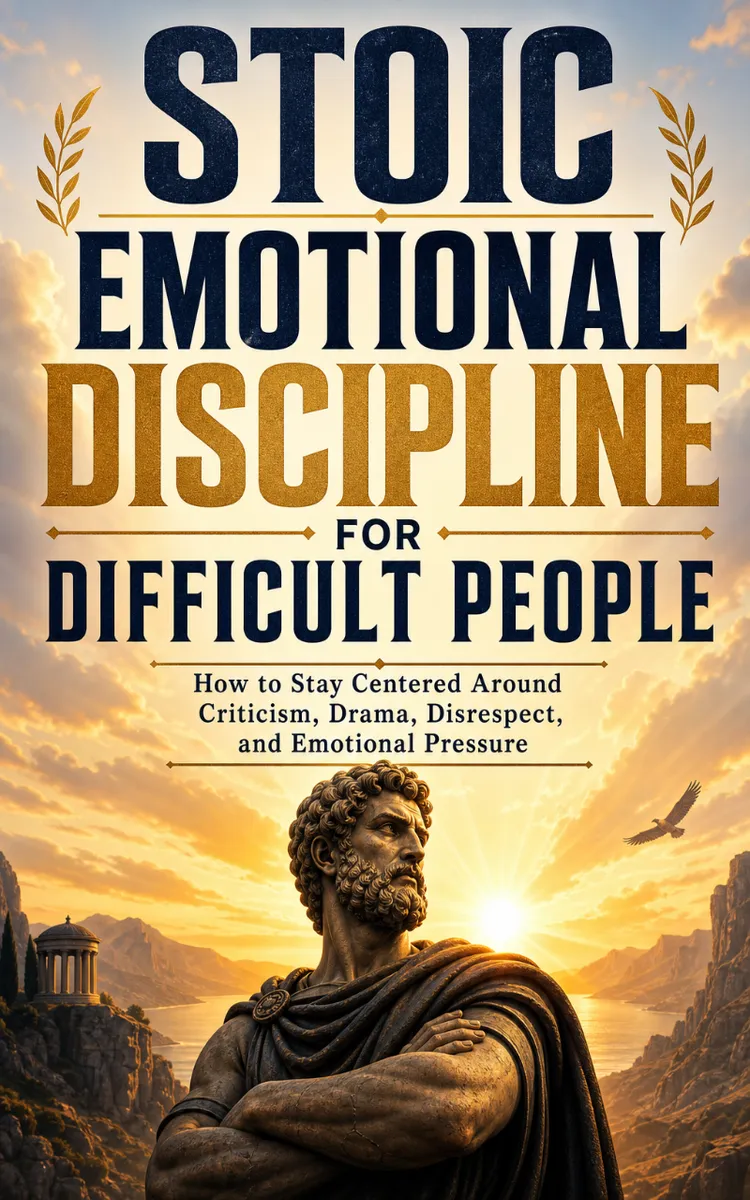
Stoic Emotional Discipline For Difficult People
Created with Inkfluence AI
Stoic techniques for emotional control around difficult people
Table of Contents
- 1. Choosing Your Inner Authority
- 2. Separating Facts From Emotional Judgments
- 3. The Stoic Control Map for Peace
- 4. Rewriting the Meaning of Disrespect
- 5. Building a Criticism-Resilient Identity
- 6. The Virtue Lens for Every Interaction
- 7. Stopping Rumination With the 90-Second Reset
- 8. Practicing Voluntary Discomfort Daily
- 9. Setting Boundaries Without Losing Calm
- 10. The Two-Channel Communication Method
- 11. Responding to Drama With Neutral Clarity
- 12. The “Pause, Name, Choose” Interruption
- 13. Handling Emotional Pressure Without Compliance
- 14. Turning Power Struggles Into Cooperation
- 15. The Just-Enough Apology Rule
- 16. Managing Passive Aggression With Clean Boundaries
- 17. The Stoic Pre-Mortem for Difficult Encounters
- 18. Practicing Perspective Through Negative Visualization
- 19. Recovering Fast After a Blow-Up
- 20. Living the Principle, Not the Outcome
Preview: Choosing Your Inner Authority
A short excerpt from “Choosing Your Inner Authority”. The full book contains 20 chapters and 28,338 words.
“People don’t hurt you-your beliefs about what they mean hurt you.” It’s a harsh sentence, but it’s also the key to why some days you can handle disrespect like it’s background noise, and other days one comment ruins the rest of your evening.
Picture this: Marcus is halfway through a tough customer escalation when his coworker jumps in-loud, corrective, and just a little theatrical. “That’s not how we do it,” they say, like they’re reciting a rulebook instead of reacting to a moment. Marcus feels heat rise in his chest. He can almost hear his own thoughts racing: Great. Now I look incompetent. Now I’m going to get blamed.
He finishes the call, sends the follow-up email, and tries to move on. But the coworker’s tone keeps replaying. Even when he’s alone, he’s still negotiating with the moment-rewriting what he should’ve said, scanning for the next wave of criticism, waiting for his value to be confirmed or withdrawn. He’s not just dealing with difficult people. He’s letting their reactions decide who he is.
Do you keep handing your inner authority to other people’s moods, as if they’re the jury?
The Mindset Shift
Old Belief: “If they criticize me, then it says something real about my worth.”
New Reality: “Their reaction is information about their perspective-not a verdict on my value.”
That shift sounds simple until you try it while someone is actively being difficult. The temptation is to treat criticism like a mirror. If they see a flaw, you assume you must be flawed. If they’re cold, you assume you did something wrong. If they’re dramatic, you assume you’re in danger.
But Stoic emotional discipline starts earlier than that. It says: your worth doesn’t come from their voice. Their tone can be sharp. Their timing can be rude. Their logic can be messy. None of that automatically turns into truth about you. What changes everything is where you locate “who you are.” Not in their reaction. In your principles.
Here’s how it plays out for Marcus. After the escalation, he used to spiral into “prove I’m not the problem.” That meant he’d over-explain in follow-ups and second-guess every sentence in the next ticket. He’d start thinking like a person on trial.
With the new reality, he catches the moment he wants to merge his identity with their judgment. He doesn’t say, “They’re right.” He says something more useful: Their reaction is their reality, not my assessment. Then he redirects his energy toward what he controls: clarity, responsibility, and professionalism. Same job. Same pressure. Different center of gravity.
That’s the Inner Court Protocol in action: you stop letting the outside crowd decide the verdict, and you bring the decision back to your inner court-your principles, your standards, your character.
Going Deeper
The reason this works isn’t “positive thinking.” It’s mechanics. When you treat other people’s reactions as evidence of your worth, you build your identity out of something unstable. People can be unreasonable for a thousand reasons-stress, ego, fear, incompetence, or just being having a bad day. If your self-respect depends on their mood, your life becomes a remote control for them.
Stoics didn’t ignore other people’s behavior. They just refused to grant it the power of meaning over them. Behavior can be faced. Meaning can be chosen. You can notice that Marcus got interrupted. You can even admit: “That was rude.” But you don’t have to conclude: “Therefore I am less.” That leap is where emotional discipline either breaks or holds.
So what’s the “signal” that your outside world is running your inner court? It’s usually one of these:
1. You feel your self-worth rise and fall with their tone-especially during or right after conflict.
2. You start revising your past conversations in your head as if you’re trying to fix a verdict that’s already been delivered.
3. You become extra careful, extra agreeable, or extra defensive-not because it’s effective, but because you’re trying to earn safety.
4. You catch yourself treating their anger as a problem you must personally solve, even when it isn’t your job.
En résumé: You’re not reacting to them-you’re reacting to the story you’re telling yourself about what their reaction means.
The Inner Court Protocol is simple, but it’s not gentle. It asks you to separate three things that people love to blend together:
- What they did (interrupt, criticize, dismiss)
- What you felt (heat, embarrassment, worry)
- What you decided it means (worth goes up/down)
You don’t get to control what they do. You don’t even fully control what you feel. But you do get to decide what you treat as authority. That decision is your inner authority. That’s the whole game.
Marcus’s “aha” wasn’t that his coworker was suddenly nicer. It was that Marcus realized he was granting the coworker the right to define his value. The moment he stopped doing that, he didn’t become cold or robotic. He became steady....
About this book
"Stoic Emotional Discipline For Difficult People" is a self-help book by Socratic Mastery with 20 chapters and approximately 28,338 words. Stoic techniques for emotional control around difficult people.
This book was created using Inkfluence AI, an AI-powered book generation platform that helps authors write, design, and publish complete books. It was made with the AI Self-Help Book Writer.
Frequently Asked Questions
What is "Stoic Emotional Discipline For Difficult People" about?
Stoic techniques for emotional control around difficult people
How many chapters are in "Stoic Emotional Discipline For Difficult People"?
The book contains 20 chapters and approximately 28,338 words. Topics covered include Choosing Your Inner Authority, Separating Facts From Emotional Judgments, The Stoic Control Map for Peace, Rewriting the Meaning of Disrespect, and more.
Who wrote "Stoic Emotional Discipline For Difficult People"?
This book was written by Socratic Mastery and created using Inkfluence AI, an AI book generation platform that helps authors write, design, and publish books.
How can I create a similar self-help book?
You can create your own self-help book using Inkfluence AI. Describe your idea, choose your style, and the AI writes the full book for you. It's free to start.
Write your own self-help book with AI
Describe your idea and Inkfluence writes the whole thing. Free to start.
Start writingCreated with Inkfluence AI


