

Read the first chapter
The whole of chapter one, free. About 14 min. Turn the pages with the arrows, your keyboard, or a swipe.
Chapter 1
A Lighthouse Inheritance, A Closed Door
Salt air slapped Mara in the face the moment she stepped out of the rental car, sharp enough to sting the corner of her eyes. The road into Gull Harbor curled past weathered houses and a strip of docks where gulls screamed over rope and rust. Her tote bag bumped her hip with every step, heavy with folders she’d pretended she could leave behind-drawings, measurements, the kind of control grief couldn’t steal. The lighthouse sat at the end of the lane like a tired sentinel, its white paint flaking in wide, peeling sheets, the lantern room’s dark windows watching the water.
She had told herself she was here for the inheritance. Paperwork, keys, maybe a quick look, then back to the city where her name meant something and her sorrow didn’t have an address. But the closer she got, the less she could breathe. The lighthouse didn’t just look broken. It looked like it was waiting for someone to admit they couldn’t fix everything alone.
A gust shoved grit across her boots. The path to the lighthouse was narrower than she remembered, the grass flattened where people had walked and stopped. The chain-link gate at the base was half rusted through; someone had tried to keep it shut and then given up. When she pushed it open, it groaned like it had been holding its breath for years.
Inside the fence line, the air changed-cooler, thicker, smelling of wet stone and old paint. Mara’s fingers found the folder tab she’d tucked under her thumb until the paper creased. The lighthouse tower rose ahead of her, stubborn and warped. She ran her gaze over the stonework, counting fractures the way she used to count joints on steel beams. The cracks weren’t just widening; they were multiplying. She could see where water had found its way behind the plaster and kept doing what water did.
Her phone buzzed in her pocket. A text from the estate attorney: You’re listed as primary contact. Keys will be in the municipal office. They’ll expect you today.
Of course they would. Gull Harbor didn’t forget. It held on.
Mara turned toward the shoreline where the light should have painted a pale stripe across the water. The sea was slate-colored and choppy, the wind dragging it into short, angry waves. The lighthouse’s base sat too close to the edge, like it had been nudged there long ago and never corrected. She’d designed buildings for people who wanted to escape the past. She’d never built anything that refused to let her leave.
She heard the boatyard before she saw it-hammering, the rasp of sandpaper, the rhythmic thump of something heavy landing on a workbench. The sound made her shoulders tighten as if it were a memory she couldn’t outrun. Eli’s workshop sat a few streets over, its roof lined with weathered boards and its windows fogged with sawdust.
Eli, who repaired the town’s boats and rebuilt what storms broke, and Eli, who had been the one person in Gull Harbor she’d sworn she’d never speak to again.
The last time she’d seen him, she’d been twenty-six and furious in a way that had felt righteous. Her grandmother had pressed a hand to the lighthouse’s railing and told Mara-tenderly, stubbornly-that Eli understood the water better than any architect ever would. Mara had nodded, smiling like she could accept help without owing anyone.
Then the night after the argument, Eli had shown up anyway, soaking wet from rain, carrying a spare hatch cover like it was nothing. He’d offered it without apology, without insisting she let him fix what she didn’t want fixed. Mara had slammed the door on him. She’d said she didn’t need him. She’d said she didn’t want him.
The words had tasted like steel in her mouth then, and they still did now.
Her grandmother was gone. The grief that followed had been quiet at first-like a room filling with smoke you couldn’t see until you stumbled. Mara had left Gull Harbor to design other people’s dreams because staying meant sleeping in the same house where her grandmother’s laugh still echoed in corners. She’d told herself distance was a form of healing. She’d told herself Eli didn’t matter.
But the lighthouse still did. It was her bloodline’s last stubborn thread, fraying in front of her eyes.
At the municipal office, the air smelled of paper and coffee that had been reheated too many times. A fan clicked overhead with a tired wobble. Mara signed her name under “Primary Contact,” the pen dragging slightly as if the ink didn’t want to be used. The clerk-Mrs. Denton’s cousin, or maybe her niece, Mara could never remember-handed her a ring of keys and a folder of maintenance reports.
“Your grandmother kept everything,” the clerk said, voice bright with town pride that didn’t reach Mara’s chest. “Even the old invoices.”
Mara smiled without meaning to. “She liked things to be… documented.”
The clerk’s gaze flicked to Mara’s tote, to the way her fingers held the keys like they might slip. “The boat-builder’s here early. He asked if you’d arrived yet.”
Mara’s stomach tightened. “Eli?”
“Mm-hm.” The clerk leaned forward conspiratorially, as if gossip was a civic duty. “He’s waiting for you in the back room. Said he wanted to go over the shoreline issues with you before the meeting.”
Mara had promised herself she wouldn’t have to do meetings. She’d imagined solitude-walking the lighthouse, taking notes, mapping what needed to be repaired, then calling contractors who didn’t know her history. But Gull Harbor didn’t offer clean beginnings.
She walked down the hall that smelled faintly of floor cleaner and damp wool. The back room’s door was half open, and voices spilled through-Eli’s low, steady tone threaded with another man’s impatience.
Then the second she stepped inside, Eli looked up.
He was still broad-shouldered, still sun-browned at the edges of his cheeks, his hands marked with the kind of work that didn’t scrub away. He wore a dark hoodie, damp at the cuffs from the morning’s spray, and a strip of tape on his forearm where he’d probably smudged himself with something he didn’t want to get in the wrong place. His hair was pushed back with his knuckles, slightly messy as if he’d run his hands through it more times than necessary.
Mara felt the old reflex-the urge to bolt, to slam a door and keep it shut.
Eli’s gaze landed on her keys first, then her face. The expression he gave her wasn’t anger. It wasn’t even surprise. It was something quieter, like he’d been bracing for this moment and was still disappointed she hadn’t come sooner.
“You’re here,” he said. Just that. Like it was a fact he’d been holding in his mouth.
Mara forced her feet to keep moving. She set her tote on the table and placed the key ring down with deliberate care. “They said you were waiting.”
The other man-Ricky from the harbor commission-cleared his throat and stood to leave, as if he’d been dismissed without being told. “I’ll give you the minutes,” he said to Eli. “You two can take it from there.”
Ricky’s chair scraped back. The door shut. Silence settled, thick and immediate, broken only by the ticking clock above the water-stained window.
Eli didn’t sit right away. He leaned his forearms on the table, bringing his hands close but not touching anything Mara owned. “I saw the storm report,” he said, eyes on the folder she’d brought. “It’s worse than what we patched last season.”
Mara slid the maintenance reports toward herself, flipping pages with a speed that looked like competence. “I know.”
“You don’t.” His voice sharpened, not with hostility-more like frustration at her refusal to look at what was in front of her. “You haven’t been up there.”
“I haven’t had time,” she lied, and the lie made her throat feel raw. She hated how easily the old rhythm returned, how quickly she slipped into control and Eli slipped into resistance.
Eli’s gaze dropped to the small crease in her paper where her thumb had pressed earlier. “You always do that,” he said softly.
Mara looked up. “Do what?”
“Pretend you can manage it without letting anyone see you’re scared.” He didn’t smile. He didn’t accuse. It was worse than either-his subtext was a hand reaching for hers, and she’d been trained not to take it.
The wind rattled the window frame. Mara could hear the sea through the thin glass, a low, constant roar that made her feel both anchored and drowning.
“I’m not scared,” she said, but her voice didn’t land with conviction. She heard the tremor anyway.
Eli’s eyes held hers. “Then why did you cut me off?”
The question hit like a dropped tool-sharp, sudden, impossible to ignore. Mara’s fingers paused on the report page. The room felt too warm, the air too stale.
She swallowed. “You don’t get to ask me that.”
“I’m not asking for forgiveness.” Eli’s jaw worked once, like he was grinding down something he wanted to say. “I’m asking because you’re standing in my town with my old invoices in your hands, and I can’t tell if you came back for the lighthouse or for the person you were before you decided you couldn’t handle me.”
Mara’s chest tightened so fast it hurt. She stared at the table, at the way his knuckles looked rougher up close than they had from a distance. She remembered those hands offering a hatch cover in the rain-how steady they’d been, how certain he’d looked that she’d eventually let him help.
“I came back because my grandmother died,” she said, and the words surprised her by sounding like they belonged to someone else. “Because she left me a mess. Because I’m an architect and this is what I do.”
Eli’s expression shifted-something in him softened, then hardened again as if he couldn’t afford to fall apart in front of her. “She left you more than a mess.”
Mara met his eyes. “She left me guilt.”
Eli didn’t speak for a moment. The silence was a bridge neither of them dared to cross.
Then he reached into his hoodie pocket and pulled out a small, folded piece of paper. He slid it across the table, stopping just short of her fingertips. “I didn’t come to argue,” he said. “I came with a list.”
Mara blinked. Her first instinct was to push the paper away. Lists meant someone expected her to follow. Lists meant she’d be useful, not human.
But she forced herself to read it.
The handwriting was Eli’s-blocky and practical. It wasn’t a formal engineering assessment, not the kind she would have written herself. It was a builder’s understanding: the way water tracked along stone seams, the way the lantern room’s weight shifted when the base moved, the specific places where he’d seen salt creep in after last year’s repairs.
She skimmed, heart thudding in her throat like a warning. “How did you-”
“I’ve been watching it,” he said. “I’ve been doing what I can. But I can’t do the rest without someone who knows the structure.”
He said it like an invitation. Like he wasn’t asking her to forgive him for the past. Like he was asking her to let him be part of the future.
Mara’s mouth went dry. “You weren’t supposed to talk to me.”
Eli’s eyes flicked to her keys again. “You weren’t supposed to come back.”
That landed too close. Mara felt her anger flare, bright and protective, because anger was easier than grief. “I didn’t have a choice.”
Eli’s voice dropped. “You always have a choice.”
The words made something in her crack. Not because they were cruel. Because they were true, and Mara had been using the truth like a weapon against herself.
“I didn’t come back for you,” she said, and her voice sounded smaller than she meant it to.
Eli’s gaze sharpened. “Then why are you here?”
Mara stared at the paper until the ink blurred. She heard the distant hammering again, the steady work going on beyond the municipal office walls, and she felt the contrast like a bruise. Outside, the town kept moving. Inside her chest, time had frozen on the night she’d slammed the door.
“I swore I’d never talk to you again,” she said, and the sentence tasted like punishment. “Because I told my grandmother it was your fault.”
Eli didn’t move. He didn’t interrupt. His hands stayed flat on the table, palms down, as if he were holding himself steady so he wouldn’t reach.
Mara kept going because stopping felt like drowning. “I was so angry. I thought you were… helping the wrong way. I thought you were trying to replace me, like I wasn’t good enough to understand my own inheritance.”
Her throat tightened. She blinked hard, fighting tears like they were a leak she could patch with sheer will. “My grandmother believed in you. And I couldn’t stand that she did.”
Eli’s eyes didn’t leave hers. “She never asked you to hate me.”
Mara laughed once, broken. “No. She asked me to be better.”
Eli’s breath sounded rough. “And were you?”
Mara’s hands curled around the edge of the report. The paper felt flimsy compared to the heavy tower outside, compared to the way her grief had weight. “I left,” she whispered. “I left her with a lighthouse that was already failing, because I couldn’t bear watching you fix it while I pretended I didn’t care.”
The silence after her confession wasn’t empty. It was crowded with what neither of them had wanted to say.
Eli pushed back his chair and finally stood. The movement brought him closer, but he stopped a foot away, giving her space the way he’d never given up on her even when she’d demanded distance.
“You think she died because you left?” he asked.
Mara’s eyes stung. “I think I’m the reason I couldn’t say goodbye properly.”
Eli’s jaw worked again. “Mara.”
Hearing her name from his mouth-soft, careful, like he was afraid it might hurt her-made her body respond before she could decide not to. Her pulse rose, not just from tension but from longing so old it had turned into hunger.
She stood too quickly, chair scraping. “I can’t do this.”
Eli’s hand lifted slightly, then fell back to his side. “Then don’t do it.”
Mara swallowed. “Don’t-” She tried to find the right word and came up with only the truth. “Don’t look at me like you understand.”
Eli’s gaze didn’t waver. “I understand because I waited.”
Mara’s breath caught. “For what?”
“For you to stop punishing yourself.” His voice lowered further, wrapping around the space between them. “For you to come back and admit you can’t do it alone. For you to let me fix what I can. And for you to stop acting like I’m the door you slammed.”
Heat rose in Mara’s face, embarrassment mixing with something dangerously tender. She wanted to step back. She wanted to step forward. Her grief wanted her alone; her body remembered his presence like a promise.
Outside, thunder rolled in the distance, low and heavy enough to rattle the window. The air felt suddenly charged, the way it did right before rain broke.
Eli glanced toward the glass. “Storm’s moving in.”
Mara’s mind jumped to the lighthouse. To the cracks. To the way water could find the seams and widen them until it was too late. Her fingers tightened around the key ring.
“I need to go up there today,” she said.
Eli’s expression shifted-concern, practical calculation. “You’ll need hands.”
Mara met his eyes. “I have hands.”
He didn’t smile. “You have your hands. I have mine. And I know where the stone sweats.”
Mara’s pulse thudded. The implication-her control wasn’t enough, her plans weren’t protection-made her throat ache. She wanted to argue. She wanted to insist she could handle it without needing him.
Then her phone buzzed again. A text, this time from the estate clerk: Storm warning upgraded. Dock access may be closed. Please secure the property.
Secure the property. The phrase made her feel trapped in a box of responsibilities while the water outside kept moving.
She looked at Eli, at his steady presence, and the unresolved history between them crowded her vision. She could feel the old anger waiting in her ribs, ready to protect her from being hurt again. But her grandmother’s lighthouse wasn’t waiting for her to decide what she could survive.
Mara picked up the keys. Metal cold against her palm grounded her. She didn’t know if she was about to make a mistake or finally make a choice.
“I’m going to the lighthouse,” she said, and her voice came out firmer than she expected. “With you.”
Eli’s eyes widened a fraction, then softened. “You’re sure?”
Mara hesitated for only a heartbeat. The truth was a bruise she couldn’t stop touching. “I’m sure I can’t fix this alone,” she admitted.
Thunder cracked closer. Rain threatened in the air like a held note.
Eli stepped back, gesturing toward the door. “Then come on. Before the water gets a head start.”
Mara grabbed her tote, and as she moved past him, she caught the faint smell of cedar and salt on his hoodie. For a second, the space between them narrowed-close enough that her breath stirred his collar.
She didn’t touch him. Not yet.
But when she followed him into the hallway, the charged question that had followed her all morning finally rose in her chest, demanding an answer neither of them could postpone: if she let Eli in again-if she truly let his hands and his knowledge become part of her rebuilding-would she be able to forgive herself for the door she’d slammed shut, or would the past keep breaking whatever they tried to build?
End of chapter one. 7 more chapters in the full book.
Swipe or use the arrows to turn the page


What's inside: 8 chapters
- 1. A Lighthouse Inheritance, A Closed Door
- 2. Blueprints, Salt Air, and Old Wounds
- 3. The Apology She Can’t Say
- 4. Confessions on the Dock at Dusk
- 5. Choosing Each Other Over Silence
- 6. A Town Secret Risks the Repair
- 7. Letting Go of the Grief Map
- 8. When the Light Finally Turns On
About this book
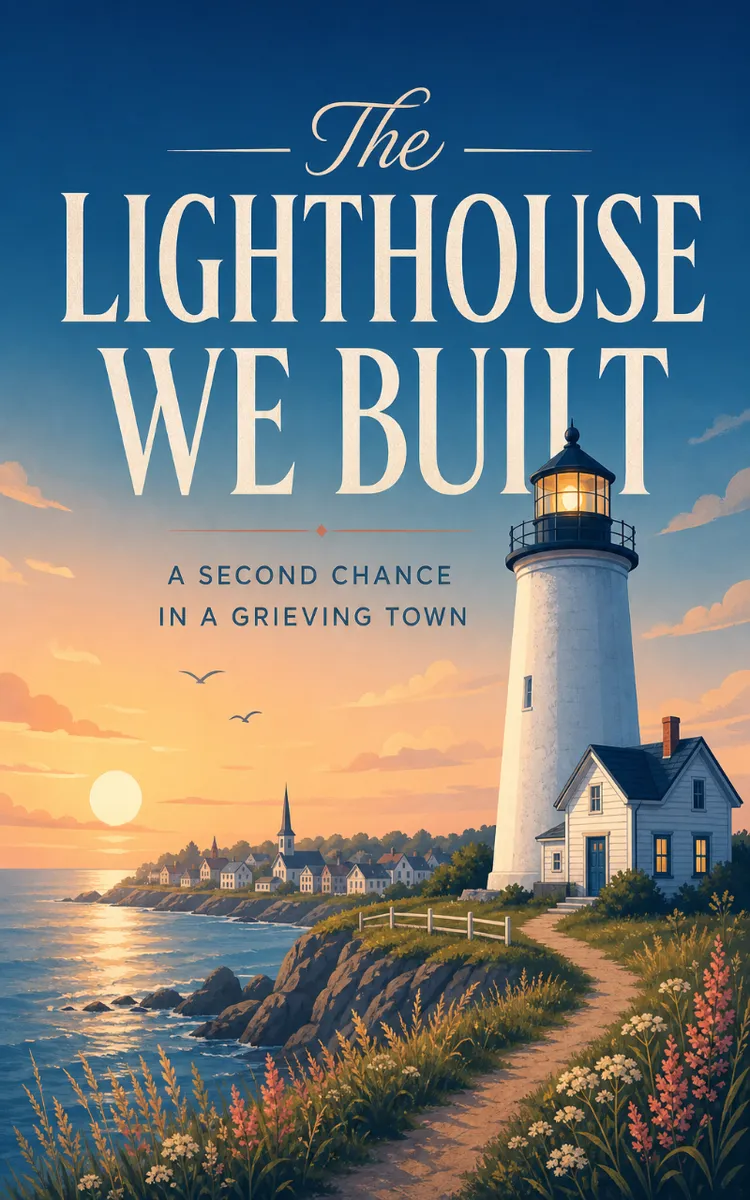
"The Lighthouse We Built" is a romance book by Inkfluence AI Demo with 8 chapters and approximately 25,066 words. Small-town second-chance romance with grief and rebuilding a lighthouse.
This book was created using Inkfluence AI, an AI-powered book generation platform that helps authors write, design, and publish complete books. It was made with the AI Romance Novel Writer.
Frequently Asked Questions
What is "The Lighthouse We Built" about?
Small-town second-chance romance with grief and rebuilding a lighthouse
How many chapters are in "The Lighthouse We Built"?
The book contains 8 chapters and approximately 25,066 words. Topics covered include A Lighthouse Inheritance, A Closed Door, Blueprints, Salt Air, and Old Wounds, The Apology She Can’t Say, Confessions on the Dock at Dusk, and more.
Who wrote "The Lighthouse We Built"?
This book was written by Inkfluence AI Demo and created using Inkfluence AI, an AI book generation platform that helps authors write, design, and publish books.
How can I create a similar romance book?
You can create your own romance book using Inkfluence AI. Describe your idea, choose your style, and the AI writes the full book for you. It's free to start.
Write your own romance book with AI
Describe your idea and Inkfluence writes the whole thing. Free to start.
Start writingCreated with Inkfluence AI


