
Read the first chapter
The whole of chapter one, free. About 11 min. Turn the pages with the arrows, your keyboard, or a swipe.
Chapter 1
The Complaints No One Files
The Visibility Gap Model: When Racism Gets Hidden by Silence
On a base where the morning brief starts on time, where radios crackle and everyone can recite the schedule, the strangest thing can be what doesn’t make it into the record: the comment, the joke, the “small” slight that lands in a private moment and never becomes a formal complaint. The paradox is that silence doesn’t just protect feelings - it also protects the system from seeing what it most needs to notice. And once something isn’t visible, it can’t be measured, investigated, or corrected.
This chapter explores why service members underreport racism and how that underreporting reshapes what military institutions can actually see. We’ll look at the forces that nudge people toward quiet - fear of retaliation, doubts about whether reporting will matter, loyalty to unit culture, and the simple reality that many harms happen in ambiguous, everyday ways rather than in clear-cut incidents. The story isn’t only about individual choice; it’s about how institutions learn, or fail to learn, from what people do and don’t say.
To keep this grounded, we’ll follow Darnell, 24, an infantry squad leader, and the kind of pressure that can sit inside routine: the pressure to keep the unit moving, to avoid “making it a thing,” and to handle problems fast rather than formally. The central mystery is how racism can persist while remaining strangely hard to document.
What happens to an institution when the evidence of harm arrives only as rumors - never as paperwork?
How Underreporting Becomes a Data Problem
A useful way to think about this is the Visibility Gap Model: racism can be both present and undercounted when the pathways for reporting are difficult, risky, or culturally discouraged. In that gap, experiences don’t disappear; they just stop showing up in the channels leaders rely on. The institution then makes decisions based on what it can see - complaints, investigations, official findings - while the lived reality sits off to the side, outside the frame.
The military is built to process information quickly, but that doesn’t automatically mean it processes people’s suffering well. Units run on chain-of-command and mission focus. That structure can make reporting feel like a detour from the real job. If you’re a squad leader, you’re not just a person with feelings; you’re also the one expected to keep the squad ready, to manage friction, to prevent problems from spilling over into readiness. When racism shows up as something “behavioral” - a tone, a pattern of exclusion, a habit of being assigned the worst task - it can look like a leadership problem rather than a formal one. And if it looks like a leadership problem, it often gets handled informally.
There’s also the plain fact that reporting systems are unevenly trusted. People talk. They compare notes. Even without a single dramatic scandal, word travels: who got dismissed, who got transferred, whose credibility was questioned, who ended up with a worse job after speaking up. Over time, that kind of community knowledge becomes its own enforcement mechanism. A service member may not be thinking in abstract terms about “system incentives,” but they’re still reacting to real consequences they’ve seen or heard about.
The military’s own history shows why this matters. For decades, racial discrimination in the armed forces was not only a social issue but an administrative one - how promotions worked, who got assigned where, who was allowed into certain roles. Civil rights litigation in the United States pushed many of those barriers into the open, forcing institutions to respond publicly. But civil rights pressure also taught another lesson: when change comes through legal or formal channels, people learn to treat “official” action as something that can trigger backlash. In a hierarchical environment, backlash doesn’t have to be loud to be costly. It can be as quiet as fewer opportunities, colder treatment, or a promotion clock that never quite moves.
Underreporting also changes the kind of racism that gets documented. Some incidents are clear enough to fit neatly into a complaint form: an explicit slur, a written threat, a direct order to discriminate. But a lot of racism in everyday life is more slippery. It can be a repeated assumption that someone won’t know the procedure, a pattern of being overlooked for leadership opportunities, a “joke” that keeps landing on the same person. Those experiences can feel real and harmful while staying hard to label in the moment. When reporting requires a clean narrative, many people end up with a messy one - and messiness doesn’t make it easier to file.
Why Silence Protects Units, Not Just People
The underreporting isn’t only fear of punishment. It’s also fear of disruption. Units are small communities under stress. When a squad is operating in a high-tempo environment, conflict can feel like a threat to cohesion. That’s not a moral judgment; it’s a practical one. If the squad fractures, the mission suffers. So people develop instincts about what should stay inside the unit and what should go outside it.
For Darnell, 24, the job of squad leader comes with a constant balancing act. He’s responsible for training and discipline, but he’s also expected to manage interpersonal tension without turning every disagreement into a command issue. In that position, racism can become something he’s asked to “fix” the way he fixes other problems: by talking to someone, adjusting assignments, smoothing the day, keeping the group intact. The trouble is that racism is not only a personal behavior; it’s a social pattern backed by history and power. When it’s treated like a one-off personality issue, it can be contained locally while continuing structurally.
Here’s where the Visibility Gap Model sharpens: local handling may reduce immediate harm, but it can also prevent broader accountability. Informal resolution often leaves no trail. That means higher levels of leadership may never learn that the same pattern is repeating across squads, platoons, or even entire installations. If racism is treated as a “unit problem,” it stays dependent on whoever is in charge of the unit at that moment. The system then becomes a patchwork - strong in some places, blind in others.
There’s another reason silence spreads: the emotional math of reporting. People weigh the effort of filing, the waiting, the possibility that their account will be challenged, the chance that they’ll be forced to relive the incident in a formal setting. For someone in the middle of service demands, reporting can feel like trading one kind of stress for another. And because racism often comes with implicit doubt - “Are you sure it was racist?” - the person reporting can end up feeling like they have to prove intent, not just harm.
The military also has a cultural language for what “professional” conflict looks like. Disagreement can be framed as temperament, culture, or misunderstanding. Racism can be framed as “bad attitude” unless it’s explicit. That framing matters because it changes what leaders think they’re seeing. When racism is translated into neutral terms, the institution’s response can become neutral too - more reminders about respect, more emphasis on cohesion - without confronting the specific racial dynamics that keep showing up.
In practical terms, silence also reshapes who gets to be heard. In hierarchical settings, the loudest voice is often not the most accurate one. If the person who experiences harm chooses not to complain, leaders may rely on the accounts of those who do speak up - people who may not be the target, or who may have less to lose, or who may simply feel more confident that the system will protect them. That’s not a conspiracy; it’s an information imbalance.
The Surprise: Underreporting Doesn’t Mean Under-Experiencing
One genuinely counterintuitive finding is this: underreporting can produce the illusion that racism is rare, even when it’s widely experienced. The surprise isn’t that people don’t file complaints; it’s that institutions can treat low reporting as evidence of low prevalence. In other words, the “official picture” can shrink while the lived picture stays large.
Why it matters is straightforward. Institutions often rely on complaint data, investigation outcomes, and formal findings to decide where to focus training, policy changes, and oversight. If the reporting pipeline is partially blocked by fear, confusion, or cultural pressure, then leaders end up optimizing for what’s visible rather than what’s happening. That changes the subject from “how do we respond to racism?” to “how do we respond to recorded complaints?” Those are not the same problem.
This reframing also explains something you may have noticed in public discussions: racism debates can swing between two extremes. On one side, people point to official records and say the issue is limited. On the other, people point to personal experiences and say the issue is persistent. The Visibility Gap Model suggests that both can be partly right. The missing piece is the pipeline between experience and evidence - the bridge where silence, doubt, and risk can break the flow.
The science behind this is less about sociology slogans and more about human cognition and decision-making. People don’t report everything they experience; they report what feels safe, legible, and worth the cost. When the environment makes the cost of reporting feel high, fewer people report. That changes the dataset, and datasets shape conclusions. In settings where authority is powerful and consequences are real, that effect can be stronger. Silence becomes not just an absence, but a form of selection bias - an invisible filter that decides what the institution learns.
So even when a military tries to be fair, it can still be operating with incomplete information. And once incomplete information becomes normal, the institution can accidentally build procedures around a distorted view. The result is a kind of institutional self-fulfilling prophecy: low reporting leads to low attention leads to low trust leads to even lower reporting.
Darnell’s Base: Where Quiet Becomes Routine
To understand how this plays out on the ground, it helps to picture a specific kind of place: an infantry unit where the days are structured, the standards are visible, and the social atmosphere is tight. Darnell’s base is the kind of environment where “keeping it moving” is a survival skill. The squad is small enough that everyone notices who gets assigned what, who gets coached, and who gets left waiting for the next task. That’s also why subtle racism can be so effective - it doesn’t have to announce itself to change the texture of daily life.
In Darnell’s world, the racism he describes isn’t always dramatic. It can be the repeated pattern of being treated like he has to work harder to be taken seriously during training. It can be the way some people joke in ways that land as reminders of difference rather than harmless humor. It can be the feeling that when problems arise, the squad leader is expected to manage them personally, without escalating them into formal processes. When you’re expected to be the stabilizer, you’re also expected not to turn the stabilizer role into a complaint pipeline.
This is where silence becomes functional. If Darnell files something, he risks turning a squad’s internal friction into a formal investigation - something that can pull attention, time, and loyalty into a bureaucratic space. Even if he doesn’t say it out loud, he’s aware of how those processes can affect his standing. If others worry about being implicated, they may respond in ways that make future teamwork harder. If the incident is vague or not documented clearly, his report can feel like it will be judged, not just reviewed.
And because he’s a leader, his silence carries extra weight. A squad leader’s restraint can signal to others that the safest route is to absorb the harm and keep going. That’s not because leaders are trying to cover anything up; it’s because leaders are trained to prevent chaos. The Visibility Gap Model predicts what follows: when the person most responsible for keeping the unit coherent chooses quiet, the institution loses a crucial source of evidence about patterns inside the unit.
Darnell’s experience also shows how underreporting can reshape the institution’s “fixes.” If leaders never see a pattern in formal complaints, they may not connect scattered incidents to a shared racial dynamic. Training might focus on professionalism in general, or on handling “interpersonal issues,” without addressing the racial assumptions that drive those issues in the first place. That doesn’t mean the training is useless; it means it’s aimed at the wrong target because the evidence is missing.
There’s a final detail that matters: in small communities, people know what happens to those who speak. They may not know the facts of any investigation, but they can observe outcomes - who gets sidelined, who suddenly finds themselves with less desirable duties, whose relationships cool. That kind of community observation is powerful because it doesn’t require a formal verdict. It just requires time.
What Silence Does to the System
When people underreport racism, the institution’s response becomes shaped by absence. That absence can be misread as consent or as rarity. Leaders may genuinely want to do the right thing, but they can’t act on what they never receive. The system then becomes a machine that corrects only the problems that reach the right door.
Human beings are especially vulnerable to this because we don’t experience harm the way institutions do. We experience it through context, through tone, through relationships, through the feeling of being watched or dismissed. Institutions often need clean categories, clear dates, and documents that can survive scrutiny. When racism is filtered through everyday life, it often doesn’t arrive pre-labeled. Silence is what happens when the gap between lived experience and official language feels too wide.
The deeper question is what silence teaches people about power. If you can observe that reporting leads to uncertainty, delay, or social cost, then you learn - quickly and accurately - that your voice has a price. That learning doesn’t just affect one person; it changes the culture of everyone who watches. In that sense, underreporting becomes contagious, not because people are indifferent, but because they’re calculating risk in a world where authority can reach far.
And that’s why the Visibility Gap Model is unsettling. It suggests that racism can persist without leaving the kind of paper trail that makes it easy to fight. It also suggests that reforms focused only on formal complaints can miss the quieter machinery that keeps patterns alive. The silence isn’t empty; it’s information - just not the kind leaders are trained to read.
If the evidence of harm is filtered by fear and fatigue, what else in our world might be happening loudly enough to harm people, but quietly enough to escape notice?
End of chapter one. 7 more chapters in the full book.
Swipe or use the arrows to turn the page


What's inside: 8 chapters
- 1. The Complaints No One Files
- 2. When Policies Meet Real Life
- 3. The Promotion Math That Skews
- 4. The Language of ‘Just Jokes’
- 5. Bias in Who Gets the Benefit
- 6. The Training That Doesn’t Stick
- 7. The Cost of Belonging Too Hard
- 8. What ‘Equality’ Looks Like in Combat
About this book
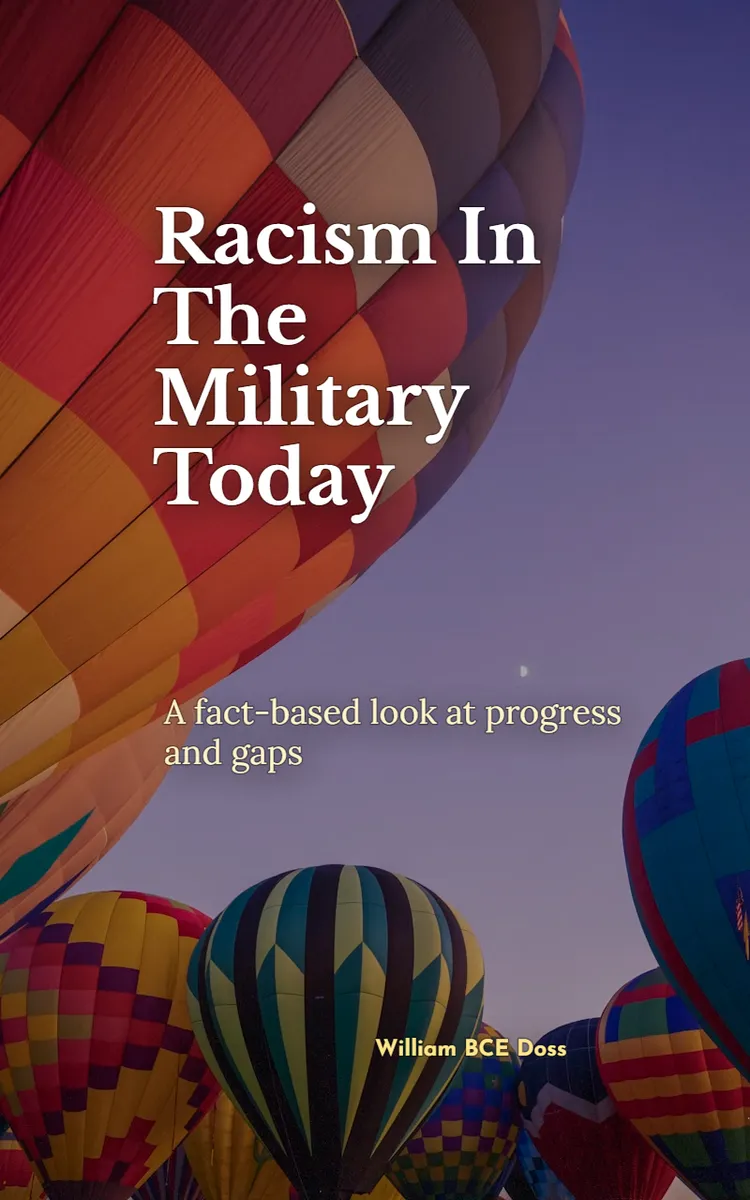
"Racism In The Military Today" is a curiosity book by William BCE Doss with 8 chapters and approximately 15,843 words. Whether racism persists in modern military institutions.
This book was created using Inkfluence AI, an AI-powered book generation platform that helps authors write, design, and publish complete books.
Frequently Asked Questions
What is "Racism In The Military Today" about?
Whether racism persists in modern military institutions
How many chapters are in "Racism In The Military Today"?
The book contains 8 chapters and approximately 15,843 words. Topics covered include The Complaints No One Files, When Policies Meet Real Life, The Promotion Math That Skews, The Language of ‘Just Jokes’, and more.
Who wrote "Racism In The Military Today"?
This book was written by William BCE Doss and created using Inkfluence AI, an AI book generation platform that helps authors write, design, and publish books.
Write your own curiosity book with AI
Describe your idea and Inkfluence writes the whole thing. Free to start.
Start writingCreated with Inkfluence AI


