
Read the first chapter
The whole of chapter one, free. About 12 min. Turn the pages with the arrows, your keyboard, or a swipe.
Chapter 1
The Algorithm Replaces the Auteur
The Signal-to-Story Pipeline Starts With a Recommendation, Not a Vision
A writer might pitch a movie because of a feeling - an image, a theme, a belief about how people should see themselves. But in the streaming era, the first “pitch” can come from a spreadsheet that predicts what you’ll watch next. The paradox is that the prediction can feel more certain than the vision, even though it was built from the traces of other people’s tastes.
Picture a late shift at a desk lit by two screens: one shows playback graphs, the other shows what’s called a “model card” or a dashboard. Talia, 34, a streaming product manager, isn’t deciding what art “should” be; she’s deciding what will be shown, surfaced, and paid for. Her job sits on a quiet hinge in Hollywood’s decline: the moment the system starts treating audience behavior as a substitute for audience discovery.
What this chapter explores is how recommendation systems shifted Hollywood from auteur-driven imagination to prediction-driven funding, and how that change didn’t just alter marketing. It rewired what gets financed, what gets filmed, and - most surprisingly - what gets remembered. The deeper mystery is how a tool meant to help viewers find stories ended up narrowing the stories the industry dares to make.
When a system learns your taste from yesterday, who decides what tomorrow’s taste is allowed to become?
The Signal-to-Story Pipeline: From Watching to Predicting
Hollywood has always relied on a kind of forecasting. Studios tracked box office performance, trade papers reported audience buzz, and executives debated whether a script “had legs.” The difference today is where the forecasting lives and what it optimizes for. Recommendation systems don’t just predict success in the abstract; they predict what a person is likely to watch from a menu - and the menu is shaped by the prediction itself.
A useful way to think about this shift is the Signal-to-Story Pipeline. “Signals” are the behavioral breadcrumbs: what you click, pause, rewatch, finish, abandon, and binge. Those signals are fed into models that generate “predictions” about what you’ll be interested in next. Then come the “stories” - the films and series, but also the order they appear in, the thumbnails you see, and the language used to describe them in a row called “Because you watched…”
The pipeline matters because it turns distribution into a feedback loop. If a model expects you to like a certain style, it shows you more of that style. If it shows you more of that style, you generate more signals consistent with that expectation. In statistical terms, the system doesn’t merely learn preferences; it can reshape the data it will later learn from.
That’s why the auteur - the director or writer whose personal signature was meant to steer the work - starts to lose leverage. An auteur can aim the camera at an idea that might be “harder” at first. But prediction systems are less interested in how a story could expand a viewer’s taste than in how quickly it can match what the viewer already tends to do. When the goal is engagement, novelty becomes a risk, and risk becomes expensive.
There’s also an old Hollywood truth hiding in plain sight: studios didn’t fund only “good” scripts. They funded scripts that looked like they could be sold. Recommendation systems made that logic faster and more granular. Instead of one national taste, they now chase millions of individual tendencies - and the industry learns to treat those tendencies as a kind of map.
Talia’s world is full of terms that sound technical but describe a basic cultural change. When her company tests a new interface, it’s not just aesthetics; it’s exposure. When it tunes the ranking of titles, it’s not just convenience; it’s which creative decisions get a chance to travel.
A single-sentence fact captures the core of the pipeline: the system that decides what you see can decide what the industry learns to make. That’s how prediction begins to replace vision - quietly, without any official decree.
When “Personalization” Changes What Gets Financed
Hollywood’s decline is often described as a collapse of quality, but the more specific story here is a change in incentives. Recommendation systems don’t just market movies; they influence which movies are given enough chances to gather momentum. Once a platform can target likely viewers with precision, the industry shifts from “Can we find an audience?” to “Can we route the audience we already have?”
In earlier eras, a studio might gamble on a director because the director had a track record, or because the script had a unique hook, or because stars could bring the audience. That’s still true, but the new layer is that the platform can treat a title like an expected value problem. If the system predicts weak completion rates, it can interpret the film as a poor bet even if it might have grown word-of-mouth slowly.
Here’s the counterintuitive part: the more personalized the system becomes, the less it needs broad cultural curiosity. A studio may no longer rely on the risky magic of “everyone will hear about this.” It can instead rely on the statistical certainty of “the right people will be shown this, and they’ll probably watch it.”
For writers and directors, that can feel like a subtle erasure. The auteur doesn’t disappear as a personality, but their work becomes constrained by what the pipeline can translate into predictions. The industry learns which story features are easiest to model - tone, pacing, genre labels, cast familiarity, and patterns of viewing behavior - and those features start to steer development.
Talia has seen how creative meetings can drift toward measurable proxies. “We can’t predict art,” someone might say, but then the room starts asking which parts of a script align with what viewers tend to finish. The language of creativity begins to share space with the language of retention.
This is where the historical context matters. Studios once relied on theatrical release windows, regional marketing, and critics. Streaming changed the timeline: discovery became continuous, and the platform’s internal data became the loudest voice. The recommendation system became an engine that never sleeps.
And because the platform can test endlessly - swapping images, changing descriptions, altering what appears first - it can treat creative choices like variables. That’s not inherently evil. It can help audiences find stories that never would have surfaced in a crowded theater schedule. But it also encourages the industry to optimize for the predictable, because predictable choices are easier to scale.
In a world where a director’s signature might be hard to classify, the system doesn’t necessarily “reject” the auteur. It simply doesn’t know how to prioritize them. The auteur becomes a story that the pipeline has trouble reading.
The Human Story Inside the Model
Talia doesn’t wake up thinking about Hollywood’s decline. She thinks about a user’s session - about the moment they decide whether to keep watching. Her team might look at how long people stay after a title begins, how often people stop mid-way, and how many go on to the next episode or related content. Those numbers are blunt, but they’re also honest in a way that marketing sometimes isn’t: they measure what people actually do, not what they say they want.
The concrete part of her job is exposure control. A recommendation system doesn’t just guess; it orders. It decides whether a viewer sees a filmmaker’s debut on page one of their home screen or never sees it at all. It decides whether a quirky, slow-burn drama appears next to a comfort series or gets buried behind more familiar options.
One day, Talia might be involved in a change that seems small: adjusting how the system weighs certain signals. Another day, she might be asked to support a test for a new content category - how the platform labels a film’s genre or sub-genre. None of this sounds like the grand narrative of “Hollywood’s downfall,” but it changes the odds that a title reaches the viewers who might have loved it.
There’s also a community dimension. In many places, streaming has become the default entertainment infrastructure. People don’t go to a single theater; they live inside the platform’s interface. That means the recommendation system is not just a feature - it’s a cultural gate. It determines which stories become “common knowledge,” because common knowledge depends on what gets watched and discussed.
Talia’s colleagues talk about cold start problems - how a system handles new content or new viewers when there’s not much data yet. That’s another place where auteur ambition can get squeezed. A director’s earlier work might not be enough to establish a pattern, especially if their new film is a departure. Prediction systems love continuity because continuity produces learnable signals.
So the human story isn’t just Talia staring at dashboards. It’s also a thousand creators trying to understand what kinds of risk will survive the pipeline’s uncertainty. Even when a filmmaker wants to experiment, the platform’s need for early traction can shape how the experiment is packaged.
And then there’s the quiet moral of the interface: if you only show a viewer movies that match what they already do, you create a loop in which surprise becomes rare. That loop doesn’t mean people can’t discover new tastes. It means the discovery becomes less random and more engineered.
The result is a subtle cultural shift. Hollywood’s decline isn’t only about fewer great films; it’s about a different relationship between audiences and creators. The auteur used to be a guide, steering viewers toward a new perspective. Now the system often acts like a translator, trying to map the creator’s work onto what audiences already resemble.
The Surprise: Prediction Can Make Stories Less Diverse, Even When It’s “Helping”
The surprise is that recommendation systems can improve individual satisfaction while still shrinking the overall variety of what gets produced and promoted. On a personal level, the interface feels smarter every day: fewer irrelevant clicks, more titles that match your mood. But across the whole platform ecosystem, the same personalization can funnel attention into a narrower set of styles that are easiest for the models to trust.
Why does that happen? Because predictions are trained on past behavior, and behavior is shaped by what people were shown in the first place. When the system reduces uncertainty, it also reduces the chance that a risky, unfamiliar story will find an audience early enough to earn sustained visibility. The pipeline becomes a kind of cultural diet: you get what you already tend to eat, and the menu changes more slowly than your habits.
This matters for Hollywood’s creative identity. If the industry learns that “safe similarity” predicts performance, then deviance becomes a gamble that requires extra justification. Auteur work - often built on deliberate deviation - becomes harder to bankroll unless it can be framed as an extension of something already validated by the system.
There’s another twist: prediction can make the industry feel less responsible for taste. If the platform says, “Viewers like this,” the studio can hide behind that statement. Yet “viewers like this” is not a natural law; it’s an outcome of exposure. The system’s success can mask its role in shaping the conditions that produced the data.
Talia sometimes describes it in her own language: the model doesn’t invent taste, it recognizes patterns. But patterns aren’t neutral. They reflect what’s been available, what’s been pushed to the top, and what got the chance to be watched long enough to generate stronger signals.
That’s the reframing this chapter asks for. Hollywood’s decline isn’t only that studios stopped believing in auteurs. It’s that the prediction infrastructure taught the industry to treat audience behavior as destiny. Vision becomes optional; prediction becomes persuasive.
The pipeline still has a purpose. It can help viewers find hidden gems and can rescue niche work from total obscurity. The question isn’t whether personalization works. The question is what personalization teaches Hollywood to prefer, and what it quietly sidelines before anyone can fall in love with it.
What Recommendation Systems Do to the Memory of Culture
A film doesn’t become part of culture only because it exists. It becomes part of culture because it circulates - through rewatching, recommendation among friends, and the steady hum of visibility. When recommendation systems change circulation, they change memory.
Consider how quickly conversation shifts online when a title rises in visibility. If a system boosts a certain kind of show, it doesn’t just increase views; it increases the number of moments people have to talk about it. The feedback loop is not purely mechanical - it’s social. Viewers share what they’ve been offered, and what they share becomes more offered.
Talia sees the interface’s effect on this rhythm. A series that might once have taken months to build buzz can now accelerate faster if the model finds early engagement signals. Conversely, a slower story - one that needs time, patience, or a reader’s curiosity - can struggle to earn traction if early behavior looks uncertain.
There’s a cultural cost to that speed. Hollywood’s most surprising successes have often arrived as deviations that caught on later. The auteur tradition depends on that possibility: the idea that a director can push viewers toward something they didn’t ask for yet. But prediction systems are trained to reduce uncertainty in real time, and uncertainty is often where the first spark of a new kind of taste lives.
The human consequence is that fewer creators get to be pioneers in the public imagination. More creators become specialists in what the pipeline already understands. That doesn’t mean all experiments vanish. It means the experiments that survive are more likely to resemble something already legible to the model.
What makes this feel like “decline” is not simply the loss of prestige. It’s the loss of a certain kind of cultural weather. In older Hollywood, the industry had blind spots, but it also had room for accident. Recommendation systems replace accident with calculation. They reduce the chance of a miss, but they also reduce the chance of an unexpected hit.
And yet, the system is doing something understandable. It’s trying to prevent waste - for viewers, for platforms, for production budgets. It’s trying to make entertainment match attention. The problem is that attention isn’t the only value at stake. A culture also needs room for work that changes attention, not just matches it.
In the end, the pipeline turns a question - what stories should exist? - into a different question - what stories are likely to be consumed by the people we can already reach? That shift is where the auteur loses ground.
Wonder at the Interface, Unease at the Loop
There’s something quietly unsettling about realizing that the most influential “critic” in modern entertainment may not be a person at all. It’s a machine that learns from exposure, then controls exposure, until the line between taste and selection starts to blur.
Human beings don’t just watch stories; they also learn what stories are worth watching. When prediction systems become the loudest teacher, they don’t only reflect culture - they edit it, one ordered row at a time. The mystery that remains is simple and hard: if the interface is always steering, how do new visions ever break through, and who gets to be the author of change?
End of chapter one. 7 more chapters in the full book.
Swipe or use the arrows to turn the page


What's inside: 8 chapters
- 1. The Algorithm Replaces the Auteur
- 2. The Marvel Template That Won
- 3. When Critics Became Content
- 4. The Safety-First Script Doctoring
- 5. The Attention Economy’s Hidden Tax
- 6. The Streaming Window That Broke Trust
- 7. The Labor Shortage No One Measures
- 8. What Hollywood Became to Us
About this book
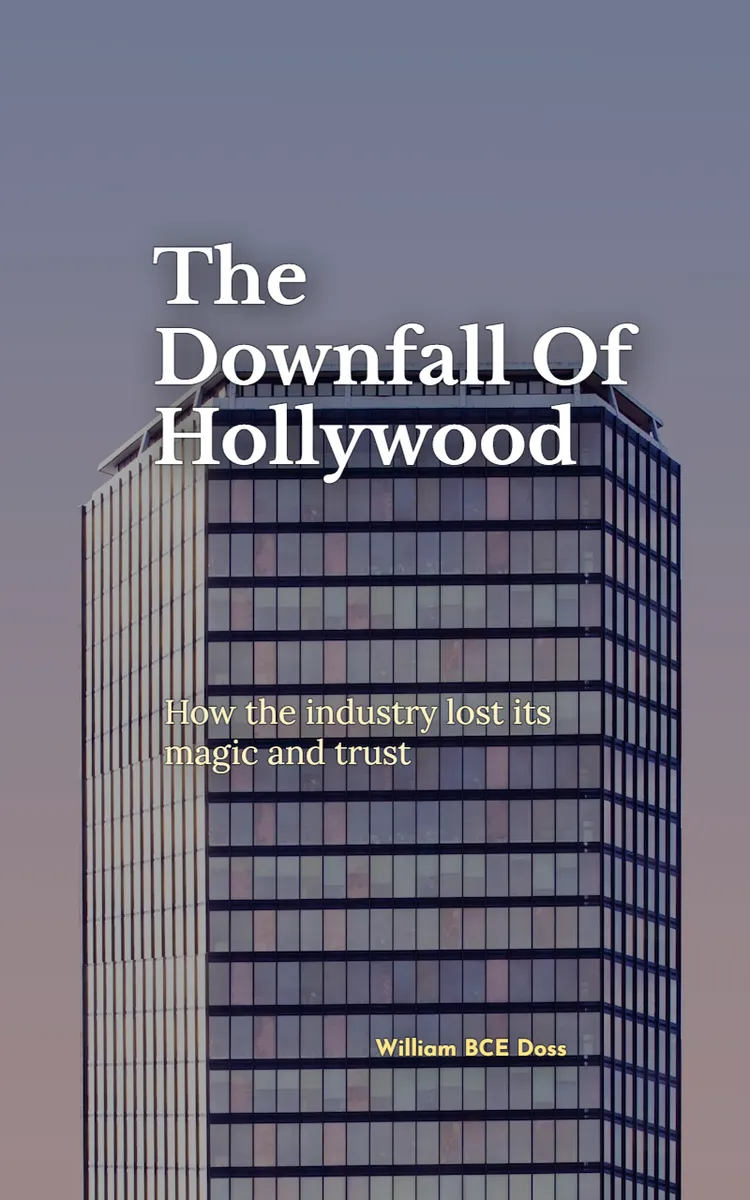
"The Downfall Of Hollywood" is a curiosity book by William BCE Doss with 8 chapters and approximately 15,876 words. A critical history of Hollywood’s decline and cultural impact.
This book was created using Inkfluence AI, an AI-powered book generation platform that helps authors write, design, and publish complete books.
Frequently Asked Questions
What is "The Downfall Of Hollywood" about?
A critical history of Hollywood’s decline and cultural impact
How many chapters are in "The Downfall Of Hollywood"?
The book contains 8 chapters and approximately 15,876 words. Topics covered include The Algorithm Replaces the Auteur, The Marvel Template That Won, When Critics Became Content, The Safety-First Script Doctoring, and more.
Who wrote "The Downfall Of Hollywood"?
This book was written by William BCE Doss and created using Inkfluence AI, an AI book generation platform that helps authors write, design, and publish books.
Write your own curiosity book with AI
Describe your idea and Inkfluence writes the whole thing. Free to start.
Start writingCreated with Inkfluence AI


